2. Health Care System
 Call Kai
 Learn
 Practice Test
 Spaced Repetition
 Match
 Flashcards
 Knowt Play
1/56

There's no tags or description
Looks like no tags are added yet.
57 Terms
System (Bertalanffy, 1968)
A system is an arrangement of parts and their interconnections come together for a purpose
System (Roemer, 1991)
The combination of resources, organization, financing and management that culminate in the delivery of health services to the population
System (WHO, 2000)
All the organizations, institutions and resources that are devoted to producing health actions
Health Care System
a complex network of people, institutions, and resources working together to improve and maintain health.
It encompasses everything from individual healthcare providers to government agencies, pharmaceutical companies, and community organizations
interconnections
A health system's core functions act as the "_______________" that bring the parts together.
Improving Population Health
Improving Responsiveness
Fairness in Financial Contribution
3 Goals of Health System
Goal 1: Improving Population Health
3 Goals of Health System:
• The overarching goal of any health system.
• Focus on improving health status across all segments of the population, addressing disparities based on:
Socioeconomic status
Ethnicity
Occupation
Gender
Geography
Sexual orientation
• Emphasis on equity: minimizing health disparities.
• Protecting populations from future health risks.
Goal 2: Improving Responsiveness
Health systems should be responsive to the needs and preferences of the people they serve.
This includes:
• Respectful and non-discriminatory care.
• Humaneness and compassion.
• Maintaining confidentiality.
• Empowering individuals to make informed choices about their health.
Goal 3: Fairness in Financial Contribution
• Access to healthcare should not be limited by financial constraints.
• The system should provide financial risk protection, preventing healthcare costs from causing impoverishment.
Fair financing means:
• No one is deterred from seeking care due to cost.
• Everyone pays a similar percentage of their income for needed services.
Health Service Provision
Health Service Inputs
Stewardship
Health Financing
4 Vital Health System Functions:
Health Service Provision
4 Vital Health System Functions:
• The most visible output of a health system.
• Encompasses public and private healthcare services.
• Includes health promotion and disease prevention through education and preventive measures.
WHO, 2000
"Delivering health services is an essential part of what the system does--but it is not what the system is."
Health Service Inputs (Resource Management)
4 Vital Health System Functions:
Assembling essential resources for service delivery.
Often outside the direct control of policymakers, who must work with available resources.
Key inputs:
• Human resources (doctors, nurses, etc.)
• Medications
• Medical equipment
Stewardship (Oversight)
4 Vital Health System Functions:
• Overall system oversight and policy framework.
• Governmental responsibility.
Stewardship (Oversight)
4 Vital Health System Functions:
Key functions:
• Identifying health priorities.
• Establishing institutional frameworks.
• Coordinating with external systems.
• Monitoring trends in health and resources.
• Generating data for policymaking (public health surveillance, performance data)
A. Revenue Collection
B. Risk Pooling
C. Strategic Purchasing
3 Health Financing
Revenue Collection
3 Health Financing:
Mechanisms for collecting money for healthcare:
• General taxation
• Donor financing
• Mandatory payroll contributions
• Mandatory/voluntary risk-rated contributions
• Out-of-pocket expenditures
• Personal savings
• Each method often linked to specific organizational and funding models.
Risk Pooling
3 Health Financing:
• Collecting and managing funds to spread financial risk across the pool.
• Core function of health insurance.
• Protects individuals from catastrophic healthcare costs.
• Encourages people to seek care when needed.
Financial risk pooling
"________________ is the core function of health insurance mechanisms."
A. Bismarck Model
B. Beveridge Model
Risk Pooling Models
Bismarck
Risk Pooling Models:
Insurance system (sickness funds), funded by employers and employees.
• Universal coverage, non-profit.
• Private providers, but government regulates costs.
Germany
France
Japan
Bismarck Model Countries
Beveridge Model
Risk Pooling Models:
Government-funded and provided healthcare (taxes).
• Government ownership of facilities, some doctors are employees.
• Low costs due to government control.
UK
Spain
Cuba
Beveridge Model countires
Strategic Purchasing
3 Health Financing:
How risk-pooling organizations use funds to buy services. Purchasers influence provider incentives for better care and service delivery models.
Leadership/Governance
WHO Health System Framework:
Establishing strategic policy frameworks combined with effective stewardship, coalition-building, appropriate regulations and incentives, attention to system design, and accountability.
Health Care Financing
WHO Health System Framework:
Raising adequate funds for health in ways that ensure access to needed services and protect people from financial hardship due to healthcare costs.
Health Workforce
WHO Health System Framework:
A responsive, fair, and efficient workforce that maximizes health outcomes given available resources. This includes having sufficient numbers and skill mix of staff, distributed equitably, who are competent, responsive, and productive.
Medical Products, Vaccines, and Technologies:
WHO Health System Framework:
Guaranteeing equitable access to essential, quality-assured medical products, vaccines, and technologies, promoting their safe, effective, and cost-effective use.
Information & Research
WHO Health System Framework:
nsuring the production, analysis, dissemination, and use of reliable and timely information on health determinants, health system performance, and health status.
Service Delivery
WHO Health System Framework:
Providing effective, safe, and quality health interventions to those in need, when and where they need them, while minimizing resource waste.
1970s: Primary Health Care for All
The Philippine Health System
Development of a largely centralized, governmentfunded, and operated health care system.
1976: Adoption of Primary Health Care
The Philippine Health System
Promotion of participatory management within the local health care system.
1982: Reorganization of DOH
The Philippine Health System
Integration of public health and hospital services.
1986: Milk Code
The Philippine Health System
Focus on prevention and nutrition, particularly promoting breastfeeding.
1988: The Generic Acts
The Philippine Health System
Mandating prescriptions to use generic drug names to lower medication costs.
1991: RA 7160 (Local Government Code)
The Philippine Health System
Decentralization of health service provision to local government units (LGUs).
1995: National Health Insurance Act
The Philippine Health System
Aiming to provide financial protection for all citizens, prioritizing the poor
1996: Health Sector Reform Agenda
The Philippine Health System
Major organizational restructuring of the DOH to improve healthcare delivery, regulation, and financing
2005: FOURmula One (F1) for Health
The Philippine Health System
Adoption of an operational framework for rapid, precise, and coordinated health reforms.
2008: RA 9502 “Access to Cheaper and Quality Medicine Act”
The Philippine Health System
Promoting and ensuring access to affordable, quality drugs and medicines.
2010: AO 2010-0037 “Kalusugang Pangkalahatan”
The Philippine Health System
Pursuing universal health coverage and access to quality healthcare for all Filipinos.
2013: Sin Taxes for Health
The Philippine Health System
Generating revenue for the DOH by discouraging alcohol and tobacco consumption
2019: Universal Health Care Law
The Philippine Health System
Automatically enrolling all Filipino citizens in PhilHealth, guaranteeing equitable access to quality and affordable healthcare services.
2020: The COVID-19 Pandemic Responses
The Philippine Health System
The UHC Law's scheduled full implementation was disrupted by the health crisis.
2021: Vaccination Program Rollout
The Philippine Health System
The government initiated the national COVID-19 vaccination program.
2022: Fuller UHC Implementation Efforts
The Philippine Health System
Despite the pandemic, the DOH prioritized the creation of Special Health Funds (SHFs) in LGUs. PhilHealth launches the Konsulta+ Package, a primary care benefit package.
2023: State of Public Health Emergency Lifted
The Philippine Health System
The public health emergency due to COVID19 was officially terminated (July)
decentralized framework ;
Department of Health (DOH) ;
local government units (LGUs)
The Philippine health system operates within a ____________, with the __________________ providing national policy direction, developing plans, standards, and guidelines, and offering technical assistance and capacity building. The DOH also coordinates national health programs through ________________.
Pre-devolution
A three-tiered system under direct DOH control:
tertiary hospitals (national/regional),
provincial/district hospitals and city/municipal health centers,
barangay health centers.
Post-Devolution (1991 LGC)
Basic health services (including health promotion and prevention) are provided by cities and municipalities. Provinces manage provincial and district hospitals. The DOH manages mostly tertiary medical centers, specialty hospitals, and some re-nationalized provincial hospitals.
cities and municipalities ;
Provinces ;
DOH
Post-Devolution (1991 LGC):
Basic health services (including health promotion and prevention) are provided by _______________
________ manage provincial and district hospitals.
The ______ manages mostly tertiary medical centers, specialty hospitals, and some re-nationalized provincial hospitals.
DOH Responsibilities
1. Developing health policies and programs.
2. Enhancing partner capacity through technical assistance.
3. Leveraging partner performance in priority health programs.
4. Developing and enforcing regulatory policies and standards.
5. Providing programs affecting large population segments.
6. Providing specialized and tertiary care.
(AO 2023-0015) Philippine Health Agenda: “8-Point Action”
Directions of the Philippine Health Sector:
Aims to guarantee that every Filipino experiences health and well-being. This comprehensive plan focuses on placing Filipinos at the heart of healthcare reforms, promoting community health, and strengthening healthcare institutions and health care worker welfare.
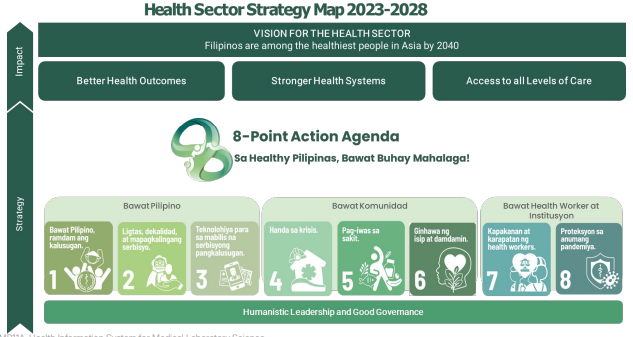
Philippine Developmental Plan 2023-2028
Directions of the Philippine Health Sector:
Four key medium-term plans translating national aspirations into action.
serves as the country’s overall blueprint in development planning for the next six years.
It reflects the government’s policies, strategies, programs, and legislative priorities in support of and consistent with President Ferdinand R. Marcos, Jr.’s Socioeconomic Agenda.
The PDP aims to reinvigorate job creation and accelerate poverty reduction by steering the Philippine economy back to its high-growth trajectory and effect economic and social transformation for a prosperous, inclusive, and resilient societ
NEDA AmBisyon Natin 2040
The Life of All Filipinos in 2040: Matatag, Maginhawa at Panatag na Buhay
Directions of the Philippine Health Sector:
A long-term collective vision for a better life for Filipinos and the country over the next 25 years.
we will all enjoy a stable and comfortable lifestyle, secure in the knowledge that we have enough for our daily needs and unexpected expenses, that we can plan and prepare for our own and our children’s future. Our family lives together in a place of our own, and we have the freedom to go where we desire, protected and enabled by a clean, efficient, and fair government.
Sustainable Development Goals (SDGs 2030)
Directions of the Philippine Health Sector:
17 global goals aimed at ending poverty, fighting inequality and injustice, and addressing climate change and its impacts.