Motor Systems II
 Call Kai
 Learn
 Practice Test
 Spaced Repetition
 Match
 Flashcards
 Knowt Play
1/45

There's no tags or description
Looks like no tags are added yet.
46 Terms
What is the purpose of reflexes?
Have as protective and postural functions; compromise an afferent and efferent limb
How does the type of reflex differ?
The number of neurons interspersed between the afferent and efferent limb determines the simplicity/modifiability of the reflex
Which is the most simple spinal cord circuit?
The monosynaptic stretch reflex
What is the afferent response of the monosynaptic stretch reflex?
The muscle stretches (from spindles); fast conducting 1a afferents fire rapidly to transmit the stretch signal back to the cord and induces inhibition of AMNs of the antagonist muscle
What is reciprocal innervation?
When an agonist muscle contracts, its opposing antagonist muscle is simultaneously inhibited and relaxes
What is the efferent response of the monosynaptic stretch reflex?
Excitation of AMNs innervating the stretched (homonymous) muscle
the stretch of the muscle initiates contraction ?
How does the stretch reflex work? (not the pathway)
The stretch reflex resists the lengthening of a muscle and utilizes feedback loops to maintain muscle activation to complete the task
How can the stretch reflex be modulated?
By activating the muscle (Jendrassik’s maneuver)
What is the Jendrassik maneuver and how does it modulate the stretch reflex?
Contracting a muscle group activates GMNs and increases the excitability of SC anterior horn cells, and reduces normal descending inhibitory signals from the brain which decreases presynaptic inhibition (allows reflexes)
What is the importance of alpha-gamma coactivation?
Allows spindles to function (send info to CNS) at all muscle lengths during movements; helps stiffen the joint for precision, stabilization, anticipation of unpredictable disturbances, and early learning
Describe alpha-gamma motor neurons coactivation?
When AMNs fire and extrafusal muscle fibers shorten, GMNs also fire which contracts intrafusal fibers to maintain stretch activity
What sets the “gain” of the stretch reflex?
GMNs activity; the larger the gain, the more change in muscle force for a given stretch of intrafusal fibers
How does the “gain” of the stretch reflex differ?
It’s continually adjusted to meet functional requirements; for more difficult complex, precise movements, GMN increase responsiveness of the spindle
How do GTOs respond in the monosynaptic stretch reflex?
Elicit a negative feedback loop to inhibit AMNs on agonist muscle and maintain muscle tension
What is the flex reflex?
Mediates withdrawal of the limb from a painful stimulus
How does the flex/withdrawal reflex work?
Stimulation of nociceptive fibers leads to excitation of ipsilateral flexors and reciprocal inhibition of the ipsilateral extensors and excitation of contralateral extensors and inhibition of contralateral flexors (crossed extension)
What is reciprocal inhibition?
Decreased activity in the antagonist from inhibitory neurons when the agonist is active, allowing the agonist to act unopposed; this prevents unwanted activity in the antagonist reflexively and voluntarily
can be suppressed to allow for co-contraction of antagonist
What do 1a inhibitory neurons do?
Enable reciprocal inhibition of the antagonist and coordinate muscles surround a joint; receive input from descending axons that make direct excitatory connections with spinal AMNs so that higher order centers do not have to send separate commands
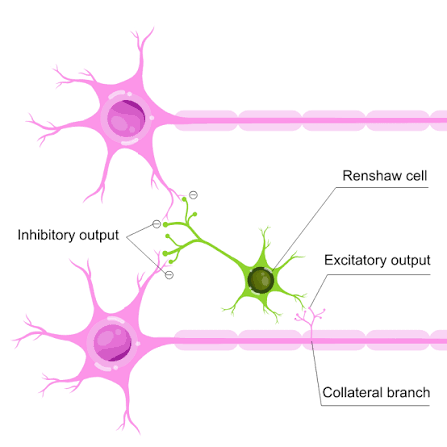
What are renshaw cells?
Inhibitory neurons in the SC that are excited by collaterals of AMN axons
What do renshaw cells do?
Inhibit the motor neuron that excites them and serve as a negative feedback system to stabilize the firing rate of MNs; they also synapse with 1a inhibitory interneurons to regulate coactivation
How is the stretch reflex normally modulated?
Presynaptic inhibition can reduce the reflexive response via descending pathways
What would pathology of the descending control of local circuits potentially look like in a stroke patient?
May result in overactivity of the stretch reflex due to the lack of inhibition from higher order centers (ex. UMN injury)
What is state dependent reflex reversal?
How spinal reflex circuitry is modulated via descending projections: 1B fibers form GTO inhibit the homonymous MNs, but during locomotion the same 1b fibers can excite the MN
What is an example of state dependent reflex reversal?
Pressing a foot pedal would enhance the tendon jerk reflex of the soleus in humans
What is a muscle synergy?
A coordinated muscular action
How does a muscle synergy work?
Afferents deliver info to SC neurons from sensory receptors then interneurons excited by these afferents project to efferent LMNs of muscles acting at other joints
What are central pattern generators (CPGs)
Local circuits in the SC that control the timing and coordination of rhythmic movements (ex. locomotion or swimming) by generating rhythmic activation of flexor and extensor muscles
T/F: CPGs cannot generate locomotion.
False
T/F: Once activated, CPGs can initiate movement without higher center controls
True
How does the brainstem and cerebral cortex ultimately control locomotion?
Visual info conveyed to the motor cortex can identify locomotion
Spinal locomotor system is activated by the mesencephalic locomotor region (MLR) and relayed by neurons in the medial reticular formation (MRF)
Cerebellum receives signals form both peripheral receptors and spinal CPGs, and adjusts the locomotor pattern through brain stem connections
T/F: Local circuits and LMNs have a specific arrangement within the SC.
True
What do medial LMN pools of the anterior horn control?
Trunk and proximal muscles
What do lateral LMN pools of the anterior horn control?
Distal muscles
What are some characteristics of lateral and medial local circuit neurons?
Medial: have longer axons in which some cross the midline so the body can move in concert to maintain and adjust posture
Lateral: have shorter axons that project to fewer SC segments (less than 5) and remain primarily ipsilateral for more fine control
How do UMNs project onto medial LMNs?
They follow patterns reflective of their function: UMNs projecting on medial LMNs/circuits have collateral branches that terminate on several SC segments and are often bilateral, therefore are primarily concerned with postural control
What is an example of UMNs (from where) that project on medial LMNs/circuits?
Vestibular nuclei and reticular formation
How do UMNs project onto lateral LMNs?
Terminate on only a few SC segments and do not have bilateral projections, therefore are primarily concerned with skilled movements of distal limbs and arm movements
What is an example of UMNs (from where) that project on lateral LMNs/circuits?
Motor cortex and red nucleus
What is lower motor neuron syndrome?
Complex signs and symptoms arising from damage to LMNs
What are some signs and symptoms of lower motor neurons syndrome?
Paralysis or paresis, flaccid paralysis, areflexia due to interruption of efferent limb of stretch reflex, loss of muscle tone, muscle atrophy
What are some examples of lower motor neuron syndromes?
Amyotropic lateral sclerosis, poliomyelitis, landry Guillain-Barre syndrome (LGBS)
T/F: One motor neuron pool may consist of several motor units
True
T/F: Due to alpha-gamma coactivation, the muscle spindle will not respond during the period that extrafusal fibers are contracting
False
T/F: The circuitry utilized during an H-reflex is the same as the circuitry utilized during a myostatic stretch reflex
True
Which of the following is not true about small or slow MUs?
A. They innervate fewer muscle fibers
B. They are capable of generating smaller forces
C. The fibers have slow contraction velocity
D. They fatigue easily
D. They fatigue easily
Which of the following diseases affects LMNs?
A. LGBS
B. ALS
C. Polio
D. All of the above
E. None of the above
D. All of the above