AHS3263: Non-Rebreathing Circuit & Calculations (Flow Rate, Tidal Volume & Reservoir Bag)
 Call Kai
 Learn
 Practice Test
 Spaced Repetition
 Match
 Flashcards
 Knowt Play
1/32

There's no tags or description
Looks like no tags are added yet.
33 Terms
Two Types of Circuits:
Rebreathing:
Animal REBREATHES the oxygen/gas
Non-rebreathing:
Animal DOES NOT rebreathe the oxygen/gas
Non-Rebreather:
DOES NOT allow rebreathing of exhaled gases
Used for SMALL PATIENTS (weight less than 7 kg) that DO NOT have the RESPIRATORY DRIVE (force generated by respiratory muscles during breathing to move air through the valves, tubes & CO2 canister)
DO NOT need a CO2 absorber & one-way valves
Missing
CO2 absorber (CO2 is removed by high fresh gas flow)
Pressure manometer
Unidirectional valves
Non-Rebreathing Circuits:
Circulate FRESH GASES to patient
Animal DOES NOT rebreathe exhaled gases


O2 (oxygen) —→ Flowmeter (controls the amount of O2) —→ Vaporizer (adds anesthetic to the O2) —→ Fresh gas flows directly to the patient —→ Patient inhales O2 + anesthetic —→ Patient exhales CO2 & waste anesthetic gas —→ Reservoir bag (collects gas & allows the patient to breathe from the circuit) —→ Pop-off/APL valve (releases excess gas & pressure) —→ Scavenging system (removes excess waste anesthetic gas) - (pop-off is attached to scavenge)
Non-rebreathing circuits require HIGHER fresh gas flow to prevent the patient from rebreathing exhaled CO2
Pros:
Less resistance for smaller patients
Faster change in anesthetic depth
Cons:
Greater heat loss (b/c oxygen is cold)
Uses more oxygen
More anesthetic waste
Two Main Circuits in Veterinary Medicine:
Rebreather
Animals > (greater than) 7kg
LOW-flow system
Requires CO2 absorber canister
LOW waste gas produced
Good moisture & temperature conservation
Non-rebreather
Animals < (less than) 7kg
LESS resistance for smaller patients
Faster change in anesthetic depth
Greater heat loss
Uses more oxygen
More anesthetic waste
Rebreathing Tubes:
Universal F-circuit
Has a tube within a tube design
Fresh gas travels to the patient through one pathway
Exhaled gas travels AWAY from the patient through another pathway
Inhale inside the blue tube & exhale around the tube
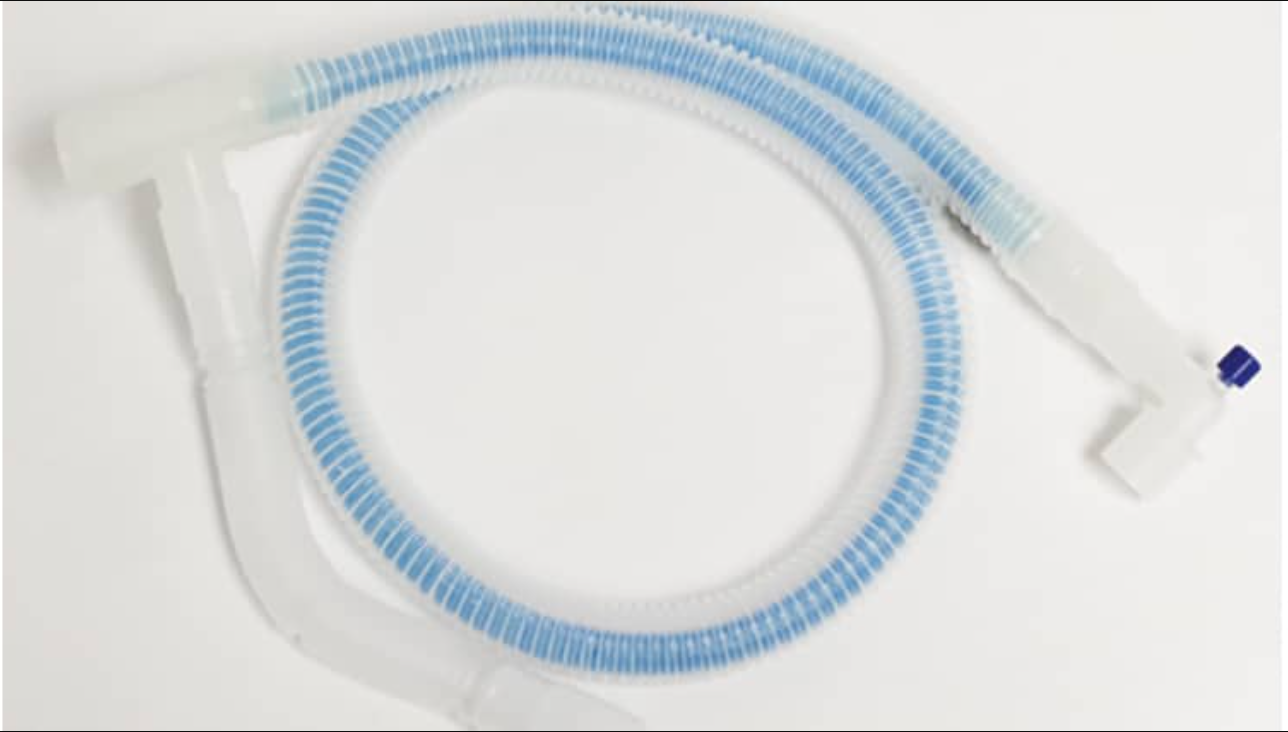
Dual Wye
Uses two separate tubes
The two tubes connect near the patient with a Y-piece
One tube delivers fresh gas to the patient
The other tube carries exhaled gas away from the patient

Non-rebreathing Systems:
Modified Jackson-Rees
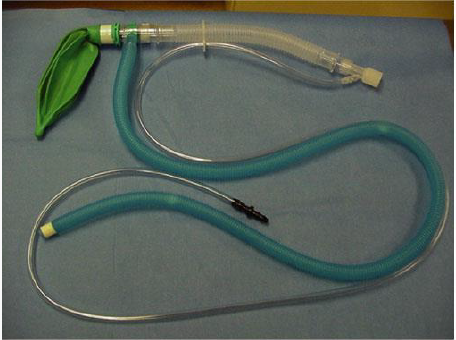
Ayre’s T-Piece

Other options:
Pediatric rebreathing system
Less dead space inside wye piece
Components are smaller – smaller one-way valve
Smaller CO2 absorber

Bain block

Scavenge:
Scavenge - Collects & removes excess waste anesthetic gas (WAG)
Passive
F/Air Canister
Charcoal canister
Uses gravity
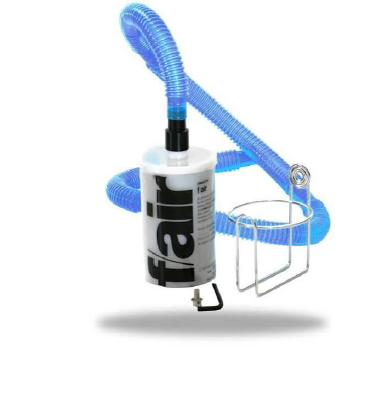
Active

Calculations - Flow Rate (L/Min):
How fast the oxygen is flowing
Rebreathing
25-50mL/kg/min O2
Generally, don’t put the O2 below 500ml/min
Can induce & recover with higher flow – 3L
DON’T go under 0.5L/min
Non-rebreathing
200mL/kg/min O2
Flow rate is faster b/c the animals is not helping you
Practice Problems:


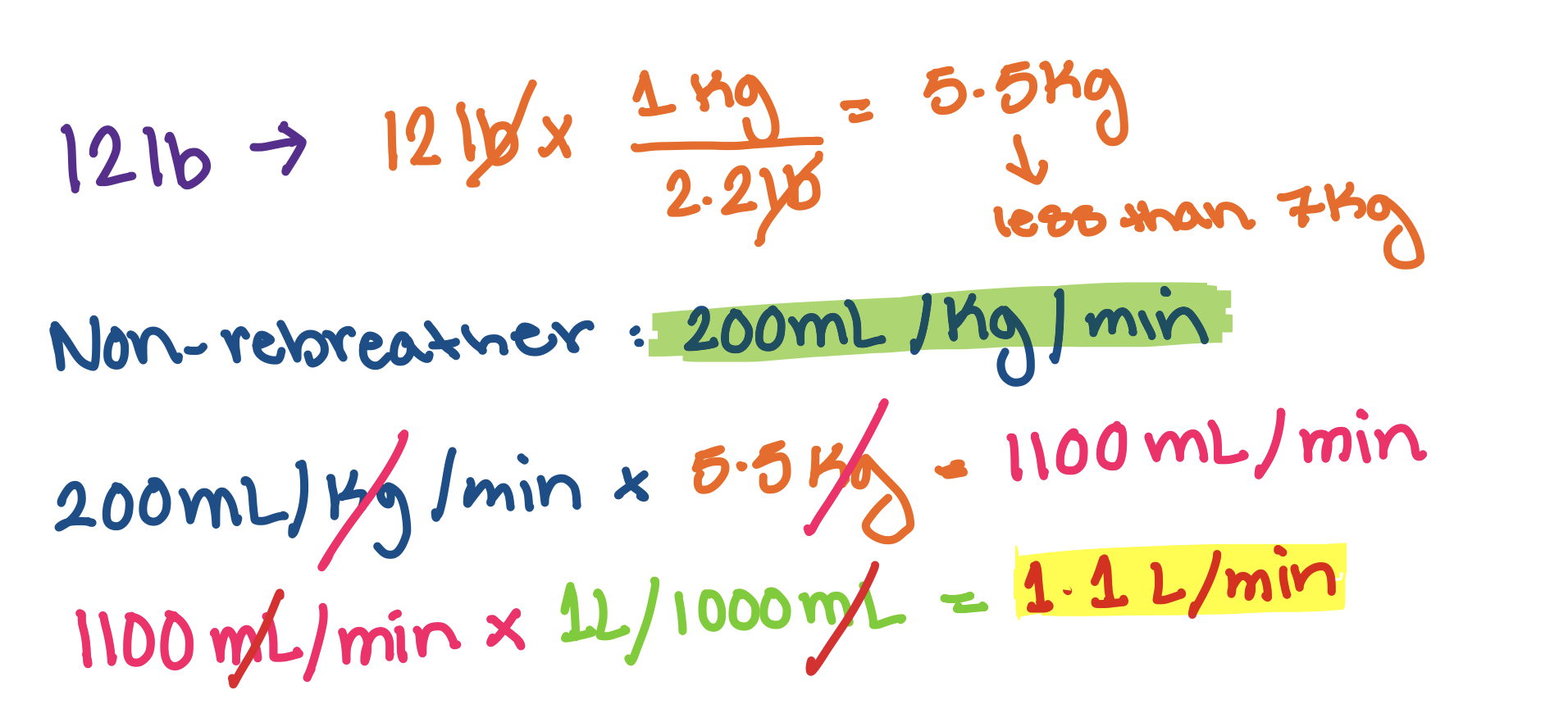

Let’s compare:
Rebreather - 11.4kg

Non-rebreather - 5.4kg

If the patient is deep from the anesthesia - DISCONNECT the patient from breathing circuit, EMPTY the bag by squeezing it - to give patient fresh oxygen, the excess anesthesia goes to the SCAVENGE (POP OFF will be OPEN)
To increase anesthesia from 1% to 3% & want to give it to the patient faster - INCREASE OXYGEN
Goes from 1L/min to 3L/min
Common Inhalant Agents:
Halogenated anesthetics
Induce/maintain general anesthesia
How do we administer gas? VAPORIZER

Isoflurane MAC = 1.2
Highly insoluble anesthetic
Almost none to 0.2% metabolized in liver & no renal effects
Older anesthetic
Low pollution concerns due to short use & fast effects
Sevoflurane MAC = 2.4
More insoluble; higher MAC
Faster, faster, faster!
Similar effects to Isoflurane & Halothane
3, 3, for 3. 3% at 3L 02 flow, for 3 minutes. Maintain between 2-4%
Least hepatic effects
Increased renal effects
Fast changes in anesthetic depth
Minimal Alveolar Concentration:
MAC is the minimal alveolar concentration (alveolar is in the lungs)
50% of the patients will NOT respond to painful stimuli (e.g., surgery-skin incision, tail clamp) - MAC is the concentration of an inhalant anesthetic required to prevent movement in response to a painful stimulus in 50% of patients
MAC is used to compare inhalation anesthetic potency (similar to mg/kg for injectable anesthetics)
Clinically, achieving a surgical plane of anesthesia usually requires 1.2 to 1.5 times MAC to ensure 99.9% of the patients will not respond to the surgical stimulation
The LOWER the MAC value, the more POTENT the anesthetic agent
Use as guide for MINIMUM levels of anesthesia
MACS to REMEMBER:
Isoflurane = 1.2
Sevoflurane = 2.4
Ex:
The patient needs 1.5 MAC of isoflurane. What is the vaporizer setting?
1.2 × 1.5 = 1.8
Remember:
50% need MORE & 50% need LESS
Use MAC as a guideline
Also depends on:
Stimulus
Status of patient
Other medications on board
Surgical MAC:
MAC x 1.25 to 1.5
What factor of MAC is required for surgery? 1.25 -1.5 of MAC
Ex:
What is surgical MAC?
4.2 × 1.25 = 5.25
New Anesthetic Gas:
CPPotent
MAC = 4%
What Will Increasing the Oxygen Flow Rate Do?
Increase the amount of fresh gas flowing through the anesthesia circuit
Deliver more oxygen to the patient
Increase the amount of anesthetic gas delivered to the patient (anesthetic concentration stays the same)
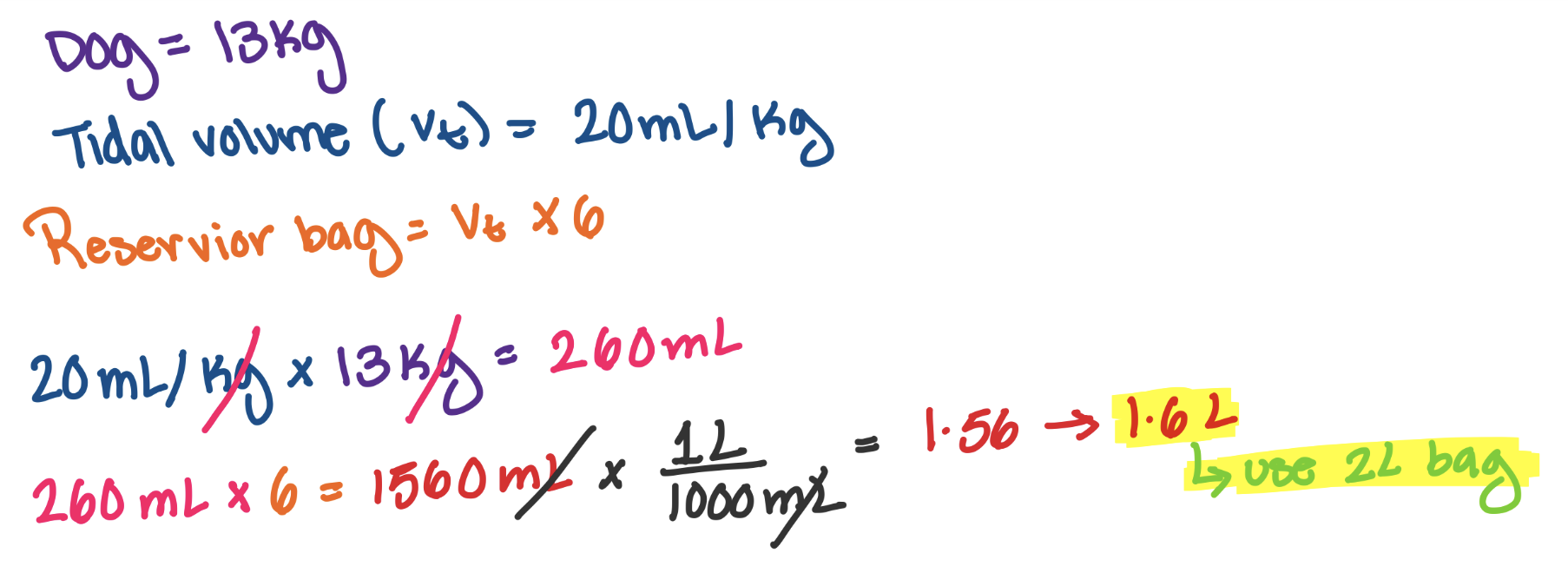
Calculations Tidal Volume (Vt) & Reservoir Bag:
Tidal volume = 10-20 ml/kg of body weight (USE 15ml/kg - BASELINE)
Volume of gas IN & OUT of LUNGS in a normal respiratory cycle
Vt=10-20mL/kg
Reservoir bag = Vt x 6 (should 6 breathes inside the bag)
Practice Problem:
Calculate tidal volume, minute volume & reservoir bag size. Assue RR of 12/min.

More Calculations:


Reservoir Bag Size - Common Problems:
Bag is too FULL
Pop-off valve is CLOSED
Patient NOT breathing
Oxygen flow is set too HIGH
Bag is too SMALL
Bag is too DEFLATED
Gas flow is inadequate
Bag is too LARGE
Leak is present in the system
Want to see the bag MOVE - to see the BREATHS of patients
“Bagging” A Patient:
Scenarios:
Too DEEP
Cardiac arrest
Controlled Ventilation:
Giving a breathe
Sighing (giving a larger-than-normal breathe to a patient)
How do you “sigh” an animal? & when you have a dog that is too deep & you want to give the dog a breathe?
1. CLOSE the pop-off valve
2. Squeeze the reservoir bag slowly
3. Open the pop-off valve again
Giving a Breathe:
Why would you empty the bag before giving a breath?
To fill the reservoir bag with FRESH GAS so the animal receives a fresh breath when the bag is squeezed as the reservoir bag contains exhaled/used gas
A rebreathing system is for animals over:
7 kg
The APL valve should never be close under any circumstances:
False
What is the purpose of an inspiratory one-way valve?
To move the gases forward
What is the purpose of the expiratory one-way valve?
To prevent the animal from inhaling expired CO2
Any animal can use a non-breathing circuit as long as you have enough oxygen flow:
True
Which circuit uses more oxygen?
Non-rebreathing circuit
You can’t do surgery with local anesthetic:
False
A rebreathing system is good for retaining heat:
True
A non-rebreathing system requires:
Scavenge
Analgesia is best:
Pre-emptively (Give pain medication BEFORE the painful procedure or surgery starts)
What is the Tidal Volume?
The volume of air in one breath cycle
What Units are in the Flowmeter?
L/min
What is the Formula to Calculate a Reservoir Bag?
Vt x 6
Tidal Volume is:
10-20mL/kg
What is the Conversion Factor for an H Tank?
3