Photosynthesis (WIP)
 Call Kai
 Learn
 Practice Test
 Spaced Repetition
 Match
 Flashcards
 Knowt Play
1/45

There's no tags or description
Looks like no tags are added yet.
46 Terms
What is Photosynthesis
the synthesis of organic compounds
-the splitting of water (photolysis) in the light dependant reaction
-the reduction of carbon dioxide in the light independant reaction
leaf adaptations
thin- short diffusion distance, light penetrates right through
vascular bundles
flat and wide to capture as much light energy + SA:V
stomata for CO2 in leaf
Air Spaces in spongy mesophyll and spaces between palisade cells allows CO2 to diffuse into cells
cell adaptations
cuticle and epidermis are transparent- light penetrates to the mesophyll
palisade cells have large vacuole- chloroplast form a single layer at the edfe of the cell so they don’t shade each other
palisade cells are cylindrical and elongated at right angles- light does not have to pass through many tissue layers before it reaches a chloroplast
chloroplast adaptation
large SA for maximum light absorption
more w/palisade cells- top or bottom based on light intensity (away if too high so not damaged)
can rotate with palisade cells
pigments in the thylakoids are in a single layer on the surface of thylakoid membrane
5 times as many chloroplasts in palisade cells as spongy mesophyll cells- palisade cells exposed to more light so more light is captured
chloropyll pigments
- absorb light photons at different wavelengths
chlorophyll types
A- blue/green
B- yellow/green
carotenoids
xanthophyll- yellow
beta carotenoids- orange
phaeophytin
grey- break down product of chlorophyll
3 biological significant factors of light
spectral quality- wavelength
intensity- the number of photons of light landing on a specific area per second
duration- photoperiod time/minutes
absorption spectra

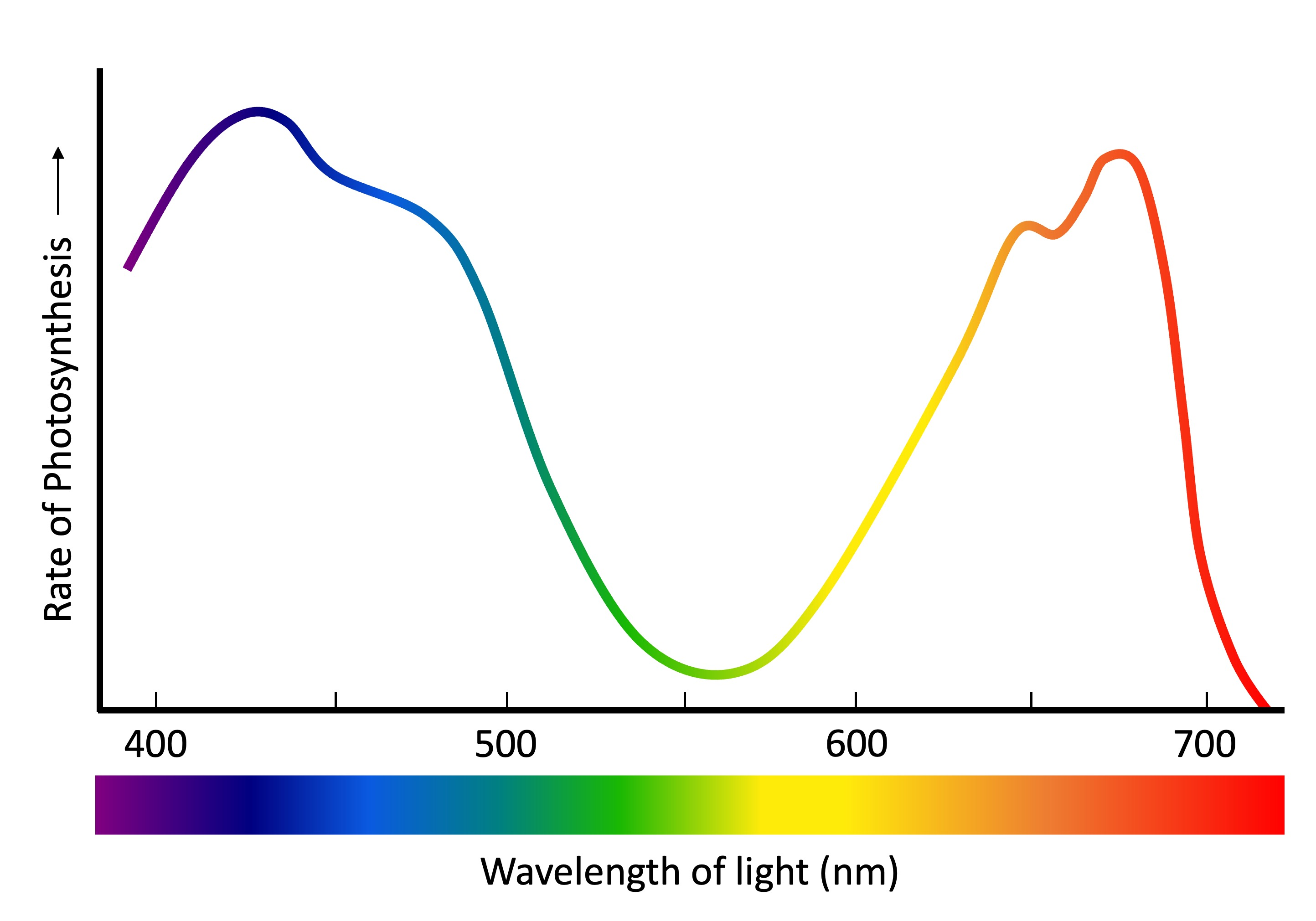
what does action spectra show
shows rate of photosynthesis at different wavelengths
action spectra
Chlorophyll a diagram

prophryn head
where is chlorophyll found
Chlorophyll and acessory pigments are found in the thylakoid membranes of chlorplasts, grouped in clusters of several hundred molecules called Antenna Complex
What do accessory pigments do
help funnel photons of light through the antenna complex to the reaction centre of 2 chlorophyll a molecules
What are photosystems
2 photosystems each containing a reaction centre containing the primary pigment (chlorophyll a) and a number of accessory pigments
photosystem I
-arranged around 2 chlorophyll a molecules
-absorption peak 700nm
-also called P700
Photosystem II
-arranged around 2 chlorophyll a molecules
-absorption peak 680nm
-also called P680
LDP- non-cyclic photophosphorylation 1
photolysis of water provides electrons (to replace those lost from the Photosystem II), protons (which aid ATP sysnthesis) and oxygen which is a waste product
-happens in thylakoid space
LDP- non-cyclic photophosphorylation 2
photosystem II absorbs light energy and passes it onto a chloropyll a molecule, P680, at the reaction centre
LDP- non-cyclic photophosphorylation 3
electrons become excited (high energy electrons) and are boosted to a higher energy level. An electron accpector is reduced as it accepts the excited electron
LDP- non-cyclic photophosphorylation 4
The electron goes through a series of redox reactions through an ETC. the energy being lost provides protons to make ATP. The electrons replace the electrons being lost inn the Photosystem I
LDP- non-cyclic photophosphorylation 5
Photosystem I absorbs light energy and passes it onto a chlorophyll molecule, P700 a the reactive centre
LDP- non-cyclic photophosphorylation 6
electrons become excited (high energy electrons) and are boosted to a higher energy level. An electron accpector is reduced as it accepts the excited electron
LDP- non-cyclic photophosphorylation 7
second ETC transferes electrons to the coenezyme NADP
chemiosmotic theory
H+ builds up inside the lumen of the thylakoids which lowers the pH in the lumen. Thylakoid membranes are impermeable to H+. Proton complex on theylakoid membrane consisters of ATP synthetase and H+. H+ pass through the pore from lumen to stroma down a concentration gradient.
The proton movement provides energy to convert ADP and Pi to ATP
cyclic photophosphorylation
-only involves P700. It absorbs photons which supply energy and the electrons become excited. They are emitted from chloropyll a to an electron acceptor. Goes through an electron transport chain. Electrons return to P700 and ATP is produced.
where does the calvin cycle take place?
the stroma
calvin cycle step 1

before the glycerate-3-phosphate an unstable 6C molecule is formed, which splits intp the glycerate-3-phosphate
Calvin cycle step 2
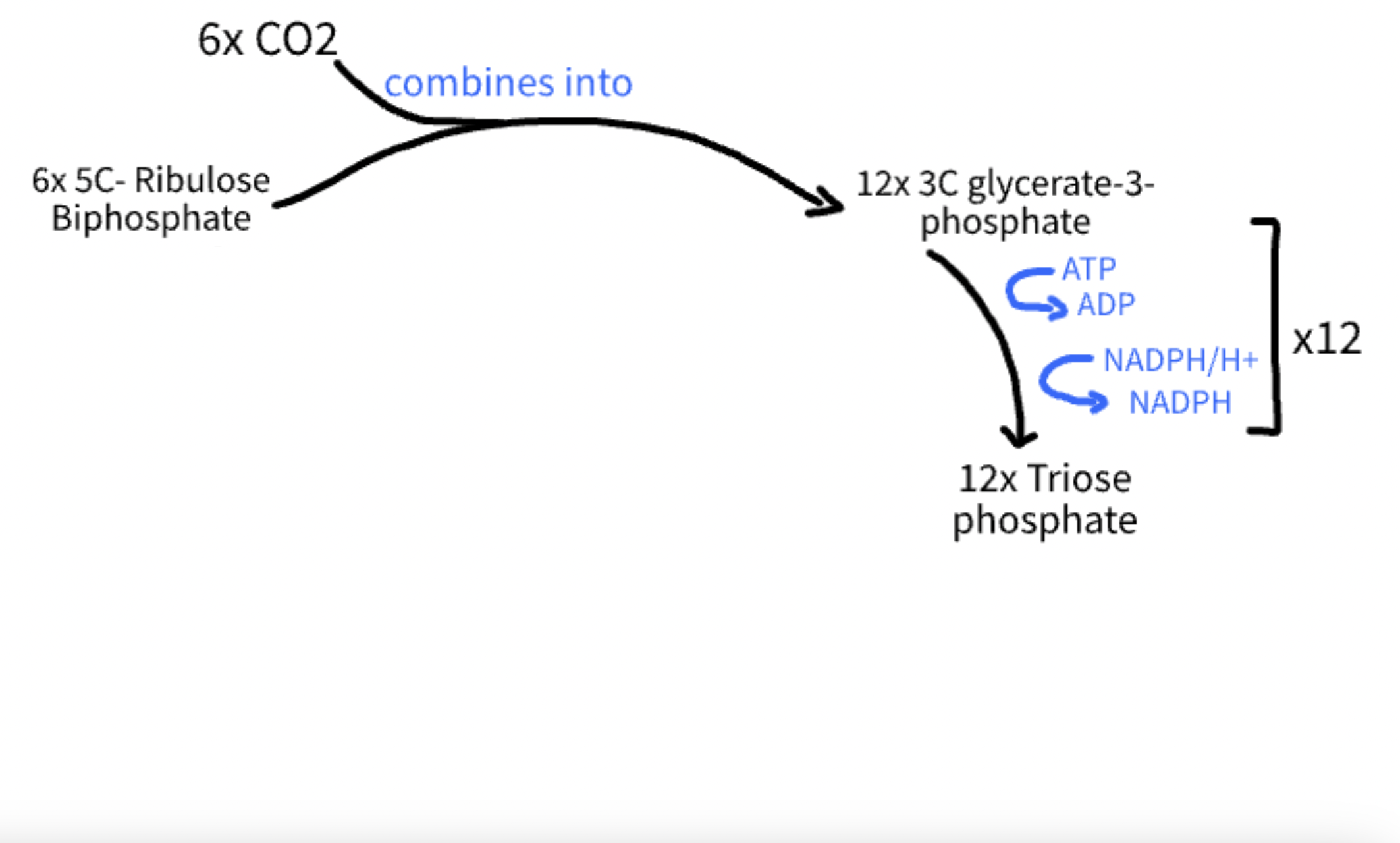
Calvin cycle step 3

This step requires ATP and releases ADP
RuBisCo- ribulose biphosphate carboxylase oxidase
catalyses step 1. It is the most abundant enzyme on earth. Made of 8 large polypeptides whihc are contained in chloroplast dna and 9 small polypeptides which are contained in nuclear DNA. In some photosynthetic bacteria the RuBisCo equivalent only has the large- evidence for endosymbiotic theory
minerals
lack of minerals may be limiting factors to metabolism in short supply
-needed for synthesis of compounds for plant growth
micro and macro nutrients
enter the root hair cells by diffusion or active transport
nitrogen uses and symptoms of deficiency
amino acid and nucelic acid synthesis
-stunted growth and chlorosis (yellowing leaves)
potassium uses and symptoms of deficiency
opening and closing of stomata; enzyme cofactor
-Stunted growth; yellow leaves (chlorosis); reduced flowering and fruit formation
phosphorus uses and symptoms of deficiency
nucleic acid and phospholipid synthesis
-Small dark-green leaves often with a red-purple edge; reduced root growth
sulphur uses and symptoms of deficiency
some amino acids
-Chlorosis in new leaves; reduced root growth
calcium uses and symptoms of deficiency
Formation of middle lamella between plant cells; enzyme cofactor
-Small leaves; death of buds at ends of stems
magnesium uses and symptoms of deficiency
Component of chlorophyll; enzyme cofactor
-chlorosis
hydroponics
the growing of plants in water containing the correct concentrations of mineral ions.
What is the law of limiting factors
when a process’ rate is determined by more than one factor then the overall rate is limited by the factor which is closest to its minimum value
light intensity as the limiting factor

A- the limiting factor is light intensity
B- the limiting factor is light intensity and something else
C- the limiting factor is something else
carbon dioxide concentraiton as the limiting factor

under normal daylight conditions this is always the limiting factor
temperature as the limiting factor

critical for the light independent reaction as is driven by enzymes
compensation point
we can plot a graph of light intensity against carbon dioxide production/ release. When no carbon dioxide is released and none is taken in by the plabt we know that the rate of photosynthesis is equal to rate of respiration
compensation point graph
