BSC1005L - Circulatory System Diagram
 Call Kai
 Learn
Learn Practice Test
 Spaced Repetition
 Match
Match Flashcards
 Knowt Play
1/37

There's no tags or description
Looks like no tags are added yet.
Name | Mastery | Learn | Test | Matching | Spaced | Call with Kai | Chat |
|---|
No analytics yet
Send a link to your students to track their progress
38 Terms
Circulatory System
System that transports oxygen, nutrients, and removes waste.
Heart
Muscular pump controlled by electrical impulses.
Blood
Fluid that carries oxygen, CO2, nutrients, waste, hormones.
Arteries
Vessels that carry oxygenated blood away from the heart.
Veins
Vessels that carry deoxygenated blood toward the heart.
Capillaries
Microscopic vessels where gas and nutrient exchange occurs.
Right Atrium
Receives deoxygenated blood from the body.
Right Ventricle
Pumps deoxygenated blood to the lungs.
Left Atrium
Receives oxygenated blood from the lungs.
Left Ventricle
Pumps oxygenated blood to the entire body.
Heart Valves
Structures preventing backflow and ensuring one-way blood flow.
Systole
Phase where the heart contracts to pump blood.
Diastole
Phase where the heart relaxes and chambers refill.
Blood Pressure
Force of blood on vessel walls; measured as systolic/diastolic.
Hypertension
Chronically high blood pressure.
Hypotension
Abnormally low blood pressure.
Thermoregulation
Control of body temperature through blood vessel dilation/constriction.
Pulmonary Circuit
Blood flow from heart to lungs and back to heart.
Systemic Circuit
Blood flow from heart to body tissues and back.
Heart Attack
Blockage of blood flow to the heart, usually due to plaque or clots.

Superior vena cava
1

Right atrium
6

Right ventricle
8
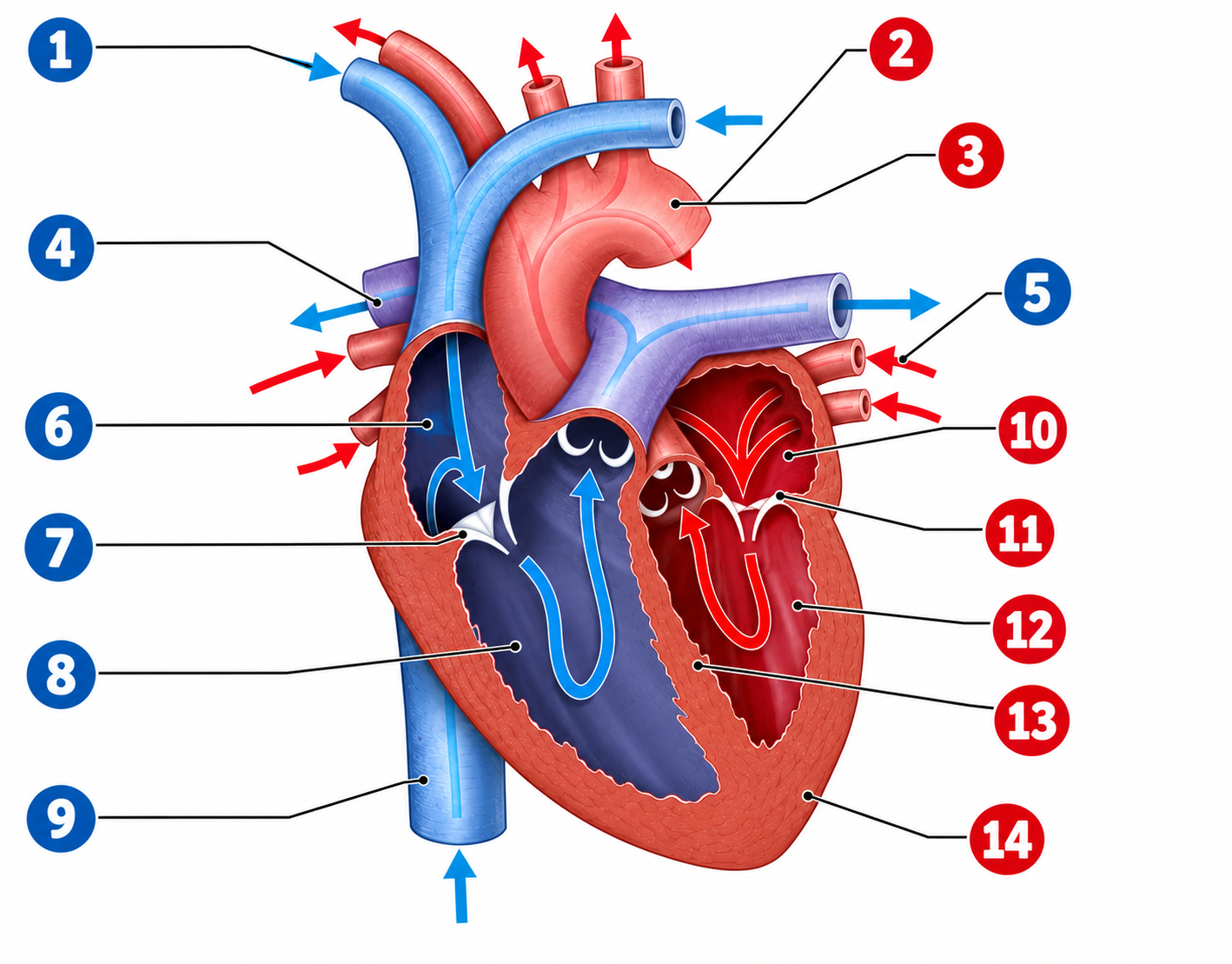
Inferior vena cava
9

Tricuspid valve
7

Pulmonary valve
15

Aortic valve
13

Mitral valve
11

Aorta
2

Pulmonary artery
3

Pulmonary veins
5

Left artium
10

Left ventricle
12

Cardiac Muscle (Myocardium)
14

Cardiac muscle (Another Myocardium location)
14
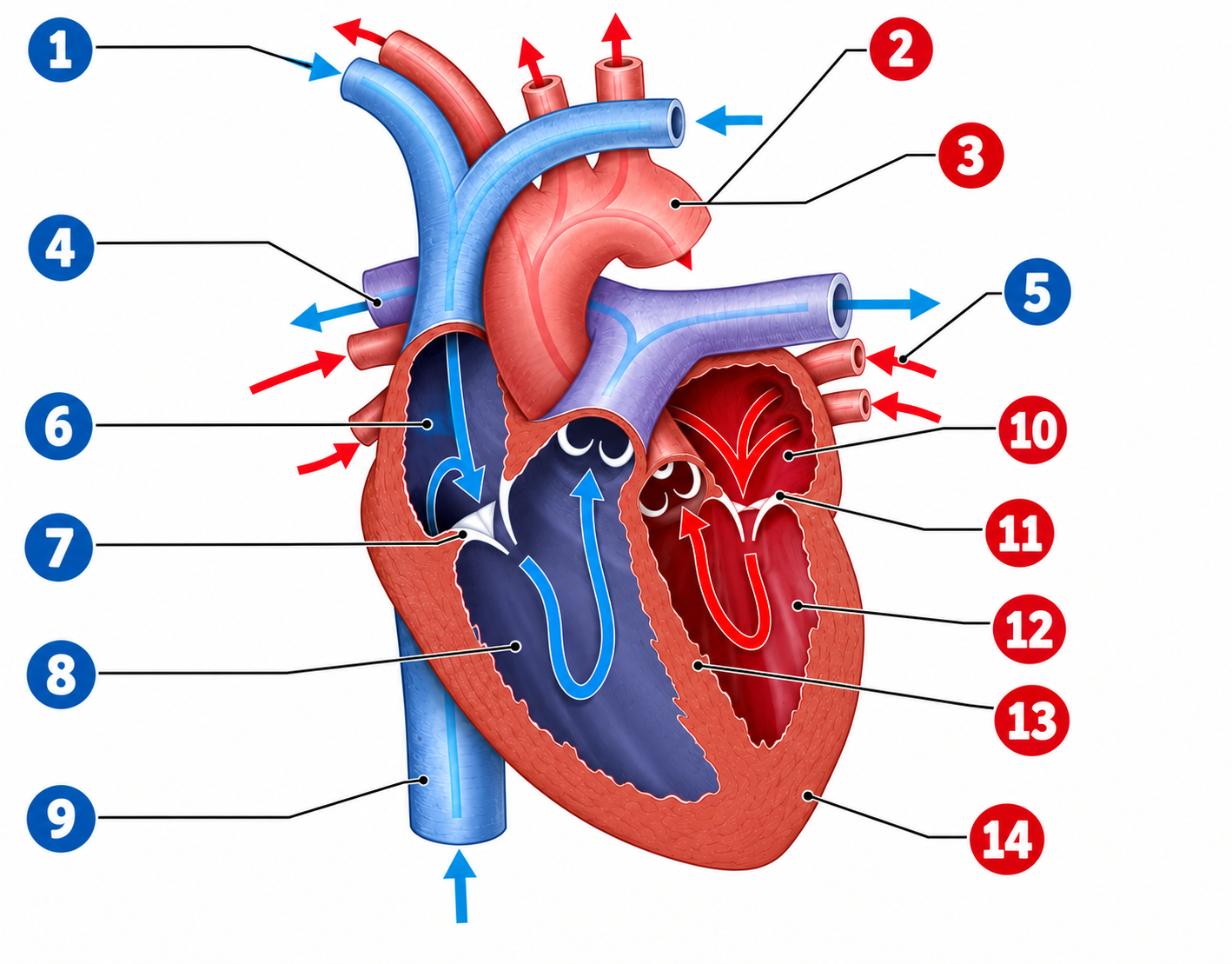
Oxygen poor blood
1

Oxygen rich blood
3
What is the Septum?
It is the thick muscular wall between the two lower chambers.