Math 32AH Definitions
 Call Kai
 Learn
 Practice Test
 Spaced Repetition
 Match
 Flashcards
 Knowt Play
1/29

There's no tags or description
Looks like no tags are added yet.
30 Terms
Cauchy Schwarz Inequality
(a dot b) <= |a||b|
Triangle Inequality
|a+b| <= |a| + |b|; |x-z| <= |x-y|+|y-z|; ||x|-|y|| <= |x-y|
Dot and Cross Product
a dot b = |a||b|costheta, a x b = |a||b| sintheta
Interior and Boundary Point of S
B(r,a) is in S → A is interior; B(r,a) meets both S and Sc —> A is boundary
Open and Closed Sets, S Closure
Open contain boundary points, closed contain none of the boundary points; S Closure is S U boundary of S
Epsilon-Delta Definition of a Limit
The limit at x = L, if for every epsilon > than 0, there exists delta s.t 0 < |x-a| < delta, and |f(x) - L| < epsilon.
Epsilon-Delta Definition of Continuity
If for every epsilon > 0, there exists delta s.t 0 < |x-a| < delta, and |f(x) - f(a)| < epsilon. Continuous at A if continuity exists at every point on A.
Basic Arithmetic Operations
Arithmetic operations of continuous functions are continuous except at dividing by 0.
Pre-Image Open Closedness
If the pre-image of an open set is open, or a closed set is closed, the function is continuous. PROVE THIS.
One Variable Differentiability & Mean-Value
f(a+h) = f(a) + mh + o(h); If f is differentiable and continuous on [a,b], there exists d in [a,b] s.t. f(a) - f(b) = f’(d) (a-b).
Gradient, Differentiability
lim h→0 (f(a+h) - f(a) - c dot h) / |h| = 0, Continuous partial derivatives imply differentiability
Tangent Plane
z= f(a,b) + ∂xf(a,b)(x−a) + ∂yf(a,b)(y−b), parameterizing (a,b,f(a,b))
Directional Derivative
lim t → 0 f(a + tu) - f(a) / t. If f is differentiable (all of it’s partials are continuous), the dertivative will also be equal to the gradient of f(a) dot u.
L is Linear if
L (sx + ty) = sL(x) + tL(y)
The Derivative Matrix
Df (a) = ∂1f1(a)··· ∂nf1(a)
∂1fm(a)··· ∂nfm(a)
equal to the gradient f(a)T for scalar valued a.
Chain Rule
D(f o g)(a) = Df(g(a)) Dg(a)
∂ℓHi(a) = sum from j = 1 to N of ∂jfi(g(a)) ∂ℓgj(a)
Homogenous Functions + Euler’s Identity
A function is positively homogenous of degree alpha if f(tx) = t ^ alpha f(x), for all t > 0 and x =/ to 0. Euler’s Identity states that x ·∇f(x) αf(x), if f is positively homogenous and differentiable.
Schwarz Theorem, The Hessian
Hf(a) = ∂i∂jf(a)n i,j=1
If the two mixed partials are continuous and all the partials exist, the two mixed partials can be taken in any order.
Multi-Index and Multinomial Formula
|α|= α1 +···+ αn, α! = α1!···αn!,
hα = h1^α1…hn^αn
(z1 + … zn)^r = sum of |α| = r r!/α! z^α
Convergence of a Sequence
A sequence Xk converges to a if for every epsilon > 0, there exists N s.t |Xk - a| < epsilon for all k >= N.
Accumulation Point
A point a is an accumulation point in S if every ball around a contains a point in S other than itself.
Completeness Axiom
Every nonempty subset of R that is bounded above has a supremum in R.
Compactness (Sequences Theorem) - PROVE
A subset of Rn is compact if it is closed and bounded. A set K ⊂ Rn is compact if and
only if every sequence in K has a convergent subsequence whose limit belongs to K.
Extreme Value Theorem
Let K ⊂Rn be nonempty and compact, and let f : K →R
be continuous. Then f attains its minimum and maximum: there are a,b ∈K such that
f(a) ≤f(x) ≤f(b) (x ∈K).
Cauchy Sequences
A sequence is cauchy if for every epsilon > 0, there exists N s.t. |Xi - Xj| < epsilon for every i,j > N.
Bolzano Weierstrass
Every bounded sequence in Rn has a convergent subsequence.
Taylor’s Theorem

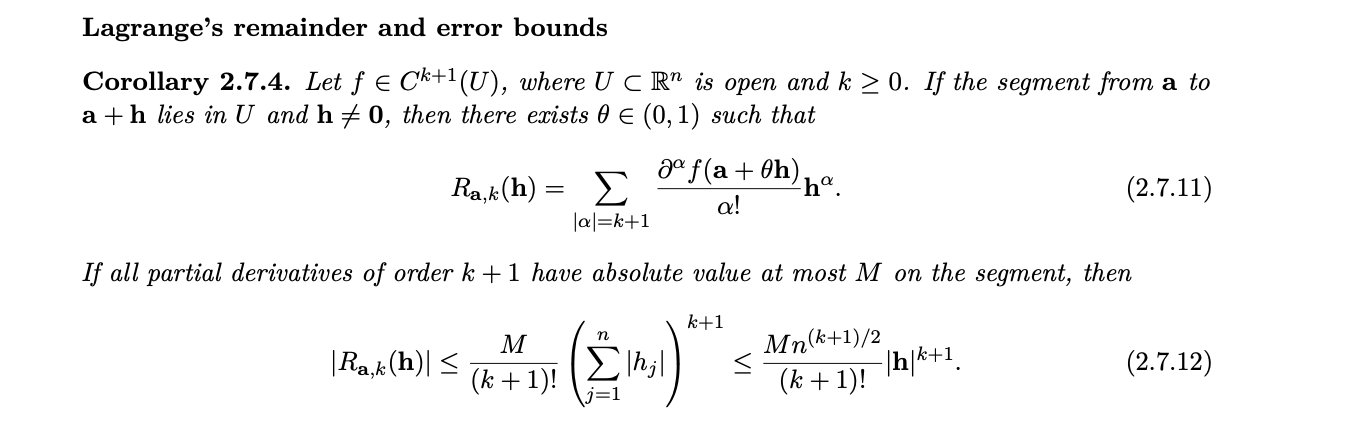
Lagrange’s Remainder
Quadratic Approximation (Taylor)

Taylor Polynomial
