Microecon CH 6 - Efficiency and Fairness of Markets
 Call Kai
 Learn
Learn Practice Test
 Spaced Repetition
 Match
Match Flashcards
 Knowt Play
1/49

There's no tags or description
Looks like no tags are added yet.
Name | Mastery | Learn | Test | Matching | Spaced | Call with Kai | Chat |
|---|
No analytics yet
Send a link to your students to track their progress
50 Terms
As more of a good is consumed, marginal benefit ________ and as more of a good is produced, marginal cost ________.
Group of answer choices
increases; decreases
decreases; increases
does not change; does not change
decreases; decreases
increases; increases
decreases; increases
To achieve allocative efficiency, one must compare the
Group of answer choices
point of production efficiency to the point of allocative efficiency.
marginal cost of a good to its opportunity cost.
marginal benefit of a good to its marginal cost.
opportunity cost to the attainable point on the production possibilities frontier.
marginal cost to the production efficiency cost.
marginal benefit of a good to its marginal cost.
All points on the production possibilities frontier
Group of answer choices
achieve allocative efficiency.
are allocatively inefficient.
are production efficient but only one point achieves allocative efficiency.
are allocatively efficient but only one point achieves production efficiency.
are production inefficient.
are production efficient but only one point achieves allocative efficiency.
When the marginal cost of producing a bike is greater than the marginal benefit of the bike, for resource use to be allocatively efficient,
Group of answer choices
more bikes should be produced.
fewer bikes should be produced.
it must be determined if the production of bikes can be increased.
people must be educated to demand more bikes.
no more and no fewer bikes should be produced.
fewer bikes should be produced.
A demand curve can be interpreted as
Group of answer choices
a total benefit curve.
a marginal cost curve.
an average benefit curve.
a marginal benefit curve.
None of the above answers is correct.
a marginal benefit curve.
Samantha was willing to pay $10 for a hamburger because she was hungry but she only paid $2.50. What is the marginal benefit Samantha gained from the hamburger?
Group of answer choices
$2.50
$7.50
$10.00
$12.50
None of the above answers is correct.
$10.00
Consumer surplus is equal to
Group of answer choices
price minus marginal benefit summed over the quantity consumed.
price multiplied by the quantity consumed.
marginal benefit plus price summed over the quantity consumed.
marginal benefit summed over the quantity consumed.
marginal benefit minus price summed over the quantity consumed.
marginal benefit minus price summed over the quantity consumed.
Consumer surplus is the area
Group of answer choices
above the supply curve and below the market price.
below the demand curve and above the supply curve.
below the demand curve and above the market price.
below the supply curve and above the market price.
above the demand curve and below the market price.
below the demand curve and above the market price.
Lauren and Katy each bought a new bike lock for $20. Both Lauren and Katy would have paid $25 for the lock. Katy's consumer surplus equaled
Group of answer choices
$5.
$40.
$20.
$10.
$50.
$5.
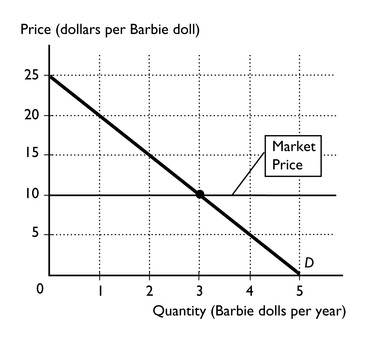
The figure above shows Lauren's demand curve for Barbie dolls and the market price for Barbie dolls. Using the area of the consumer surplus triangle, Lauren's total consumer surplus from purchasing 3 dolls is
Group of answer choices
$5.50.
$10.00.
$22.50.
$45.00.
3 dolls.
$22.50.
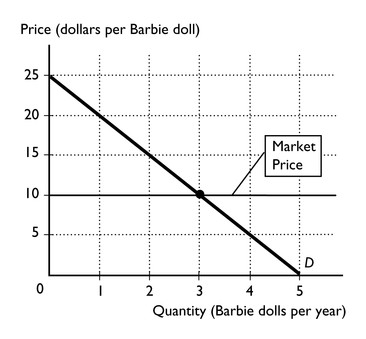
The figure above shows Lauren's demand curve for Barbie dolls and the market price for Barbie dolls. In order for Lauren to avoid paying more for dolls than they are worth to her, she must not purchase any more than
Group of answer choices
3 dolls.
4 dolls.
0 dolls.
5 dolls.
1 doll.
3 dolls.
Which of the following describes the economic meanings of cost and price?
Group of answer choices
Cost refers to what the buyers pay for the good, and price refers to what sellers receive when the good is sold.
They are the same, and they both mean what is received when a good is sold.
Cost refers to the price that buyers must pay to buy the good.
Cost is what must be given up to produce a good, and price is what a seller receives when the good is sold.
Cost is exchange worth, and price is dollar worth.
Cost is what must be given up to produce a good, and price is what a seller receives when the good is sold.
The opportunity cost of producing one more unit of a good or service is the
Group of answer choices
marginal cost.
marginal benefit.
price of the good or service.
efficient level of production.
market outcome.
marginal cost.
Producer surplus is the ________ summed over the quantity produced.
Group of answer choices
marginal cost of the good minus the opportunity cost of producing it
marginal benefit of the good minus its marginal cost
price of the good minus the marginal cost of producing it
marginal benefit of the good minus its price
None of the above answers is correct.
price of the good minus the marginal cost of producing it
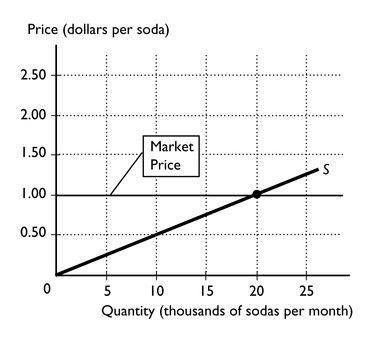
The figure above shows the supply curve for soda. The market price is $1.00 per soda. The producer surplus from the 10,000th soda is
Group of answer choices
$0.00.
$0.50.
$1.00.
more than $1.00.
None of the above answers is correct.
$0.50.

The figure above shows the supply curve for soda. The market price is $1.00 per soda. The producer surplus from the 20,000th soda is
Group of answer choices
more than $1.00.
$1.00.
$0.50.
$0.00.
None of the above answers is correct.
$0.00
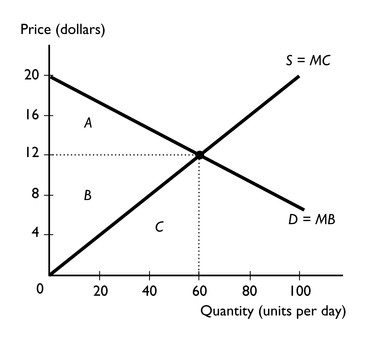
In the figure above, if the market price is $12, then the total consumer surplus is
Group of answer choices
$10.
$240.
$12.
$480.
minimized.
$240

In the figure above, if the market is at equilibrium, then the total consumer surplus equals the area ________ and the total producer surplus equals the area ________.
Group of answer choices
A; B
B; C
A; C
A + B; C
C; B
A; B
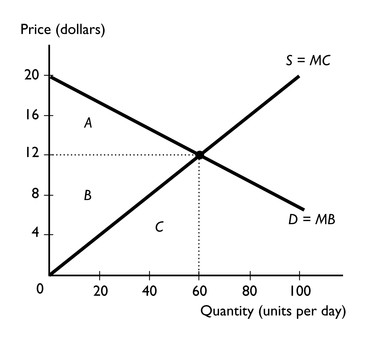
In the figure above, if the market is at equilibrium, the sum of the total consumer surplus and the total producer surplus is
Group of answer choices
$240.
$600.
$1,000.
$0.
$60.
$600.

In the above figure, if the market is in equilibrium, area A + area B + area C equals
Group of answer choices
total surplus.
consumer surplus.
deadweight loss.
producer surplus.
total revenue.
consumer surplus.

In the above figure, if the market quantity is restricted to 500,000 and the price is allowed to rise to set the quantity demanded equal to the quantity supplied, then the producer surplus is equal to
Group of answer choices
area D + area F.
area C + area E.
area A + area B + area C.
area A + area B.
area B + area D + area F.
area B + area D + area F.
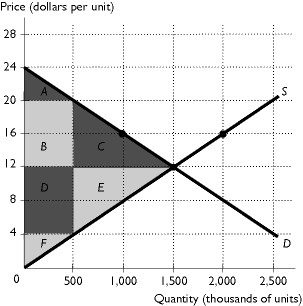
In the above figure, if the quantity is restricted to 500,000 and the price is allowed to rise to set the quantity demanded equal to the quantity supplied, then area C + area E is equal to
Group of answer choices
deadweight loss.
consumer surplus.
total surplus.
producer surplus.
total revenue.
deadweight loss
Which of the following leads to a deadweight loss?
i. | overproduction |
ii. | underproduction |
iii. | taxes |
iv. | monopoly |
Group of answer choices
i, ii, and iii
i, ii, iii, and iv
iii and iv
ii only
i and ii
i, ii, iii, and iv
When a market is efficient, the
Group of answer choices
marginal benefit of the last unit produced exceeds the marginal cost by as much as possible.
quantity produced is maximized.
sum of consumer surplus and producer surplus is maximized.
total benefit equals the total cost.
deadweight gain is maximized.
sum of consumer surplus and producer surplus is maximized.
As pointed out by the "big tradeoff," government action that redistributes incomes so that everyone has the same income leads to
Group of answer choices
a smaller total output.
efficient markets.
fairness according to the "fair rules" approach.
resources being allocated according to a command system.
lower taxes on the rich than on the poor so that the rich do not lose their incentive to work.
a smaller total output.
Mary is willing to pay $50 for a Christmas tree, John is willing to pay $45 and Jeff is willing to pay $40. The price of a tree is $40. The total consumer surplus for Mary, John and Jeff taken together is
Group of answer choices
$120.
$95.
$40.
$135.
$15.
$15.

The figure above shows Diane's demand curve for soda. The price of a soda is $1.00. Diane's consumer surplus from her 15th soda is
Group of answer choices
$2.50.
$1.00.
$1.50.
$0.50.
$0.00.
$0.00
We allocate resources efficiently when
Group of answer choices
marginal benefit is greater than marginal cost by as much as possible.
total benefit is greater than total cost.
marginal benefit is equal to marginal cost.
marginal benefit is greater than marginal cost by any amount.
marginal cost is greater than marginal benefit.
marginal benefit is equal to marginal cost.

Bill and Krista sell potted plants from a roadside stand. The figure above shows Bill and Krista's marginal cost curve and the market price. If Bill and Krista sell 60 plants per week, their producer surplus from the 60th plant will equal
Group of answer choices
$20.
$480.
$8.
$0.
More information is needed to answer the question.
$0.
The marginal cost curves slope upward because of the principle of
Group of answer choices
decreasing marginal benefits.
decreasing marginal cost.
increasing marginal benefits.
increasing marginal cost.
decreasing total benefit.
increasing marginal cost.
In 2015 the president of a company decided that all employees (from president to custodians) would all earn the same wage of $60,000 per year. The president's policy followed the ________ approach to fairness.
Group of answer choices
fair rules
gouging
fair results
command
majority rule
fair results
When people cannot be excluded from consuming a good, even if they have not paid for the good, competitive markets would
Group of answer choices
allocate more resources than the efficient amount to the production of the good.
produce less than the efficient quantity.
eliminate the deadweight loss.
produce more of the good than society needs.
produce the good so that people could enjoy a "free ride."
produce less than the efficient quantity.
Equal opportunity but unequal results
Group of answer choices
means that the outcome is definitely not fair.
occurs only if the state fails to establish and protect private property rights.
cannot occur if all exchange is voluntary.
can occur under the fair-rules view of fairness.
occurs only when the economy is not producing at the allocative efficient point on the PPF.
can occur under the fair-rules view of fairness.
If the government imposes a tax on a competitive market with no externalities, then
i. | resource use is not efficient. |
ii. | there is a deadweight loss. |
iii. | consumer surplus is at its maximum. |
Group of answer choices
iii only
ii only
i and ii
i and iii
i, ii, and iii
i and ii
A demand curve can be interpreted as
Group of answer choices
an average benefit curve.
a marginal benefit curve.
a marginal cost curve.
a total benefit curve.
None of the above answers is correct.
a marginal benefit curve.
Suppose the price of a scooter is $200 and Cora Lee is willing to pay $250. Cora Lee's
Group of answer choices
marginal benefit from that scooter is $100.
consumer surplus from that scooter is $150.
consumer surplus from that scooter is $50.
consumer surplus from that scooter is $200.
consumer surplus from that scooter is $250.
consumer surplus from that scooter is $50.
Allocative efficiency is achieved when the marginal benefit of a good
Group of answer choices
exceeds the marginal cost, but not by as much as possible.
is less than the marginal cost.
equals the marginal cost.
equals zero.
exceeds the marginal cost by as much as possible.
equals the marginal cost.
If you split your dessert with your date, you are using a ________ allocation method.
Group of answer choices
sharing equally
personal characteristics
first-come, first-served
contest
command
sharing equally
The principle of decreasing marginal benefit explains why the marginal benefit curve
Group of answer choices
has an infinite slope.
is upward sloping.
is downward sloping.
is vertical.
is horizontal.
is downward sloping.
The marginal benefit of a taco is measured by
Group of answer choices
the price of the taco.
the amount of another good a person must give up to get one more taco.
a point on the PPF.
the amount of another good a person is willing to give up to get one more taco.
the opportunity cost of producing another taco.
the amount of another good a person is willing to give up to get one more taco.
If an economy is allocatively efficient, it must be producing
Group of answer choices
beyond its production possibilities frontier.
on its production possibilities frontier.
inside its production possibilities frontier.
the goods and services that are the least expensive to produce.
the goods and services that are the most expensive.
on its production possibilities frontier.
Marginal benefit curves
Group of answer choices
are upside-down U-shaped curves.
have positive slopes.
have negative slopes.
are horizontal lines.
are vertical lines.
have negative slopes.
Cost
Group of answer choices
is greater than market price, which results in a profit for firms.
is what the buyer pays to get the good.
is what the seller must give up to produce the good.
is always equal to the marginal benefit for every unit of a good produced.
means the same thing as price.
is what the seller must give up to produce the good.

The figure above shows the demand curve for pizza and the market price of pizza.
In the figure above, the total benefit from pizza is ________ per day.
Group of answer choices
$100,000
$125,000
$150,000
$50,000
None of the above answers is correct.
$150,000
When a product benefits people other than the buyer of the product, the product is said to have
Group of answer choices
an external benefit.
an external cost.
an excludable benefit.
an excludable cost.
a subsidized benefit.
an external benefit.
If a landlord will rent an apartment only to married couples over 30 years old, the landlord is allocating resources using a ________ allocation method.
Group of answer choices
majority rule
contest
command
personal characteristics
market price
personal characteristics
Which of the following is an example of consumer surplus?
Group of answer choices
Anne finds a mountain bike for which she is willing to pay a maximum of $550 and the price of the bike is $600.
John believes the price he paid for his computer was too high.
Jose buys a hamburger for $2 and tells you he would not have paid a penny more.
Sue would have paid $15 for a new compact disc but paid only $10.
Mary buys a paper tablet for $2 and finds the same good at another store for $1.50.
Sue would have paid $15 for a new compact disc but paid only $10.
Which of the following occurs when a market is efficient?
Group of answer choices
Scarce resources are used to produce the goods and services that people value most highly.
Production costs equal total benefit.
Consumer surplus equals producer surplus.
Producers earn the highest income possible.
Every consumer has all of the good or service he or she wants.
Scarce resources are used to produce the goods and services that people value most highly.
Which of the following situations describing a resource allocation method most resembles the market price method?
Group of answer choices
Lattes are sold at Starbucks.
Jose works at Intel. His manager tells him what work needs to be completed each month.
Seventy percent of Austin's chess club wanted to purchase new chess sets and thirty percent did not. The club purchased the sets.
Matt's mother had the rule that whoever cuts the cake chooses their slice last.
Food from the Weld County Food Bank is distributed to families in need.
Lattes are sold at Starbucks.
The chair of the Department of Economics at Colorado State University decided that office space is for tenured faculty and that graduate students are required to share cubicles. What method is used to allocate office space?
Group of answer choices
sharing equally
command
lottery
first-come, first-served
majority rule
command