Pharm 1 Lecture 5: Topical Medications and Acne
 Call Kai
 Learn
 Practice Test
 Spaced Repetition
 Match
 Flashcards
 Knowt Play
1/58

There's no tags or description
Looks like no tags are added yet.
59 Terms
risk of topical corticosteroids
HPA axis suppression, esp with high potency ones
atrophy of skin (especially face, skin folds, genitalia)
hypopigmentation
striae
bruising
acne
contact dermititis
increased intraocular pressure
corticoid rosacea
perioral dermatitis
Clobetasol propionate
high potency corticosteroid (group 1 and 2)
Ointment
no water or less than 20% water
most occlusive/greasy
for chronic + dry/scaly/lichenified conditions
occlusivity spectrum for topical drugs
The degree to which a topical preparation prevents evaporation from the skin
least occlusive = lotions, solutions/sprays, and foams (alcohol-based) = evaporates the fastest = for acute conditions
most occlusive = ointments (oil-based) = traps water in stratum corneum = slower to dry = for chronic or dry skin conditions
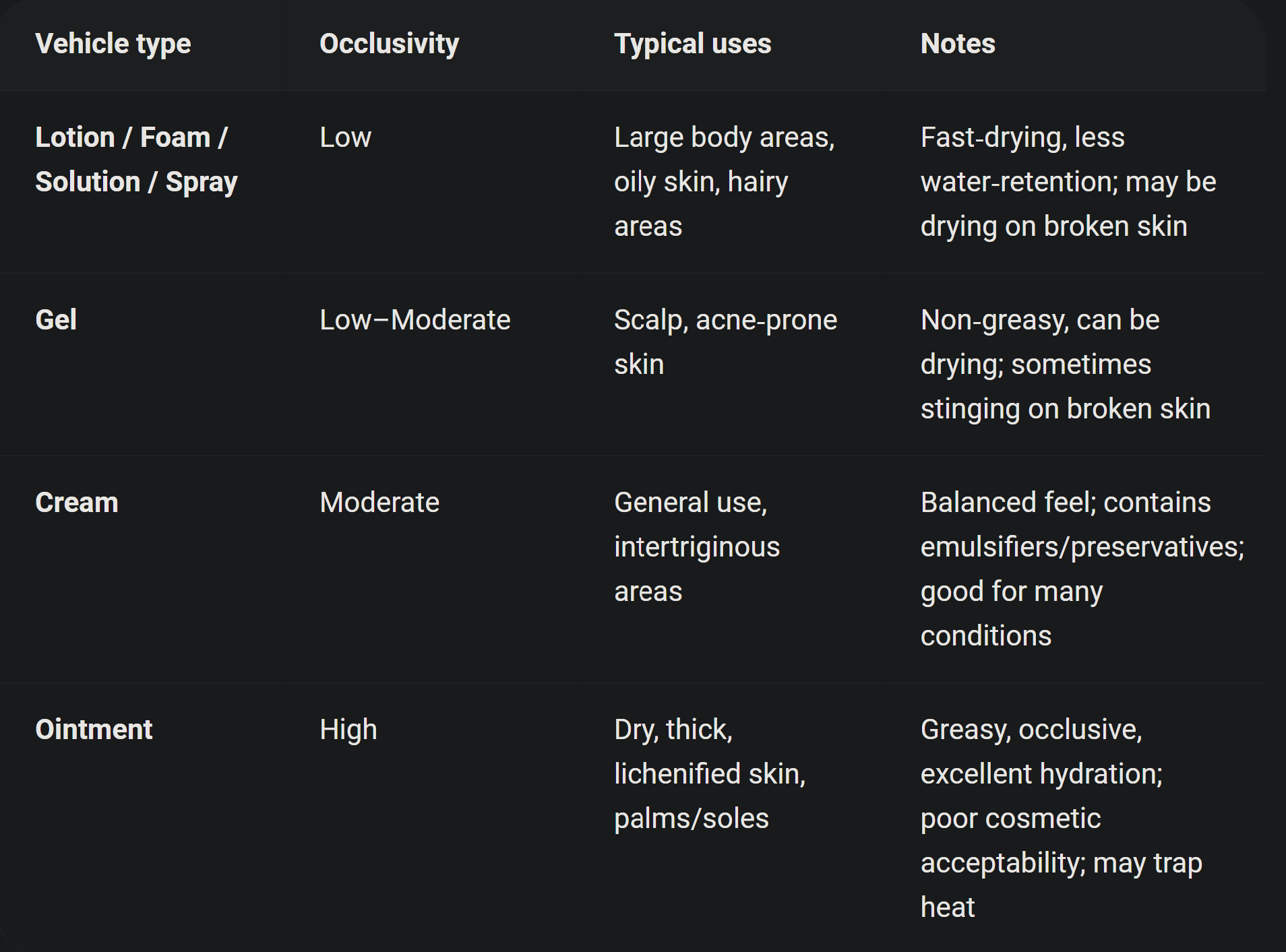
low vs high occlusive for chronic or acute conditions?
occlusive = chronic/dry (e.g., ointment)
less occlusive = acute/wet/oozing (e.g., lotion, solution/spray, foam)
Cream
An oil-in-water emulsion containing 20-80% water
moderately occlusive
for chronic + dry/scaly/lichenified skin
Gel
containing water-soluble polyethylene glycols, and may have an alcoholic solvent
pretty low occlusive
often used for oily/hairy areas
When do you not use high potency corticosteroids?
do not use on face, genitalia, axilla
Lotion
suspended
may be aqueous or alcoholic
low occlusive
for acute/wet/oozing conditions
Solution/Spray
A dissolved drug base
may be aqueous or alcoholic
low occlusive
Foam
aqueous or alcoholic
low occlusive
for hairy areas
most common local cutaneous reaction to topical medications and Tx?
irritation (nonallergic)
treated with petroleum jelly
cytotoxic damage to keratinocytes
causes: occupational, cosmetics, detergents, cleaning agents, exposure to water
Acute skin inflammation
Characterized by oozing, vesiculation, and crusting
treated with drying preparations like tinctures, wet dressings, lotions.
Chronic skin inflammation
Characterized by xerosis, scaling, lichenification
treated with lubricating preparations like creams and ointments.
Scalp and hairy areas treated with ___
treated with tinctures, lotions, gels, foams, and aerosols.
Fingertip unit
DIP to tip of finger
estimate how much topical corticosteroid the patient needs
~ 500 mg
Capsaicin (Salonpas® Hot)
OTC for neuropathic (post-herpetic neuralgia) and arthritic pain.
stimulates then desensitizes/degenerates cutaneous nociceptive neurons, depletes substances P (hurts first, quiets nerves later)
patch and cream
make take weeks to work
Lidocaine
OTC for arthritic pain and neuropathic pain
blocks voltage-gated sodium channels —> prevents depolarization —> blocks nerve impulse conduction
ointment, patch, viscous (for ENT)
localized response, avoid exposure to eyes
Diclofenac (Voltaren®)
OTC for knees and hand arthritis
reversibly inhibits COX 1 and 2 —> decrease prostaglandins
gel or patch
role of prostaglandins
increase blood vessel dilation and permeability during inflammation, lower pain threshold, fever, blood flow, increase or decrease blood clotting, protect stomach lining, support kidney function, reproductive functions
Menthol/Methyl Salicylate (Bengay, IcyHot, Salonpas)
for aches and pains of muscles and joints due to arthritis, bruises, simple backache, sprains, and strains
MOA: counterinteraction
foam, spray, cream, patch
localized reaction worse w/ heat
Topical corticosteroids absorption
Minimally absorbed when applied to normal skin
penetration increases in inflamed skin or with occlusion
Topical corticosteroids potency
Ranked based on potency from 1-7 with 1 being most potent and 7 least
clobetasol propionate is most potent
hydrocortisone is the least potent
Triamcinolone
topical corticosteroid; commonly prescribed the primary care; low to medium potency
Which topical corticosteroid is super-high potency (Group 1 and 2)
Clobetasol propionate
Least potent (Group 7)
Hydrocortisone (base or acetate)
Perioral dermatitis
A rash around the mouth that may occur with corticosteroid use
Hypertrichosis/hirsutism
Excessive hair growth associated with corticosteroid use
atopic dermatitis/eczema treatment
first line = topical corticosteroids! do not use on face and genitals unless low potency
Mild-to-moderate: Low-potency topical corticosteroid once daily x 2-4 weeks
Moderate to severe: Medium- to high-potency topical corticosteroid once to twice daily x 2-4 weeks
second line: anti-inflammatory PDE inhibitor (Crisabrole)
third line: topical calcineurin inhibitors (tacrolimus ointment and pimecrolimus cream)
fourth line: JAK kinase inhibitors (Ruxolitinib, oral tofacitnib, upadacitinib)
Crisaborole (Eucrisa®) nonsteroidal 2% ointment
2nd line Tx for mild-to-moderate atopic dermatitis
MOA: PDE inhibitor
good for genitals and face (where topical steroids cannot be used)
Tacrolimus ointment (Protopic®)
2nd or 3rd line Tx for atopic dermititis / eczema
topical calcineurin inhibitor
other is Pimecrolimus cream (Elidel®)
boxed warning
Pimecrolimus cream (Elidel®)
2nd or 3rd line Tx for atopic dermititis
topical calcineurin inhibitor
other is Tacrolimus ointment (Protopic®)
boxed warning
JAK kinase inhibitors
A class of medications that inhibit Janus kinase enzymes to reduce inflammation
4th line Tx for atopic dermatitis, also treat RA
Roxolitinib, tofacitnib, upadacitinib
boxed warnings for infections, malignancies, mortality, MACE, thrombosis
Ruxolitinib (Opzelura®)
A topical JAK kinase inhibitor used for atopic dermatitis.
boxed warnings for infections, malignancies, mortality, MACE, thrombosis
Tofacitinib (Xeljanz)
An oral JAK kinase inhibitor used for various inflammatory conditions.
boxed warnings for infections, malignancies, mortality, MACE, thrombosis
Upadacitinib (Rinvoq®)
An oral JAK kinase inhibitor used for inflammatory conditions.
boxed warnings for infections, malignancies, mortality, MACE, thrombosis
open vs closed comedones
open=blackheads
closed=whiteheads
both are noninflammatory acne
Treated with topical retinoids (promote cell turnover —> expulses open comedones and converts closed comedones into open)
Topical retinoids
1.Tretinoin: classic
2.Adapalene: less irritating
3.Tazarotene: most potent, CI pregnancy
class MOA: increase epidermal cell turnover —> expulsion of open comedones and closed comedones become open
Retinoic acid
A form of vitamin A / retinoic acid used for treating skin disorders
for hyperkeratonic and hyperproliferative skin disorders
Tretinoin
the “classic” topical retinoid effective
for acne vulgaris, photodamaged skin, fine lines and wrinkles
increases epidermal cell turnover —> expulsion of open comedones and closed comedones become open
SE: erythema, dryness, tumorigenic potential of UV radiation so use sunscreen
Adapalene (Differin®)
topical retinoid (increase cell turnover)
OTC for mild to moderate acne vulgaris
0.1% gel, cream, or lotion and Rx 0.3% gel
less irritating than Tretinoin
can use with benzoyl peroxide
Benzoyl Peroxide
antimicrobial against Cutibacterium acnes
peeling and comedolytic effect
start with 2.5% then increase
synergizes w/ topical antibiotics and topical retinoids
for papulopustular acne: topical retinoid + benzoyl peroxide
bleaches your towels and pillowcases
cousin to salicylic acid
benzoyl peroxide often combined with ___
topical antibiotics or topical retinoic acid such as Adapalene
(combine with retinoic acid for papulopustular acne)
synergistic effect
Treatment for papulopustular inflammatory acne
topical retinoid + benzoyl peroxide
Spironolactone
Antiandrogen oral agent used to treat acne
often combined w/ oral contraceptives
possible teratogen
Antibiotics for acne
oral: minocycline, doxycycline, sarecycline
topical: clindamycin, erythromycin, minocycline
Clascoterone
Androgen receptor inhibitor used to treat acne
Dapsone (Aczone)
topical agent for acne treatment
Salicylic acid
Topical agent used to treat acne
sometimes in soaps
skin turnover, similar to benzoyl peroxide
Isotretinoin (Accutane®)
synthetic retinoid taken orally
for scarring acne, treatment-refractory inflammatory/cystic acne, or severe nodular acne
MOA: inhibit size and fxn of sebaceous glands
titrate upward until cumulative dose is reached
20 weeks
CI in pregnancy (teratogenic) or within 1 month before or after
SE: depression, IBD
REMS/iPLEDGE: contraception, lipid and liver enzyme monitoring
iPLEDGE REMS requirements
Risk Evaluation and Mitigation Strategy for isotretinoin (Accutane)
pharmacy, prescriber, and patients must enroll
must use contraception, monitor lipids and liver enzymes
Azelaic Acid (Azelex®) (Finacea®, Finacea Foam®) for both acne vulgaris and rosacea
acne vulgaris = Azelex®
acne rosacea = Finacea®, Finacea Foam®
MOA: antimicrobial against C. acnes AND inhibits testosterone conversion to dihydrotestosterone
SE: mild irritaiton, redness, dryness
improvement in 6-8 wks
Metronidazole 0.75-1% gel/cream (MetroGel, MetroCream)
Topical for papules/pustules and moderate/severe rosacea
MOA: inhibits Demodrex brevis (a parasite) and antiinflammatory
CI: Pregnant women, Nursing mothers, Children
Ivermectin 1% cream and Metronidazole 0.75% gel/cream
for inflammatory papules/pustules or severe rosacea
MOA: antiparasitic against Demodex, antiinflammatory
Oxymetazoline 1% cream and Brimonidine 0.33% gel
alpha agonists for rosacea with erythema
Oral Antibiotics for Rosacea
1. Tetracyclines (Doxycycline, Tetracycline, Minocycline)
2. Macrolides (clirithromycin, azithromycin, erythromycin)
3. Metronidazole
acne vs rosacea
rosacea: spares back, face/cheeks/nose/chin, usually >30y/o, ocular involvement, sensitive skin, flushing
acne: shoulder/chest/back, open & closed ***comedones***, hyperandrogenic disorders
both: inflamed papules and pustules
Azelaic acid is a good choice for both
Tazarotene
most potent topical retinoid (increase cell turnover)
for mild to moderately severe facial acne
gel, cream, foam
CI: pregnancy
Tacrolimus ointment (Protopic) and Pimecrolimus cream (Elidel)
2nd line Tx for atopic dermititis - nonsteroidal
topical calcineurin inhibitor
boxed warning
other 2nd line Tx is Crisaborole (Eucrisa) or JAK kinase inhibitors (Ruxolitinib, tofacitinib, upadacitinib)