4 - Acid Base Disorders
 Call Kai
 Learn
 Practice Test
 Spaced Repetition
 Match
 Flashcards
 Knowt Play
1/85

Earn XP
Description and Tags
4 Questions
86 Terms
Acid base balance?
Important for normal body processes and how medications work
Why it matters → affects body functions and medication pharmacokinetics (PK) and pharmacodynamics (PD)
Who is affected by acid-base imbalances?
ICU/emergency patients
Chronic kidney disease patients
Pulmonary disease patients
Overdose/toxicology patients
What is normal blood pH?
7.35-7.45
Very tightly regulated to keep the body in balance
Alkalosis?
Increasing pH
>7.45
Acidosis?
Decreasing pH
<7.35
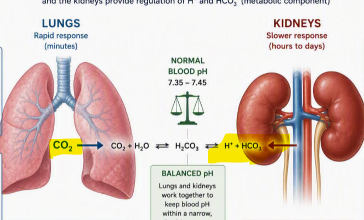
Acid-base homeostasis ?
How the body keeps blood pH balanced
Lungs → provide rapid regulation of CO2 → respiratory component
Kidneys → provide regulation of H+ and HCO3- → metabolic component
Work together to keep blood pH within a narrow healthy range
How quickly do the lungs compensate for acid-base imbalances?
Rapidly → within minutes
By changing ventilation to regulate CO2 and blood pH
How do the lungs compensate for acidosis (low pH)?
Increase ventilation → exhale more CO2 → increase pH
How do the lungs compensate for alkalosis (high pH)?
Decrease ventilation → retain more CO2 → decrease pH
How quickly do the kidneys compensate for acid-base imbalances?
Slowly → over hours to days
By adjusting H+ and HCO3- handling
How do the kidneys compensate for acidosis (low pH)?
Secrete more H+ into urine + reabsorb/generate HCO3- → increase blood pH
How do the kidneys compensate for alkalosis (high pH)?
Secrete less H+ and excrete more HCO3- in urine → decrease blood pH
Bicarbonate buffer system ?
A chemical system that helps keep blood pH stable by balancing acid (H+) and base (HCO3-)
CO₂ + H₂O ⇌ H₂CO₃ ⇌ H⁺ + HCO₃⁻
What is the bicarbonate buffer equation?
CO₂ + H₂O ⇌ H₂CO₃ ⇌ H⁺ + HCO₃⁻
More CO₂ → shifts right → more H⁺ → more acidic
Less CO₂ → shifts left → less H⁺ → less acidic
What does Base Excess (BE) measure?
The metabolic component of acid–base balance
Metabolic problem → HCO₃⁻ or acid problem. The body has too much acid or too little base, or too much base or too little acid.
What does a negative Base Excess (BE) indicate?
Base deficit → metabolic acidosis
HCO₃⁻ is reduced
< -2 mEq/L
What is the normal Base Excess (BE) range?
−2 to +2 mEq/L
No significant metabolic disturbance
What does a positive Base Excess (BE) indicate?
Base excess → metabolic alkalosis
>2+ mEq / L
ABG vs VBG for base excess?
ABG → Gold standard, reflects systemic arterial status
VBG → useful for rapid assessment / trending
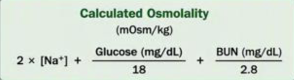
Osmolar gap?
Measured serum osmolality − calculated osmolality
The difference between measured and calculated blood osmolality
A high gap can indicate extra particles in the blood, such as toxic alcohols, that aren't included in the calculation
Measured osmolality includes → Na⁺, glucose, BUN, ethanol, and other osmotically active substances (e.g., toxins)
Examples of osmotically active substances?
Alcohols → ethanol, propylene glycol, methanol, ethylene glycol
Sugars → mannitol
Lipids → Hypertriglyceridemia
Lung acid base disturbance?
Respiratory acidosis → too much CO2
Respiratory alkalosis → too little CO2
Kidney acid base disturbance?
Metabolic acidosis → Too much acid or too little HCO3-
Metabolic alkalosis → Too much HCO3- or too little acid
How does CO2 and water equilibrium affect blood pH?
CO₂ + H₂O ⇌ H₂CO₃ ⇌ H⁺ + HCO₃⁻
More CO2 exhaled → less CO2 retained → less H⁺ → pH rises
Less CO2 exhaled → more CO2 retained → more H⁺ → pH falls
Respiratory acidosis?
pH → <7.35
pCO2 → >45mmHg
Metabolic compensation for respiratory acidosis?
An increase in HCO3-
Medication causes for respiratory acidosis?
Meds that cause respiratory suppression
Opioids
Benzodiazepines
Alcohol
Other respiratory depressant medications taken in excess
Non-medication causes for respiratory acidosis?
Change in mental status
Trauma
Stroke
Thoracic cage injury
Symptoms of respiratory acidosis?
Dyspnea
Confusion
Psychosis
Headache
Anxiety
Seizures in more severe cases
What conditions can cause chronic respiratory acidosis?
Asthma
Chronic Obstructive pulmonary disease (COPD)
Neuromuscular disorders → myasthenia gravis, multiple sclerosis
Symptoms of chronic respiratory acidosis?
Tremor
Gait disturbances
Somnolence
Memory loss
Hyperventilation vs Tachypnea ?
Hyperventilation → Fast and deep breathing → excess CO2 loss → respiratory alkalosis
Tachypnea → Fast, shallow breathing → does not always cause CO2 loss/alkalosis
Respiratory alkalosis?
pH → >7.45
pCO2 → <38 mmHg
Metabolic compensation for respiratory alkalosis?
Decrease in HCO3-
Examples of causes of hypoxic respiratory alkalosis?
Pneumonia
Pulmonary embolism
Heart failure
Examples of causes of NON-hypoxic respiratory alkalosis?
Pain
Anxiety
Fever
Metabolic alkalosis?
pH → >7.45
HCO3- → >26mmol/L
Respiratory compensation for metabolic alkalosis?
Increase pCO2
What causes chloride-responsive metabolic alkalosis?
GI disorders → gastric acid loss
Excessive bicarbonate therapy
Diuretic therapy
How do carbonic anhydrase inhibitors (CAIs), like acetazolamide, treat metabolic alkalosis?
Increase HCO3- excretion in urine → lower blood bicarbonate and pH toward normal
How do loop diuretics and thiazides cause metabolic alkalosis?
Loop diuretics → Increase Na, K, and Cl loss
Thiazides → Block Na reabsorption
Both cause fluid and Cl loss → kidneys secrete more H⁺ and retain HCO₃⁻ → blood pH increases !!!
What causes chloride-resistant / potassium responsive metabolic alkalosis?
Excessive aldosterone activity
Magnesium deficiency
Corticosteroid therapy
Excessive black licorice intake
What other things can cause metabolic alkalosis?
Hypokalemia
Milk alkali syndrome
Metabolic acidosis?
pH → <7.35
HCO3- → <22mmol/L
Respiratory compensation for metabolic acidosis?
Decreases in CO2
What causes hyperchloremic metabolic acidosis (non-anion gap)?
GI bicarbonate losses
Medications
Renal tubular acidosis
Sodium chloride overdose
Anion gap?
Unmeasured anions (negatively charged substances) in the blood that can indicate extra acid buildup
The anion gap helps you figure out why someone has metabolic acidosis
Formula →[ Na - (Cl + HCO3-) ]
Anion gap formula?
Na - (Cl + HCO3-)
Measured cations → Na+
Measured anions → Cl + HCO3-
Normal anion gap?
8-12 mEq/L
High anion gap?
>12 mEq/L
Caused by →
Lactic acidosis
Ketoacidosis
Renal failure / uremia
Toxins → methanol, ethylene glycol, salicylates
Low anion gap?
< 8 mEq/L
Caused by →
Hypoalbuminemia
Lab error
Increased in unmeasured cations → Mg, Ca
What drives the anion gap?
Unmeasured anions
High gap → Extra acids build up
Normal gap → HCO₃⁻ loss is replaced by Cl⁻
What does MUDPILES stand for (causes of high anion gap metabolic acidosis)?
M – Methanol
U – Uremia
D – Diabetic ketoacidosis
P – Propylene glycol
I – Isoniazid or iron
L – Lactic acidosis
E – Ethylene glycol
S – Salicylates
“M” in MUDPILES?
Methanol
“U” in MUDPILES?
Uremia
“D” in MUDPILES?
Diabetic ketoacidosis
“P” in MUDPILES?
Propylene glycol
“I” in MUDPILES?
Isoniazid or possibly iron tablets
“L” in MUDPILES?
Lactic acidosis
“E” in MUDPILES?
Ethylene glycol
“S” in MUDPILES?
Salicylates
What does GOLD MARK stand for (causes of high anion gap metabolic acidosis)?
G – Glycols
O – Oxoproline
L – L-lactate
D – D-lactate
M – Methanol
A – Aspirin (salicylates)
R – Renal failure
K – Ketoacidosis
“G” in GOLDMARK?
Glycols
“O” in GOLDMARK?
Oxoproline
“L” in GOLDMARK?
L-Lactate
“D” in GOLDMARK?
D-Lactacte
“M” in GOLDMARK?
Methanol
“A” in GOLDMARK?
Aspirin
“R” in GOLDMARK?
Renal failure
“K” in GOLDMARK?
Ketoacidosis
Treatment for diabetic ketoacidosis?
Insulin → promotes glucose utilization by cells and suppresses ketogenesis
Fluids
Goal of treatment for diabetic ketoacidosis?
Close anion gap
Return pH to normal
Reduce beta-hydroxybutyrate
Treatment of toxic alcohols?
Fomepizole inhibits alcohol dehydrogenase (ADH) → preventing toxic metabolitesfrom forming from methanol and ethylene glycol
This helps prevent high anion gap metabolic acidosis and organ damage.
Toxic alcohols → methanol, ethylene glycol
When do we use fomepizole?
Suspected methanol or ethylene glycol exposure
Signs of toxicity
Serum concentration >20 mg/dL of either toxic alcohol
Loading dose of Fomepizole?
15 mg/kg followed by maintenance dose in 12 hours
Maintenance dose of Fomepizole?
10 mg/kg every 12 hours for 4 doses
After that → if level still elevated resume maintenance dose at 15 mg/kg every 12 hours until less than 20 mg/dL, asymptomatic with normal pH
What if dialysis is needed with fomepizole?
Dosing should be increased to every 4 hours for fomepizole
Adjunct treatment with fomepizole for methanol toxicity?
Folic acid 50 mg IV every 4 hours
Continue until methanol < 20mg/dL
Used to promote metabolism of formic acid to formate
Adjunct treatment with fomepizole for ethylene glycol toxicity?
Thiamine 100 mg IV daily
Pyridoxine 50 mg IV q6h
Used to decrease metabolism to oxalate crystals
What can cause Salicylate toxicity?
Aspirin
Bismuth subsalicylate → Pepto-bismol
Methyl salicylate → oil of wintergreen
Mild salicylate toxicity?
Nausea
Vomiting
Diaphoresis
Tinnitus
Early phase salicylate toxicity?
Hyperventilation
Respiratory alkalosis
Middle phase salicylate toxicity?
Impaired kidney function
Uncoupling of oxidative phosphorylation
Lactic acidosis
Late phase salicylate toxicity?
Respiratory depression
Increased renal excretion of bicarbonate
Hypokalemia
Hypotension
Cardiac arrhythmias
Seizures
Treatment for Salicylate toxicity?
Sodium bicarbonate (NaHCO3) → 1-2 mEq/kg IV push
Followed by infusion NaHCO3 → 150 mEq in 1 L of D5W at 250 mL/hr
Goal of Salicylate toxicity?
Increase serum pH to 7 - 7.5
Achieve alkalization of urine to pH >7.5