3.1.4. Identifies abnormal colour vision and appreciates its significance
 Call Kai
 Learn
 Practice Test
 Spaced Repetition
 Match
 Flashcards
 Knowt Play
1/13

There's no tags or description
Looks like no tags are added yet.
14 Terms
Reasons for assessing colour vision
Careers: Police, armed forces, pilots and electrical engineers.
Educational: Primary school colour-coded teaching, chemistry, geography and history.
Safety: Traffic lights, electrical wiring and electronic PCBs.
Pathology: Changes in colour vision can be a sign of potential pathology.
What are the key features of congenital colour vision deficiencies?
Recessive X-chromosome-linked trait.
Occurs in 1:12 males and 1:250 females.
Carrier: Mother carries the defective gene but usually has normal colour vision.
Most common type: Deuteranomaly (5% of all males).
Assessment: All first-time males should have a colour vision assessment as part of their eye examination, especially young boys.
How are congenital colour vision deficiencies classified?
Trichromacy: All cones and pigments are present and functioning.
Protanomaly: Abnormal long-wavelength pigment.
Deuteranomaly: Abnormal medium-wavelength pigment.
Tritanomaly: Abnormal short-wavelength pigment.
Dichromacy: Two cone pigments are present.
Protanope: Long-wavelength pigment missing.
Deuteranope: Medium-wavelength pigment missing.
Tritanope: Short-wavelength pigment missing.
Monochromacy: No cones at all or only one single functioning cone.
Key features of acquired colour vision deficiencies
Secondary feature of pathology, which can be ocular or systemic.
Certain drugs may produce colour vision defects, e.g. chloroquine.
Defects often fluctuate in severity.
Can be associated with loss of visual acuity (VA) + VF defects.
Monocular differences: Frequently occur.
Characteristics of acquired colour vision defects?
3 types of defects.
Acquired colour defects often show a combination of characteristics associated with more than one type.
Can be both dichromatic and anomalous trichromatic.
Blue pathway: Particularly vulnerable to acquired defects (retinal lesion), therefore type III defects are common.
Red-green defects: Common with optic nerve (ON) defects.
Types of CV deficiency
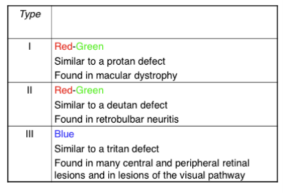
What are the key features of the Ishihara Colour Vision Test?
Standard test: 38-plate version; 24-plate version is mainly found in practice (14 screening plates, 2 classification plates and pathway plates).
Purpose: Does not grade severity; results are either PASS or FAIL.
Number of plates misidentified does not indicate severity or deficiency.
No tritan-detecting ability.
What are the different types of Ishihara plates and their purposes?
Screening plates: Used to detect a defect.
Classification plates: Indicate the type of defect.
Pathway plates: Used for people who are non-verbal or non-numerate.
What are the pass/fail criteria for the Ishihara test?
38-plate version:
3 mistakes only = PASS.
8 mistakes or more = FAIL.
24-plate version: 2 mistakes only = PASS.
What are the testing conditions for the Ishihara test?
Viewing time: Maximum 4 seconds per plate.
Viewing distance: 75 cm.
Illumination: At least 250 lux; daylight is best and fluorescent lighting is acceptable.
Tungsten lighting: Must not be used as it produces a red bias and may allow patients with subtle red defects to pass.
What are the key features of the City University Test?
Derived from the Farnsworth D-15 test and presented in a book format.
5 coloured targets per page, subtending 1.5 degrees at a test distance of 35 cm.
Three represent the average isochromatic confusions of protanopes, deuteranopes and tritanopes.
The remaining colour is the most similar to the central colour.
What are the key features and procedure of the D-15 test?
Arrangement test with a viewing distance of 50 cm.
Patient places 15 coloured caps in sequence.
Clinician plots the pilot cap first, then the patient positions the others.
Can classify protan, deutan and tritan defects and grade the severity.
Order of caps is revealed by the numbers on the reverse side.
What is the aim of the D-15 test and how are patients classified?
Aim: Divide patients into two groups:
Normal or slight colour defect.
Moderate or severe colour defect.
Allows people with slight defects to work with colours when safety is not an issue.

What are the key features of the 100 Hue Test?
Mainly used in HES
Uses 85 coloured buttons.
Some computerised versions are available with software analysis of results.
Results are obtained in the form of a score and a polar diagram.