Biomes: Forests, Adaptations & Migration

0.0(0)
Studied by 0 people
call kaiCall Kai
learnLearn
examPractice Test
spaced repetitionSpaced Repetition
heart puzzleMatch
flashcardsFlashcards
GameKnowt Play
Card Sorting

1/86

encourage image

There's no tags or description

Looks like no tags are added yet.

Last updated 2:21 AM on 10/19/26
Name
Mastery
Learn
Test
Matching
Spaced
Call with Kai
Chat

No analytics yet

Send a link to your students to track their progress

87 Terms

1
New cards

Biome

Large area on earth (determined by latitude) that has similar climate as well as plants and animals (community) with similar features to help them survive (adaptations).

<p>Large area on earth (determined by latitude) that has similar climate as well as plants and animals (community) with similar features to help them survive (adaptations).</p>
2
New cards

Climate

long-term weather system found in an area over time; influenced by 5 factors: latitude, temperature, precipitation, topography, and elevation

<p>long-term weather system found in an area over time; influenced by 5 factors: latitude, temperature, precipitation, topography, and elevation</p>
3
New cards

Weather

"Right-now" atmospheric conditions: temperature, air pressure, wind speed, precipitation

4
New cards

Ecosystem

All the biotic and abiotic factors in a specific area

<p>All the biotic and abiotic factors in a specific area</p>
5
New cards

Adaptations

Physical or behavioral characteristics of plants and animals that help them survive in their own environment

<p>Physical or behavioral characteristics of plants and animals that help them survive in their own environment</p>
6
New cards

Marine Biome

Habitats that exist in saltwater; examples include oceans, estuaries, coral Reefs. Found in many regions of the Earth. Animals have adaptations that allow them to survive without limbs in salty water.

<p>Habitats that exist in saltwater; examples include oceans, estuaries, coral Reefs. Found in many regions of the Earth. Animals have adaptations that allow them to survive without limbs in salty water.</p>
7
New cards

Freshwater biome

Habitats that exist in water with no salinity (no salt); Found in many regions of the Earth. Has plants that can float to surface to get sunlight. Animals may have adaptations to swim in shallow water or to survive in cold water temperatures (layers of fat).

<p>Habitats that exist in water with no salinity (no salt); Found in many regions of the Earth. Has plants that can float to surface to get sunlight. Animals may have adaptations to swim in shallow water or to survive in cold water temperatures (layers of fat).</p>
8
New cards

Tundra

Cold, dry biome located near poles (between about 60-90 degrees latitude). Receives little precipitation. Has white animals and plants with short roots. Has permafrost.

<p>Cold, dry biome located near poles (between about 60-90 degrees latitude). Receives little precipitation. Has white animals and plants with short roots. Has permafrost.</p>
9
New cards

Taiga

Also called coniferous forest or boreal forest. Located only in northern hemisphere. Located roughly between 50-60 north latitude. Characterized by temperate climate. Has forests with many evergreen trees, lots of rainfall (50-100cm annually). Generally temperate, with short summers.

<p>Also called coniferous forest or boreal forest. Located only in northern hemisphere. Located roughly between 50-60 north latitude. Characterized by temperate climate. Has forests with many evergreen trees, lots of rainfall (50-100cm annually). Generally temperate, with short summers.</p>
10
New cards

Grasslands (Savannah)

Characterized by the growth of many species of long grasses. Can be tropical (hot all year- located closer to the equator) or temperate (has seasons). Temperate grasslands receive between 50-90cm precipitation (both rain and snow). All grasslands have a rainy season followed by a long dry season. Many grasslands have extreme temperatures in both winter and in summer. Fires commonly caused by lightning drives ecological succession.

<p>Characterized by the growth of many species of long grasses. Can be tropical (hot all year- located closer to the equator) or temperate (has seasons). Temperate grasslands receive between 50-90cm precipitation (both rain and snow). All grasslands have a rainy season followed by a long dry season. Many grasslands have extreme temperatures in both winter and in summer. Fires commonly caused by lightning drives ecological succession.</p>
11
New cards

Tropical Rainforest

Biome located between the Tropics of Capricorn and Cancer (between the equator and 22.5 degrees north and south latitude). Characterized by a hot, humid climate with up to 200cm rainfall annually.

<p>Biome located between the Tropics of Capricorn and Cancer (between the equator and 22.5 degrees north and south latitude). Characterized by a hot, humid climate with up to 200cm rainfall annually.</p>
12
New cards

Temperate Deciduous Forest

Georgia's Biome. Characterized by 4 seasons, lots of biodiversity, and trees with leaves that fall off in the autumn before growing back in the springtime. Receives between 75-150cm precipitation annually.

<p>Georgia's Biome. Characterized by 4 seasons, lots of biodiversity, and trees with leaves that fall off in the autumn before growing back in the springtime. Receives between 75-150cm precipitation annually.</p>
13
New cards

Desert

Biome with hot, arid (dry) climate. Plants and animals have specialized features to help them store water. Animals have special behaviors to help them survive extreme temperatures.

<p>Biome with hot, arid (dry) climate. Plants and animals have specialized features to help them store water. Animals have special behaviors to help them survive extreme temperatures.</p>
14
New cards

system

Connected parts that work together

<p>Connected parts that work together</p>
15
New cards

Latitude

Measure of how far north or south of the equator a location is

<p>Measure of how far north or south of the equator a location is</p>
16
New cards

Temperature

Measure of how hot or cold the air temperature is. In science, this is measured in Celsius.

17
New cards

Precipitation

Water vapor that falls as rain, snow, sleet, hail, or fog.

<p>Water vapor that falls as rain, snow, sleet, hail, or fog.</p>
18
New cards

Topography

Land features that affect air currents (affecting weather and climate). Examples are canyons and mountains.

<p>Land features that affect air currents (affecting weather and climate). Examples are canyons and mountains.</p>
19
New cards

Elevation

How far above or below sea level a location is. Temperature is colder at higher elevations because there are fewer air molecules to hold the sun's heat energy.

<p>How far above or below sea level a location is. Temperature is colder at higher elevations because there are fewer air molecules to hold the sun's heat energy.</p>
20
New cards

Camouflage

Physical adaptation that helps a plant or animal survive by disguising it to blend in with its surroundings
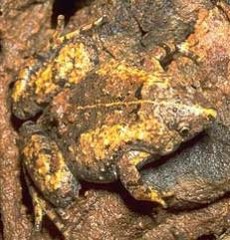
<p>Physical adaptation that helps a plant or animal survive by disguising it to blend in with its surroundings</p>
21
New cards

Migration

Behavioral adaptation that helps animals survive by driving them to temporarily relocate their homes to a warmer climate where more resources will be available to them
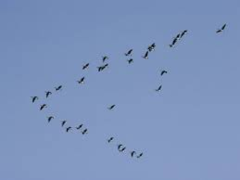
<p>Behavioral adaptation that helps animals survive by driving them to temporarily relocate their homes to a warmer climate where more resources will be available to them</p>
22
New cards

Hibernation

Behavioral adaptation that helps animals survive by driving their bodies to store energy for long periods of time so they can be protected from weather during winter months.
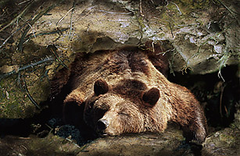
<p>Behavioral adaptation that helps animals survive by driving their bodies to store energy for long periods of time so they can be protected from weather during winter months.</p>
23
New cards

Large ears

Physical adaptation commonly found in desert animals that helps them release body heat to stay cooler

<p>Physical adaptation commonly found in desert animals that helps them release body heat to stay cooler</p>
24
New cards

Herding

Behavioral adaptation that helps grassland animals survive by protecting animals in the middle

<p>Behavioral adaptation that helps grassland animals survive by protecting animals in the middle</p>
25
New cards

V-formation Flight

Behavioral adaptation that helps birds conserve energy in flight

<p>Behavioral adaptation that helps birds conserve energy in flight</p>
26
New cards

Streamlined Body

Physical adaptation in many fish and particularly dolphins that allows them to swim further faster by making them more aerodynamic

<p>Physical adaptation in many fish and particularly dolphins that allows them to swim further faster by making them more aerodynamic</p>
27
New cards

White fur

Physical adpatation of many tundra animals to help them blend in with icy surroundings and absorb as much of the sun's heat as they can.

<p>Physical adpatation of many tundra animals to help them blend in with icy surroundings and absorb as much of the sun's heat as they can.</p>
28
New cards

temperate

has 4 seasons; the biomes are located at mid-latitudes

29
New cards

tropical

hot; located near the equator; these biomes are located between 0-23 degrees latitude north and/or south

30
New cards

arctic

cold; located near the poles; these biomes are located above 60 degrees latitude

31
New cards

Biome

A large region characterized by a specific type of climate and certain types of plant and animal communities.

<p>A large region characterized by a specific type of climate and certain types of plant and animal communities.</p>
32
New cards

Savanna

A tropical / subtropical grassland biome with scattered individual trees, large herbivores, and three distinct seasons based primarily on rainfall, maintained by occasional fires and drought.

<p>A tropical / subtropical grassland biome with scattered individual trees, large herbivores, and three distinct seasons based primarily on rainfall, maintained by occasional fires and drought.</p>
33
New cards

Desert

A region of little vegetation, either cold or hot, that receives ten inches or less of precipitation each year, long periods without rain, deserts have extreme temperatures.

<p>A region of little vegetation, either cold or hot, that receives ten inches or less of precipitation each year, long periods without rain, deserts have extreme temperatures.</p>
34
New cards

Tundra

Biome that surrounds the north and south poles; treeless landscape with short, cool summers, and long, very cold winters with short periods of winter sunlight, beneath the topsoil is a layer of permafrost.

<p>Biome that surrounds the north and south poles; treeless landscape with short, cool summers, and long, very cold winters with short periods of winter sunlight, beneath the topsoil is a layer of permafrost.</p>
35
New cards

Temperate Deciduous Forest

Characterized by warm summers, cool winters, has all four seasons, year-round precipitation and fertile soil.

<p>Characterized by warm summers, cool winters, has all four seasons, year-round precipitation and fertile soil.</p>
36
New cards

Conifer

Cone-bearing trees (ie: pine, or fir tree) of middle and high latitudes that are mostly evergreen and that have needle-shaped or scale like leaves. Conifers are able to withstand the long, cold winter season.

<p>Cone-bearing trees (ie: pine, or fir tree) of middle and high latitudes that are mostly evergreen and that have needle-shaped or scale like leaves. Conifers are able to withstand the long, cold winter season.</p>
37
New cards

Coniferous Forest

Forest populated by cone-bearing evergreen trees; mostly found in the colder northern latitudes.

<p>Forest populated by cone-bearing evergreen trees; mostly found in the colder northern latitudes.</p>
38
New cards

Flora

All the plant life in a particular region, or period.

<p>All the plant life in a particular region, or period.</p>
39
New cards

Fauna

All of the animal life in a particular region, or period.

<p>All of the animal life in a particular region, or period.</p>
40
New cards

Steppe

A climate with partly dry grassland often found on the edges of a desert. It receives less than 20 inches of rain per year.

<p>A climate with partly dry grassland often found on the edges of a desert. It receives less than 20 inches of rain per year.</p>
41
New cards

Prarie

A large area of flat land, or rolling hills covered by grasses and wild flowers but few trees.

<p>A large area of flat land, or rolling hills covered by grasses and wild flowers but few trees.</p>
42
New cards

Temperate

Climate zones with moderate (warm) temperatures that are located between the tropics and the polar zones.
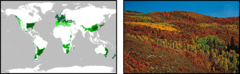
<p>Climate zones with moderate (warm) temperatures that are located between the tropics and the polar zones.</p>
43
New cards

Permafrost

A layer of permanently frozen subsoil found in the tundra

<p>A layer of permanently frozen subsoil found in the tundra</p>
44
New cards

Plankton

A general term for the tiny, free-floating or weakly swimming organisms that live in both freshwater and saltwater environments.

<p>A general term for the tiny, free-floating or weakly swimming organisms that live in both freshwater and saltwater environments.</p>
45
New cards

Estuary

An area where fresh water from a river mixes with salt water from an ocean; are productive ecosystems because they constantly recieve fresh nutrients from the river and the ocean.

<p>An area where fresh water from a river mixes with salt water from an ocean; are productive ecosystems because they constantly recieve fresh nutrients from the river and the ocean.</p>
46
New cards

Forest

Large tree and plant filled area that covers 30% of Earth's land surface. Provide habitats, maintain soil, air, and water quality, acts as a carbon sink in biogeochemical cycle.

<p>Large tree and plant filled area that covers 30% of Earth's land surface. Provide habitats, maintain soil, air, and water quality, acts as a carbon sink in biogeochemical cycle.</p>
47
New cards

Coral Reef

A structure of calcite skeletons built up by coral animals in warm, shallow ocean water.

<p>A structure of calcite skeletons built up by coral animals in warm, shallow ocean water.</p>
48
New cards

Wetland

An ecosystem in which water either covers the soil or is present at or near the surface of the soil for at least part of the year.

<p>An ecosystem in which water either covers the soil or is present at or near the surface of the soil for at least part of the year.</p>
49
New cards

Marsh

A type of wetland featuring grasses, reeds and other plants in shallow water.

<p>A type of wetland featuring grasses, reeds and other plants in shallow water.</p>
50
New cards

Tributary

A stream or river that flows into a larger river.

<p>A stream or river that flows into a larger river.</p>
51
New cards

Freshwater

Aquatic ecosytem that does not contain any saltwater, can be rivers, lakes, streams,ponds, and wetlands.
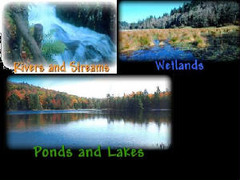
<p>Aquatic ecosytem that does not contain any saltwater, can be rivers, lakes, streams,ponds, and wetlands.</p>
52
New cards

Brackish Water

More salty than fresh water, and less salty than marine saltwater. It is found in estuaries where freshwater and saltwater mix.

<p>More salty than fresh water, and less salty than marine saltwater. It is found in estuaries where freshwater and saltwater mix.</p>
53
New cards

Organism

Individual living thing.

<p>Individual living thing.</p>
54
New cards

Species

A group of organisms that are closely related, who can mate to produce fertile offspring. All of the cats are feline, but each cat is a different species.

<p>A group of organisms that are closely related, who can mate to produce fertile offspring. All of the cats are feline, but each cat is a different species.</p>
55
New cards

Biodiversity

The number, and variety of living organisms in a given area, during a specific period of time.

<p>The number, and variety of living organisms in a given area, during a specific period of time.</p>
56
New cards

Ecosystem

A system formed by the interaction of a community of organisms with their physical environment.

<p>A system formed by the interaction of a community of organisms with their physical environment.</p>
57
New cards

Habitat

Place where an organism lives.

<p>Place where an organism lives.</p>
58
New cards

Niche

An organism's particular role in an ecosystem, or how it makes its living.

<p>An organism's particular role in an ecosystem, or how it makes its living.</p>
59
New cards

Abiotic

All of the non-living parts of an ecosystem.

<p>All of the non-living parts of an ecosystem.</p>
60
New cards

Biotic

All of the living parts of an ecosystem.

<p>All of the living parts of an ecosystem.</p>
61
New cards

Herbivore

A consumer that eats only plants.

<p>A consumer that eats only plants.</p>
62
New cards

Carnivore

An animal that eats other animals

A consumer that eats only animals.

<p>An animal that eats other animals</p><p>A consumer that eats only animals.</p>
63
New cards

Omnivore

A consumer that eats both plants and animals.
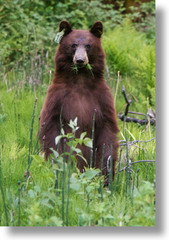
<p>A consumer that eats both plants and animals.</p>
64
New cards

Producer

An organism that can make its own food.

<p>An organism that can make its own food.</p>
65
New cards

Consumer

An organism that obtains energy by feeding on other organisms.

<p>An organism that obtains energy by feeding on other organisms.</p>
66
New cards

Autotroph

An organism that makes its own food.

<p>An organism that makes its own food.</p>
67
New cards

Heterotroph

An organism that cannot make its own food, it gets food by consuming other living things, or their by-products.

<p>An organism that cannot make its own food, it gets food by consuming other living things, or their by-products.</p>
68
New cards

Taiga

A biome in which the winters are cold, but summers are mild enough to allow the ground to thaw, it contains mostly coniferous forests.

<p>A biome in which the winters are cold, but summers are mild enough to allow the ground to thaw, it contains mostly coniferous forests.</p>
69
New cards

Prey

An organism that is hunted, killed and eaten by another organism.

<p>An organism that is hunted, killed and eaten by another organism.</p>
70
New cards

Predator

An animal that hunts, and kills other animals for food.

<p>An animal that hunts, and kills other animals for food.</p>
71
New cards

Population

A group of individuals that belong to the same species and live in the same area.

<p>A group of individuals that belong to the same species and live in the same area.</p>
72
New cards

Community

A group of interdependent organisms inhabiting the same region and interacting with each other.

<p>A group of interdependent organisms inhabiting the same region and interacting with each other.</p>
73
New cards

Limiting Factor

A biotic or abiotic factor that restricts the number, distribution, or reproduction of a population within a community.

<p>A biotic or abiotic factor that restricts the number, distribution, or reproduction of a population within a community.</p>
74
New cards

Predation

An interaction in which one organism captures and feeds on another organism to gain energy.

<p>An interaction in which one organism captures and feeds on another organism to gain energy.</p>
75
New cards

Competition

Ecological relationship in which organisms compete for available resources. There are 2 types: between organisms within a population, and between different populations.

<p>Ecological relationship in which organisms compete for available resources. There are 2 types: between organisms within a population, and between different populations.</p>
76
New cards

Co-evolution

Relationship in which 2 organisms change or adapt together over time.

<p>Relationship in which 2 organisms change or adapt together over time.</p>
77
New cards

Cooperation

Relationship in which behavior by two or more individuals leads to mutual benefit.
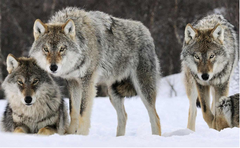
<p>Relationship in which behavior by two or more individuals leads to mutual benefit.</p>
78
New cards

Decomposition

The breaking down of matter into simpler molecules. Typically performed by bacteria.

<p>The breaking down of matter into simpler molecules. Typically performed by bacteria.</p>
79
New cards

Deciduous

Falling off or shed at a particular season, stage of growth, etc., as leaves, horns, or teeth; not permanent; transitory.

<p>Falling off or shed at a particular season, stage of growth, etc., as leaves, horns, or teeth; not permanent; transitory.</p>
80
New cards

Frigid

Intensely cold temperatures; cold in manner; Ex. frigid zone

<p>Intensely cold temperatures; cold in manner; Ex. frigid zone</p>
81
New cards

Tropical

Biome near the equator with warm temperatures, wet weather, and lush plant growth.
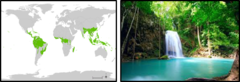
<p>Biome near the equator with warm temperatures, wet weather, and lush plant growth.</p>
82
New cards

Climate

Seasonal pattern of weather conditions in a large geographic area over many years; it does not change rapidly.

<p>Seasonal pattern of weather conditions in a large geographic area over many years; it does not change rapidly.</p>
83
New cards

Grassland

A biome found in the dry temperate interiors of continents. This biome is characterized by rich soil, moderate rainfall, a hot, dry climate, thick grasses, and herds of grazing animals.

<p>A biome found in the dry temperate interiors of continents. This biome is characterized by rich soil, moderate rainfall, a hot, dry climate, thick grasses, and herds of grazing animals.</p>
84
New cards

Canopy

Dense covering formed by the leafy tops of tall rainforest trees.

<p>Dense covering formed by the leafy tops of tall rainforest trees.</p>
85
New cards

Tropical Rain Forest

Biome characterized by hot temperatures, large amounts of rainfall, and high biodiversity,that grows near the equator; it receives large amounts of rain, and has dense growths of tall, leafy trees; the weather is warm and wet year-round; few plants live on the dark forest floor.

<p>Biome characterized by hot temperatures, large amounts of rainfall, and high biodiversity,that grows near the equator; it receives large amounts of rain, and has dense growths of tall, leafy trees; the weather is warm and wet year-round; few plants live on the dark forest floor.</p>
86
New cards

Swamp

A type of freshwater wetland that consists of spongy, muddy land full of water.

87
New cards

Treeline

The limit of the area that trees can grow in on Earth. Above it, it's too cold for trees to grow.

<p>The limit of the area that trees can grow in on Earth. Above it, it's too cold for trees to grow.</p>



