M7 - Cellular Respiration
 Call Kai
 Learn
 Practice Test
 Spaced Repetition
 Match
 Flashcards
 Knowt Play
1/69

There's no tags or description
Looks like no tags are added yet.
70 Terms
Pyruvate Dehydrogenase
Mitochondrial enzyme that converts PYR into acetyl-CoA and CO2 in preparation for the TCA cycle.
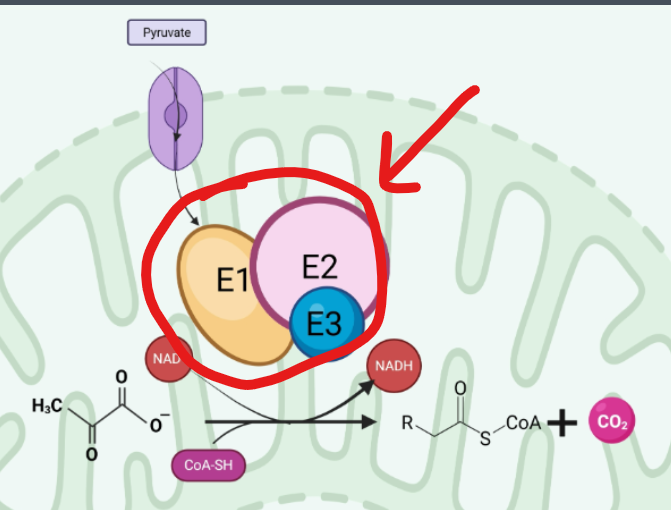
PDH Complex
Large, multiprotein complex of enzymes that makes up PDH. Contains E1 Dehydrogenase, E2 Transacetylase, and E3 Dehydrogenase domains.

E1 Dehydrogenase Coenzymes
Thiamine Pyrophosphate (TPP)
Thiamine Pyrophosphate (TPP)
Cofactor for E1 Dehydrogenase in PDH.
Derived from thymine or VB1
Contains Thiazolium Ring as its key functional component for aldehyde transfer

E2 Transacetylase Cofactors
Lipoic Acid
CoA
Lipoic Acid
Cofactor of E2 Transacetylase. Covalently bound to Lysine residue in E2 and adopts multiple forms: oxidized, acetylated, reduced. Transfers 2C (acetyl group) from PYR to form acetyl-CoA

CoenzymeA
Cofactor in E2 Transacetylase with active thiol group. Derived from VB5 or pentoplenic acid. Becomes acyl carrier group

Flavins FAD and FMN
Coenzyme e- carriers in E3 Dehydrogenase. Requires riboflavin to form. NOT motile and is fixed to RXN/Enzyme site and highly associated with other proteins.
May form semiquine or FADH2
Act as reducing agents
FAD (Flavin Adenine Dinucleotide)
Dinucleotide flavin coenzyme that can carry 1e-/H+ (carries 2e- total)
FMN (Flavin mononucleotide)
Mononucleotide flavin coenzyme
Flavoproteins
proteins that contain a nucleic acid derivative of riboflavin. Have FMN or FAD as prosthetic group or cofactor
NAD+ (Nicotinamide Adenine Dinucleotide)
Coenzyme e- carriers that accept hydride ions (H-). Derived from niacin, VB3, and are mobile and soluble.
PDH Mechanism (5)
1 Oxidative Decarboxylation
2 Reduction of Lipoic Acid
3 Formation of Acetyl CoA
4 Reduction of FAD and Re-Oxidation of E2
5 Reduction of NAD and Re-Oxidation of FADH2
DPH 1 - Oxidative Decarboxylation
PYR is decarboxylated and E1 Pyruvate Dehydrogenase. PYR’s acetyl group is transferred to to TTP (forming hydroxyethyl TTP)

PDH 2 - Reduction of Lipoic Acid
E2’s oxidized lipoamide arm takes TTP’s hydroxyethyl group form E1. This convert’s the lipoamide arm to its acetylated form (hydroxyethyl → acetyl group).

PDH 3 - Formation of Acetyl-CoA
Acetyl group on the lipoamide arm is transferred to CoA (HS-CoA), creating acetyl-CoA. The lipoamide arm is converted to its reduced form.

PDH 4 - Reduction of FAD and Oxidation of E2
Products Acetyl-CoA and CO2 are released from the complex (to TCA) and the reduced lipoamide arm is oxidized with FAD. e- from Reduced lipoamide arm are transported to FAD, reducing it to FADH2.
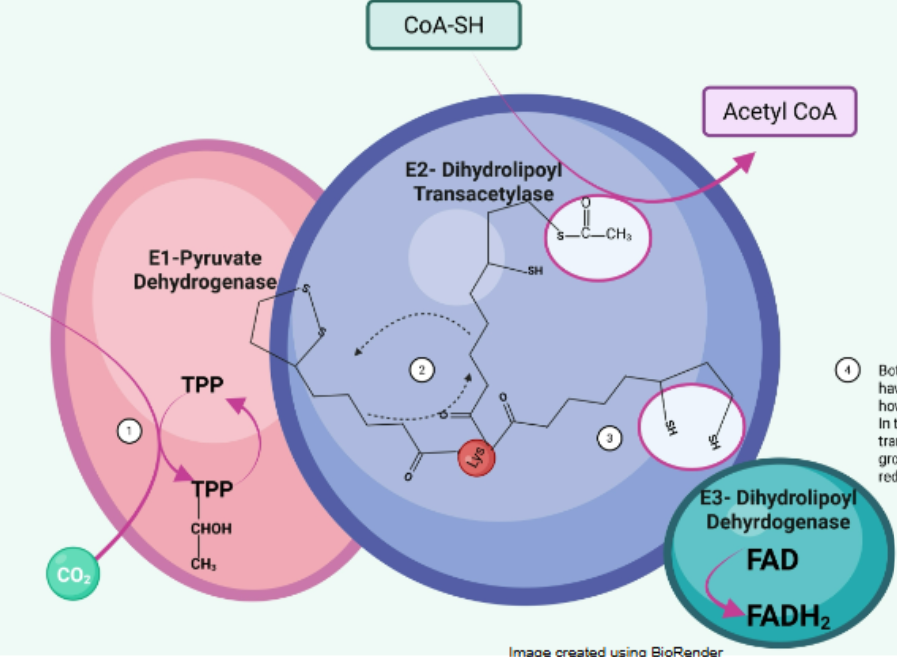
PDH 5 - Reduction of NAD+ and Re-Ox of FADH2
FADH2, enzyme bound in E3, is re-oxidised to FAD with the reduction of NAD+ to NADH.

Positive Allosteric Regulation of PDH
(+) → AMP, CoA, NAD+
Positive Allosteric Regulation of PDH
(-) → ATP, Acetyl-CoA, NADH
Covalent Modification Regulation of PDH
PDH is modulated by phosphorylation;
(+) Activated when Dephosphorylated
(-) Inactivated when Phosphorylated
Pyruvate Dehydrogenase Phosphatase (PDP)
Enzyme associated with E2 that dephosphorylates E1 (serine residuals targeted)
Activates PDH
Regulated by INSULIN
Phosphatase 1 and 2 versions
Pyruvate Dehydrogenase Phosphatase 1
PDP phosphatase 1 that’s present in Muscles
strongly regulated by Ca2+
Pyruvate Dehydrogenase Phosphatase 2
PDP phosphatase 2 that’s present in the Liver
less sensitive to Ca2+ regulation
Regulated by hormonal/metabolic signaling
Pyruvate Dehydrogenase Kinase (PDK)
Enzyme associated with E2 that phosphorylates E1 (serine residuals targeted)
Inactivates PDH
NOT regulated by glucagon/epinephrine
The Citric Acid Cycle
Pathway that continues oxidation of Carbon from carbohydrates and FA by converting acetyl-CoA to CO2 and OAA. Occurs in mitochondria and generates large amounts of reduced cofactors.
Products of TCA
2ATP + 8NADPH + 2FADH2 + 6CO2
Steps of TCA (8)
1 Formation of Citrate
2 Formation of Isocitrate
3 Oxidation of Isocitrate
4 Oxidation of alpha-Ketoglycerate
5 Conversion of Succinyl-CoA to Succinate
6 Oxidation of Succinate to Fumarate
7 Hydration of Fumarate to Malate
8 Oxidation of Malate to OAA
TCA Step 1
OAA (4C) and Acetyl-CoA (2C) are converted to citrate (6C) by citrate synthase
Irreversible
Allosterically Regulated

Citrate Synthase
Enzyme that converts OAA and Acetyl-CoA to Citrate and CoA in a condensation reaction.
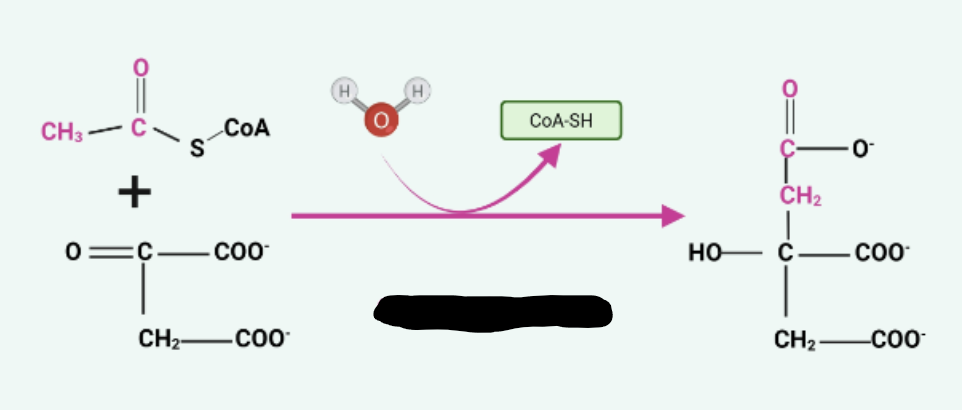
Citrate (3)
Product of the first step of TCA
6 carbon molecule
Used in FA biosynthesis
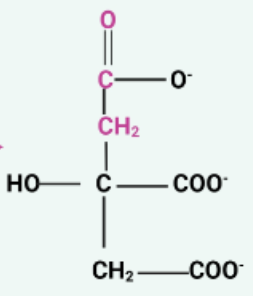
TCA Step 2
Citrate is converted to isocitrate by Aconitase. Step creates oxidizable product since citrate’s tertiary alcohol can’t be oxidized

Aconitase
Enzyme that converts curtate to isocitrate.

Isocitrate
Product created from Citrate in 2nd step of TCA

TCA Step 3
Isocitrate (6C) is oxidized to alpha-ketoglutarate (5C) by isocitrate dehydrogenase.
Produces NADPH and CO2
Irreversible
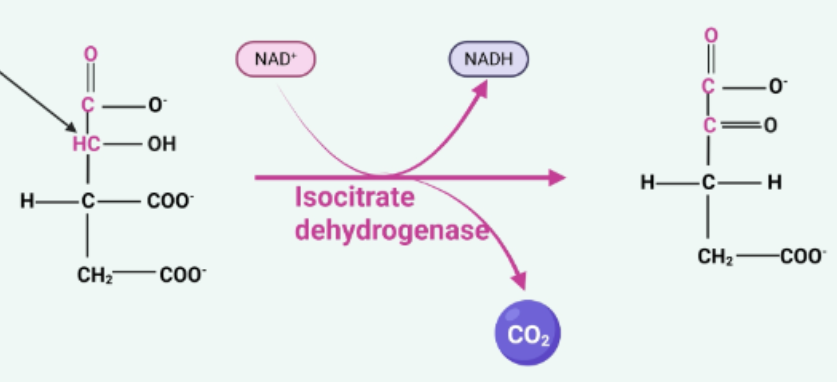
Isocitrate dehydrogenase
Enzyme that converts isocitrate into alpha-ketoglutarate and CO2 and reduced NAD to NADH. Allosterically activated by ADP and Ca+2 and repressed by ATP and NADPH

Alpha-Ketoglutarate
5C product produced when isocitrate is oxidized.
Used in Amino Acid and nucleotide biosynthesis.

TCA Step 4
Alpha-ketoglutarate (5C) is oxidized to succinyl-CoA (4C) by alpha-ketoglutarate dehydrogenase complex. Uses CoA as to attach CoA group to carbon backbone and produced CO2 and reduced NADH.
Irreversible
Highly Exergonic
Highly Regulated

Alpha-ketoglutarate Dehydrogenase Complex
Enzyme that oxidizes alpha-ketoglutarate to succinyl-CoA and CO2. Requires CoA and NADH cofactors. NAD reduced to accept e- form reaction.
Structurally similar to PDH: Has E1, E2, and E3 complexes

Succinyl-CoA
Product from the decarboxylation of alpha-ketoglutarate

TCA step 5
Succinyl-CoA is oxidized to succinate by succinyl-CoA synthetase coupled with Substrate level Phosphorylation. GTP or ATP is synthesized and CoA is released.
Reversable
GTP in biosynthetic cells, ATP in active cells
(SLP is driven by high E thiodiester bond)

Succinyl-CoA synthetase.
Enzyme that catalyzes the reversable reaction between succinyl-CoA and succinate.

Succinate
4 Carbon molecule produced when CoA is removed from succinyl-CoA

TCA step 6
Succinate (4C) is oxidized to fumarate (4C) by Succinate Dehydrogenase. FAD is reduced to FADH2.
reversable
Complex 2 of etc

Succinyl Dehydrogenase
Enzyme that catalyzes the conversion of succinate to fumarate through the creation of a db in the C backbone. Also known as Complex II of etc and reduces FAD to FADH2.

Fumarate
4 Carbon compound that’s formed when succinate is oxidized.

TCA step 7
Fumarate is oxidized to L-Malate in a hydration reaction catalyzed by fumarase.
Reversable

Fumarase
Enzyme that catalases the reversable reaction that converts fumarate to L-Mate through the addition of water. Addition of water makes malate optically active.

L-Malate
Optically active product that forms in a reaction when fumarate is hydrated by fumarase.

TCA step 8
L-Malate is oxidized to OAA by Malate dehydrogenase in this final step of TCA. NADH is generated.
Reversable
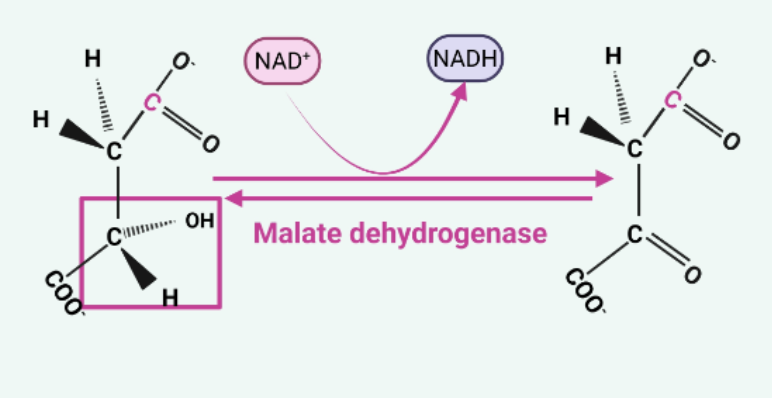
Malate Dehydrogenase
Enzyme that reversibly oxidizes L-Malate and coverts it to OAA. e- are transferred to produce NADH

Mitochondria
Double membrane organelle with an inner membrane space where electrochemical gradients are generated.
Constituents of ETC (4)
NAD and FAD
Cytochromes
Ubiquinone (CoQ/C)
Iron Sulfur Centers
NAD and FAD in ETC
Reduced cofactors which are the first groups to grovide e- for ETC.
Cytochromes
Light absorbing structures that contain iron propherene rings with heme-like* rings. Have central Fe ion that donates e- in Fe+2 form and accepts e- in Fe+3 form. Can only accept one e- at a time.

Iron-Sulfur Centers
Structures in Fe-S proteins that participate in e- transfer. May contain inorganic or protein sulfurs.

Ubiquinone (CoQ/C)
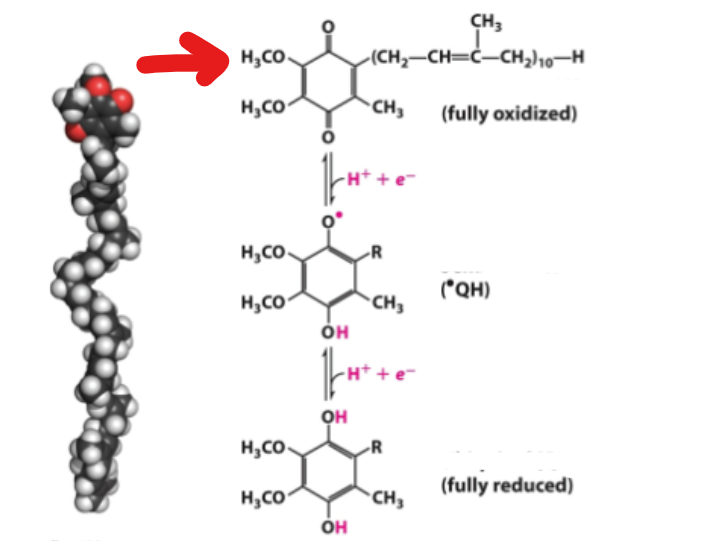
Long, lipid soluble carbohydrate chains with aromatic head. Accept 1-2e- and can be fully ox, radical, or fully red. Can diffuse through membranes and carry e- between complexes.
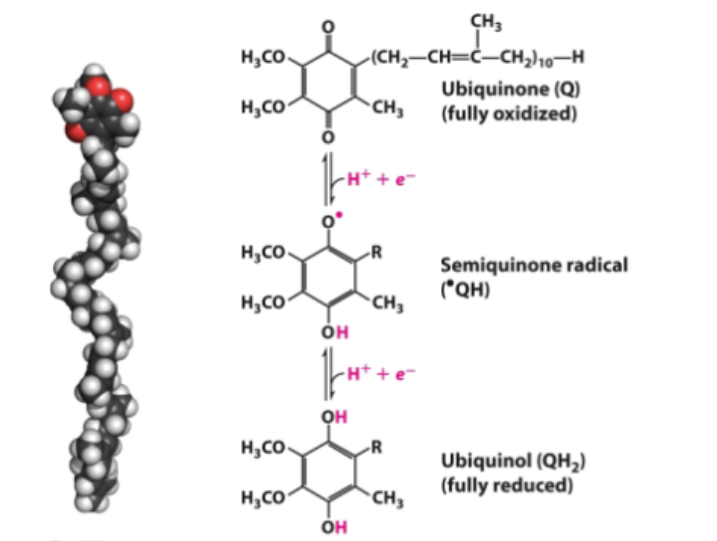
Ubiquinol (QH2)
Ubiquinone that’s Fully reduced. Carries 2e-

Semiquinone radical (*QH)
Ubiquinone thats partially red/ox. Only carries one e-

Ubiquinone (Q)
Ubiquinone thats fully oxidized. Carries NO e-
Complex I
NADH Dehydrogenase
Oxidizes NADH for e-
Has FMN containing complexes and Fe-S centers that pass e- along to reduce Q to QH2
Is thermodynamically favored so coupled with a Proton Pump
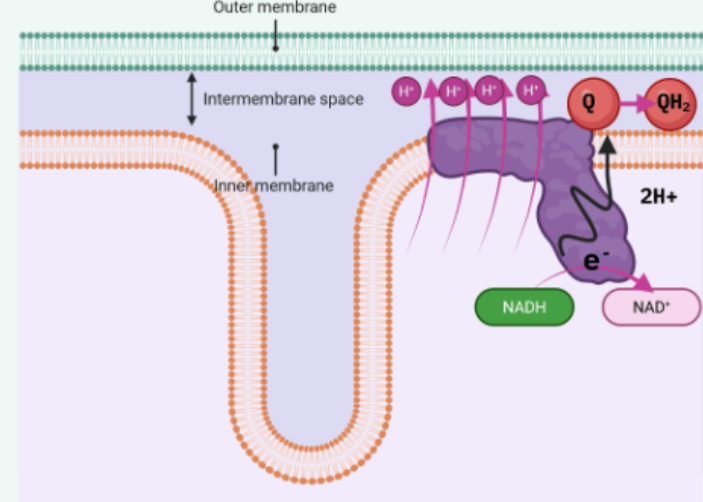
Complex II (succinate dehydrogenase)
Succinate Dehydrogenase
Oxidizes FADH2 from TCA to donate e-
e- is passed through Cytochromes and Fe-S carriers to reduce Q to QH2
NO proton pump (less thermodynamically favorable)

Complex III
QH2 is oxidized to Q to donate e-
e- passes through Fe-S centers until cytC is reduced

CytochromeC (cytC)
Soluble peripheral pertion of intermmebrane**
Accepts e- and is reduced in complex III of the ETC
Pumps Protons
Very Large
Complex IV
cytC Donates its e- to the complex
e- eventually is accepted by O2, which is reduced into H2O
A3 involved in e- transport
Protons pumped

Overall ETC Reaction
NADH + 11H+(inter) + 1/2O2 → NAD+ + 10H+(outer) + H2O
/