BIOL 1120 Lab Final
 Call Kai
 Learn
 Practice Test
 Spaced Repetition
 Match
 Flashcards
 Knowt Play
1/87

Earn XP
Description and Tags
Exercises 6-10
88 Terms
Biodiversity, & the 3 types
The variety of life, regional to global
Species diversity: the variety of species that exist
Genetic diversity: the variety of genes in individuals of a species
Ecosystem diversity: the vareity of ecosystems in which multiple species interact
Species diversity: 2 components
Species diversity uses species richness and evenness
Species richness: the number of species present
Species evenness: proportions of each species in a community
Plankton
Organisms that primarily move by drifting in water. Bacteria, protists, plants, animals.
Found in wetland and riverine habitats.
Wetland
stagnant water, low light, high nutrient load, low oxygen
River
flowing water, higher light, contain sediments, meandering
Shannon Diversity Index
Unitless index that quantifies diversity for comparison
H’- index value (higher = higher diversity)
S- number of species encountered in a community
Pi- proportion of the entire community that is made up by a given species
Ni / N (number individuals/total number of individuals)

Maximum H’
The value for any community will range between 0 and the natural log of the total number of species in the community. Max H’ = ln(S)
Lab Report- Introduction
background on topic
your question
hypothesis
2 CSE sources
Lab Report- Methodology
Concisley describe your experiment so that someone could replicate it
Past tense
Not a list
Lab Report- Results
What you found, not interpreted
Present data in figures or tables
Lab Report- Discussion
Interpret results
Was hypothesis supported or rejected?
Compare to similar peer-reviewed sources
Discuss error and future directions
Lab Report- References & CSE format
Alphabetical list of all citations
CSE format
CSE:
Author 1 Last Name 1st initial, Author 2 Last Name 1st initial. —> Year..etc
Author 1 et al. Year of publication. Title of article. Name of Journal. Volume(Issue):pages. DOI or URL
Fungi
Eukaryotic
Heterotrophic
More closely related to animals than to plants
Unicellular or multicellular
Multicellular can create hyphae that forms mycelium when woven together
Chitin- composes strong and flexible cell walls
Saprophytic
Obtain food by decomposition and absorption of dead organic matter
Parasitic
Extract nourishment from living organisms
Mycorrhizal
Fungi form a beneficial relationship with plant roots that aid in nutrient absorption for both
plant receives minerals, fungi receives sugars and amino acids
usually not a parasite
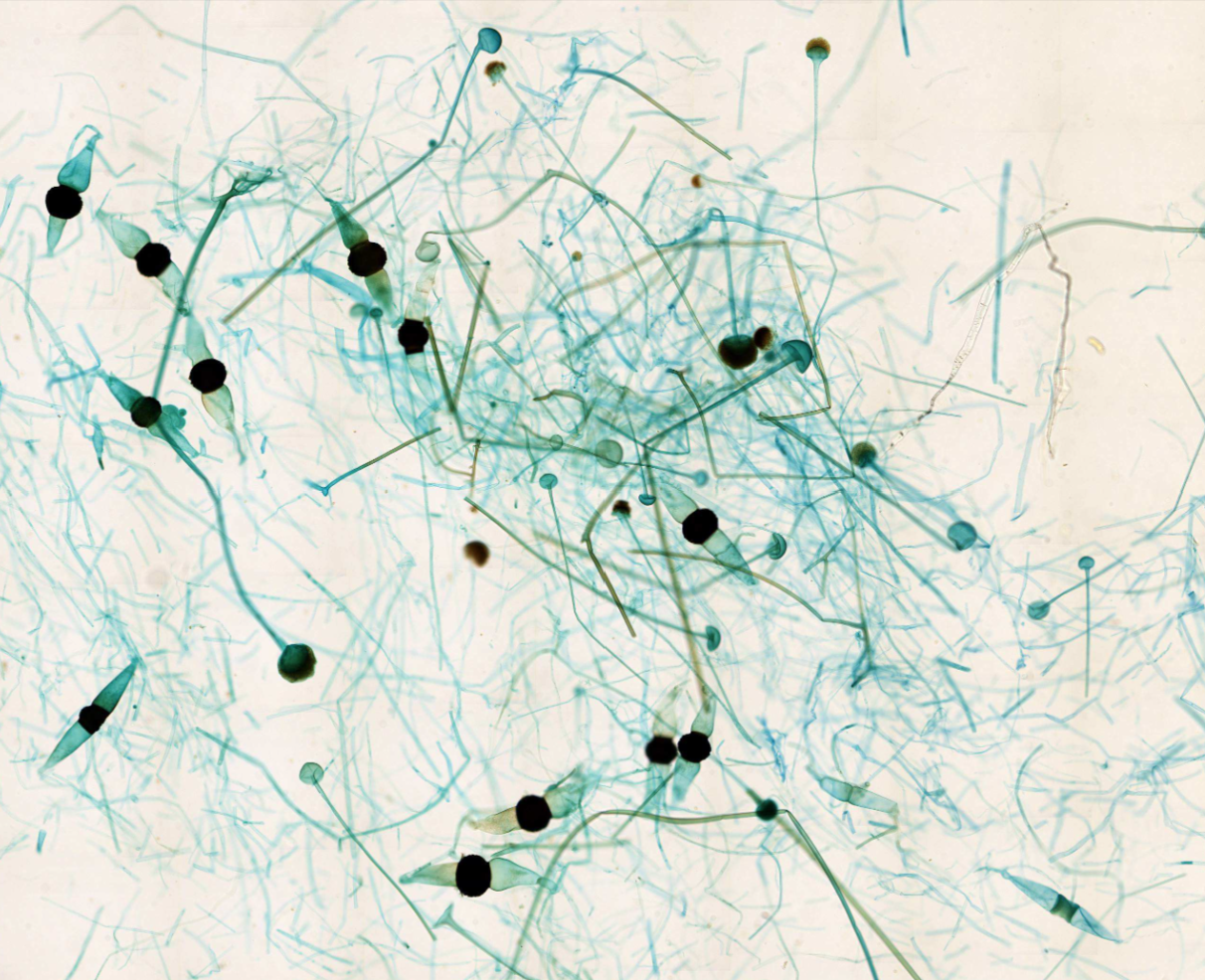
Phylum Mucoromycota
Rhizopus- genus of bread mold
This phylum has zygospores, which are resistant to environmental stressors (have thick cell walls and spines)
Asexual reproduction:
Hypae grow across food surface, then form an erect sporangium that produces and releases asexual haploid spores
Spores germinate into haploid filaments
Sexual reproduction:
Sexual reproduction occurs between two different mating strains and forms a diploid zygospore
Zygospore undergoes meiosis and develops into a new haploid hyphae
Phylum Ascomycota
Yeasts, molds, mildews, cup fungi, morels
Many are important to medicine- Penicillium
Sac fungi (sac-like reproductive structures)
Sexual Reproduction:
Haploid mycelia fuse to form dikaryotic hyphae
Dikaryotic- two n nuclei
Hyphae produce asci that line a fruiting body- ascocarp
In an ascus, haploid ascospores are produced and released and germinate into new haploid myceia
Asexual reproduction:
Mycelia undergo aexual reproduction when conidiophores produce conidia that germinate into a new mycelia

Phylum Basidiomycota
Produce club-shaped spore bearing basdia
Underground mycelium produce above ground mushroom
Mushroom have gills
Sexual Reproduction:
Gills bear bsaidia where haploid spores/basidiospores are produced
The haploid cells fuse into a diploid zygote
The zygote undergoes meiosis to form haploid spores
Spores are released and germinate into haploid mycelia
Mycelia of different mating strains fuse into dikaryotic cells
Cells divide by mitosis to form a dikaryotic mycelium, which develops into a mushroom

Lichens
An association between a fungus and algae or a cyanobacteria
Not a plant
The algae or cyanobacteria provide food via photosynthesis, the fungi absorbs water and minerals
Crustose- attach tightly to the substrate like a crust
Foliose- leaf-like and fold away from substrate
Fruticose- shrub with branches like stalks

Indicator species
Serve as a early warning of environmental damage
Many lichens are indicator species because they are sensitive to air pollution.
Kingdom Animalia
Eukaryotic
Multicellular
Heterotrophic
Evolved from a line of protists
Supergroup Unikonta with Fungi
Symmetry
Sponges: no symmetry
Cnidarians: radial symmetry
All other animals have bilateral symmetry at some point
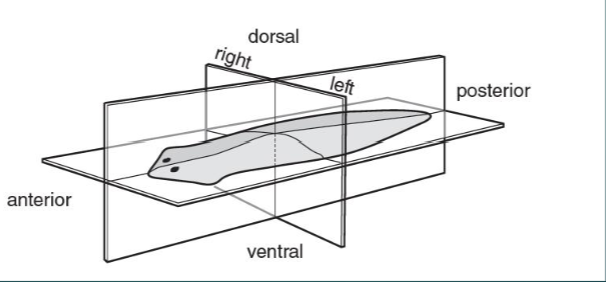
For bilateral symmetrical animals:
Doral- top side
Ventral- bottom side
Anterior- front end
Posterior- back end
Body Cavity Plan/Coelomic Plan
Coelom: body cavity, space between body wall and digestive tract
Acoelomate- no coelom
Pseudocoelomate- body cavity partially lined by mesodermal tissue and partially by endodermal tissue
Coelomate- body cavity is entirely lined with mesodermal tissue
Fate of the blastopore
The blastopore is the first opening in an embryo
Protostome: mouth first, primitive
Deuterostome- anus first, advanced

Phylum Porifera- Sponges
Most primitive animals as they have…
No tissue, no symmetry, no coelomic plan
Most marine
A porous sac of two cell layers
Outer- epidermal cells
Inner- flagellated collar cells
Filter feeders
Obtain food when nutrients in the water are trapped in a sticky mucus at the base of a fagellum of a collar cell, water move sthrough pores and out the opening called an osculum.

Phylum Cnidaria
Radial symmetry throughout their entire lives
No coelomic plan
Unbranched gastrovascular cavity with one opening
Cnidocytes (nettle cells) contain stinging organelles with nematocysts
No brain
Two tissue layers
Epidermis- outer layer from ectoderm
Gastrodermis- lines gastrovascular cavity, inner layer forms endoderm
Mesoglea between
Polyp stage attached to surfaces
Medusa stage is free living
these two stages are seen at different points in the life cycle
Name three advances cnidarians have over sponges?
Cnidarians have distinct tissues, radial symmetry, and two tissue layers.
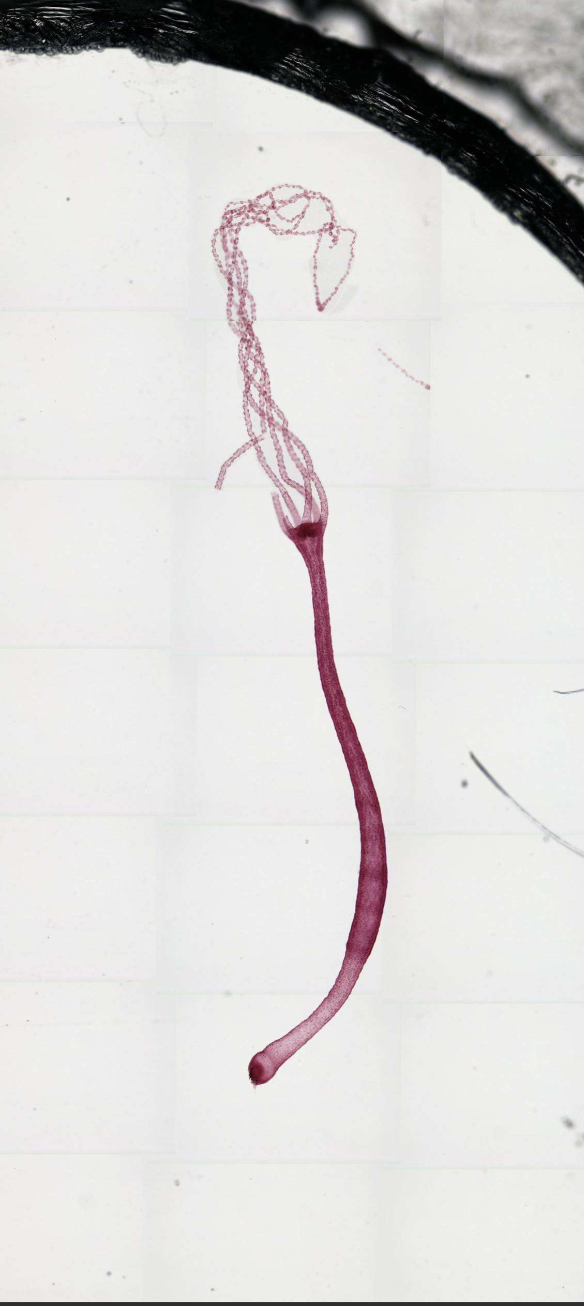
Hydra
polyp stage only
contractile fibers control the body’s movement
unbranched gastrovascular cavity
net of inerconnecting nerve cells
Obelia
Alternating polyp and medusa stages
Feeding polyps have a mouth surrounded by stinging tentacles
Reproductive polyps- medusa develop, and once free living produce gametes that become a zygote
increases genetic diversity and species dispersal

Jellyfish
Medusa stage is dominant
Sea Anemone
Most advanced cnidarians
No medusa stage
Preserved looks like goo
Coral
No medua stage
Symbiotic relationship with green algae or protists
Protists/algae provide nutrients, coral provides structure
Phylum Platyhelminthes
Protosome
No body cavity, acoelomate
Bilateral symmetry
Three tissue layers
Epidermis from ectoderm
Endodermic from endoderm
Middle tissue layer derived from mesoderm
Cephalization- concentration of nervous system in the head
Some free living, some parasitic
Branched gastrovascular cavity for many
Platyhelminthes- Planaria
Pharynx for food to enter and leave
Eyespots for light and auricles for chemoreceptors
Branched gastrovascular cavity for greater nutrient absorption (more surface area)
Free living

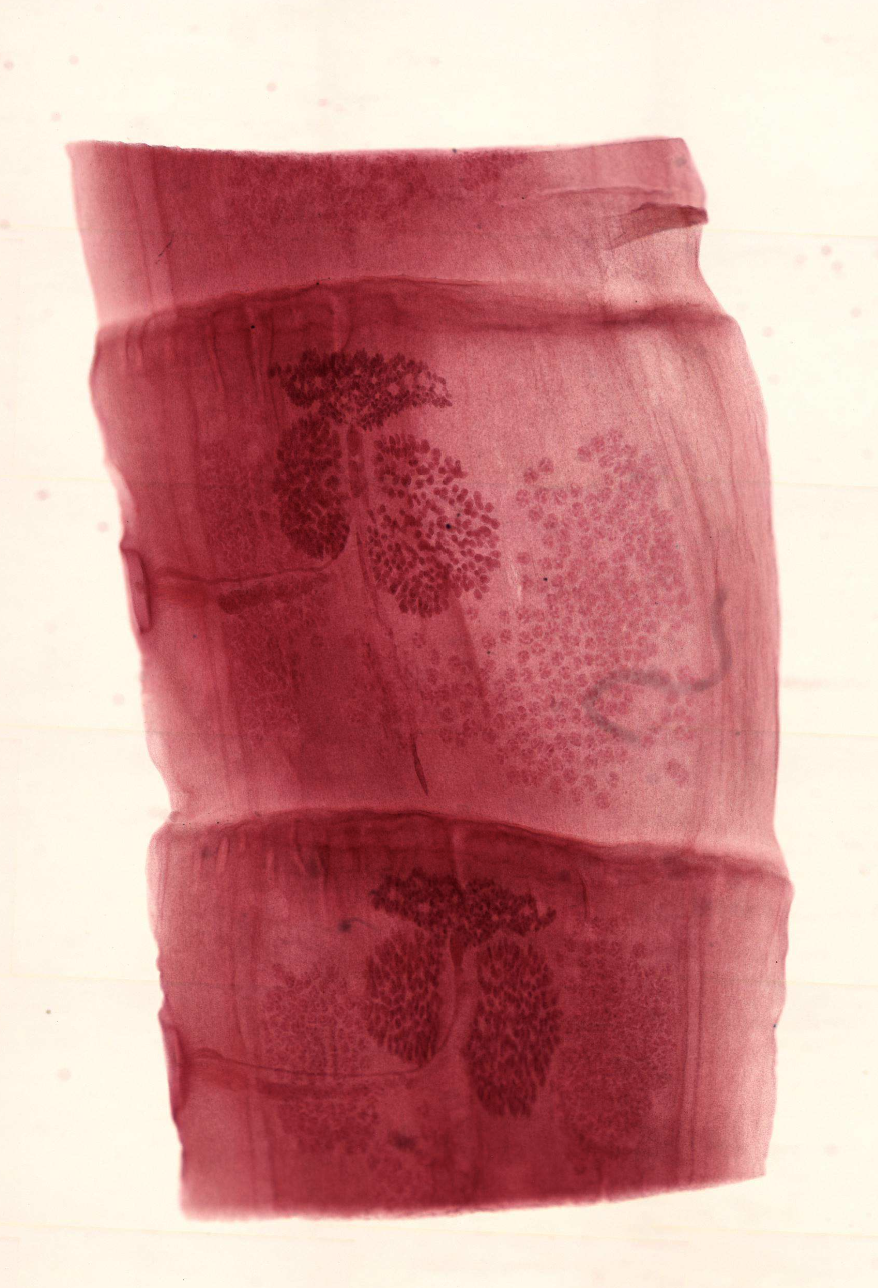
Platyhelminthes- Tapeworm
Mating in proglottids
Larvae develop and are released by the hundreds from the last proglottid segment
Intermediate host and primary hosts- fleas and cats, dogs, humans, etc.
They only only have to eat a single infested flea to have hundreds of larval worms
Parasitic
Attach to hosts digestive tract with hooks and suckers on the scolex (head region)
Absorb nutrients through body surfaces, evolved to mimic hosts digestive tract
Continually froms proglottids (which develop male and female organs, then reproduce)
Osculum
The large central cavity in sponges.
Cnidocyte
Nettle cells - specialized cells that contain stinging organelles.
Collar cells
In sponges, cells that contain flagella that move water and food through pores
Feeding polyp
Polyps with a mouth surrounded by tentatcles in some Cnidarians
Medusa
Free living motile body form form of many Cnidarians
Scolex
The head region of tapeworms
Cephalization
The concentration of the nervous system in the head.
Proglottid
Continually formed behind the scolex in tapeworms, has male and female reporductive strucures.
Spicules
Thin, pointed structures that give strength to the sponge body.
Pore
Openings where water can enter a sponge
Reproductive polyp
Polyps that develop medusae in some Cnidarians
Nematocyst
Discharge a thread when the cnidocyte is touched. The thread can be of various types and uses: sticky, coiling around prey, or containing barbs that can inject toxins to paralyze prey.
Gastrodermis
Derived from the endoderm, inner tissue layer covering the gastrovascular cavity in some simple animals
Mesoglea
Gelatinous non cellular layer between the epidermis and gastrodermis
Epidermis
Derived from the ectoderm, outer tissue layer covering an animal
Nematoda- Roundworm
Bilateral symmetry, protosomes
Pseduocoelomate
Unsegmented
Fluid filled body cavity provides space for organs
Some are parasitic, others are free living. Critical in ecosystems. Many beneficial.
Ascaris
Parasitic in many mammals- humans, cats, dogs, etc.
Adult worms attach to small intestine to feed on nutrients
Complete digestive tract
About a billion humans are infected
Many very tiny
Thick cuticle resists digestion
Females lay over a million fertile eggs in the host, shed in feces, larvae develop in moist soil, are consumed, hatch in intestines, migrate through blood to lungs, travel to pharynx, then back to the stomach where they develop into mature adults
Nematoda- Dog heartworm
Requires two hosts, dog and mosquito
After infection via mosquito, the heartworms make their way to the heart via bloodstream, where they reproduce
They can cause severe illness and death
Mollusca- Clam
Oysters, clams, mussels, nautili, cephalopods, snails, nudibranchs
Protosome
Marine, freshwater, and terrestrial species
Bilateral symmetry
Coelom is present, reduced
No segments
Annelida- Earthworm
Bilateral symmetry
Protosomes
True coelom
fluid in this serves as a hydrostatic skeleton
Segmented (metameres) - advantage over flatworms and roundworms
Central nervous system
Closed circulatory system
Arthropoda- Trilobites & Grasshoppers
Largest and most successful animal phyla, >80%
Exoskeleton of chitin
Protosomes
Crustaceans, insects, arachnids
Bilateral symmetry
True tissues present
True coelom is reduced
Segmented
Central nervous system
Open circulatory system
Large respiratory system, often with spiracles
or gills or booklungs
Jointed legs- walking, sensory organs, jaws
Arthropoda- Trilobite
Get their name from the median and two lateral lobes
Extinct for 250 million years
Primitive segmentation
Echinodermata- Sea Star
Deuterostomes
Larvae have bilateral symmetry
Radial symmetry in adults
Coelomate
Unsegmented
No excretory system, use diffusion
Poorly developed circulatory system
No brain or head
Do have nerves in rings
Water vascular system for locomotion
Aboral= opposite side of oral
The mouth is on the bottom, in the center
Sea Star Wasting Disease (SSWD)
Chordata- Rat
Deuterostome
Notochord
Dorsal hollow nerve cord
All vertebrates, some are invertebrates
Post-anal tail (humans have a pharyngeal one)
Gill slits (embryo)
Coelomate
Segmented
True tissues present
Bilateral symmetry at some point
Gills
Used for gas exchange for many aquatic organisms.
Dorsal Vessel
A major vessel in annelids lying on top of the digestive tract.
Adductor muscles
Contract to close the shell in mollucs
Ovipositor
Used in digging a site for egg deposits.
Gonads
Reproductive organs
Exoskeleton
Made of chitin, outer covering of arthropods
Gizzard
Grinds food with the aid of sand grains.
Setae
Bristles in many annelids and arthropods.
Spiracles
Tiny pores on the main body of arthropods that are used for gas exchange.
Crop
Used for temporary storage of food.
Cuticle (in Ascaris)
Thick protective outer layer that resists digestion
Aortic arches
Hearts in annelids
Seminal receptacles
Sperm are released from seminal vesicles of one worm into this.
Hermaphroditic
Male and female sex organs present.
Ring canal
From this water flows down each arm via radial canals.
Diaphragm
A sheet of muscle that contracts and relaxes during breathing in chordates.
Hemolymph
Is the "blood" of arthropods- pumped by the heart.
Visceral mass
Contains the digestive, excretory, and reproductive organs of clams.
Pancreas
Diffuse, pink tissue located in the mesentery behind the stomach and upper small intestine in chordates.
Thyroid
Important for regulating metabolism.
Clitellum
Enlarged, light segment in earthworms.
Mantle
Secretes a calcareous shell in mollucs.
Umbo
Bulge on the dorsal surface of clams.
Urinary bladder
A small muscular sac that drains through the urethra.
Heterotrophs
Organisms that obtain glucose and other complex energy-yielding molecules by consuming other organisms.
Include:
Hervivores- only eat plants
Carnivores- only eat meat
Omnivores- eat both
Detritivores- decompose organic matter
Autotrophs
Organisms that produce complex energy-yielding molecules like glucose from simple substances in their environment (like sunlight)
Trophic levels
Positions of organisms within food chains or webs. Primary producers, primary consumers, secondary consumers, tertiary consumers,
At each trophic level, 90% of energy is lost
Food chain
Represents feeding relationships among organisms in a community in a simple, linear way.
Food web
Depicts how food chains are linked together into more complex feeding relationships.
Biomass
The mass of living material that represents the amount of fixed energy at a particular time.