Fundamentals of geometric optics Topic 1
 Call Kai
 Learn
Learn Practice Test
 Spaced Repetition
 Match
Match Flashcards
 Knowt Play
1/90

There's no tags or description
Looks like no tags are added yet.
Name | Mastery | Learn | Test | Matching | Spaced | Call with Kai | Chat |
|---|
No analytics yet
Send a link to your students to track their progress
91 Terms
What is wave-particle duality?
when in some instances light can be considered as particles, and other phenomena mean it can be considered as waves
What are the 2 basic rules in geometric optics?
light travels as rays from a light source
Light rays travel in straight lines (rectilinear propagation) until it reaches an optical boundary
What are the 2 ways of representing propagation of light rays?
ray diagrams
Wavefronts
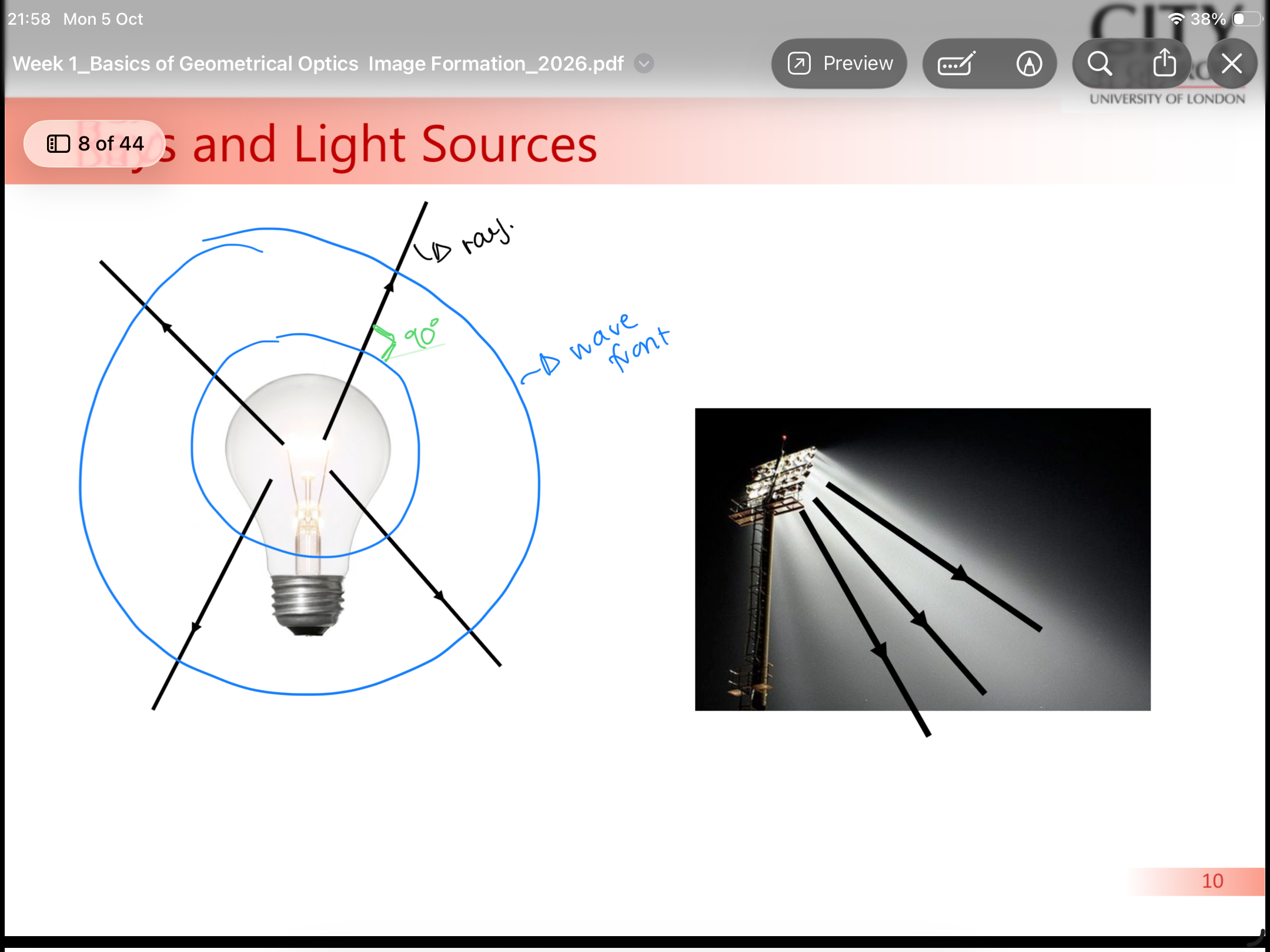
Why are we able to see all sorts of objects, not just sources of light?
light rays coming from a light source bounce off objects and travel in some other direction
What is a diffuse surface?
light rays are scattered in all directions
What is white light?
A combination of all colours/wavelengths of light
How is colour of an object seen?
for example, sun emits white light
Rays reach pencil in straight lines
Here, the dyes only reflect back red light
All other colours are absorbed
Therefore, only red rays are re-emitted, so the observer perceives the pencil as red, as only the red rays reach observers eyes
What are some of the properties of light?
Wavelength (colour)
frequency
intensity
polarization
speed
Where does the visible light spectrum range on the electromagnetic spectrum?
450nm (violet/blue) to 750nm (red)
Define monochromatic
when we have a single wavelength
Define polychromatic
when we have many wavelengths
Define transparent medium
a medium which transmits all wavelengths in the visible spectrum without reflecting or absorbing any
Eg. Air and water (most common)
What parts of the eye are transparent?
Cornea
Lens
Aqueous and vitreous humours
Some parts of the retina
What is the speed of light (in a vaccum)?
300,000,000 m/s
(Or 700,000,000mph)
What letter represent the speed of light?
c
What letter represents the speed of light in a medium other than a vaccum?
v
What is refraction?
The change in direction (bending) of light when it crosses an interface between two transparent media with different optical densities
Why does light refract when it enters glass from air?
because it’s speed decreases when it enters optically denser glass from air
What happens to the speed of light when it enters glass from air?
it slows down
Why does one part of a wavefront slow down before another part?
because the wavefront reaches the air glass interface at an angle, so the bottom part enters the glass before the top part
What happens to the part of the wavefront that enters the glass first?
it slows down and starts to lag behind the part that is travelling through air
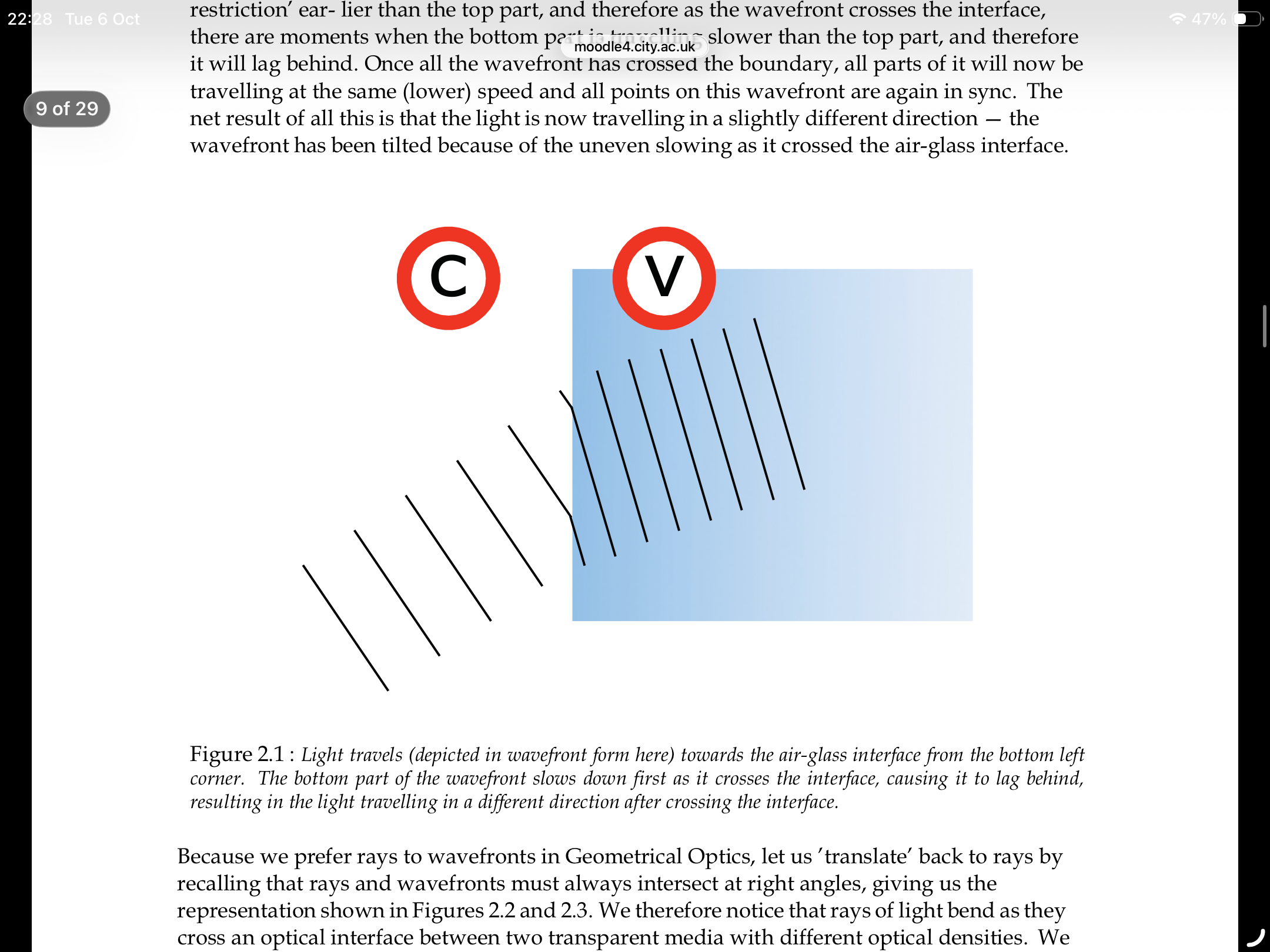
How does the wavefronts slowing cause light to change direction?
the uneven slowing causes the wavefront to tilt. S
Since rays are perpendicular to wavefronts, the rays change direction
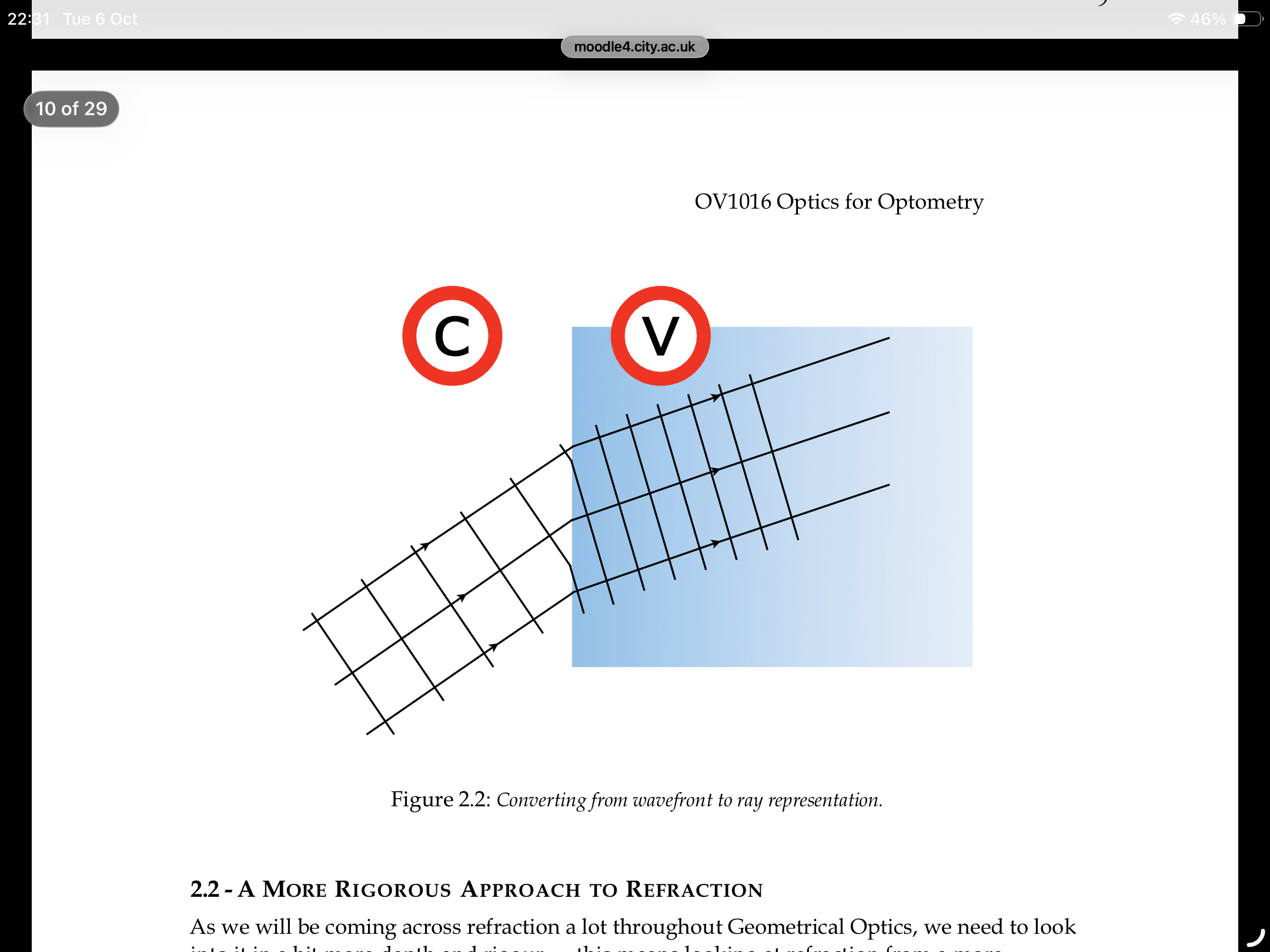
What is the relationship between rays and wavefronts?
always perpendicular (90 degrees) to eachother
What happens once the entire wavefront has entered the glass?
The whole wavefront travels at the same lower speed, but it is now tilted compared to its original orientation

What is an optical interface?
The boundary between 2 transparent media with different optical densities, such as air and glass
What is the refractive index of a material?
the speed of light in vacuum, c, divided by the speed of light within the material, v
What letter is used to represent refractive index?
n
What is the equation for reflective index?
n = c/v
Why is speed of light in a vaccum used as a reference value?
highest speed possible
What is the refractive index of a vaccum?
1
Why is the refractive index of most materials greater than 1?
Light travels slower in a material than in a vacuum, so the refractiveindex is greater than 1.
What is the relationship between the speed of light and refractive index?
The slower light travels through a material, the higher its refractive index
What is the refractive index of air?
1.0003
Why is air usually approximated as having a refractive index of 1 in geometrical optics?
Because 1.0003 is only slightly greater than 1, so light travels only marginally slower in air than in vacuum. Therefore, we commonly use nₐᵢᵣ ≈ 1
What are the approximate refractive indices of common materials?
Vacuum: 1.000
Air: 1.0003
Water: 1.333
Glass: 1.4–1.9
Why is the refractive index of water particularly important in optometry?
Many biological structures contain large amounts of water.
The refractive indices of the humours of the eye are therefore very similar to that of water.
What is a homogenous medium?
A homogeneous medium is one in which the refractive index is constant throughout the medium
What is an inhomogeneous medium? Give an optometric example
An inhomogeneous medium is one in which the refractive index varieswith location.
Example: The crystalline lens of the human eye—the refractive index is higher in the core than in the outer regions.
Why is the crystalline lens often treated as a homogeneous mediumin geometrical optics?
Because an inhomogeneous medium is more difficult to analyse.
Therefore, the crystalline lens is often approximated using an equivalent constant refractive index, assuming it is homogeneous.
Define normal
Normal — The normal to a surface is a straight line (an imaginary line) that intersects the
surface at right angles, as shown below

Define refractive surfaces
how a ray of light will bend, or refract, as it crosses a transparent optical boundary
Define angle of incidence
The angle of incidence, i, is the angle between an incident ray of light (a ray of light which is
travelling towards the surface) and the normal to the surface drawn at the point where the ray
intersects the surface.
Define angle of refraction
The angle of refraction, i’ (pronounced i prime), is the angle between a refracted ray of light (a
ray of light which is travelling away from the surface) and the normal to the surface drawn at
the point where the ray intersects the surface.

What is the equation for snells law of refraction?
n sin i = n’ sin i’

What do the n and n’ represent?
n is the refractive index of the first medium (containing the incident rays) and n’ is the
refractive index of the second medium (containing the refracted rays)
Describe the difference in refraction when a ray of light is travelling from a low refractive index to a high one (less optically dense to more) and vice versa
When going from low to high, the ray refracts towards the normal (i.e. the angle of refraction i′ is smaller than the angle of incidence i)
while when the ray is going from high to low, the ray refracts away from the normal (i.e. i′ is
greater than i.)
What is prime (‘) used for?
to show after refraction
What is total internal reflection?
Total Internal Reflection occurs when all the light is reflected backinto the original medium instead of being refracted.
What are the two conditions required for Total Internal Reflection?
Light is travelling from a medium with higher refractive index to a medium with lower
refractive index (i.e. n > n′),
AND
The angle of incidence i is greater than the critical angle of incidence, ic (i.e. i > ic).
What is the critical angle (ic)?
The critical angle is the angle of incidence that produces a 90° angle of refraction
What happens when the angle of incidence is equal to the critical angle?
The refracted ray travels along the boundary at 90°.
What happens when i>ic?
Total Internal Reflection occurs, so there is no refracted ray
Why is it called "Total Internal Reflection"?
Total → all the light is reflected.
Internal → reflection occurs within the original material.
Reflection → light is reflected rather than refracted.
Can Total Internal Reflection occur when light travels from a lowerrefractive index to a higher refractive index?
No. TIR only occurs when light travels from a higher refractive indexto a lower refractive index.
What is the maximum possible angle of refraction?
90°, which occurs at the critical angle.
What happens to light when i<ic?
Some light is refracted into the second medium, and some may be reflected.
What happens to light when i>ic?
All the light is reflected internally and none is refracted out.
Law of reflection equation?
i = i’
i’ is now angle of reflection
Define Centre of curvature of a spherical surface
Centre of Curvature, C — The centre of curvature of a spherical surface is a point representing
the centre of the sphere the surface would be part of, had the whole sphere been present.

Define radius of curvature of a spherical surface
Radius of Curvature, r — The radius of curvature of a spherical surface is the distance from the
surface to the centre of curvature C

What is the relationship between the normal and the centre of curvature of a spherical surface?
The normal at any point on a spherical surface is perpendicular (90°) to the surface and therefore coincides with the radius, passing through the centre of curvature.
How do parallel rays behave when they meet a spherical refracting surface?
Each ray meets the curved surface at a different point, so each hasa different normal.
Because the normals are not parallel, the rays havedifferent angles of incidence, causing different amounts of refraction and making the rays converge after refraction.

How is the normal defined at a spherical surface, and why are the normals different?
The normal is a line at 90° to the surface at the point where the rayintersects it.
Since a spherical surface is curved, rays hitting different pointsrequire different normals, which are therefore not parallel.
Each normal passes through the centre of curvature.
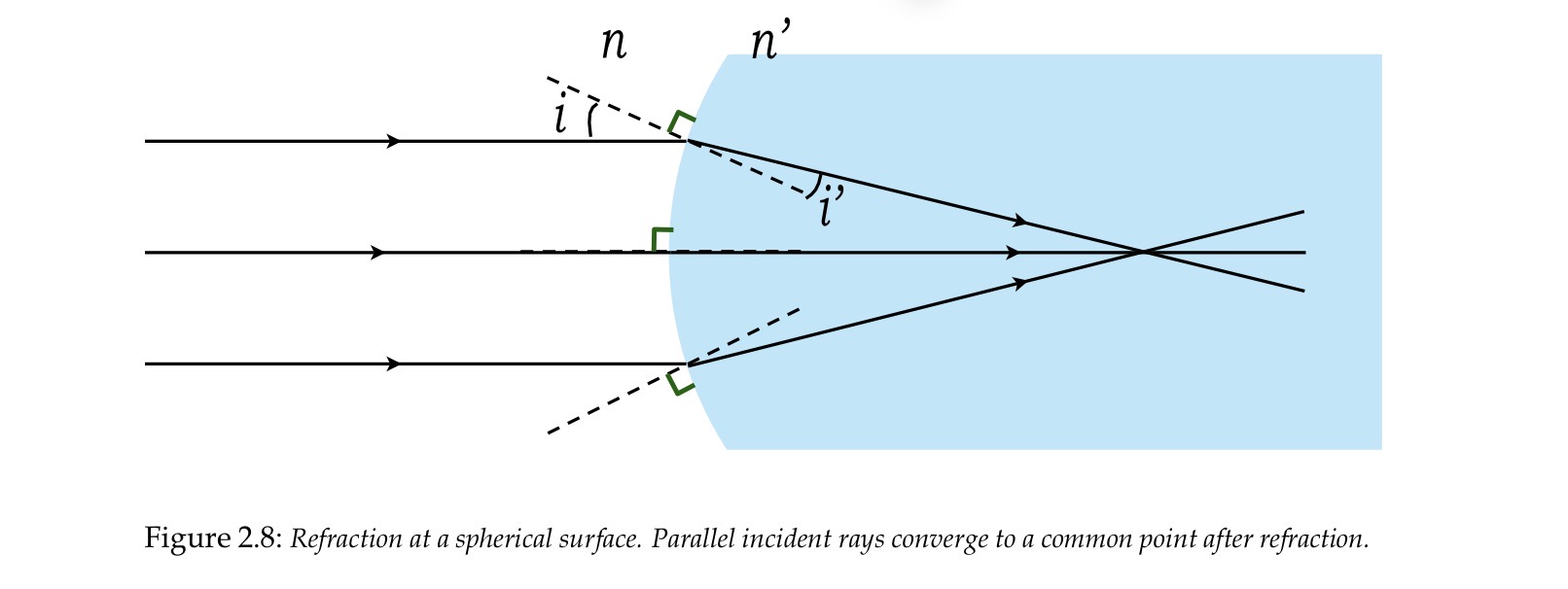
What happens when parallel rays travel from a low to a high refractive index at a spherical surface?
The rays refract towards the normal.
Since their angles of incidence differ, they refract by different amounts and converge to a point.
The middle ray is parallel to its normal, so i=0∘ and therefore i′=0∘ (no deviation).

What is a prism?
An optical element with two plane refracting surfaces that changes the direction of light
What’s happens when light enters a prism?
rays are deviated towards the base, bend
What happens to the image when viewed through a prism?
The image is displayed towards the apex
What are the two parts of a prism?
base - thickest part
Apex - thinnest part
What are the two types of images we can get concerning an images orientation?
inverted
Erect
What are the two types of images we can get concerning the size of the images?
diminished / demagnified
Magnified
Define object height, h
height if an object
Distance from the optical axis to the top of an object
Define image height, h’
height if an image
Distance from the optical axis to the top of the image
Define magnification,M
ratio of image height to object height
M = h’/h
Define Object space and Object rays
objec5 space - region of space in which rays are travelling towards an optical system
Object rays - light Ayr’s in object space
Define Image space and Image rays
image space - region of space in which rays travel away from an optical system
Image rays - light rays in image space
What happens when the rays do not converge at a single point?
rays do not meet
Observer is trying to observe the object through a lens
Cannot obverse the object rays directly ( the rays that are actually originating from the object)
instead she sees rays that have gone through the lens and have therefore been refracted
Observers eye can’t take into account this refraction
Rays appear to be coming, along straight lines, from a point farther than the actual object
The eye therefore thinks that the pencil is located at the point from which these image rays appear to be coming from — the eye observes an image of the pencil.

What type of images we can is this (the previous case)?
virtual
Why do we use dashed lines?
the image rays do not actually exist on the left of the lens.
The real rays are the object rays diverging from the object towards the lens, and the image rays travelling from the lens towards the observer.
Object rays only exist in Object Space, and image rays only exist in Image Space!
Define real object and real image
real object - object rays are diverging
Real image - image rays are converging
Define virtual object and virtual image
virtual object - object rays are converging
Virtual image - image rays are diverging
One real and one virtual day to day image
real image - picture on a phone , optical 8maging system is camera lens, converges light from the environment onto the digital sensor chip
Virtual image - reflection whilst brushing your teeth, optical imaging system is bathroom plane mirror, bounces light directly back, seems to sit at an equal distance behind the glass
Why are spherical surfaces described as "an approximation" for image formation?
Rays from an object point refracting at a spherical surface do not all converge to the same single image point. The ideal sharp focus is only an approximation — real rays spread out around the ideal image position.
What happens to the information from an object point at a spherical refracting surface?
Information (wavelength, brightness, etc.) is not replicated exactly. Instead it spreads over a region in space around the ideal image point.
What is the visible result of rays not meeting at one common image point?
Blurring — the image point becomes a blurred copy of the original object point.

Differences between ideal and non ideal image formation
Ideal Image Formation
All rays from a single object point converge to one exact, common image point
Information from the object point (wavelength, brightness, etc.) is replicated exactly
Produces a perfectly sharp, faithful copy of the object point
Non-Ideal Image Formation (at spherical surfaces)
Rays from one object point do not all pass through the same point
Information spreads over a region around the ideal image position
The result is blur — the image point is a blurred copy of the object point
Why are all imaging systems non ideal?
due to a property of light, diffraction
Due to aberrations , the deviations due to the shape of the refracting surface which prevent image rays from all meeting at the same
point, as we saw above
Why do we spend time studying the ideal case even though it never happens?
in many cases the blur is so small that its effects are negligible and can be ignored
even in cases when we cannot ignore the blur, the information we get from the ideal
scenario is easy to obtain and still relevant to non-ideal systems.
What is special about the rays that are closest to the centre of a spherical surface?
For the rays closest to the centre, the spherical surface behaves as an ideal optical system, only when taking into account the rays farther away dies it become non ideal

What is the paraxial region (and paraxial rays)?
paraxial region - The paraxial region is the narrow area directly around the central line (optical axis) of a lens or the eye, where light rays enter at very small angles and form a sharp, distortion-free focus, giving an ideal optical system
P rays are rays within that region
What is the optical axis?
an 8mahinary line at the centre of the optical system

What is the principal of reversibility?
if a ray of light travels through an optical system along a certain path, it would travel along the exact same path if it were reversed.
