Exam 4 Study Guide
 Call Kai
 Learn
 Practice Test
 Spaced Repetition
 Match
 Flashcards
 Knowt Play
1/61

There's no tags or description
Looks like no tags are added yet.
62 Terms
What is fertilization? (Animals)
The union of the male and female gametes. It is the first step in sexually reproducing animals.

What are the animal fertilization structures and what are their purposes?
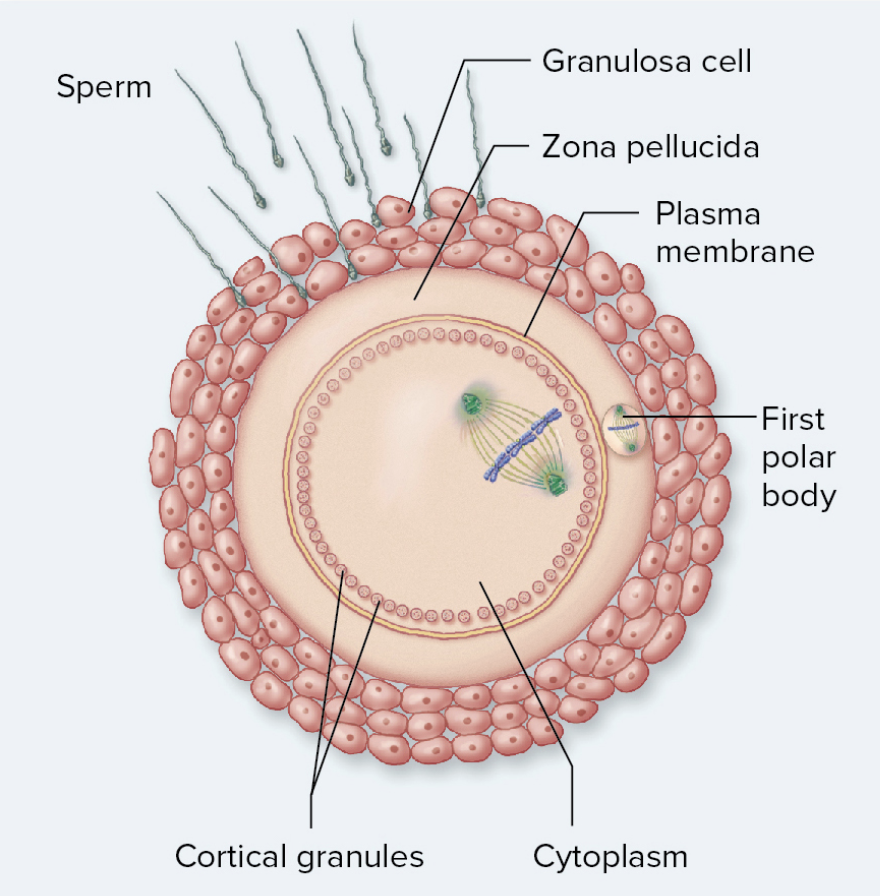
Granulosa Cells - Protective layer that helps support developing oocyte
Zona Pellucida - Thick layer that surrounds the plasma membrane of oocyte
Cortical Granules - Small vesicles underneath plasma membrane that release enzymes to prevent polyspermy
What is the process of fertilization?
Sperm penetrates granulosa layer of egg
Sperm reaches zona pellucida and releases digestive enzymes to break it down
Sperm and egg membranes fuse and sperm nucleus is released
Sperm nucleus enters egg cytoplasm
Fusion triggers release of intracellular Ca2+, which causes cortical granules to release enzymes that prevent polyspermy. Calcium also signals egg proteins to prepare for embryonic development
Sperm and egg nucleus fuse and form a diploid nucleus, which turns into a zygote
What is cleavage?
The rapid division of a zygote into many smaller cells.
What are blastomeres?
The smaller cells produced during cleavage that make up the early embryo.
What is true of embryo cell division?
As cell numbers increase, cell size decreases
What is Holoblastic Cleavage and which type of animal does it occur in?
Cell division occurs through the entire egg. It is usually present in mammals, where there is little to no egg yolk.
What is Meroblastic Cleavage and which type of animal does it occur in?
Only part of the egg undergoes cell division. It is usually present in reptiles, fish, and birds, where there is lots of egg yolk.
What is the blastula? (Amphibians)
A hollow ball of cells from meroblastic cleavage. It consists of:
Animal Pole - Forms external tissues
Vegetal Pole - Forms internal tissues
Blastocell - Fluid-filled cavity

What is the blastocyst? (Mammals)
A hollow ball of cells from holoblastic cleavage. It consists of:
Trophoblast - Outer later of cells that contributes to the formation of the placenta
Inner Cell Mass (ICM) - A clump of cells located at one pole that forms the developing embryo
Blastocel - Central, fluid-filled cavity

What is gastrulation?
How does it occur in MAMMALS?
The rearrangement of cells to make the blueprints of an embryo.
An embryo develops from the ICM and flattens into an embryonic disc. From there it differentiates into 3 layers and gets nutrients from the placenta.
What is the Gastrula?
The result of ICM differentiation. It has 3 layers:
Ectoderm - Epidermis of skin/nervous system
Mesoderm - Muscles, bones, blood vessels, organs, notochord
Endoderm - Lining of digestive/respiratory tract, pancreas, and liver

What are the 3 extra-embryonic membranes to know?
Amnion - Encloses amniotic fluid
Chorion - Contributes to placenta in mammals
Yolk sac - Food source in bird embryos. Found in mammals, but not nutritive.
What are the four levels of vertebrate organization and how are they defined?
Cells - The basic building blocks of an organism
Tissues - Groups of cells that are similar in structure/function
Organs - Combinations of different tissues that form a structural and functional unit
Organ Systems - Groups of organs that cooperate to perform the major activities of the body
What are the four adult vertebrate tissues and what are they generally for?
Epithelial - Skin
Connective - Bone
Muscle - Skeletal Muscle
Nerve - Spinal Cord, Brain
What is Epithelial Tissue and what is its purpose?
Its material, Epithelium, covers every surface of the vertebrate body.
It usually lines the digestive tract or inner surface of blood vessels
What is true of Epithelia’s structure and function?
They are tightly bound together to form a protective barrier
They can also allow nutrients and O2 to diffuse short distances across the epithelium
What are the classes and shapes of Epithelium?
Classes:
Simple - One layer thick
Stratified - Several layers thick
Shapes:
Squamous - Flat
Cuboidal - Equal in width and height
Columnar - Slightly taller than they are wide
What are the locations and functions of all the types of simple Epithelial tissue?
Simple squamous - Lines the lungs and blood vessels. They allow for diffusion
Simple cuboidal - Lines kidney tubules and several glands. They have ion transport channels that allow for secretion and absorption
Simple columnar - Lines airways of respiratory tract and the gastrointestinal tract. They secrete mucus from goblet cells
What is the location and function of stratified squamous tissue?
It is the epidermis(skin). Has a keratinized, water-resistant layer that helps with its function of protection
What is connective tissue and what are the two classes (and what are their types) ?
It is derived from the embryonic mesoderm
Proper Tissue - Has loose and dense type
Specialized - Cartilage, bone and blood
What is loose connective tissue proper? What is an example?
Cells scattered within an ECM that contains a lots of gelatinous material. Held together by collagen that forms a meshwork
Ex: Adipose cells/tissues (fat-storing cells)
What is dense connective tissue proper? What are the two types?
Cells within a tight ECM with less gelatinous material. It contains tightly packed collagen and is stronger than loose connective tissue.
It has two types:
Regular - Collagen is parallel (tendoms/ligaments)
Irregular - Collegen has varied orientation (tough outer protections)
What is the structure of cartilage tissue and what are examples of it? (Specialized Connective Tissue)
Its ECM has the chondroitin protein, and its collagen fibers are in long parallel arrays. It is firm, flexible tissue that doesn’t stretch
Ex: Ears and nose
What is the structure of bone tissue and what are examples of it? (Specialized Connective Tissue)
It is made of osteocytes, and its ECM hardens with calcium phosphate crystals.
Ex: …Bone
What cells compose blood tissue and what is their purpose? (Specialized Connective Tissue)
It is composed of 3 things:
Erythrocytes (red blood cells) - Holds oxygen with hemoglobin
Leukocytes (white blood cells) - Immune defense
Thrombocytes (platelets) - Clotting and scabs
Why is blood considered a connective tissue?
Because it has so much extracellular material (plasma)
What are the three types of muscle tissue and where are they found?
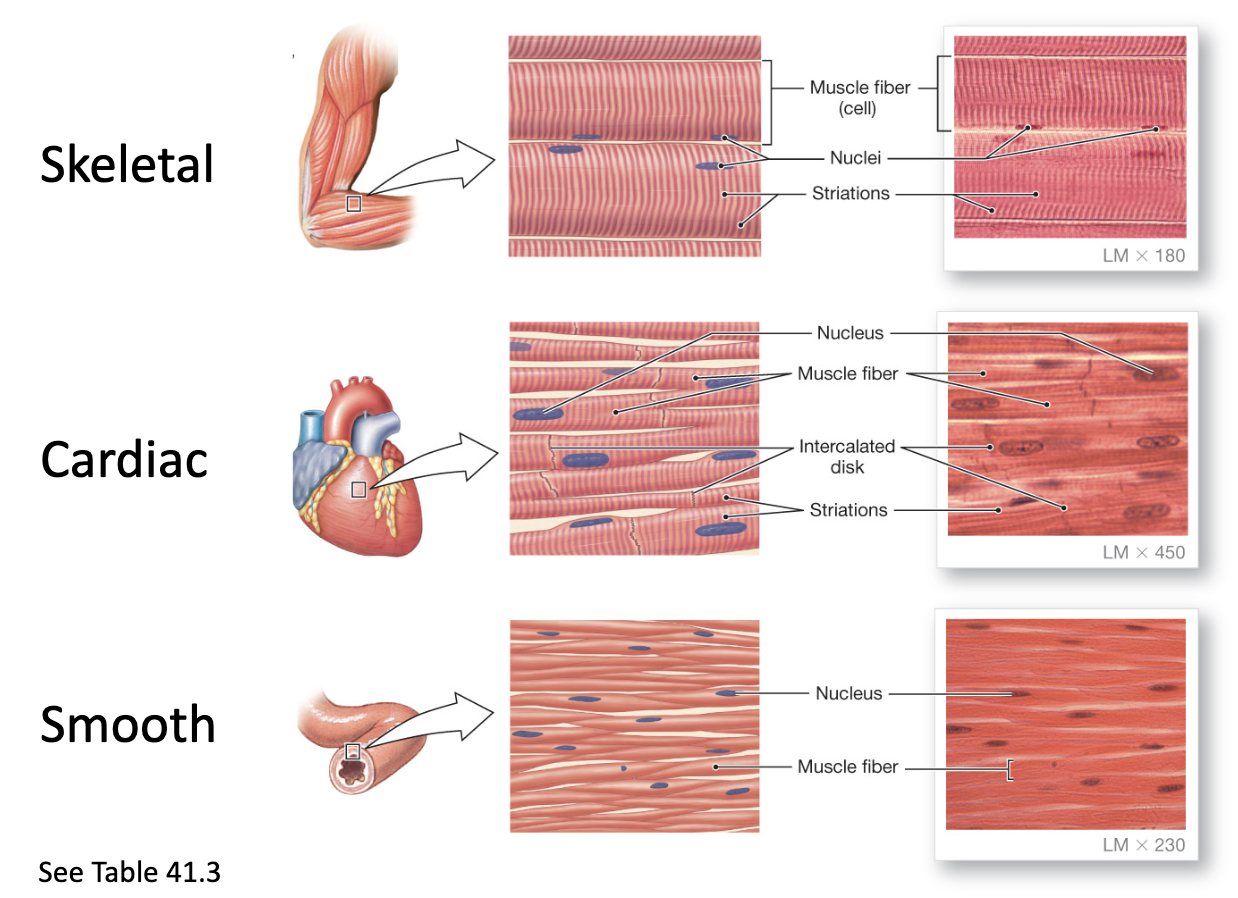
Smooth - Walls of hollow organs (intestines, blood vessels). Involuntary control
Skeletal - Attached to bones, important for movement. Voluntary control
Cardiac - Found in heart (pumps blood). Involuntary control
What are the two textures of muscle?
Smooth - Smooth muscle
Striated (striped) - Skeletal/cardiac
What is nerve tissue?
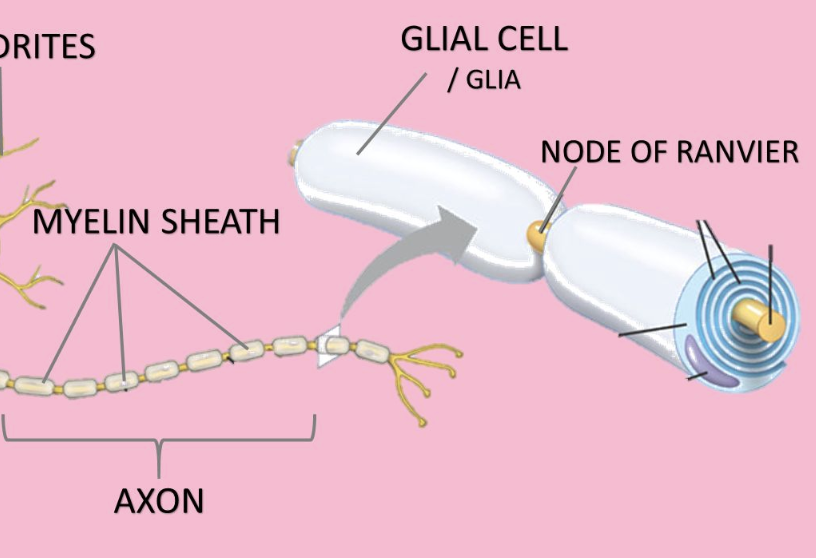
It makes up the nervous system, which is composed of neurons and supporting cells called neuroglia
What is a neuron and what is its structure?
It produces and conducts electrical impulses.
It’s made up of:
Cell body: Contains nucleus
Dendrite: Branched extensions that receive signals and carry them to the cell body
Axon: Long extension that conducts electrical signal from body to other cells

What is neuroglia’s function?
They make up the myelin sheath, which supports and insulates neurons and helps make their signals stronger.
What is Homeostasis?
The ability of an organism to maintain a stable internal environment
Ex: Temp, pH, concentrations of glucose/oxygen
What is a negative feedback loop?
It is one of two ways to maintain homeostasis. The output of a process is fed back to limit the process down to a set point.
What is an effector and how does it work?
The part of the negative feedback loop that carries out the response, often a muscle or a gland. It usually changes the condition back to a set point.
It can work in pairs, where both work in opposite directions to maintain homeostasis.
What is an example of a negative feedback loop in humans?
When blood temperatures exceed 37ºC, the hypothalamus signals effectors to return conditions back to a set point.
What is a positive feedback loop?
When the output of a process amplifies the original change. It does not maintain homeostasis.
What is an example of a positive feedback loop?
The uterine stretching in childbirth leans to oxytocin release, which stimulates contractions; the stretching from contractions releases more oxytocin.
What is thermoregulation?
Temperature control in a system.
What are the four types of heat transfer and how do they work?
Radiation - Transfer through electromagnetism (sunlight)
Conduction - Heat transfer between 2 objects
Convection - Heat transfer by movement of liquids/gases
Evaporation - Heat loss when a liquid becomes a gas
What are the three types of temperature regulation in animals?
Endothermic - Use metabolism to generate body heat and maintain stable internal temperature (mammals, birds)
Ectothermic - Use the environment to maintain body temperature (reptiles, amphibians, fish)
Heterothermic - Have both endo/ectothermic traits
What is an example of an ectothermic behavior?
Lizards sunbathing to raise body temperature.
What is an example of an endothermic behavior?
Blood flow:
Dilation of vessels - More heat loss
Constriction of blood vessels - Less heat loss
What are Homeothermic Ectotherms and what is an example?
Animals that use behavior to maintain temperature homeostasis.
Large fish can maintain parts of their at higher temps than water through concurrent exchange (warm blood from arteries transfer to cooler veins)
What is Thermogenesis and what are its two forms?
The use of normal energy metabolism to produce heat. It is activated when temperatures fall below a critical threshold.
Shivering - Rapid muscle contractions generate heat through ATP hydrolysis
Nonshivering - Metabolism of fats is altered to produce heat instead of ATP. Occurs in Brown Adipose Tissue (BATs)
What are hormones? (Animals)
Regulatory chemical messengers that are secreted and carried by blood over large distances. Only target cells with receptors for them will respond.
What is the endocrine system and what are endocrine glands?
The endocrine system are organs/tissues that produce hormones
Endocrine glands are specialized organs that secrete hormones
What is the function of cell receptors?
They bind to a hormone and cause a signal for change in a cell.
What are the two basic hormone characteristics?
They must be complex enough to convey regulatory information to specific target cells
They must be stable enough to resist destruction before reaching the target cells
What are the three classes of hormones and how are they made?
Peptides/Proteins - Encoded in DNA and made like any other protein. Ex: Insulin
Amino Acid Derivatives - Made by enzymatic modification of a specific amino acid. Ex: Melatonin
Steroids - Made by enzymatic modification of cholesterol. Ex: Testosterone, estradiol, corticosteroids
What are the two types of soluble hormones, what is their polarity, and what are they soluble in?
Lipophilic (nonpolar) - fat-soluble
Hydrophilic (polar) - water soluble
What are Lipophilic Hormones, where do they bind to, and what is their active period?
They are steroid/thyroid hormones. They travel on transport proteins in blood
Bind to INTRAcellular receptors because they can pass through the cell membrane’s lipid bilayer. They have a long active period (days/weeks)
What are Hydrophilic Hormones, where do they bind to, and what is their active period?
They are any non-steroid hormone. They are freely soluble in blood
Bind to EXTRAcellular receptors because they can’t pass through the cell membrane’s lipid bilayer. They have a short active period (minutes/hours)
What is Thyroxine?
A thyroid hormone formed from coupled iodine, found in salts
What are the facets of hormone signaling?
Hypothalamus - Master regulator of the endocrine system
Secretes releasing/inhibiting hormones and controls pituitary activity
Pituitary Gland - Responds to signals from hypothalamus
Composted of anterior/posterior pituitary
Pituitary hormones target endocrine glands/directly act on tissues
How do the endocrine system facets contribute a negative feedback loop?
Increased hormone levels from target glands inhibit hypothalamus and pituitary and vice-versa. Helps maintain homeostasis
What are the eight major glands
Hypothalamus
Pituitary
Thyroid
Parathyroid
Adrenal
Pancreas
Ovary/Testis
Pineal
What are thyroid glands and what are their function?
They secrete thyroid hormones (T3/T4)
They are the only molecules that require iodine
They regulate and control carb/lipid metabolism to maintain basal metabolic rate
What is a goiter and how does it form?
It is an enlarged thyroid gland from iodine deficiency, which is caused by increased TSH from low levels of T3/4
What is hypo and hyperthyroidism?
Hypothyroidism - Abnormally low release of T3/T4
Symptoms: Fatigue, overweight, coldness, decreased metabolism
Treatment: Thyroxine pills
Hyperthyroidism - Abnormally high release of T3/T4
Symptoms: Weight loss, nervousness, fever, high metabolism
Treatment: Thyroxine inhibitors
What is insulin, its source, and its function? (Pancreas Hormones)
It comes from beta cells of the pancreas, and it promotes cellular uptake of blood glucose to lower blood glucose levels
What is glucagon, its source, and its function? (Pancreas Hormones)
It comes from alpha cells of the pancreas; it acts antagonistically to insulin
It stimulates glycogen breakdown to release glucose from the liver/adipose and increase glucose levels for cell energy