Economics Unit 1
 Call Kai
 Learn
Learn Practice Test
 Spaced Repetition
 Match
Match Flashcards
 Knowt Play
1/96

There's no tags or description
Looks like no tags are added yet.
Name | Mastery | Learn | Test | Matching | Spaced | Call with Kai | Chat |
|---|
No analytics yet
Send a link to your students to track their progress
97 Terms
Explain the basic economic problem
Wants are unlimited. Resources are finite so therefore not all wants can be met. This creates scarcity.
What makes a resource scarce
Less of it exists that what people want at a zero price
State the chain following scarcity
Scarcity → Opportunity Cost → Choice
Explain what is meant by choice
Since resources are scarce economic agents must allocate these resources and choose where to allocate them
State what are the 3 economic agents
Individuals
Firms
Government
State what is scarce for individuals / households
Income and time
State what is scarce for firms
Revenue, premises, labor
State what is scarce for governments
Tax revenue
For these economic agents if a resource is scarce what does this mean?
That the agent has to choose where to allocate their scarce resources
State what is meant by opportunity cost
The benefit of the next best alternative forgone when choosing something else
Does opportunity cost apply to all resources?
No free goods have no opportunity cost
Why exactly do free goods have no opportunity cost?
As obtaining them uses no scarce resources so no choice is made since no resources are allocated to obtaining them
What must every economy do?
Answer the 3 fundamental questions of resource allocation
State what are the 3 fundamental questions of resource allocation (Include a brief explanation)
What to produce (Given the scarce amount of resources it needs to be decided what goods and services are to be produced and at what quantities)
How to produce (What combination of the factors of production should be used to produce said goods and services)
For whom to produce (How is the output of goods and services shared out in an economy? What decides who get what goods and services)
The way an economy answers the 3 fundamental questions of resource allocation determines what?
The economic system of the economy
At its core what does economics study
Economics studies how the economic agents allocate scarce resources
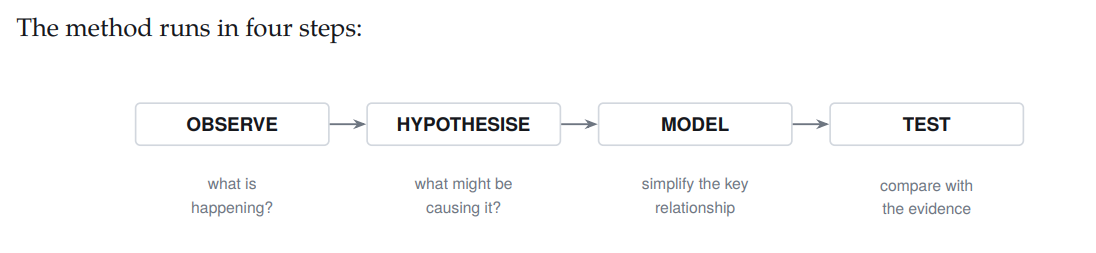
What are the 4 steps of the research method for economics
Observe (What is happening)
Hypothesis (What might be causing this)
Model (Simplify the key relationship)
Test (Compare the model with evidence)
State what is meant by a model
A model is a simplified representation of reality that is built on assumptions
What make a model usable but is also its limitation and explain why
Simplification make the model usable but also limits the accuracy of the model
Why are controlled experiments not possible in economics like in other subjects like physics?
As an economist cannot hold an entire economy just to test a theory
What is another issue with trying to prove an economic theory
Correlation does not mean causation, if to variables increase at the same time it does not mean because one affected the other, a third variable could be driving both
State what is meant by positive statement
An objective statement that can be tested against evidence and shown to be true or false
State what is meant by a normative statement
A subjective statement based on a value judgement which cannot be proved to be true or false by evidence
SUMMARY WHAT IS THE DIFFERENCE BETWEEN A NORMATIVE AND POSITIVE STATEMENT
Positive - Objective - Can be shown to be T OR F with evidence
Normative - Subjective - Cannot be shown to be T OR F with evidence
If you are confused look at this table to be able to tell the difference between positive and normative

What are the signal words for a normative statement
Should be, ought to be, unfair, best, too high
What are signal words for positive statements
Measurable quantities + relationships
Does including numbers make a statement positive?
No for example the statement : “Income tax should be raised to 45%” This statement is subjective and cannot be proven using evidence so it normative
State what does Ceteris Paribus mean
“all other things be equal”
Explain ceteris paribus
That we must assume that all other factors are equal when examining how one variable affects another
Why is ceteris paribus used
In reality many variable change at once, so the effect of any single one cannot be isolated
Holding all other variables constant allows a cause-effect relationship to be identified
Why is using ceteris paribus not accurate
Since in reality multiple other variables change rather than one a prediction cannot be observed
State what is meant by a time period
Time periods: Defined by which factors of production can be varied (change)
In the short run which factors of production can change
In the short run at least one factor of production is fixed (does not change), while the variable factors can change
In the short run which factors of production are usually fixed and which are usually varied
Fixed: Capital and Land
Varies: Labor
In the long run which factors of production can change
All factors of production are variable EXCEPT Technology which remains unchanged
In the Very Long Run which factors of production can change
All factors of production are variable as well as technology and other background conditions can change
NOT that each “long run and short run” don’t have a fixed time scale as it depends on the industry and how quickly each factor of production can be varied
OK
State what is meant by a factor of production
The scarce resources used in the production of goods and services
State the definition of each factor of production
Land: All natural resources used in producing a good or service
Labor: The human input/effort (mental or physical) required to produce a good or service
Capital: Any man-made resource used in producing a good or service
Enterprise: The factor that organizes the other 3 factors of production and bears the risk of production
State the reward for each factor of production
Land: Rent
Labor: (Wages → Unskilled Physical labor) + (Salaries → Skilled mental labor) Blue collar vs White collar
Capital: Interest
Enterprise: Profit
When referring to capital as in one of the factors of production we are referring to capital goods NOT money
Oks
Why is money not a factor of production
Money is not used in the production of goods and services rather a means of acquiring resources
State what are the two types of capital
Human Capital and Physical Capital
State what is meant by physical assets
Man-made productive assets
State what is meant by human capital
The skills, knowledge and expertise embodied in the workforce
How is physical capital created
Investments by firms and governments
How is human capital created
Through education, training and work experience
What is the effect of physical capital
Raises output per worker by giving workers more tools to work with
What is the effect of human capital
Raises labor productivity by making workers more effective
SUMMARY THE EFFECTS OF HUMAN AND PHYSICAL LABOR
Physical - Raises Output per worker
Human - Raises Labor productivity
EXPLANATION: Physical capital improves how much each worker outputs as they have better tools, however the worker themselves have the same skills and effectiveness, while human capital increase labor productivity as each worker can produce more and be more efficient with the same tools so in conclusion
One improves the tools and the other improves the workers (People using the tools)
What does an increase in Human or Physical capital do to the PPC
It shifts it outwards
Explain how individually an increase in Human Capital and Physical Capital cause an outwards shift of the PPC
Physical Capital - Increases the quantity of capital in an economy
Human Capital - Increase the quality of labor in an economy
Since either an increase in the quantity and quality of the factors of production cause a shift they do to
State what is meant by specialization
The concentration by a worker, firm, region, or country on a narrow range of tasks or products
State what is meant by division of labor
Dividing the production process into simpler tasks where each task is carried out by a worker
How does division of labor relate to specialization
Division of labor is specialization applied within a production process → Division of labor leads to specialization
State 5 advantages to specialization and division of labor
Since workers only do one task they become more skilled at it so labor productivity rises
Since workers are more skilled and efficient each worker can produce more with the same input so Higher output per worker → lower average cost per unit
Splitting the production process into simpler tasks allows specialized machinery to be used which can increase efficiency and thus overall output
Workers can be matched to the task they are the best at
Higher output allows firm to supply/serve international markets
State 5 disadvantages to division of labor and specialization
Repetition of doing the same task causes boredom and demotivates workers which can reduce productivity and lower the quality of output
Bored workers are more likely to leave and be absent thus raising absenteeism and labor turnover which increases recruitment and training costs
Workers have less occupational mobility
The production process becomes dependent on each worker so if one is absent they can’t be easily replaced and so production is affected
Division of labor and specialization works well with standardized mass produced products so this reduces variety and consumer preferences are less well met
Describe the enterprise factor of production
They take the risk of organizing and combining the other 3 factors of production
Outline the 2 functions of an entrepenuer
Organization: Entrepreneurs decide what to produce and in what quantities then acquires, organize and combines the other 3 factors of production to do so
Risk-Bearing: Commits their own or borrowed funds without knowing whether the output will sell. Returns are not a guaranteed and may be negative
State what is meant by an economic system
The way an economy is organized to answer the 3 fundamental questions of resource allocation.
What to produce, for whom to produce, how to produce
What 2 ways are economic systems classified - IMPORTANT
Who makes the decisions
By what mechanisms resources are allocated
State what are the 3 economic systems
Market (Free market)
Planned (Command)
Mixed
In a market system who decides how resources are allocated
Households and firms independently
DECENTRALIZED
In a planned economy who decides how resources are allocated
The government through a central planning authority
CENTRALIZED
In a mixed economy who decides how resources are allocated
Both the private and public sector
In a market economic system who owns the factors of production
Private individuals and firms
In a planned economic system who owns the factors of production
The state/government
In a mixed economic system who owns the factors of production
Both the public sector: government, and the private sector: Individuals and private firms
In a market economic system what mechanism allocates resources
The price mechanism
Price Mechanism: The interaction of the forces of demand and supply
How are resources allocated in a planned economic systems
By the government
How are resources allocated in a mixed economic system
By the price mechanism also however modified with government intervention
State what is meant by the price mechanism
The allocation of resources by the interaction of the forces of demand and supply
In the price mechanism what is the role of price
Signaling, the greater the price it signals to producers that consumers want more of that good
Incentive, price creates an incentive for producers to produce more of that good and allocate resources to it
Rationing, A greater price limits the number of people who are able to obtain that good by only allowing consumers who are willing and able to pay to acquire it
In a market economic system how are the 3 basic questions of resource allocation answered

In a planned economy how are resources allocated
Primarily by administrative decision rather than by price
How are resources allocated in a mixed economic system
Most resources are allocated by the price mechanism in the private sector but the government intervenes where the market alone produces an unsatisfactory outcome
State 4 examples of “unsatisfactory outcomes” that governments have to correct and intervene in a mixed economic system
Direct provision of public goods: Private firms have no incentive to produce public goods since they are non-excludable so thus they must be provided by the government otherwise they will not be provided.
Provision of merit goods: In a free market system merit goods are under consumed and under supplied the government must intervene and increase their consumption and supply
Regulation of demerit goods: To prevent overconsumption of demerit goods governments must regulate their consumption and production using regulation laws AND Taxation
Unfair distribution of income: through taxes and welfare benefits (which only the government can enforce) the government can increase income equality
So in essence each economic systems differ in degree of government intervention
TRUE

State 3 advantages of a market economic system
Consumer sovereignty - Firms produce what consumers want
The motive of profit incentivizes higher quality production and more variety
Competition leads to lower prices and increased quality, as well as increased efficiency
State 3 disadvantages to market economic systems
Public goods are not provided at all since there is no profit incentive. Merit goods are under-consumed and under-produced while demerit goods are overproduced and overconsumed
Who gets resources is purely decided by their ability to pay so often times poorer people do not have access to basic needs
Fast moving economy results in market failure, recession, and monopolies
State 4 advantages to a planned economy
Public and merit goods are not undersupplied since they are supplied by the government
Output can be distributed far more equally since it is a centralized authoritative system
Resources can be directed to national priority quicklu
No waste from competition
Consumers are not exploited
State 3 disadvantages to planned economic systems
Less variety and output is decided by government so output necessarily won’t be what consumers want
No profit incentive or competition decreases worker motivation, quality and innovation
Government may lack information prices convey which may result in shortages and surpluses persisting
State one disadvantage to a mixed economic system
Government intervention may be inefficient or politically motivated
State what is meant by government failure
When a government is intervention is ineffective and not efficient and is rather politically motivated rather than focused on bettering the economy
State what is meant by a PPC
A PPC shows the maximum combination of two goods an economy can produce when all of its resources are being employed efficiently given its current state of technology
What 4 assumptions does a PPC rest on?
Only 2 goods are being produced
the quantity and quality of the factors of production are fixed
The state of technology given
on the curve all resources are fully and efficiently employed towards producing only those two goods
What 3 things does a PPC show and how?
Good to know don’t need to memorize

U know this already 100% but just to remind you
oks

What does a straight line linear PPC graph show?
The factors of production are perfectly suitable for producing both goods. Each extra unit of one always costs the same quantity of the other so an example of this is producing one chocolate cake is not producing one chocolate cookie
What does a concave (Curved) PPC show?
The factors of production are not equally suited to produce each good. As output of one good expands resources that are less suited to it are progressively transferred, so each extra unit costs more of the other good than the last.
1.5.2 Why is a PPC concave? (example) Resources are not equally suited to both goods, so each extra unit of one good costs more of the other. Example: an economy producing wheat and steel gives up 10, then 20, then 30, then 40 wheat for each extra 10 steel. The first resources moved are poor at wheat and good at steel, but the last are the best farmers and farmland, which are poor at steel. A straight-line PPC (constant opportunity cost) happens only when factors are perfectly substitutable, e.g. identical workers making hoodies and T-shirts at a fixed 1 hoodie : 2 T-shirts.
What are the 2 things that cause a shift in the PPC?
A change in the quality of the factors of production
A change in the quantity of the factors of production
What causes an outwards shift in the PPC
An increase in the quality of the factors of production
An increase in the quantity of the factors of production
What does an outwards shift in the PPC show?
Economic Growth - As the productive potential of the economy has increased
What causes a PPC to shift inwards
A decrease in the quality of the factors of production
A decrease in the quantity of the factors of production
What are the primary causes of an inward shift of the PPC
War
Natural Disaster
Depletion of resources
Destruction of capital
Describe what is meant by a pivot shift of the PPC
A change affecting the ability of an economy to produce one good only