bio midterm 2 lecture notes (pls dont die)
 Call Kai
 Learn
Learn Practice Test
 Spaced Repetition
 Match
Match Flashcards
 Knowt Play
1/42

There's no tags or description
Looks like no tags are added yet.
Name | Mastery | Learn | Test | Matching | Spaced | Call with Kai | Chat |
|---|
No analytics yet
Send a link to your students to track their progress
43 Terms
what are glycoproteins and glycolipids?
carbs (glyco) attached to lipids or proteins that help cells recognize each other.
what are 6 main things transmembrane proteins are doing?
-transporting via channels or gates
-enzymes activation
-signal transduction via a signaling molecule + receptors
-cell-cell recognition via glycos
-intercellular joining
-attaching the cytoskeleton and matrix
water potential
-how much water can move around
-water wants to move from high to low concentration
-adding solute or more pumps for water will help increase the water potential
-this also relates to tonicity
what is a G protein coupled receptor

what is a RTK

what are ligand gated ion channels
gate opens when ligand touches the receptor so that things can go through
what are intracellular receptors?
-receptors that are inside the nucleous/cytosol, and can affect gene regulation
-example: steroid hormones, TFs, etc.

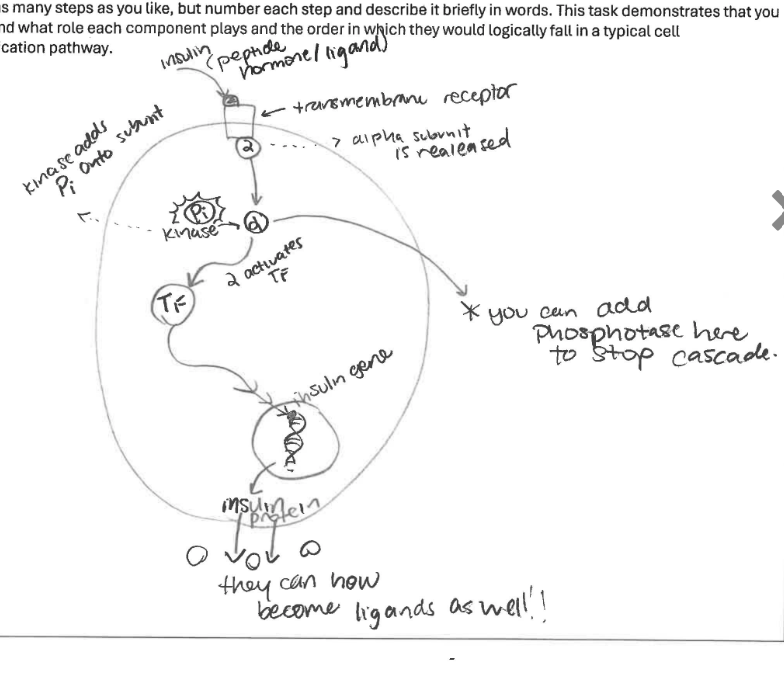
what is a phosphorylation cascade?
a cascade stops when phosphatase removes phosphate groups from ATP and thus stops energy from having potential to transfer between active proteins and inactive proteins. kinase activates the reaction

what are second messengers?
small, nonprotein, molecules or ions that are hydropphobic and thus get through
help with G proteins and RTKs
cAMP and Ca+2 are very common messengers.
what is a signal transduction pathway?
essentially, everything involved in a gene regulation response. after the ligand signals to a receptor, the cascade occurs with the second messenger often helping initate it. then, the transcription factors get activated and decide what genes are coded for.
what is membrane potential?
the charge gradient across a cell membrane. It’s normal for cells to have a membrane potential, and the inside of the cell is usually more negative than the outside of the cell.
what is depolarization?
making charges more similar inside and outside of the membrane
in the sodium-K pump of neurons, what is the ratio needed?
3 Na and 2 K.
where does action potential state in a neuron?
the axon hillock
positive ions come into the neuron via dendrites, then travel to the hillock before getting to the axon terminal
explain the different stages of action potential with voltage-gated channels
voltage channels are closed, because there hasn’t been a change in potential yet. resting potential of a neuron is about -70 mV
the neuron gets depolarized—why? which brings the neuron to the threshold level, about -55 mV
Na+ comes in to make the cell very positive very quickly
Na+ closes quickly as the K+ moves out, which makes things negative again.

when do two neurons, pre and post-synoptic, meet together and send signals to each other?
as the signal from a pre-synaptic cell travels to its axon terminal, it connects to the dendrites of the post-synpatic cell.
the neurotransmitters inside it move into the synaptic cleft, and then move into ligand-gated ion channels on the dendrite.
what is transport work in a cell?
moving proteins through a channel with ATP powering it.
if you think about it, work is basically when something isn’t going to happen without help, aka the need for ENERGY COUPLING!
what is mechanical work
ATP binds to motor proteins to help it move
why do enzymes work to energy couple exer and endergonic reactions together?
what affects enzymes?
-cofactors
-inhibitors
-pH
-temp
enzyme: substrate concentration
reactant to product concentration
what is allosteric regulation
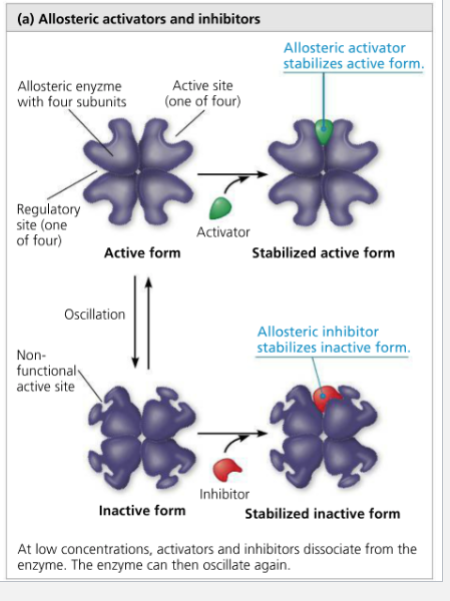
what is cooperativity?

NAD+ is a shuttle, how does that work?
glycolysis: where, what, why
-sugar split in two 3-carbon molecules of pyruvate
-NADH formed as a product after gaining a hydrogen
-cytoplasm
-2 ATP net gain, 2 NADH gain (2 electrons moving around)
-important for all types of respiration, including fermentation. without this step, the products cannot be products in a reaction.
pyruvate oxidation: where, what, why
-mitochondrial matrix (little inside pocket)
-CO2 is released
-NADH created again as pyruvate is oxidized and forms acetyl CoA

citric acid cycle: where, what, why
-mitochondiral matrix
-3 NADH and 1 FADH 2 both produced, as well as 1 ATP
-acetyl coA becomes citrate, then CO2 is released (2 per cycle, 6 total though)
step 1: oxaloacetate (4 carbon molecule attaches to 2-C acetyl group to make citrate)

oxidative phosphorylation: where, what, why
-inner mitochondrial membrane
-ETC
-ATP made
-FADH2 and NADH are reoixidized and give away all of the electrons they have saved up. this is important because oxygen is going to take the electrons from them and bring it to H2O.
-26-28 atp produced here!
when we say all foods lead to the citric acid cycle, what does that mean?
essentially, all roads lead to the citric acid cycle, not everything needs to get through every stage

what is chemiosmosis?
it is when protons move across a membrane to power ATP synthase.
the potential energy of the gradient transfers to kinetic energy to help get ATP formed. this kinetic energy then converts back to potential energy when it is sotred in ATP bonds!

what are all of the complexes in the ETC in MC for?
essentially, cells can’t release all of their energy out at once. there are 4 complexes in the membrane that help diffuse energy so the cell does not explode. each complex creates redox reactions as the electrons move on. oxygen is the last acceptor!
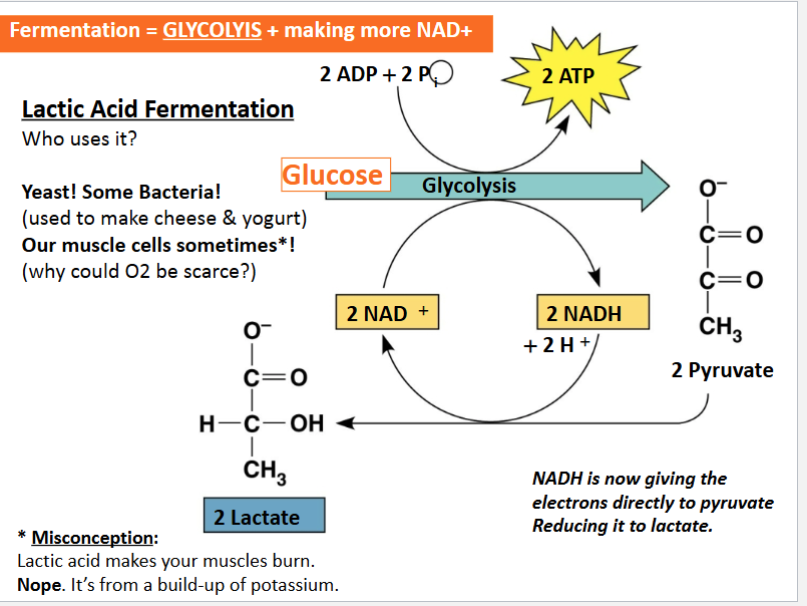
how does fermentation work?
as you can see in the picture, glucose goes through glycolysis, making 2 ATP. as that happens, NADH and NAD+ are going back and forth between each other. The NADH gives electrons to pyruvate which makes it into lactate!
concept check: the light cycles don’t produce anything that shows up in the final reaction of photosynthesis, so why do they still matter?
the light reactions (photophosphorylation) make light energy into ATP and use it to move NADP+ to NADPH.
the ATP and NADPH are used to help fixate carbon into glucose in the calvin cycle.
what are photosystems?
PS II and PS I are the light reactions of photosynthesis. as photons hit chlorophyll, the heat from the electrons moving up levels in chloropyll makes them transfer heat between each other. this transfer of energy eventually goes to the chlorophyll a molecules that give their electrons away to an acceptor, building lots of energy up.
lets discuss PS2
-the first of them!
-special a chlorophyll is called P680+ and is the strongest oxidizing agent known
-H from H2O goes into the thylakoid space
-Oxygen left behind becomes O2 which is why it is a product of PS
-only PS 2 makes oxygen and uses up water. only PS 1 makes NADPH
-where are the electrons coming from and going to?

what is cyclic electron flow?

chemiosmosis in PS before the calvin cycle!

what is the calvin cycle like in PS?
-rubisco fixates carbon into a new 6-C molecule that immediately becomes a 3-C molecule. this is done via ATP turning into ADP
-G3P is formed, 6 to be exact. 5 continue to regenerate RuBP and 1 goes to form glucose
why do leaves’ structure matter?
firstly, leaves are flat, so they maximize surface area. second, they have little pores (stoma) that are able to open and close, which are on the underside of leaves, which helps maximize gas exchange without losing water.
lastly, water and nutrients get to the rest of the plant because the chloroplasts are close to veins of the plant.
quick! draw out a plant sketch with all of the different parts.
why are the stomata such a big deal for plants?
plants have to choose between opening their pores to get CO2 and closing them to save water. if things are too dry or hot, plants are in a tricky position. they choose water instead of food (CO2—> glucose).
however, if oxygen increases, rubisco is going to use oxygen instead of CO2 into RuBP. O2 needs ATP and will steal it, which makes the entire system go haywire!
with this problem of stomata, how do we work around it?
C4 plants:
-fix carbon dioxide and move acid to rubisco
-break acid apart
-calvin cycle
-only certain cells (bundle sheath cells) have rubisco. so calvin cycle is in a seperate position than other parts of the plant. as a result, C4 plants fix CO2 in other cells (mesophyll cells) with PEP-C which doesn’t like oxygen.

what are CAM plants?
open stomata only during the night so water is less likely to leave. in the daytime, the stomata close!
what are the three steps of cell communication?
recption → trandsuction → response