RADT - Benign & Malignant Disease
 Call Kai
 Learn
 Practice Test
 Spaced Repetition
 Match
 Flashcards
 Knowt Play
 Podcast
1/43

There's no tags or description
Looks like no tags are added yet.
44 Terms
How do tumours form?
Tumours are a result of abnormal cellular proliferation. Either cellular proliferation is:
abnormal
or a normally non-dividing cell starts to proliferate (aka divide)
They have a higher rate of cell replication compared to cell death
What is cell proliferation?
An increase in the # of cells (cell growth)
What are the 3 classifications of normal cellular proliferation and give examples?
Constantly renewing - ex. bone marrow, GI mucosa, ovary, testis, epithelial
Slowly proliferating (in response to injury) - lung, liver, kidney, endocrine glands
Static = unable to repair injury except with scar tissues - muscle, bone, cartilage, nerve, connective tissue (b/c these cells are non-dividing)
What is mitosis in normal tissue?
A process of cell division where a single cell splits into two identical daughter cells with the same genetic material. In normal tissue, these cells continue to divide and differentiate (process of a cell starting as immature and becoming a mature cell) until mature cells with specific functions result. Mitosis is controlled by genes in the cells DNA.
What is hyperplasia?
an increase in the number of cells
What is hypertrophy?
an increase in the size of cells in tissue
Why might normal tissue have cellular changes? Does that indicate cancer?
Tissues with self-renewing capacity may demonstrate cellular changes due to irritation or injury which are reversible and not neoplastic (cancer)
Explain Barrett’s esophagus
It is when squamous cells in the esophagus are replaced by goblet cells that secrete mucus due to acid causing inflammation in the esophagus
What is metaplasia?
replacement by a cell type not normally present (e,g, Barrett’s esophagus)
What is dysplasia?
disordered growth - abnormal development of tissue like an alteration in the size, shape, and organization of adult cells (e.g. due to carcinogen; pre-cancerous)
What is anaplasia?
(to form backwards) highly abnormal cells that do not resemble cells of origin (i.e. daughter cells look less and less like their parents). They do not respond to normal regulatory mechanisms. (synonymous with malignant)
What is atrophy?
decrease in the cells size after it has reached a normal, mature size
What is cancer?
A group of over 100 diseases characterized by abnormal, uncontrolled cell growth

Name the differences that tell you the one on the right is a cancer cell:
Large vs small cytoplasm
spherical nucleus vs irregular nucleus shape
fine chromatin vs coarse chromatin
single nucleolus vs multiple nucleoli
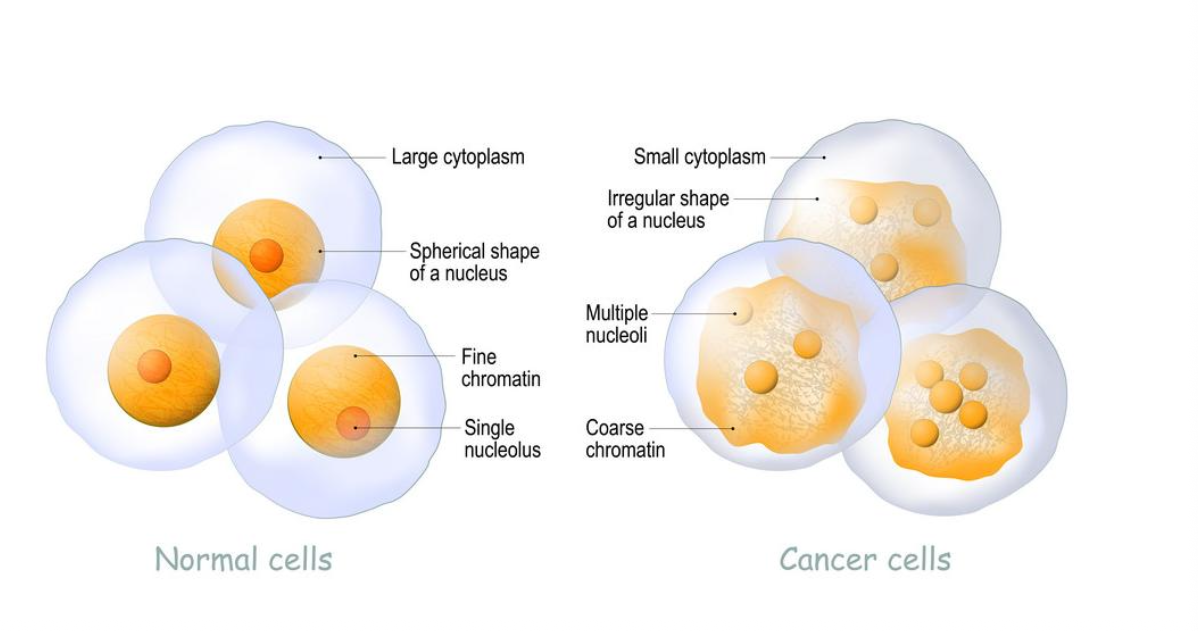
Describe disorganized and uncontrolled cell growth in cancer.
Cancer cells may change in size, shape, and organization from its parent cells
these cells are unable to perform necessary cellular functions
these cells grow and spread at a rapid rate
What are genes involved in cancer called?
oncogenes & tumor suppressor genes
How can gene mutations occur?
exposure to carcinogens (usually repetitive exposure)
viruses, sunlight, radiation, cigarette smoke, alcohol
familial mutations passed down from generations
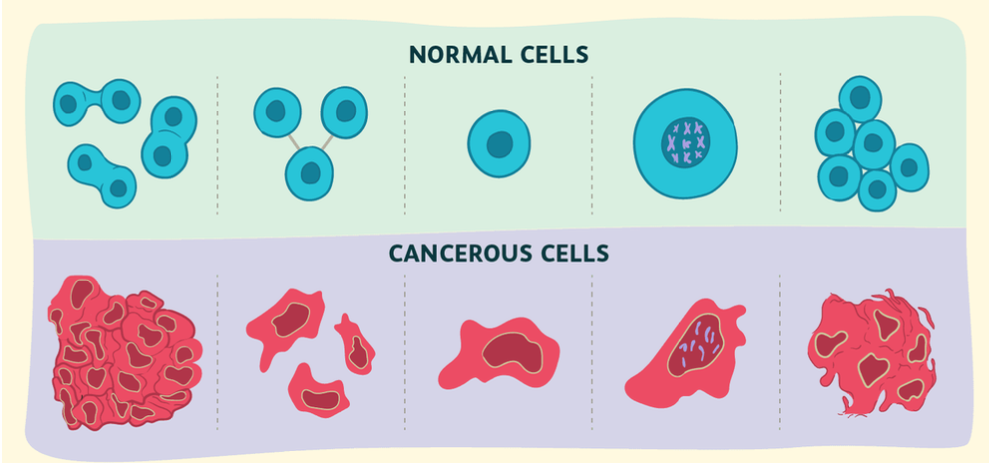
What tells you the purple line is cancerous?
Cells that are growing and dividing
Variations in size and shapes of cells.
Nucleus that is larger and darker than normal.
Abnormal number of chromosomes arranged in disorganized fashion.
Cluster of cells without a boundary.
What is the P53 Tumor Suppressor Protein and why is it relevant?
Usually triggers cell suicide when there is excessive DNA damage. Mutation or loss of function in p53 gene can lead to cancer.
What is differentiation?
Cells differentiate aka change/mature to develop specific functions
What are qualities of benign cells?
well differentiated cells
closely resemble their parent cells
not cancer
can sometimes be pre-cancerous
do not metastasize
What are malignant cells?
abnormal cells that divide without control, invade nearby tissues, and do metastasize
There is evidence that cancer arises from the transformation of a single stem cell or precursor cell which proliferates to form a clone. This proliferative response is permanent and inherited by subsequent generations of cells. New sub clones may arise by mutation and many sub clones will have new characteristics leading to heterogeneity (cells range in level of differentiation).
What is neoplasm?
a new growth or lesion that is abnormal - can be benign or malignant
What does treatment target?
the cells that are clonogenic; the main target of radiation is DNA strands
What is tumour growth?
higher rate of cell replication compared to cell death (balanced in normal cells). As a tumour grows larger the blood, oxygen, and nutrient supply becomes inadequate creating areas of necrosis = dead tissue
What are qualities of benign tumours?
not cancer
do not metastasize
usually well differentiated
often encapsulated (by CT)
slow growing
no local invasion
normal nucleus
not usually life threatening
benign tumours of the brain are behaviourally malignant because of their adverse effects
named “-oma” usually (but also true for some malignant tumours)
what are malignant tumours?
are cancer
do metastasize
poorly differentiated - do not resemble their parent cells
edges are not encapsulated, are irregular
fast growing
local invasion
variable, irregular nucleus
usually life-threatening if not treated
What are the differences b/w malignant and benign tumours?

What does pathology do?
distinguishes b/w benign and malignant cells which
influences treatment choice
determines the histogenesis (the origin of the cancer).
gives information regarding sequence of events of carcinogenesis.
provides prognostic outcome (anticipated outcome like life expectancy or 5-year survival) information based on the level of differentiation of the cells (better prognosis if cells are well differentiated/closer to their parent cell).
post-op evaluation of clear margins which tells us if malignant cells remain after tumour was removed and dictates future treatment decisions
What is histopathology?
examination of a biopsy or surgical specimen by a pathologist. The specimen is processed and histological (histo=tissue) sections are placed on glass slides and examined under a microscope.
What is cytology?
microscopic examination of a single cell or small clumps of cells
What is chemical pathology?
the chemical analysis of tissue, blood, or urine
What is a cancerous tumour of origin in the connective tissues and cartilage called and give an example.
Sarcoma
ex. Chondrosarcoma - tumour of the cartilage
What is a cancerous tumour of origin in epithelial cells called?
carcinoma
ex. Squamous cell carcinoma of the lung
What is a cancerous tumour of origin in the glandular epithelial cells called?
Adenocarcinoma
ex. Adenocarcinoma of the stomach
Name the tumour classification for: Glandular epithelia, squamous epithelium, connective tissue, smooth muscle, bone, hematopoietic (WBCs), lymphoreticular (lymph), neural

What is Wilm’s tumour?
kidney cancer in children
What is Kaposi’s sarcoma
tumour from connective tissue that line GI tract
Define Burkitt’s Lymphoma
rare, fast-growing type of blood cancer that starts in your B-cell white blood cells
What is Hodgkin’s disease?
lymphoma
What is the most common type of cancer? Why?
carcinoma - cancer of the epithelium so cells that cover the external surface of the body or that line the internal cavities and line the glands (85%) These cells are the first point of contact of the body with the environment and thus things like carcinogens (directly - squamous cells; indirectly - glandular cells)
Why are epithelial cells more susceptible to cancer?
Epithelial cells usually have fast cell division, their DNA can be damaged by carcinogens more often than non-dividing cells

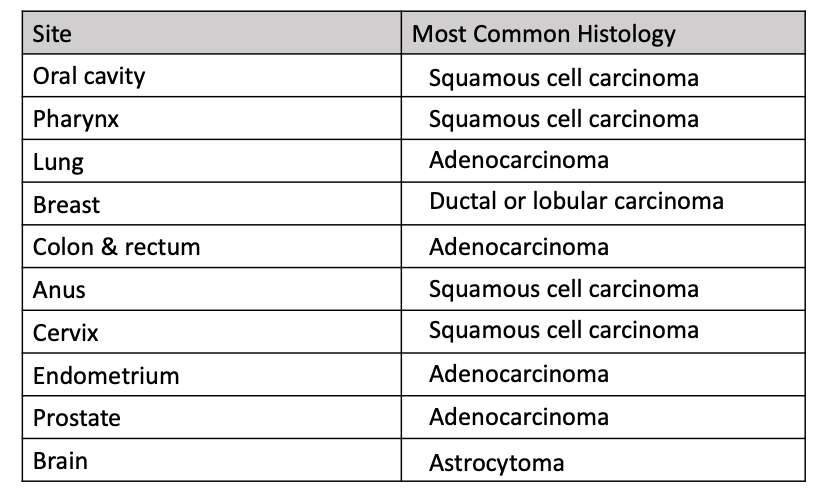
Complete this table:
Which benign conditions are treated with radiation?
acoustic neuroma - noncancerous tumour that grows on the main nerve leading from the inner ear to the brain
brain arteriovenous malformation - abnormal tangle of blood vessels in the brain where high pressure arteries connect directly to veins without normal intervening capillaries
Grave’s Disease - autoimmune disorder where the immune system attacks the thyroid gland and causes hyperthyroidism
heterotrophic bone formation - abnormal growth of true, mature bone tissue in soft tissues and muscles where bone normally does not exist
keloid scars - thick, raised growths of scar tissue that extend well beyond the edges of the original skin injury
pituitary adenoma - benign tumour that forms in the pituitary gland at the base of the brain