Mammalogy Exam 3
 Call Kai
 Learn
 Practice Test
 Spaced Repetition
 Match
 Flashcards
 Knowt Play
1/135

Earn XP
Description and Tags
Boreoeutheria
136 Terms
Boreoeutheria include what clade(s)?
Euarchontoglires, Laurasiatheria

T/F Eulipotyphla is united by a morphological character? If so, what is it?
FALSE! No known morphological characters unite this group! But Relationships from DNA are clear
Draw The Phylogenetic Tree
There is still some uncertainty here, but this is the most probable relationship based on current methods

What Families are in Order Eulipotyphla
Families: Erinaceidae, Solenodontidae, Nesophontidae, Soricidae, Talpidae
Draw the tree for Order Eulipotyphla
Though shrews and moles have historically thought to have been sister species, which makes sense when you look at them, all modern studies have supported a hedgehog/shrew monophyly

Note: Anything in red is most likely a good bonus question, fret not if you don’t have time to understand or study
Other colors mean difficult but not impossible to have as a regular question, I wasn’t sure how to categorize it, or he put a lot of emphasis on it and it’s a gamble whether he’ll ask

What muscle in Hedgehogs erects the spines? What Family?
panniculus carnosus. Erinaceidae
What Subfamily includes hedgehogs, what’s the main family?
Subfamily Erinaceinae. Family Erinaceidae
What Family or Subfamily is resistant to snake venom but Not immune?
Subfamily Erinaceinae
What Subfamily or Family is probably heterothermic and hibernates in some species?
Subfamily Erinaceinae
What Subfamily includes gymnures and moon rats, what’s the main family?
Subfamily Galericinae
What Subfamily or Family does not have spines, rather, course to soft hairs?
Subfamily Galericinae
What Subfamily or Family is ecologically similar to opossums?
Subfamily Galericinae
What Subfamily or Family has a recently extinct species? What Order?
Family Solenodontidae, Order Eulipotyphla
T/F The relict group of Family Solenodontidae are both endangered?
Relict group restricted to Hispanola and Cuba – Both endangered, esp. Cuban species
What Subfamily or Family is Venemous?
Family Solenodontidae
Method of action for Family Solenodontidae venom?
Second lower incisor grooved – May transport venom
What Subfamily or Family has the Os probocis? What does it do?Genus?
Os proboscis in the genus Solenodon. Os proboscis: ”cigar-shaped” bone extending off the premaxilla. Solenodons have a highly mobile nose they use to root around in the dirt. The hypothesis is that this bone provides extra tendon and muscle attachment support for the nose, and is like a “ball-and-socket” joint
What Subfamily or Family is all now thought to be extinct?
Family Nesophontidae, Order Eulipotyphla. Some survived into 18th century, possibly later
What Subfamily or Family are shrews in?
Family Soricidae
Species richness of Family Soricidae?
Worldwide, except Australia, most of South America, and Antarctica
There are new species of shrews published all the time. Much Soricidae diversity is yet to be discovered and described. WHY?
Small and inconspicuous

Unique subfamily with iron deposits in teeth?
Soricinae = red toothed shrews (iron deposits), Family Soricidae
What makes Family Soricidae so unique?
• Terrestrial, semifossorial, semiaquatic, maybe scansorial?? • Insectivorous • Some species venomous • Active day and night (most) • High metabolic rates, especially in Soricinae • Must eat constantly to survive • Some use a rudimentary form of echolocation to find prey • Do not hibernate, active year round, even in the Arctic. • Live fast, die young (~1.5 year maximum lifespan) • Very fast embryonic development (~2 weeks!)
Paper: Venom of short tailed shrew, 1981
Blarina brevicauda insect immobilizing agent

What Subfamily or Family has aggressive mating?
Family Soricidae
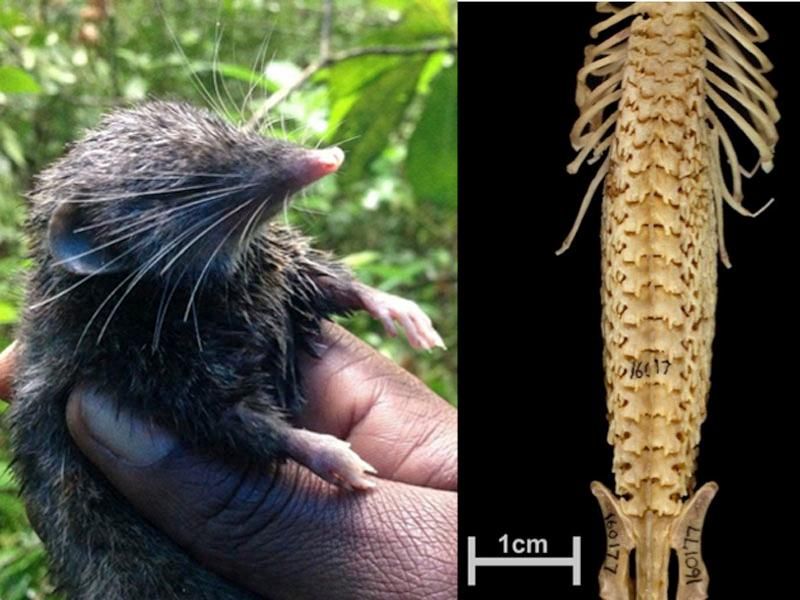
Hero Shrews
Unlike typical mammals that have 5 lumbar vertebrae, the hero shrew has 11. The spine makes up about 4% of the animal's total body weight. It can withstand massive compressive force, famously demonstrated when a 72 kg (160 lb) human stood on the shrew and it walked away completely unharmed
What Subfamily or Family includes moles and desmans?
Family Talpidae, Order Eulipotyphla
Family Talpidae methods of transport/movement?
Terrestrial, semifossorial, semiaquatic, fossorial
What are the Fossorial adaptations of Family Talpidae?
– Pelage lustrous—lies in any direction – Forelimbs rotate so digits point laterally – Limbs and phalanges short – Claws long – Sternum enlarged for muscle attachments
Star-Nosed Mole
• Body parts of a star-nosed mole in their normal anatomical proportions, and in proportion to their representation in the somatosensory cortex of the brain • Highest-resolution touch organ among mammals. Star-nosed moles maximize optimum foraging. If they located and obtained their food any slower, they wouldn’t survive

Paper: Underwater ‘sniffing’ by semi-aquatic mammals
Star-nosed Moles and North American Water Shrews can smell underwater by releasing bubbles through their nose, then inhaling them back in This may be more common, but it’s very hard to study

Soricidae Sensory Detection
Slides 37-42, Key idea: Shrews have poor vision, and enhanced hearing, smelling, and (at least sometimes) touching abilities. Paper: PNAS 2006

Draw the Tree of Chiroptera in relation to the tree of life/other Laurasiatheria
There has been a lot of uncertainty in the placement of Chiroptera in the mammal tree of life (are they flying horses? flying shrews? flying carnivorans?) We will stick with this relationship, recognizing that there is uncertainty

Chiroptera Tree
probably going to draw just Yinpterochiroptera and Yangochiroptera

Order Chiroptera
• Second-largest mammalian order – ~250 genera and 1492 species (as of 16 October 2025) • They fly • Echolocation in most species • Exploit wide array of foods • Tropics to the Arctic (seasonally, or with assistance from heaters) – Greatest diversity in tropical regions – Only terrestrial mammals on isolated oceanic islands • Extremely successful • Phylogeny still somewhat unclear
Echolocating Bats - Morphology
20 families of echolocating bats Tremendous variation in morphology. The different face, nose, and ear morphologies are related to the way they send and receive sound waves Even within families, noses and ears change shape related to diet and ecology
Chiroptera Previous phylogenetic hypothesis?
based on morphology. “Megabats” and “Microbats” still used colloquially. Unites all the echolocating bats into one clade* *(Pteropodidae have some non-laryngeal echolocation).
How do the 2 modern clades categorize echolocation
Molecular Phylogenetics supports two clades: Yinpterochiroptera and Yangochiroptera. Yinpterochiroptera and Yangochiroptera echolocate in different ways, with Yinpterochiroptera use broadband multiharmonics or tongue clicking. But still no synapomorphy that unites all Yang. or Yinptero.
Article: Inner ear neuroanatomy of bats 2022
The team was working on a broader study of bat cranial evolution, but then they noticed a strange feature in the cochlea of some bats. • The cochlea has a canal that holds the nerves that pick up wave signals (Rosenthal’s Canal) • In Yinpterochiroptera and all other mammals, tiny holes in the canal for nerves. ~17,000 neurons availble • In Yangochiroptera the holes are large, or the wall is absent, making hearing more sensitive, ~45,000 neurons present, different sizes • A new link between different forms of echolocation and neuroanatomy! And a synapomorphy!
Bat Flight
slides18-24 of Chiroptera 1. I would focus on how bat wings are structured, how wing shape affects flight, and the basic evolutionary evidence but not out of all the exam material this can’t be priority. Keypoint: Extreme variation
Wing structure and flight
Elongated digits (phalanges) support the patagium (wing membrane).
Wings provide both lift and thrust.
Downstroke = power stroke.
Bats are relatively slow but highly maneuverable
Wing loading and aspect ratio
Wing loading: body weight ÷ wing area. Low wing loading = greater maneuverability.
High aspect ratio: long, narrow wings → fast, sustained flight; open habitats.
Low aspect ratio: short, broad wings → slower, maneuverable flight; dense vegetation. Common in bats
Hovering
Some nectar-feeding bats can hover.
Requires specialized wing movements and is energetically expensive
Evolution/Fossils
Early Eocene fossils (~50 MYA) include Onychonycteris and Icaronycteris.
Onychonycteris: probably lacked echolocation.
Icaronycteris: probably capable of echolocation.
No clear transitional fossils; origin of flight remains uncertain, but likely evolved from gliding
What Families are in clade Yinpterochiroptera?
Families: Pteropodidae, Rhinopomatidae, Craseonycteridae, Megadermatidae, Hipposideridae, Rhinolophidae. If you know Yinpterochiroptera it has less families and if you run out of time just assume the rest are Yangochiroptera

What Family or Subfamily includes Old World fruit bats (flying foxes)?
Family Pteropodidae
T/F Family Pteropodidae uses echolocation?
False. Non-echolocating bats – Except Rousettus and Stenonycteris, which use tongue- click echolocation
T/F Family Pteropodidae lack tragus?
True
How Many Clawed wing digits does Family Pteropodidae have
Two-clawed wing digits – Except in Eonycteris and Dobsonia
Hammer-Headed Bat
Hypsignathus monstrosus, Massive vocal apparatus in males, resonation chambers in the face (hence the shape) Males form communal leks, 40-135 individuals, “sing” to attract females
What family is the Hammer-headed bat in?
Family Pteropodidae
Lactation in male fruit bats
Because why not I guess. Not sure why: unique endocrine profiles, Dietary Phytoestrogens, parental help?
T/F Is Family Craseonycteridae monotypic?
True - Bumblebee bat (Craseonycteris thonglongyai); Endangered
What family is known as the “false vampire”?
Family Megadermatidae. Vampire stories began in the 1700’s. The folklore preceded the bat connection • Stories from Brazil described bats that fed on blood • Some bats got named “vampire” even though those were not the blood feeding ones • Bram Stoker’s Dracula fixed the between bats and vampires in popular culture
What Family hunts partly by sight and eavesdropping and has a nose leaf on snout
Family Megadermatidae
What family Emits echolocation signals
through nostrils?
Family Hipposideridae
___ ___ of Africa is one of largest insectivorous bats – Weighs 150 grams with half- meter wing span
Hipposideros gigas
What Family is known as the “Horseshoe” bat?
Family Rhinolophidae, refers to skin folds on nose
What Family is known as a reservoir for coronaviruses?
Family Rhinolophidae

Zoonotic Spillover and Bats
• Bats are often reservoirs of viruses, but are unaffected. • Highly efficient immune systems in bats. • Possibly related to the metabolic demands of flight… high metabolism means more toxins and inflammatory biproducts, which they cope with. • Rarely are viruses transmitted from bats to humans, typically an intermediate host is required
What Families are in clade Yangochiroptera?
Nycteridae, Emballonuridae, Phyllostomidae, Mormoopidae, Noctilionidae, Furipteridae, Thyropteridae, Mystacinidae, Myzopodidae, Vespertilionidae, Miniopteridae, Molossidae, Natalidae

What Family or Subfamily has: Glandular sac on propatagium, have white dorsal stripes and tend to be found in houses?
Family Emballonuridae
What Family or Subfamily in Chiroptera has a recently (1965) extinct species?
Family Mystacinidae. One cat killed 100+ individuals in 7 days
Only endemic to New Zealand, brush-like papillae on tip of tongue, brush-like papillae at tip, and breed in leks?
Family Mystacinidae
Most diverse (ecologically) bat family or subfamily?
Family Phyllostomidae (Leaf-nosed Bats)
Wide diversity in morphology and ecology
Family Phyllostomidae
– Vampyrum is large and carnivorous
– Desmodus specializes on blood
– Trachops specializes on frogs
– Choeronycteris feeds on nectar
– Artibeus feeds on fruits
Paper: Morphological diversity in the sensory system of phyllostomid bats: Implications for acoustic and dietary ecology
Took molds of ear and nose-leaf shapes, then used CT scans to generate shape meshes. Tested the hypothesis that nose-leaf and ear pinnae shape relates to feeding ecology in Phyllastomidae
-Nose leaf shape changes with feeding ecology.
-Ear pinnae shape changes too.
-Similar leaf noses convergently evolved in
species with similar feeding habits
What Family or Subfamily includes Vampire Bats
Subfamily Desmodontinae
What Family or subfamily…
– Skull and dentition highly
specialized
– Typically land on ground nearby
and walk to prey
– Detect local temperature
differences on skin to locate
blood vessel near surface
– Razor sharp incisors – prey
often don’t feel the cut
– Most simple digestive tract of
any mammal
Subfamily Desmodontinae

What Family or Subfamily do we have a large colony of on campus?
Family Molossidae
• Ears broad and project to sides
– Reduce drag during flight
• Thick lips (wrinkled in some
species)
• Well-developed quadrupedal
locomotion
• High speed and enduring flight
• Fly far and high (up to 3000 m)
to forage
• Roost in massive colonies
Family Molossidae
What Family or Subfamily includes most Florida bats?
Family Vespertilionidae
What Family or Subfamily includes species that occasionally feed on birds?
Family Vespertilionidae. Nyctalus lasiopterus and Ia io occasionally feed on birds
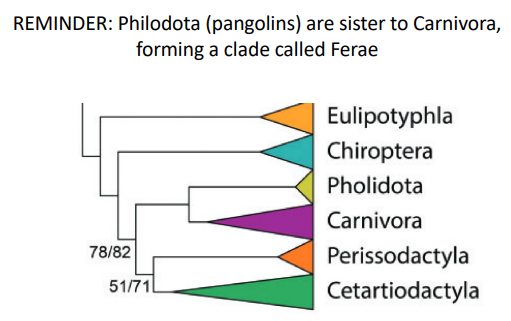
Clade containing Pholidota and Carnivora
Clade Ferae

Not closely related to Xenarthrans, but are sister to Carnivora
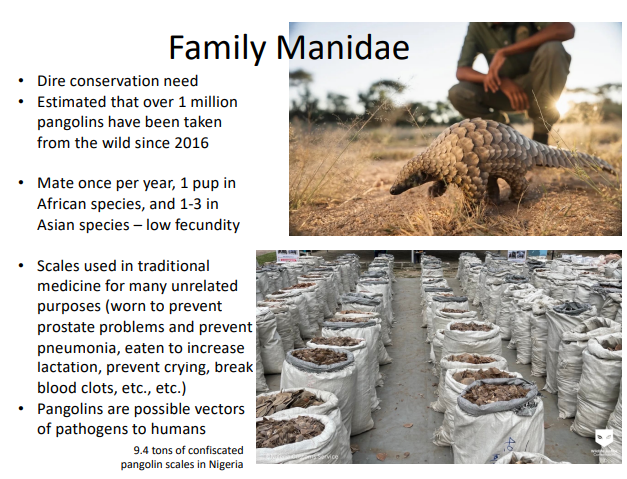
Family Manidae
Tongue muscles originate on posterior sternum (Asian species) or on an enormously extended and bifid xiphoid process (African species)
Family Manidae

Endangered and used for medicinal reasons, low fecundity
Family Manidae
T/F Does Carnivora mean Carnivorous?
False
What are the characteristics of Extant carnivorans?
– Expanded braincase
– Loss of the third molar
– All teeth rooted
– Carnasials (shearing P4/m1) present in many
– Foot posture usually digitigrade or plantigrade
What order is sister to philodota and forms clade Ferae?
Order Carnivora
Define Carnassials?
specialized, paired upper and lower cheek teeth in carnivorous mammals that act like a pair of scissors to slice through flesh, tendons, and muscle
Define “Key Innovation”
a novel physical or physiological trait that allows a species to exploit a completely new ecological niche or resource
How many suborders does Carnivora have?
2
What are the Suborders of Carnivora
Feliformia and Caniforma
Draw the tree for Carnivora

What Families are in Suborder Feliforma?
• Nandiniidae
• Felidae
• Viverridae
• Hyaenidae
• Herpestidae
• Eupleridae
• Prionodontidae

T/F Feliformia phylogenetics especially Felidae, have been quite difficult
True, Lots of morphological and phenotypic variation, but little genetic difference, or long histories of hybridization
How do we infer phylogenetic relationships, and what could generate different relationships?
• To infer phylogenetic relationships among species, we use
similarities and differences in DNA sequences
• Though we hope it’s not the case, different regions of the genome
(on the same or different chromosomes) could generate different
relationships
Paper: Phylogenetic evidence for ancient hybridization in the genomes of living cats (Felidae), 2016
• Data from: Genome-Wide SNP array,
autosomal, X, and Y linked variants, and
mitochondrial genomes
• Phylogenetic results are highly discordant. In
other words, different DNA types generate
different trees

Follow Up Paper: Recombination-Aware Phylogenetics Reveals the Structured Genomic Landscape of Hybridizing Cat Species, 2019
In a follow up paper, the authors examined differences between genomic regions
Authors hypothesize that regions of high recombination generate different relationships among Felidae species than regions of low recombination (X or Y
The authors’ hypothesis was confirmed! At least sometimes….chromosomes, and autosome regions near centromeres)
slides 12-16 of Carnivora I

What Family or Subfamily (of Feliforma) has a single species
Family Nandiniidae, Nandinia binotata

What Family or Subfamily…
• Efficient predators (often of large prey)
• Worldwide except Antarctica, Australia, Madagascar, some oceanic islands
• Number of teeth reduced
Family Felidae, – Anterior-most upper premolar is reduced or lost – Carnassials well-developed

What Family or Subfamily…
• Digitigrade foot posture
• Claws recurved and retractile (except in cheetah)
• Spotted or striped pelage common
• Weights range from 1 to 275 kg
Family Felidae
What Family or Subfamily….
• Excellent senses of smell, sight, and hearing
• Many species nocturnal
– Tapetum lucidum present in eye
• Most species are agile climbers
• Cheetahs sprint to 90 kph (60 mph) over short
distances
• Most species solitary
– Lions are social—live in large prides
Family Felidae
What Family or Subfamily includes: civets, palm civets, genets, and binturong?
Family Viverridae
What Family or Subfamily…
• Tail long and bushy
• Well-developed perineal (near the
anus) scent glands
• Some are agile climbers, some
semiaquatic, others terrestrial
• Broad diet among species
Family Viverridae
What Family or Subfamily includes mongooses?
Family Herpestidae
What Family or Subfamily has highly structured social behaviors?
Family Herpestidae
Highly destructive to native species, especially birds; imported to Carribean, Hawaii, and other islands to control rats in cane fields
Family Herpestidae, Small Indian Mongoose Urva auropunctata. Turns out mongooses are diurnal, rats are nocturnal