Thermal Physiology
 Call Kai
 Learn
 Practice Test
 Spaced Repetition
 Match
 Flashcards
 Knowt Play
1/18

There's no tags or description
Looks like no tags are added yet.
19 Terms
______ maintain _____ internal state and external environments, while _____ maintain some or all of their internal environments at relatively _______ regardless of external condition.
conformers; similar; regulators; constant condition
perfect conformity is a 1:1 line with internal and external environments
regulators stay at some setpoint
for most animals, there is a limit to how much can actually be regulated

Thermal Performance Curve
shows the importance of temperature; is asymmetrical with more leeway on cold side than on hot
includes:
optimal temperature
critical temperatures - min and max that an animal can do anything (anything above or below that is death)
tolerance range
performance breadth - where an animal can function
_____ _____ accounts for about 94% of variation in FMR.
body mass; there is a clear distinction between endotherms and ectotherms, but they still have the same scaling exponent

Endothermy
warming animal tissues by metabolic heat production
done by mammals and birds mainly
note: all animals make metabolic heat, but not necessarily enough to warm body tissues; ectotherms don’t have a thermal neutral zone and that endotherms have a higher BMR than all of the MRs of ectotherms

Do most animals do endothermy or ectothermy?
ectothermy; most animals are incapable of endothermy
Endothermy vs. Ectothermy
endothermy:
maintain high core temperature
rely on metabolic heat energy
core temperature is usually greater than ambient temperature
balance heat loss with heat production
ectothermy:
rely on external heat sources
regulate body temperature behaviourally
core temperature is less than or equal to ambient temperature usually

Poikilothermy vs. Homeothermy
types of thermoregulation
poikilothermy (changeable):
do not regulate body temperature. make some heat but not enough to warm the tissues
temperature usually varies directly with environmental temperature
homeothermy:
regulate body temperature physiologically
maintain relatively constant, high body temperature

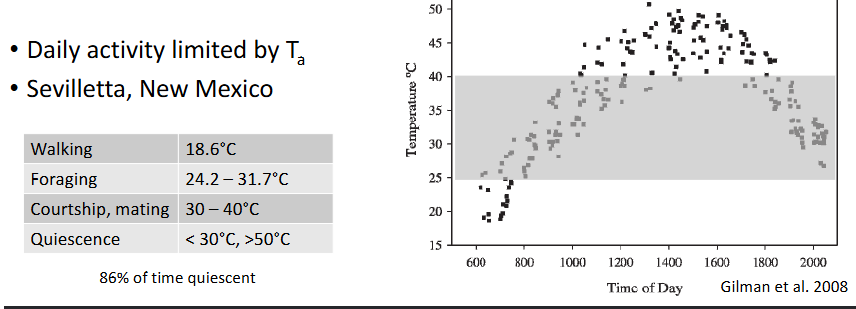
Non-thermoregulating Poikilotherm
e.g. pallid-winged grasshopper
what they do during the day is dictated by ambient temperature since they cannot make metabolic heat, so this limits what can be done at different times of day
Thermoregulating Endotherm
e.g. amazonian manatee
will maintain stable core body temperature even as the water warms and cools in the nights and mornings

Heterotherms
have spatial and temporal variation
regional heterothermy: different thermal relations in some parts of the body than others
e.g. moth flight muscles get going faster when their thoracic temperature is warmer until some critical point
temporal heterothermy: thermal relations vary through time
arctic foxes don’t get cold because they have counter-current heat exchange - maintained a constant core body temperature (Rectal) even while foot pads were put into below freezing water
foot pad temperature plummeted until freezing (0) so that there is no damage
Heat
the energy that matter possesses by virtue of the ceaseless, random motions that all atoms and molecules undergo on an atomic molecular scale
aka molecular kinetic energy
Temperature
a measure of the speed or intensity of the ceaseless random motions that all atoms and molecules of any substance undergo
Heat transfer is dictated by _______.
the difference in temperature
if two objects are the same temperature there is not net heat transfer
if block 1 is bigger than block 2 and they are the same temperature, block 1 has higher heat
if block 1 is warmer than block 2 and they are in contact, there is net heat transfer from block 1 to 2
Temperature and Heat
heat moves from high temperature to low
transfer of hear raises the temperature of the object receiving heat and lowers the temperature of the object losing heat
in a simple system, two objects in contact with each other are at thermal equilibrium when their temperatures are the same. heat transfers between both objects, but no net heat transfer
Temperatures and Animals
TB/Tb: core body temperature - often simply body temperature, uniform temperature
Ts: surface temperature - often less than Tb, Tsk skin temperature is commonly used
d: distance of gradient Tb → Ts - bigger gradient is a bigger influence on heat flow
TA/Ta: ambient temperature - local environmental temperature

Heat Transfer
there is only stable body temperature when heat inputs are balanced by losses
Hm (metabolism) is gain only, He is loss only (evaporation)

Metabolic Heat Production (Hm)
heat gain only, generally negligible for ectotherms
follows the bathtub model with the thermo-neutral zone as the base, even the arctic fox that barely gets cold has a slight bathtub shape
Conduction (Hcd)
transfer of heat through a material substance that is macroscopically motionless
(t1-t2)/d is the thermal gradient, temperature difference per unit of distance
k coefficient of thermal conductivity,way high in water than air (20x) but air is still one of the most highly insulating materials in the natural world e.g. from air trapped in fur
reduce t1-t2 to minimize Hcd loss to the environment

Antelope Ground Squirrel
live in hot desert habitat - flip their tail over their body for shade since underside of the tail is whit