HELL ON EARTH
 Call Kai
 Learn
 Practice Test
 Spaced Repetition
 Match
 Flashcards
 Knowt Play
1/90

There's no tags or description
Looks like no tags are added yet.
91 Terms
What is the overall diversity of mammals?

What are the subclasses and infraclasses of class mammalia?

What is the distribution and characteristics of order Monotremata?

Explain monotreme reproduction

What is the morphology of monotremes?

What are the species that are found in the order monotremata?
Platypus
Echidnas
What are the characteristics of infraclass metatheria?

What is the natural history of metatherian?
Choriovitelline- temporary or permanent fetal membrane structure formed by the fusion of the yolk sac and the chorion

What is the characteristics of order Didelphimorphia? What are the species in the order?
Opossums
Woolly Opossums

What is the characteristics of order Paucituberculata? What are the species in the order?

What is the characteristics of order Microbiotheria? What are the species in the order?
Monito del Monte

What is the characteristics of order Dasyuromorphia? What are the species in the order?
Tasmanian Tiger
Tasmanian Devil
Quoll
Mulgara
Dunnert
Numbat

What is myrmecophagy?
Specialized feeding on ants/termites
What is the characteristics of order Peramelemorphia? What are the species in the order?

What is the characteristics of order Diprotodontia? What are the species in the order?
Wombats
Wallabies
Kangaroos
Koala
Possum
Sugar Glider
Characteristics:
Saltatorial Locomotion- a form of terrestrial locomotion characterized by hopping or jumping
Diprotodont - a prominent pair of large, forward-pointing (procumbent) incisors on the lower jaw

What is the characteristics of order Diprotodontia? What are the species in the order?

What are the characteristics of infraclass Eutheria?

What are the characteristics of order Afrosoricida? What are the species in the order?

What are the characteristics of order Macroscelidea? What are the species in the order?

What is the natural history of order Macroscelidea?
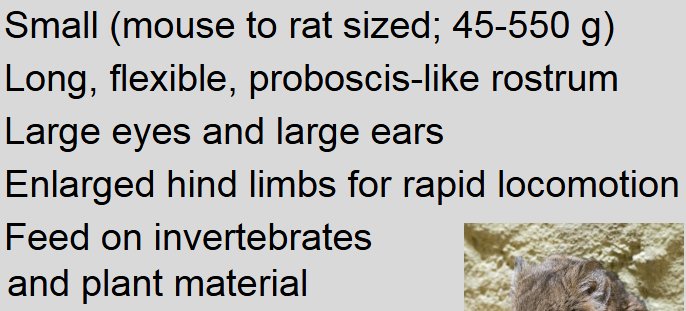
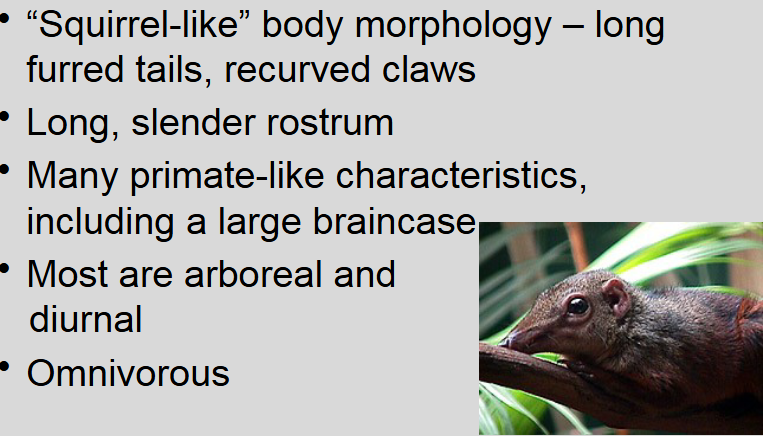
What are the characteristics of order Scandentia? What are the species in the order?
What is the natural history of order Scandentia?
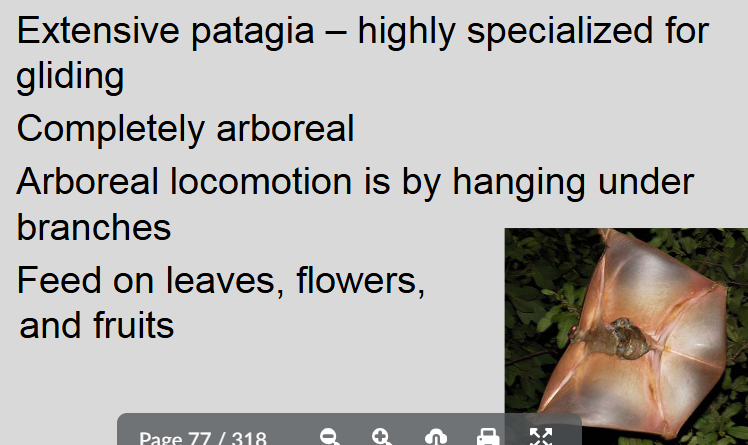
What are the characteristics of order Dermoptera? What are the species in the order?

What is the natural history of order Dermoptera?
What are the characteristics of order Eulipotyphla? What are the species in the order?
Shrews, Moles, Desmans, and Solenodons
Hedgehogs and Gymnures

What are the characteristics of order Chiroptera?

What are the historical and current suborders of Chiroptera?

What are the natural history of order Chiroptera?

What are the adaptations for flight?
Forelimbs modified into wings (hind limbs not highly modified)
Hind limbs have a tendon locking mechanism for hanging
Patagia – skin covering the wing
Highly specialized pectoral musculature
Vertebral fusion- rigid backbone for supporting the wings
What are the properties of physics that allow flight?
Air on top of the wing moves faster than the air underneath
Bernoulli’s Principle- an increase in the speed of a fluid occurs simultaneously with a decrease in pressure
Higher pressure under the wing creates lift
How can bats adjust the speed of flights?
Air Speed Adjustments
Angle of attack – angle of the wing relative to the direction of travel
Higher angles create higher speed of air, and increases pressure under the wing creating more lift
Camber- curvature of the wing
Low camber leads to low drag which leads to high speed
Deep camber leads to high lift leading to low speed
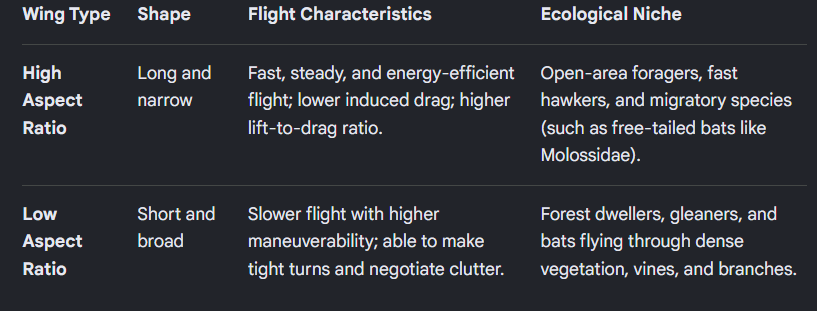
What is wing aspect ratio? What is the correlation between bats and wing aspect ratio?
Wing aspect ratio in bats is a physical measurement that compares a bat's wingspan to its wing area, defining whether its wings are long and narrow or short and wide.
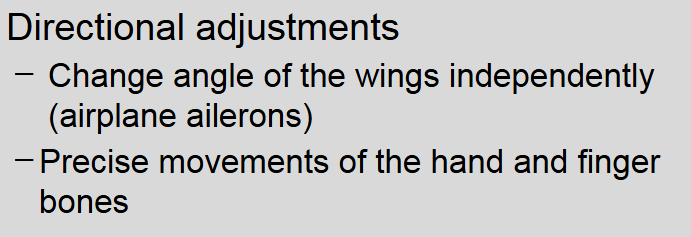
What are directional adjustments in bat flight?
What is echolocation and who uses it?
About 20% of all mammals echolocate
Mostly bats, but also shrews, whales, seals, and rodents
Used to obtain information from the environment
It is produced in the larynx, and it is emitted through the mouth or nose in the ultrasound (>20 kHz)
What is the process of echolocation?
Sound emitted through the mouth or nose
Sound waves reflected
Returning sound (echo) is different than the sound that was emitted
Bat interprets the difference between the emitted call and the returning echo
Doppler Shift- frequency increases as it heads towards you, frequency decreases as it heads away from you
Why is ultrasound used in echolocation?
More detailed information with faster time to hear
The sound wavelength hits more surface area, and the returning echo has more info from the shorter wavelength
Drawback: Ultrasound does not travel far
What are the characteristics of order Primates?

What are the characteristics of natural history in Primates?
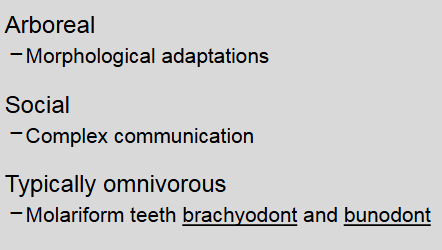
What are the molariform dentition in mammals?
Brachydont: General, soft, or mixed diets (not heavily abrasive like grass)
Bunodont: Omnivorous diets requiring crushing and grinding

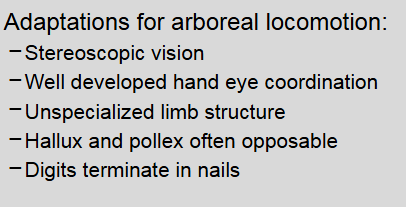
What are the adaptations for arboreal locomotion in Primates?
What are the differences between Claws vs Nails?
Claws
End of the digits
Most mammals
Structure: Narrow, laterally compressed, curved, and sharply pointed. Both the hard unguis and the softer subunguis are prominent and balanced.
Used for traction, climbing, digging, self-defense, and capturing or killing prey (such as raptor talons).
Nails
Dorsal surface only
Increased nerve endings on digits
Structure: Broad, flat, and relatively straight with a blunt or curved edge rather than a sharp point. The unguis dominates, while the subunguis is greatly reduced.
Function: Protects the sensitive nerve endings and fleshy pads of fingertips while enhancing tactile perception, precision manipulation, and fine grip.
What are the characteristics of Suborder Strepsirhini? What species are in this suborder?
Lemures
Aye-Aye
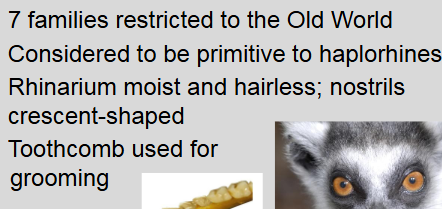
What are the characteristics of Suborder Haplorhini? What species are in this suborder?
Tarsiers
Orangutan
Chimpanzees
Gorillas
Tamarin
Capuchin

What are the differences between Old World Primates (Catarrhini) vs New World Primates (Platyrrhini)

What are examples of species in Catarrhini?
Orangutans
Chimpanzees
Gorillas
What are examples of species in Platyrrhini?
Monkeys
Tamarins
Capuchins
What are the characteristics of Xenarthrans?

What is the morphology of Xenarthrans?

What are the characteristics of order Pilosa? What species are in this order?
Sloth (Suborder Folivora)
2 families = Two-toed and Three-toed sloths
Adapted for a specialized form of arboreal locomotion
Folivorous (eat leaves)
Inhabit tropical forests
Anteaters (Suborder Vermilingua)
Southern Mexico to central South America
Highly specialized for myrmecophagy (Tapered skulls with elongate rostrums, Long sticky tongue, Edentate (lack teeth), and long claws)
What are the characteristics of order Cingulata? What species are in this order?

What are the characteristics of order Pholidota? What species are in this order?

What are the characteristics of order Tubulidentata? What species are in this order?

What are the characteristics of order Carnivora?

What is the morphology of carnivores?
Well-developed, elongate canines; carnassial teeth present in many group
Carnassial – cusps form blade-like cutting edges shear against the tooth in the opposing jaw
Zygomatic arch and associated facial musculature well-developed (stronger bite force)
Mandibular fossa distinct and transversely elongate (it supports a strong, stable jaw joint adapted for gripping, biting, and tearing meat)
Digitigrade or plantigrade
What are the types of foot postures?
Plantigrade: The entire surface of the foot—from the toes to the heel (including the metatarsals, tarsals, and sole)—flatly touches the ground.
Digitigrade: Only the phalanges (toes and fingers) touch the ground, while the wrist and ankle are elevated in the air.
Unguligrade: Only the tips of one or two modified digits protected by hooves touch the ground.

What are the species under Feliformia?

What are the species under Caniformia?

What are the characteristics of order Rodentia?

What is the morphology of order Rodentia?

What are the five suborders of order Rodentia? What are species in the suborders?
Sciuromorpha- Squirrels, Mountain Beaver, Dormouse
Castorimorpha- Beavers, Pocket Gophers, Kangaroo Rat
Hystricomorpha- Naked Mole Rat, Capybara, Porcupine
Myomorpha- Jerboa, Pouched Rat, Woodrat
Anomaluromorpha- Springhare, Anomalure
What are the skull differences between the suborders?

What are the characteristics of order Lagomorpha? What are species in the order?

What is the morphology of order Lagomorpha?

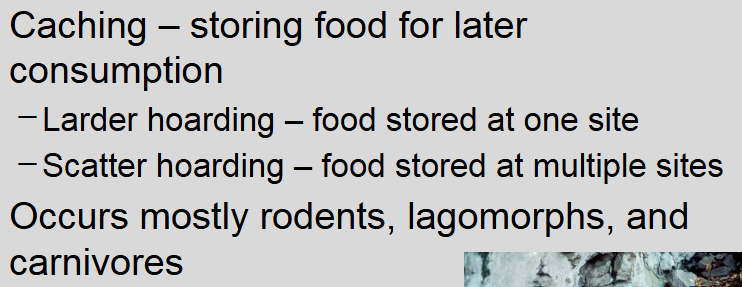
What is food hoarding and the types of food hoarding?
What is the characteristics of order Proboscidea? What species are in Proboscidean?

What is the morphology of order Proboscidean?

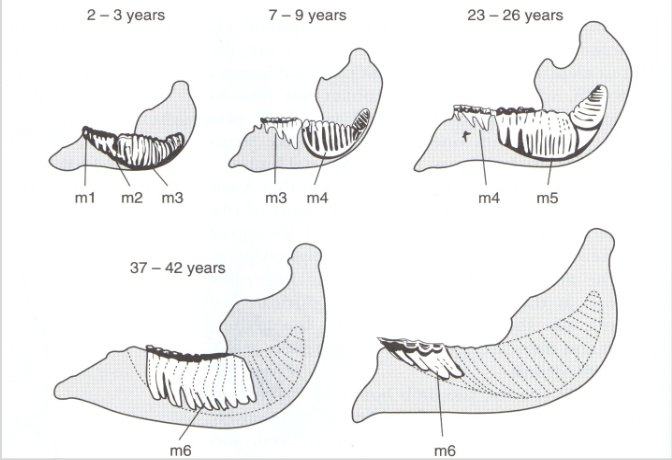
What is mesial drift?
Elephants use a horizontal conveyor-belt system called horizontal tooth displacement to replace their molars. Instead of replacing teeth vertically like humans, new, progressively larger molars erupt in the back of the jaw and tilt/push forward as old ones wear down and shed out the front.
What is the natural history of order Proboscidean?

What are the differences between African and Asian elephants?

What is the characteristics of order Hyracoidea? What species are in Hyracoidea?

What is the morphology of order Hyracoidea?

What is the characteristics of order Sirenia? What species are in Sirenia?
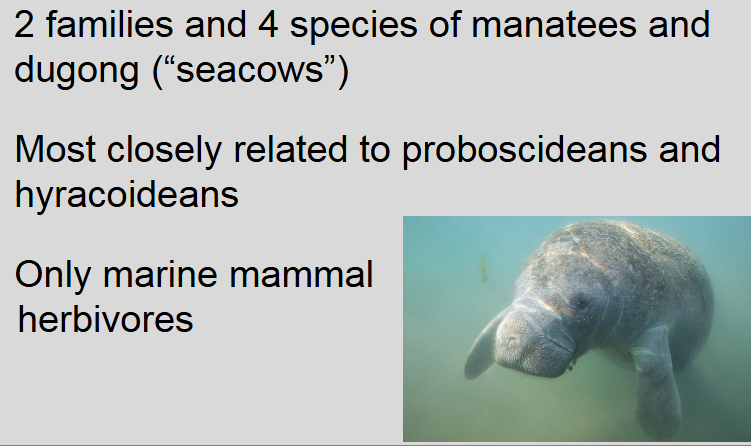
What are the differences between the two species in the order Sirenia?

What are specialized adaptations for aquatic carnivores?

What is the morphology of sirenians?

What is characteristics of ungulates?

What is cursorial locomotion?
Having adaptations for running to avoid predators and long distance seasonal movements
The morphological specializations are related to stride length and stride rate
What is unguligrade?
Weight is borne the tips of the digits
What are the specializations to increase stride length in ungulates?
Lengthening of the limbs (especially in the metacarpals/metatarsals)
Increases stride length allowing ungulates to cover more ground
Loss/reduction of the clavicle (Scapula has no connection to the axial skeleton)
The limbs are able to move more freely increasing mobility of the limb
Spinal flexion
Increasing the extension and retraction of the back allows for longer stride length
What are the specialization for stride rate in ungulates?
Addition of limb joints
The joints allow for coordinate limb movement, more efficient joint movement, and improved weight support
More forward and backwards without extensive sway
Reduction in number and mass of distal limb bones
Cannon bone – fused “meta” bone segments
The reduction in number and mass of distal limb bones requires less energy to swing the leg forward
Lighter limbs=faster swing forward
Specialized “springing” ligaments
As the hoof lifts off the ground, the elastic recoil of the ligaments snaps them back, propelling the animal forward without requiring extra muscular effort. This drastically reduces metabolic energy costs
What are the feeding specializations in ungulates?

What is foregut fermentation?
Multi-chambered stomachs with cellulose-digesting microorganisms
Occurs in pre-gastric pouches, such as the rumen, reticulum, and omasum in ruminants, or specialized forestomachs in non-ruminants
Occurs in most artiodactyls, kangaroos, sloths, some primates
Rumination ("Chewing the Cud"): Many foregut fermenters regurgitate partially digested plant matter to chew it a second time, increasing surface area for microbes
What is the process of foregut fermentation?
Ingestion and Entry into the Forestomach- Instead of going straight to a single acid stomach, the food enters a specialized pre-gastric chamber—such as the rumen/reticulorumen in ruminants
Microbial Breakdown (Fermentation)- In the reticulum, the chamber is an anaerobic (oxygen-free) environment filled with dense communities of bacteria, protozoa, and fungi. These microbes secrete specialized enzymes that hydrolyze and ferment the plant material.
Rumination ("Chewing the Cud"): Many foregut fermenters regurgitate partially digested plant matter to chew it a second time, increasing surface area for microbes
Passage to the True Stomach and Intestines- The partially digested food and a large wave of microbes move from the forestomach into subsequent compartments—such as the omasum and the abomasum (the true, acidic stomach).
Nutrient Absorption- As the digested microbes and plant remnants pass into the small intestine, the host absorbs high-quality nutrients from the plant material
What is hindgut fermentation?
Monogastric digestive system
Single-chambered stomach
Microbial fermentation occurs in the colon or caecum
Perissodactyls, elephants, hyraxes, lagomorphs, rodents, primates, and marsupials
What is the process of hindgut fermentation?
Ingestion and Foregut Digestion: The food passes through a single-chambered stomach where everything except plant material is broken down
Arrival at the Hindgut: Undigested plant fiber moves past the small intestine and enters the hindgut, which includes the cecum and the large intestine (colon). Microbes ferment and break down the plant material.
Nutrient Absorption: The animal absorbs the nutrient through the gut wall to use as energy
What is coprophagy?
Feeding on feces to optimize the uptake of vitamins and energy. The feces also help maintain the gut microbiome.
Some lagomorphs, rodents, and shrews
What are the differences between foregut and hindgut fermentation?
Foregut – advantageous when food is limited but high quality
Efficient at extracting nutrients from high- quality food
Long digestion times
Strategy – feed quickly, move to safety to digest
Hindgut – advantageous when food is abundant but low quality
Less efficient, but shorter digestion times
Adapted to feeding on poor quality food
Forage longer or more frequently
What are the characteristics of ungulate dentition?
Hypsodont “high-crowned”- more crown than root
Helps resist the abrasive wear by plant material
Lophodont or selenodont molariform cusp pattern

What are the characteristics of Perissodactyla? What species are present in the category?
Horses, Zebras, and Donkeys
Tapirs
Rhinos

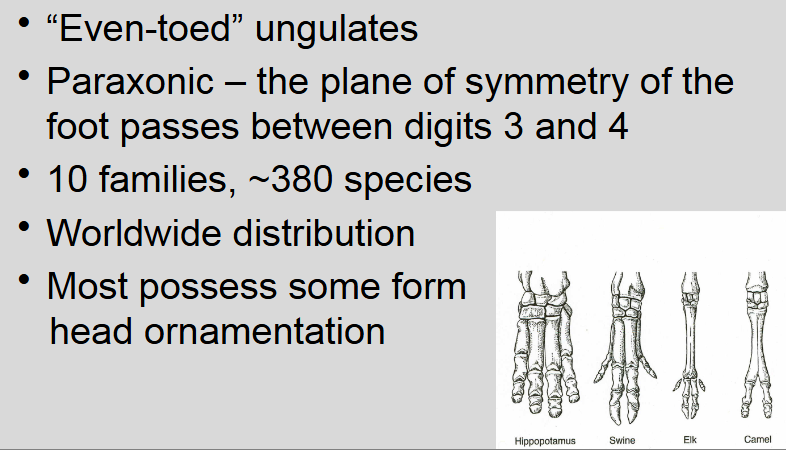
What are the characteristics of Atriodactyla? What species are present in the category?
Deer, Antelope, Sheep, Bison, Pigs, Peccaries, Pronghorn, Giraffes, Okapi, Camels, Hippos, Musk Deer, Mouse Deer, and Llamas
What are the types of head ornamentations in Artiodactyla?
Giraffe Horns (Ossicones)- Bony core covered by furred epithelium, permanent, and occurs in both males and females
Antlers- Composed entirely of bone (no keratin), Shed annually, only in males except for one species