Lab 4: Protists
 Call Kai
 Learn
Learn Practice Test
 Spaced Repetition
 Match
Match Flashcards
 Knowt Play
1/73

There's no tags or description
Looks like no tags are added yet.
Name | Mastery | Learn | Test | Matching | Spaced | Call with Kai | Chat |
|---|
No analytics yet
Send a link to your students to track their progress
74 Terms
Microscope parts- identify parts 1-9.
1-eyepiece that contains the ocular lense (only one in this photo) 2-nosepiece 3-objective lenses 4-focus adjustment knob 5-stage with stage clips 6-light source 7-condensor and diaphragm 8-arm 9-base

How do you calculate the total magnification on a microscope?
Multiply the magnification of the ocular lens and the objective lens. For example, 10 (ocular) x 4 (objective) = 40 total magnification.
wet mount
A slide preparation where the sample is placed on a slide with a drop of water, and covered with a coverslip. You made wet mounts of the live protists.

Protists
An informal group of small, usually single-celled Eukaryotes.
clade
an ancestor and ALL of its decedents

Are the protists a clade?
No, the protists are comprised of many groups of single-celled organisms, but they do not all share a common evolutionary history and are therefore not a monophyletic group or clade.
endosymbiosis
The process by which one cell engulfs other cells and each cell provides a level of specialization. The great diversity of protists may be due to multiple endosymbiotic events. The formation of m mitochondria and chloroplasts are the most well-known cases of endosymbiosis.
Why are protists critical to life?
They make up much of life's diversity. They are at the bottom of the food chain and many multicellular organisms depend on them; without them life as we know it would not exist.
unicellular
Made of one cell; Unicellular protists are mostly unicellular and that one cell can perform all functions.
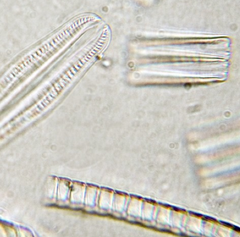
Diatoms
Unicellular photosynthetic alga with a unique glassy cell wall containing silica

Are protists unicellular?
Most protists are unicellular. Some unicellular protists can form associations such as colonies or filaments. A few protists are multicellular.
What are the cell walls of diatoms composed of?
silicon dioxide (glass)
parasitic
The process when one organism (the parasite) lives on or in another organism (the host) and harms the host.
Trypanisoma
Protozoan disease transmitted by Tsetse fly causing sleeping sickness. Trypanosoma are purple and are outside of the red blood cells.

African sleeping sickness
The disease caused by the protist Trypanosoma. The protist is carried by Tsetse flies.
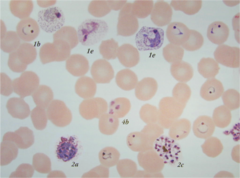
Plasmodium
Protist that causes malaria. The plasmodium is purple, and outside of the circular red blood cells.
malaria
The disease caused by Plasmodium in humans. Plasmodium has life stages in both humans and mosquitos.
What are some of the diseases caused by protists?
Malaria is caused by Plasmodium. African Sleeping sickness is cause by Trypanosoma. Amoebic dysentery is caused by Amoeba.
Which protists are often multicellular?
The brown algae and kelp. The red algae.
Brown Algae (Phaeophyta) Kelp
These protists are commonly known as seaweeds and are the largest and most complex plantlike protists. All are multicellular and most live in marine environments. Some are very large, such as the giant kelp pictured here.
Brown Algae (Phaeophyta) Sargassum
Note the air bladders. You saw a representative in class.

colonial cells
Two or more cells living together. The single cells of colonial protists may aggregate together to form large groups.
Red Algae (Rhodophyta)
marine algae in which the chlorophyll is masked by a red or purplish pigment. Typically multicellular.

Which protist is colonial?
Volvox form round colonies.

Volvox
A green, single-celled aquatic organism that forms minute, free-swimming spherical colonies.

daughter colonies
Small new colonies formed by the larger parent colonies in Volvox.

Which protists is filamentous?
Spirogyra form long filaments. The cells attach end to end and form long threads. many thread can form a very thick matt of algae.

Spirogyra
Filamentous green algae

conjugation
A process by which two individuals exchange cell contents. Protists exchange nuclear material or gametes.

conjugation tubes
Structures formed between Spirogyra filaments allowing the transfer of material (gametes) into the tube. A 2n zygospore forms from the material of both cells.

What protists undergo conjugation?
Paramecium undergo conjugation exchanging haploid micronuclei. Spirogyra form visible conjugation tubes between filaments allowing the formation of a 2n zygospore within the conjugation tube.
non-motile
Does not move on its own accord or has no specialized structures for movement like cilia, flagella or amoeboid movement.
flagellum (pleural- flagella)
Structure for locomotion shaped like a thread or whip. Flagella are hard to see on slides but the lab manual has photos. You can see protists move from their use
Which protists have flagella?
Chlamydomonas are biflagellate or have 2 flagella. Cells of Volvox are biflagellate. Euglena have a single flagellum with an eyespot on the end.

Chlamydomonas picture A
unicellular green algae A

Chlamydomonas picture B
unicellular green algae B

Euglena diagram A
protist that moves by a flagellum, known for its eye spot at the base of the flagellum

Euglena picture B
Unicellular organism; moves using its flagella; have chloroplasts (are autotrophic)

eyespot
A photoreceptor or spot with light-sensitive pigment. In protists, eyespots can function like an eye, generally to move to and from light.

Which protist has an eye spot?
Euglena have a single flagellum with an eyespot on the base.
cilia
Structure for locomotion shaped like many fine hairs, all moving in tandem

Which protists have cilia?
Paramecium have cilia but they are very hard to see on the slides. The lab manual has photos.

Paramecium picture A
A ciliated (it propels itself via cilia) protist that lives in fresh water and eats other tiny organisms for food.

Paramecium Picture B
Protist, paramecium. You can see the green chloroplasts, you cannot see the cilia

What protists plays an important role in decomposition of dead vegetation and feeling on bacteria, yeasts, and fungi?
Slime molds
slime molds
Funguslike protists that play key roles in recycling organic material

In which protists might you see cytoplasmic streaming?
Slime molds (demo scope) and in the conjugation tubes of Spirogyra as cell contents are moved across from one cell to another.
Amoeba
A protist characterized by great flexibility and the presence of pseudopodia.

phagocytosis
The process by which amoeba engulf food particles with their pseudopodia and bring food into the cell from outside the membrane.

pseudopodia
A temporary and arm-like projection of the cell membrane that allows the cell to move by "crawling" and to ingest food by phagocytosis.

Which protist ingests food with pseudopodia?
Amoeba
Amoebic dysentery
A disease caused by Amoeba. Causes diarrhea and abdominal pain. Spreads through contaminated food and water.
amoeboid movement
Movement from forming pseudopodia (false feed) that are protrusions of the cytoplasm. May look like the organism is crawling on the pseudopodia.
Which protist has ameboid movement?
Amoeba. The slime molds can have amoeboid movement when they are single cells, but you only looked at the large aggregation on the demo scope.
chloroplast
Organelles that conduct photosynthesis or conversion of light energy to food energy. Allows cells to be autotrophic.

autotrophic
can convert energy from non-living forms into biologically useful energy from light (photosynthesis) or inorganic chemicals (chemosynthesis).
heterotrophic
cannot obtain energy from non-living forms and must eat other organisms to obtain energy
mixotrophic
can be heterotrophic and autotrophic
cytoplasmic streaming
Process by which the cytoplasm moves around inside the cell in currents. The cytoplasm is all the cell contents except for the nucleus.
What protist is mixotrophic?
Euglena
life cycle
Series of changes through the full cycle or stages of the life of an organism.
sexual life cycle
A life cycle that includes sexual reproduction (formation of gametes and resulting zygote).
asexual life cycle
A life cycle that does not include sexual reproduction but results in the creation of new organisms.
fertilization
fusion of gametes to form a zygote.
zygote
the diploid (2n) cell formed from two haploid (1n) gametes
mitosis
Cell division in which both daughter cells have the same number and kind of chromosomes as the parent cell. (Most cellular division in growth)
meiosis
Cell division in which the daughter cells have half the number of chromosomes as the parent cell.
syngamy
Fusion of two haploid cells (two gametes undergo syngamy and form the zygote).
isogamous
gametes that are similar in shape and appearance (not differentiated into male and female).
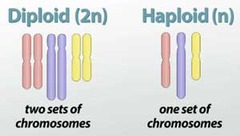
1n
Haploid. Having one set of chromosomes.
2n
Diploid. Having two sets of chromosomes.
haploid
Having a single set of chromosomes. 1n

diploid
Having two sets of homologous chromosomes. 2n Humans are diploid.
diagnostic character
character that is unique to a species