6.2 Climate change - causes and impacts
 Call Kai
 Learn
 Practice Test
 Spaced Repetition
 Match
 Flashcards
 Knowt Play
1/15

There's no tags or description
Looks like no tags are added yet.
16 Terms
Climate
The atmospheric conditions expected in a particular area over a long period of time. Result from physical process in the atmosphere.
What are the two main factors affecting climate change?
Average temperature
The average amount of distribution of precipitation
Weather
The specific conditions being experienced at a particular time or over a short period.
Includes:
Temperature, humidity, air pressure, and wind speed.
Weather conditions can change rapidly, even on the same day.
Climate change
The long term sustained changes in the average global weather conditions.
It encompasses global warming but refers to the broader changes that are happening in the planet as a result.
What has driven CO2 concentrations to increase in the atmosphere over the past 50 years?
Anthropogenic CO2 emissions have caused CO2 conc to increase significantly due to the spread of industrialisation and human population increase.
What can we use to gain data in order to indicate a positive correlation between the concentration of CO2 in the atmosphere and global temperatures?
Analysis of ice cores
Tree rings
Deposited sediments
Tree rings as a method indicate positive correlation between
Need to take multiple trees, as can be prone to disease. Thicker rings, imply hotter wetter weather.
Deposited sediments as a method indicate positive correlation between
Deposited during the ice age.
Reveal information about past ocean oxygen levels.
Their relationship with atmospheric carbon dioxide.
Ice core as a method indicate positive correlation between
Winter snow compresses into ice layers that accumulate over thousands of years.
Scientists extract ice cores containing dust, pollen, ash and gas bubbles to analyse post ocean conditions, volcanic eruptions, solar intensity and atmospheric conditions.
What are some Local ecological impacts of climate changes? Give real world examples
Coral bleaching - Great Barrier Reef, Australia: Rising sea temperatures cause coral bleaching, reducing coral survival and reef biodiversity.
Desertification - Sahel, Africa: Higher temperatures and changing rainfall can increase drought stress and land degradation, reducing vegetation cover and soil productivity.
What are some Global ecological impacts of climate changes? Give real world examples
Changes in ocean circulation - North Atlantic: Greenland ice melts → freshwater enters the North Atlantic → salinity and density decrease → GOCB weakens → global heat distribution and marine ecosystems are disrupted.
Sea-level rise - Maldives: Rising sea levels, caused by thermal expansion of seawater and melting land ice, increase coastal flooding and threaten low-lying islands.
How does climate change affect societies and their resilience?
Health: Heatwaves increase heat-related illness and deaths — Europe, 2022.
Water supply: Drought reduces freshwater availability — Cape Town, 2018.
Agriculture: Droughts and floods reduce crop yields, increasing food insecurity — Horn of Africa.
Infrastructure: Flooding and sea-level rise damage homes, roads and electricity supplies — Bangladesh.
Resilience: Wealth, healthcare, infrastructure, technology and governance affect a society's ability to adapt. Wealthier societies generally have greater adaptive capacity.
Draw a systems diagram and explain Ice albedo as a positive feedback loop?
A positive feedback climate process.
Ice has a high degree of albedo.
Larger ice caps on the Earth reflect more of the Sun’s energy back out.
Reducing these caps and ice levels on Earth leads to more absorption of the Sun’s energy by the Earth’s surface resulting in a warmer planet.

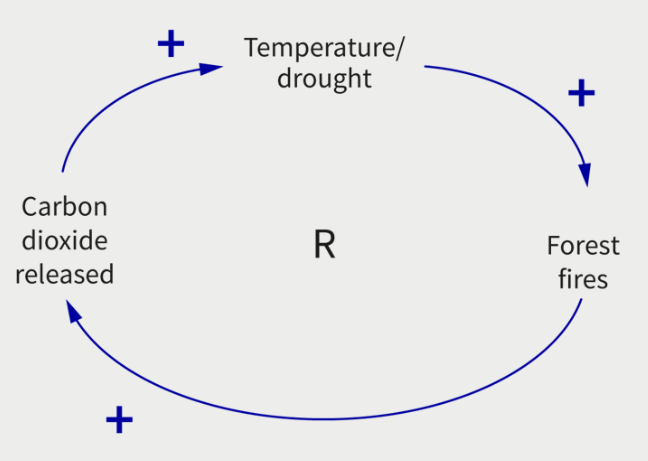
Draw a systems diagram and explain forest fires as a positive feedback loop?
Forests absorb and store carbon dioxide.
Increased temperatures and droughts lead to more frequent and intense forest fires.
Burning trees release stored carbon dioxide, enhancing the greenhouse effect, causing further warming that increases the risk of forest fires.
What evidence suggests Earth has exceeded the climate change planetary boundary?
The climate change planetary boundary model is determined by CO2 conc and radiative forcing → the balance of incoming and outgoing solar energy.
CO₂ concentration: Boundary = 350 ppm; actual = 420 ppm (2023).
Radiative forcing: Boundary = +1.0 W/m²; actual = +2.91 W/m² (2022).
Conclusion: Both indicators exceed their boundaries, increasing the risk of major, potentially irreversible changes to Earth's systems.
How might different perspectives view climate change and what are personal perspectives effected by?
Ecocentric → reduce consumption and energy use.
Anthropocentric → governments introduce carbon taxes and emissions targets.
Technocentric → invest in carbon capture and renewable energy technology.
Personal perspectives: An individual's EVS can be influenced by their upbringing, education, culture, wealth, political beliefs and personal experiences of climate change.