Chemistry - Kinetics Test
 Call Kai
 Learn
 Practice Test
 Spaced Repetition
 Match
 Flashcards
 Knowt Play
1/27

28 Terms
Kinetics
Measures time required for a rxn to occur
What can kinetics of a rxn tell us?
how long it will take to complete a rxn
how chemicals react to form products (mechanism)
effects of catalysts & enzymes
how to control a rxn
Thermodynamic Stability
substance doesn’t spontaneously decompose at room temp
Kinetic Stability
activation energy for decomposition is so high that the rxn goes too slowly for a change to be detected
Factors Influencing Rxn Rates
reactant structure (polar v. nonpolar)
physical state of reactants (vapor v. liquid)
concentration of reactants (medications)
surface area (sugar cube v. crystals)
temp (hypothermia & metabolism)
catalyst (H2O2 & blood)
concentration
more reactants
more collisions
increase of reactant concentration then increase # of collisions & increase rxn rate
more surface area increases collisions
temperature
higher temp increases collisions (more energy)
catalyst
adding catalyst increases collisions (lower activation energy, don’t need to have as much energy to collide)
homogeneous catalyst
in same phase as reactants
heterogeneous catalyst
not in same phase as reactants
are surface on which substances can react
Rate Law Expression
rate = k(H2)(I2)
rxn rate varies directly as product of concentrations of reactants
specific rate constant (k)
depends on size, speed, and kind of molecule involved in rxn
large is products form quickly
small is products for slowly
Rate Law
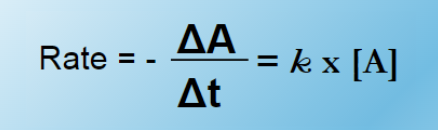
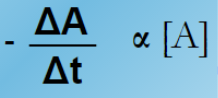
rate of disappearance of A is _____ to concentration of A
proportional
order of a rxn
power to which concentration of a reactant must be raised to give the experimentally observed relationship between concentration and rate
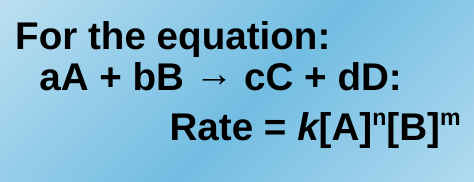
rate law based on 3 things:
concentration (molarity) of each of the reactants
power to which each of the reactants is raised (calculated from experimental data; rxn order is SUM of all of reactant orders)
value of k (rate constant)
elementary rxn
rxn in which reactants are converted to products in single step
one activation energy peak
peaks are energies of activated complexes, valleys are energy of intermediate
intermediate
product of ONE of the steps in a rxn mechanism
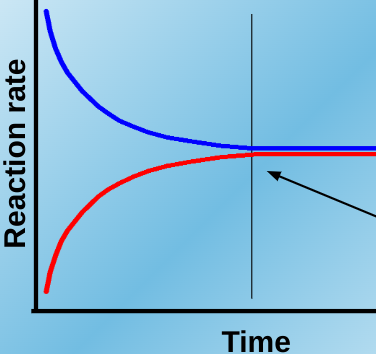
equilibrium
state where forward & reverse conditions occur at same rate
dynamic equilibrium
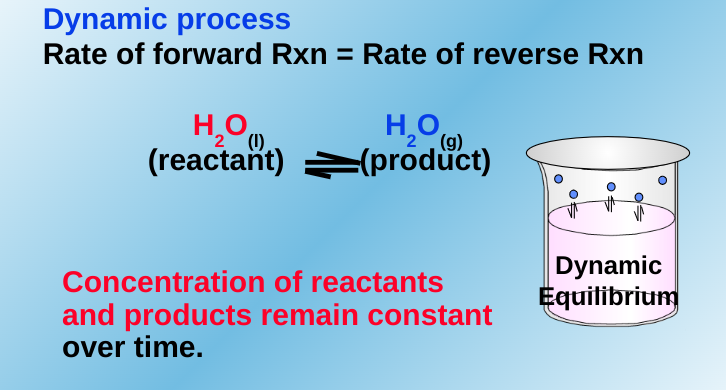
when is equilibrium reached?
where rates of forward & reverse rxns are the same
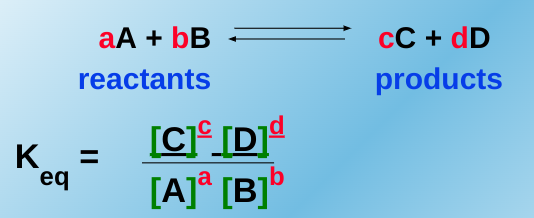
equilibrium expression
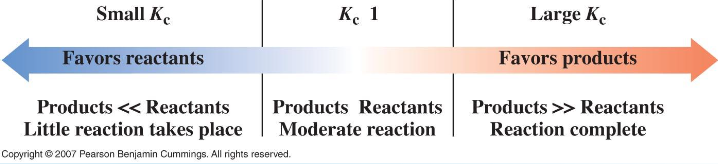
equilibrium constant
LeChatelier’s Principle
stress causes shift in equilibrium (temp, concentration, pressure)
pressure only affects gases (increase in pressure causes equilibrium to shift to side with least moles of gas)
shift towards decrease; shift away from increase