History of the Modern Middle East - HIST2120: Review #1
 Call Kai
 Learn
 Practice Test
 Spaced Repetition
 Match
 Flashcards
 Knowt Play
1/56

There's no tags or description
Looks like no tags are added yet.
57 Terms
Ottoman Empire (1481-1922)
The largest, strongest empire. Survived for over four centuries until it was dismantled in World War I (1918-1922). Governed territory in the Middle East, North Africa- etc. Also referred to as the “present terror in the world" and promoted substanial growth in the Middle East.
Institut d'Egypt (Aug 22, 1798)
A scientific institution and research center in Cairo, Egypt. Founded by Napoleon Bonaparte for the progression of Enlightenment in Egypt through military forces.
Domninique Vivant Denon
A french artist, writer, diplomat and museum offical that developed the Louvre collection. Accompanied Napolean to his expedition for Egypt and drew notable sketches of ancient monuments, notably at the fire of the enemy.
Regime al-Jadid / Coup d'etat
Led by Salah Jadid during the Assad family's rise to power; a neo-Ba'athist movement in Syria that was dominated by Jadid for Hafez al-Assad's seizure of power.
Janissaries
A member of the Turkish infantry that formed the Sultan guard between the 14th - 19th centuries. Staffed from Devisharmes, and resisted reforms from Ottoman army.
Capitulations
The action of surrendering or ceasing to resist an opponent. Prominence to this action falls under the reign over Alexandria in 1801- bring french invasion of Egypt and Syria to an end. Said text allowed for Arbian manuscripts, statues and collections made for the French republic to be made public property and transfered in British hands.
Defensive Developmentalism
Reforms taken that involved militarical modernization, revenue expansion, education and the shake-up of elites. Mirrored what was happening in the West and used similar methods to adopt measures towards their own reforms across the Middle East.
Selim III (1789 - 1807)
Reigned throughout the 19th century and was the person that fought towards defensive developmentalism. Made new reforms in the military, creates the New Order with the janissaries and trained his army with European officers with modern weapons.
Tanzimat
Meaning “regulations”. A series of reforms among the Ottoman Empire between 1839 and 1876. Intended to make changes of the empire using a old system to a more modern state.
Abbas Mirza (1804-1813, 1826-1828)
The Qajar Crown Prince of Iran notably well known for wars against Russia and his modernization reforms. Introduced European military techniques, went to war with the Ottoman Empire in 1821, and was influenced by European ideas.
What were some of Abbas Mirzas’s reformations?
Hired french advisors to train his military, sent people to Europe to study Western technologies/sciences, created the “Nezam-eJadid"
Dar al-Funun (1851)
A school established during a brief attempt at defensive developmentalism by Amir Kabir. Trained youth to medicine, engineering, military sciences and geology; considered the first modern institution of learning in Iran.
Sayid-Ali Muhammad (1884)
The founder of the Babi movement. Government opposed a large, genocidal torture/murder against the Babis, killing over 20,000 and torturing the Babi- further on executing him by the orders of Prime Minister of the Persian Empire.
Who was the opposing sides of the Babism movement?
The Shi'ism muslims and Persian government; did not like the new relevations of the religion. Leader defied the Bab's want to reform principles, standards and laws, along with political elements.
Treaty of Peace/Turkmenchay (1828)
Signed between Russia and the Persian empire, which ended the Russo-Persian wars of 1826-1828. Agreed to pay monetary amounts for damages, giving right to sail in the Caspian Sea, and release military hostages.
Treaty of Balta Liman
Between the Ottoman Empire and Great Britian regarding trade agreements. All monopoiles of the Empire were to be abolished for full access to Ottoman markets, provided trade privileges to Britian, and curbed French/Russian influence over their market.
What are some of Muhmad II's reforms?
Established a new provisional government holding, created a bigger army, introduces the first census, establishes stock exchanges and hunted down the Janissaries.
Greater Iran
A sphere of influence that extends out from Mesopotamia to Caucasus. However, was stripped mostly by Greater European powers over the course of the 19th century; penetration resulted in loss of territory due to military action.
Amir Kabir (1807-1852)
A reformist responsible for serving alongside the viceroy al-Din Shah Qajar. Considered Iran's first reofmrer, appoints reformation of tax collection, founded the first modern school ‘dar al-Fanun’ and argued for natural policy towards imperial societies.
What were some of Amir Kabir's reforms?
1, 2, 3 Soleils Concert (France, 1998)
A performance by three major Algerian artists (Faudel, Khaled, Taha) that symbolized the importance of rai and transformed a poem (Abdel Kader) into a recognized stadium anthem. Universalizes chants rooted in Algeria and considered the most important concert ever staged.
Sufism
Defined as a mystical Islam involved in more individual religious practice experiencing God personally. Some followed rules strictly, some believed rituals/rules mattered less than the internal spiritual relationship with God.
Zawiya
Affliated with Sufism; building/institution that functioned for religious activities and instruction. Housed religious leaders either in residence or in tomb. Also functioned as a school, promoting literacy rates in Algeria during French conquests in the 19th century.
Abd al-Kader
An Algerian Sufi religious leader that was born into zawiya leadership in 1832- during French expansion. Believed that moderinity can be responded by Muslims to draw strength from Islamic traditions, rather though copying.
Khedive Ismail Pasha (1863-1879)
Ruler of Sudan and Ottoman Viceroy of Egypt; a modernizer who invested in canals, railways, expanded public education and completed the Suez Canal. Is also primarily known for putting Egypt in severe debt.
What was the difference of debt during Ismali's reign from 1863 to 1878?
$3,000,000 to $93,000,000.
Suez Canal
Completed during Ismail's reign and partnership with a notable company; an example of extraordinary engineering feats that connects the Mediterranean Sea to the Red Sea. A primary trade route between Europe and Asia.
Ahmed Urabi (1839 - 1911)
An egyptian nationalist and military leader that became the first figure in Egypt to rise from peasantry into leadership. Led a social-political movement that demanded for pay for what they were owed to elected parliament, built military, and a new constitution.
Orientalism
The imitation or depiction of aspects of the Eastern world- especially Asia or the Middle East. Prominent during the reign of the Urabi revolts.

What is this painting?
The Conquest of Constantne (Horace Vernet, 1837)
What is the importance of the “Conquest of Constantine" primary source?
Served as a high profile propaganda to strength France's conquest of Algeria, serving as political legitmacy for the monarchy. Reasoned their “civilizing mission" scale projecting imperial power over the Middle Eastern states.
What is the importance of the “Battle of the Pyramids" primary source?
Highlighted the campagian of Napoleon's attempts in Egypt invasion. Middle East introduction to the Modern Era, as he believed it was important to triumph for global imperial expansion. Felt it was strategic- which marked the very beginning of modernization.

What is this painting?
The Battle of the Pyramids (Antoine-Jean Gros, 1810)

Who is this photograph of?
Soliman Pasha al-Faransawi, founder of the Modern Egyptian Army
What is the importance of Soliman Pasha al-Faransawi?
He was the founder of the modern Egyptian army; served under Muhammand Ali Pasha and completely converted to Islamic traditions despite being a French-born man. Was the advisor who adapted European-style training for Middle Eastern military.

Who is this portrait of?
The van Lennep family.
What is the importance of the van Lennep family?
The world that the Middle East was shaping due to concessions; the economc penetration that Europeans did to shrink and weaken the Ottoman Empire through intervetion of markets. Practically devastated their economy due to concessions and special privileges.
Nasseridin Shah
One of the first modernizers of the Persian Empire; was a person who loved photography and adapted the Middle Eastern state with western flavours of the telegraph, postal system.

What is this painting/portrait?
Ottoman Sultan Mahmud II (Henri-Guillaume Schlesinger, 1839)
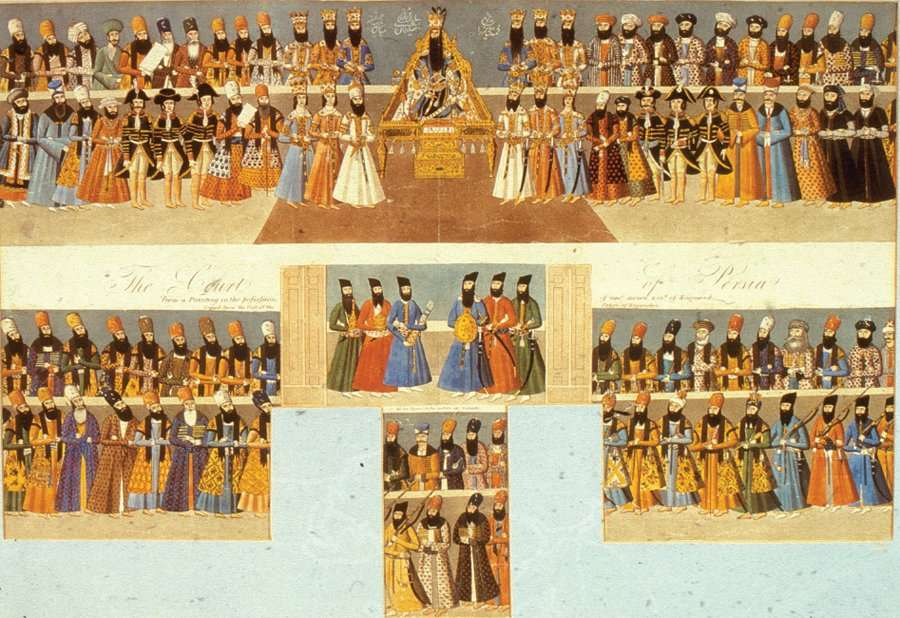
What is this painting of?
The Court of Persia / Fath Ali Shah enthroned with princes, noblemen, ministers and foreign envoys (Robert Havell, 1834)

Who is this portrait of?
Self-portrait of Nasseridin Shah (date unknown).
Effendi / Effendiyya
Defined as a man of high education in eastern Mediterranean country.
What were some political and economic incursions that were dealt to the Middle East?
Defensive developmentalism, imperialism, economic penetration, diplomatic coercion, settler colonialism and occupation of markets
Imperialism
Agents of an expanding society that gain influence over weaker society vitalities.
What did imperialism do to Alegria?
Transformed the state from Ottoman to French; flooded with mass settlers to dump politicals dissidents from the French Revolution, established more population for investment opportunities, crop culitivation, and transformed the state to a plantation colony.
Caisse de la Dette
A European government implementation that oversaw Egyptian finances with debt payment. Took control of 50% of Egyptian revenue, directed revenue from railraods/telegraph and ports to foreign creditors.
What were some of the great nineteenth century transformations in the Middle East?
Peripheralization, integration, defensive developmentalism and imperialism
Wasif Jawhariyyeh
A Jerusalem musician that documented and experienced the rapid transformation of the Middle Eastern states. Documented education, literacy exposures, fluidity of boundaries (identities and social/political roles), and the print revolution
Nizam-i Jedid / New Order
A military reform made by Sultan Selim III that adopted Western forms of drill and arament. Was continued by Mahmud II during his succession, but was later wiped out due to threatening power over his position.
What was the cost of defensive developmentalism throughout the nineteenth century?
The international depression of 1873 and the bankruptcy of Ottoman finances, leaving European states to supervise over them.
What was the purpose of defensive developmentalism for the Middle Eastern states?
To defend themselves from Western political and economic intrusion. Failed, as Egypt was subjected to British occupation, divided Persia into spheres of influence, and facilitated Western economic penetration from borrowing methods.
What led to the Urabi revolt?
The overall sense of instability of Egyptian nations; socioeconomic factors, debt and imperial state control over the Middle Eastern state.
How was Urabi represented in most cases during the revolt?
Both an unthreatening, ignorant child and a cunning, unprincipaled traitor. Utilized orientalist views between European states to demostrate the justification of civilizing the Middle East and created an imagined world of Egypt that was “out of control" and abandoned by Urabi.
“Mahommendanism has not and cannot have any relation to nationality, is indeed, inconsistent with the very idea of patriotism.” What does this quote signfy and why is it important?
Suggests muslims are incapable of having nationalist feelings and cannot pursue anything anything nationalism related. Evaluates how religious identity intersects with modernization and how both nationalism and patriotism clash with each other.
Devishirme
Special schools established by the rise of the New Order- took in recruits to convert into islam and trained to serve in the janissary corps.