Bio Lab Final
 Call Kai
 Learn
 Practice Test
 Spaced Repetition
 Match
 Flashcards
 Knowt Play
1/136

There's no tags or description
Looks like no tags are added yet.
137 Terms
Hardy-Weinberg
Hardy-Weinberg purpose → Describes allele and genotype frequencies in a non-evolving population.
Hardy-Weinberg equation → p + q = 1.
Genotype frequency equation → p² + 2pq + q² = 1.
What does p represent? → Frequency of one allele.
What does q represent? → Frequency of the other allele.
What does p² represent? → Frequency of the homozygous dominant genotype.
What does 2pq represent? → Frequency of the heterozygous genotype.
What does q² represent? → Frequency of the homozygous recessive genotype.
Hardy-Weinberg assumptions → Large population, random mating, no mutation, migration, or natural selection.
If q² = 0.25, what is q? → 0.5.
If q = 0.3, what is p? → 0.7.
If p = 0.7, what is p²? → 0.49.
If p = 0.7 and q = 0.3, what is 2pq? → 0.42.
Chi-square
Chi-square purpose → Tests whether observed and expected frequencies differ significantly.
Chi-square equation → χ² = Σ[(observed − expected)² / expected].
Observed value → What was actually measured or counted.
Expected value → What would be predicted if the null hypothesis were true.
Large chi-square value → Observed values differ substantially from expected values.
Phylogenetics (maximum parsimony)
The study of evolutionary relationships among organisms
Maximum Parimony - Choose the evolutionary tree requiring the fewest changes
Phylogram vs. Cladogram vs. Chronogram
Phylogram - tree where branch lengths represent amount of evolutionary change
Cladogram - relationships based on shared derived traits, branch length has no meaning
Chronogram - branch length represents time
Homology vs. Homoplasy
Homology - similarity due to common ancestry
Homoplasy - similarities that evolved independently rather than from a common ancestor
Distance Matrixes
How to use a microscope
Objective lens → Lens closest to the specimen that provides magnification.
Ocular lens → Eyepiece you look through; commonly provides 10× magnification.
Total magnification → Objective magnification × ocular magnification.
10× ocular + 40× objective → 400× total magnification.
Why use low power first? → It makes the specimen easier to find and center.
Diversity (abundance, richness, evenness)
Abundance - number of individuals of a species in an area
Richness - number of different species present
Evenness - how equally individuals are distributed among species
Shannon Diversity Index
Measures diversity using richness and evenness
High Shannon diversity → High richness and/or high evenness; considers richness + evenness.
Low Shannon diversity → Low richness and/or low evenness.
Simpson’s Diversity Index
Measures diversity based on the probability of selecting individuals from different species
Simpson’s Index concept → Measures dominance/diversity based on species abundances. Higher = more diverse if using 1 − D; lower D = more diverse.
Mesocosms
Controlled, simplified model of a natural experiment
Community Evenness
measures how equally individuals are distributed among the different species in an ecological community. High evenness means species have similar abundances, while low evenness means one or a few species dominate
Margalef’s Diversity Index
Diversity measure primarily based on species richness and sample size
Margalef mainly measures → Species richness while accounting for sample size. Higher = greater species richness.
Fundamental vs. Realized Niches
Fundamental niche → All conditions and resources a species could potentially use.
Realized niche → The niche actually occupied after competition and other interactions.
Ecological Succession
Gradual change in a community over time
Niche Partitioning
Species reduce competition by using resources differently
Niches in general
The role and conditions a species occupies in its environment
Grinnellian Niche - A species’ environmental requires and habitat
Extinction and Rewilding
Rewilding is a conservation approach that restores self-regulating ecosystems and helps reverse biodiversity loss by reintroducing missing species, removing human barriers, and letting natural processes recover. Unlike traditional conservation that often aims to freeze an ecosystem in a fixed historical state, rewilding focuses on restoring ecological functions—such as predation, herbivory, seed dispersal, and natural disturbances—that keep landscapes resilient against extinction and climate change
Flower/Inflorescence Anatomy
Flower - Reproductive structure of angiosperms (flowering plants).
Inflorescence - Arrangement or cluster of flowers on a plant. Includes the flowers, pedicels, rachis, and peduncle
Meristems
Regions of actively dividing, undifferentiated plant cells.
Specialized tissue in plants consisting of stem cells
ABC model of flower development
A = sepals; A+B = petals; B+C = stamens; C = carpels.
A model of the process by which flowering plants produce a pattern of gene expression in meristems that leads to the development of a flower
Homeotic Genes
Genes that determine the identity and development of plant structures. Regulate the development of anatomical structures in organisms
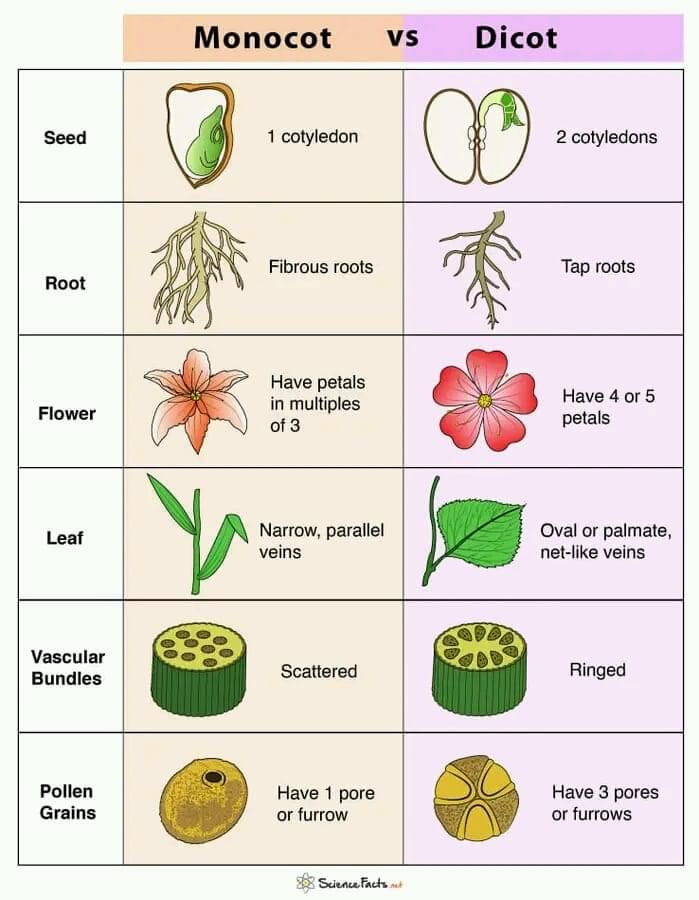
Eudicots vs. Dicots vs. Monocots
Eudicots = two cotyledons, every eudicot is a dicot but not all dicots are eudicots, monophyletic group
monocots = one; traditional, monophyletic group
dicots include eudicots and other lineages, paraphyletic group
Monophyletic vs. Paraphyletic
Monophyletic = a clade, most recent common ancestor and all descendants; paraphyletic = last common ancestor and only some descendants.
Seed Anatomy
Embryo = developing plant; cotyledon = embryonic leaf; endosperm = stored nutrients; seed coat = protection.
Magnoliids vs. Angiosperms vs. Gymnosperms
Magnoliids = lineage of angiosperms; angiosperms = flowering plants; gymnosperms = plants with exposed seeds.
Plant Vascular Tissue
Xylem transports water and minerals; phloem transports sugars and nutrients.
Primary vs. Secondary growth in plants
Primary = growth in length caused by apical meristems
Found in all plants
• Occurs in both roots and stems
• Apical buds
• Axillary buds
• All roots
• Only type of growth found in
monocots
Primary xylem and
primary phloem
• Cells originate from cell
divisions of primary
meristem
Collenchyma
Parenchyma
secondary = growth in thickness caused by lateral meristems.
• MOSTLY found in perennial dicots (ignore tomatoes for now- they’re
weird)
• Result of lateral meristems
• Leads to the thickening of stems and roots
• Two types of lateral meristems:
• 1) Vascular cambium
• 2) Cork cambium
• Vascular cambium
• Formed by differentiation of
parenchyma cells
• Interfascicular cambium
• Fascicular cambium
• Results in secondary xylem
and phloem
• Cork cambium
• Provides a protective covering
around the expanding trunk
• Develops FROM cortex
parenchyma cells
• Develops INTO cork cells and
phelloderm cells
Dendrochronology and Dendroclimatology
Dendrochronology = dating using tree rings; dendroclimatology = reconstructing past climates.
Student’s T-test
Tests whether two means are significantly different.
Assumes normality
Shapiro-Wilk Test
Tests whether data follow a normal distribution. Null = data is normally distributed
Compares data variance to expected variance under normal distribution
Nuisance Parameters/Covariates
Additional variables that may influence results and need to be controlled or accounted for.
Independent and dependent variables in hypotheses
Independent = explanatory variable; dependent = measured outcome.
Null vs. Alternative Hypotheses
Null = no effect or difference; alternative = an effect or difference exists.
P-values
Probability of obtaining results at least this extreme if the null hypothesis is true.
Phenotypic Plasticity
One genotype can produce different phenotypes in different environments.
Ex. height, leaves
Stomata
Pores in epidermis of leaves that regulate gas exchange and water loss. Bordered by a pair of guard cells that regulate the size of the opening
F-test
Statistical test used to compare variances (not means) or evaluate overall model significance.
Requires normality
Null: two groups have equal variance
Stabilizing Selection
Favors intermediate phenotypes and selects against extremes.
Shapiro Wilk Test - Not significant (normally distributed)
T-Test - Not significant
F-Test - Significant
Relaxed Selection
Reduced selection pressure allows variation to accumulate.
the strength of natural selection decreases (e.g. eliminating predators or
pathogens), leading to the accumulation of mutations that would have
previously been removed. This can happen when a trait becomes less important due to environmental changes, a new ecological niche, or a reduced population size.
Shapiro Wilk Test - Not significant (normally distributed)
T-Test - Not significant
The F-Test - Significant!
Directional Selection
Favors one extreme phenotype.
Shapiro Wilk Test - Not significant (normally distributed)
T-Test - significant
The F-Test - Not (necessarily) significant
Diversifying Selection
Favors both extreme phenotypes over intermediate phenotypes leading to an increase in genetic variance and the development of distinct groups within a population.
Sympatric speciation!
Shapiro Wilk Test - Significant
T-Test - Not (necessarily) significant
The F-Test - Significant
Allometry
Change in the relative size of body parts as overall body size changes.
Paired T-test
Compares two related measurements, such as before and after treatment.
Physiology and Homeostasis
Physiology = study of body functions; homeostasis = maintaining stable internal conditions.
Model Organisms
Species studied to understand biological processes that may apply to other organisms.
Open vs. Closed Circulatory Systems
Open = fluid leaves vessels and bathes organs; closed = blood stays inside vessels.
Stimulants vs. Depressants
Stimulants increase CNS activity; depressants decrease CNS activity.
Effects of caffeine/tea on physiology
Caffeine blocks adenosine receptors, increasing alertness and potentially heart rate.
Respiration
Gas exchange (O₂ and CO₂) or cellular energy production, depending on context.
Gymnosperms
Seed plants with exposed seeds, usually found in cones; do not produce flowers.
Angiosperms
Flowering plants whose seeds develop inside an ovary.
Built upon a structural foundation consisting of a compressed stem with
four nodes/modified leaves
• Compressed stem -> receptacle
• Node 1 -> gynoecium (female reproductive parts; carpels)
• Node 2 -> androecium (male reproductive parts; stamens)
• Node 3 -> corolla (individually called petals)
• Node 4 -> calyx (individually called sepals)
Nodes where modified leaves are attached -> whorls
Two or more modified leaves are attached radially around node
Receptacle
Enlarged tip of the flower stalk where floral parts attach.
Gynecium
Female reproductive whorl of a flower.
Carpels
Female reproductive structures containing ovules. Composed of stigma, style, and ovary
Androecium
Male reproductive whorl of a flower.
Stamens
Male reproductive structures consisting of anthers and filaments; produce pollen.
Corolla
Floral whorl consisting of petals.
Petals
Often colorful structures that attract pollinators.
Calyx
Outermost floral whorl, consisting of sepals.
Sepals
Leaflike structures that protect the developing flower bud.
Whorls
Circular arrangements of floral parts.
Stigma
Tip of the carpel where pollen lands.
Style
Stalk connecting the stigma to the ovary.
Ovary
Structure containing ovules; develops into fruit after fertilization.
Pistil
Female reproductive structure consisting of one or more carpels.
Calyx Whorl
Whorl containing all the sepals.
Tepals
Floral parts where sepals and petals are not distinguishable.
Corolla Whorl
Whorl containing all the petals.
Androecium Whorl
Whorl containing all the stamens. Can be in an open arrangement or cone arrangement
Composed of filament and anther
Gynecium Whorl
Whorl containing the carpels/pistil. Composed of style, stigma, and sometimes ovary
Ovules
Structures containing the female gametophyte; develop into seeds after fertilization.
Complete vs. Incomplete
Complete = all four floral whorls; incomplete = missing at least one, ex. corn.
Flower
Reproductive structure of angiosperms.
Inflorescence
Arrangement or cluster of flowers on a plant.
Pedicel
Stalk supporting an individual flower.
Rachis
Central axis of an inflorescence that bears flowers.
Peduncle
Main stalk supporting an inflorescence or flower.
Cauliflory Inflorescence
Flowers growing directly from the trunk or older branches.
Meristems/Apical meristems
Meristems are dividing cells; apical meristems occur at root and shoot tips and cause lengthwise growth, can transform into the reproductive tissues for certain shoots.
Homeotic Genes
Genes that control the identity of plant structures during development.
Determinate Growth vs. Indeterminate Growth
Determinate growth - Growth that stops after a specific size or developmental stage.
• Apical meristem transforms into
inflorescence at end of stem
• Terminal inflorescence
• Places flowers at ends of stems and
branches
• Plants are considered determinate
Advantage/disadvantage: fruits ripen
synchronously
Indeterminate growth - Growth that continues throughout an organism's life.
• Apical meristem remains a vegetative
meristem that may form new nodes
and internodes all season
• Called indeterminate growth due to
number of nodes on stems and branches
potentially added throughout the year
• Advantage/disadvantage: Fruits ripen
at different times
Cotyledon
Embryonic seed leaf that stores or absorbs nutrients. Partition between endosperm and embryo
Coleoptile
Protective sheath surrounding the emerging shoot in monocot embryos to protect it as it germinates.
Endosperm
Nutrient-rich tissue that feeds the developing embryo.
Magnoliids
Early-diverging lineage of angiosperms, including magnolias and laurels.
Third largest after monocots and eudicots
Independent vs. Dependent Variable
Independent variable - Variable manipulated or used to explain changes in an experiment.
Dependent variable - Measured outcome that may change in response to the independent variable.
Mean
Arithmetic average of all values.
Standard Deviation
Measures how spread out data are around the mean.
Higher SD = higher variance/spread
Normal Distribution
Symmetrical, bell-shaped distribution where mean, median, and mode are equal.
Canalization
Ability to produce a consistent phenotype despite environmental or genetic variation.
Stomata
Pores that regulate gas exchange and water loss.
Histology
Study of tissues and their microscopic structures.
Hydrophytes
Plants adapted to aquatic or very wet environments.
Stomata on upper epidermis only, or completely absent in
submerged leaves.
High density of stomata.
No protective adaptations to reduce water loss.
Open during the day
Mesophytes
Plants adapted to environments with moderate water availability.
Stomata mostly on lower epidermis.
Moderate to high density of stomata.
Open during the day when water is plentiful,
closed when heat stressed.
Xerophytes
Plants adapted to dry environments with limited water.
Stomata on lower epidermis only.
Stomata often sunken in pits.
Fewer stomata per unit area to reduce water loss.
Trichomes (hairs), waxy plugs, and rolled leaves to trap moisture.
Open at night, closed during the day.
Guard Cells
Cells that open and close stomata by changing turgor pressure.
Variance
Average squared deviation from the mean; standard deviation squared.
Allometry (positive and negative)
Positive = body part grows faster than overall size; negative = grows slower.
Isometry
Body parts grow at the same proportional rate as overall body size.