factors affecting ewt: anxiety
 Call Kai
 Learn
 Practice Test
 Spaced Repetition
 Match
 Flashcards
 Knowt Play
1/7

There's no tags or description
Looks like no tags are added yet.
8 Terms
what is anxiety
a state of emotional and physical arousal
emotions include having=worried thoughts and feelings of tension
Research has, however, also shown that recall may actually be better in the presence of high anxiety
anxiety has a negative effect on recall
anxiety creates p_____ a_____ (changes) in the body which prevents what, so r____ is worse
Another reason why anxiety may affect recall is w______ f_____ e_____ (WFE)
WFE tends to happen during the commission of a crime if what is used
The eyewitness may f____ on the w____ due to f____ on the fight-or-flight response etc.
Due to this intense focus on the weapon, the criminal is not really n____ (the eyewitness does not take in their height, hair colour etc.)- Thus, recall of the d____ of the perpetrator is virtually n____-e____
anxiety has a negative effect on recall
anxiety creates physiological arousal in the body which prevents us paying attention to important cues, so recall is worse
Another reason why anxiety may affect recall is weapon focus effect (WFE)
WFE tends to happen during the commission of a crime if a weapon is used
The eyewitness may fixate on the weapon due to fear or the fight-or-flight response etc.
Due to this intense focus on the weapon, the criminal is not really noticed (the eyewitness does not take in their height, hair colour etc.)- Thus, recall of the details of the perpetrator is virtually non-existent
anxiety has a negative effect on recall- research
J_____ & S____ (1976) researched the weapon focus effect
Procedure:
Participants were told what and were asked to sit down in a w_____ a____
what were the 2 groups participants were split into
The low-anxiety group overheard what and saw a man do what
The high-anxiety group overheard what and saw a man do what
Participants were asked to identify the man from what
Findings:
The low-anxiety group correctly identified the man with a mean accuracy of ____%
Accuracy dropped to ___% in the high-anxiety group
The researchers concluded that a____ f_____ and has t____ v____ on the weapon and away from other details of the event
anxiety has a negative effect on recall- research
Johnson & Scott (1976) researched the weapon focus effect
Procedure:
Participants were told they were taking part in a lab study and were asked to sit down in a waiting area
Participants were split into a low-anxiety group or a high-anxiety group
The low-anxiety group overheard a casual conversation from a room and saw a man walk out with a pen and grease on his hands
The high-anxiety group overheard an argument from the room and saw a man walk out with a knife and blood on his hands
Participants were asked to identify the man from a set of photographs
Findings:
The low-anxiety group correctly identified the man with a mean accuracy of 49%
Accuracy dropped to 33% in the high-anxiety group
The researchers concluded that anxiety focuses and has tunnel vision on the weapon and away from other details of the event
anxiety has a positive effect on recall
witnessing a stressful event creates anxiety through p____ a____ within the body.
what is triggered, increasing a_____.
This may improve memory for the event as we become more aware of what
anxiety has a positive effect on recall
witnessing a stressful event creates anxiety through physiological arousal within the body.
The flight or flight response is triggered, increasing alertness.
This may improve memory for the event as we become more aware of cues in the situation
anxiety has a positive effect on recall - research
Research carried out by Y____ & C____ (19___) investigated whether anxiety may improve memory of events
Procedure:
Witnesses of what in a g____ shop in V_____, C____ were asked to take part in the study (____ witnesses out of ____ agreed)
participants were interviewed f____ to f____ months following the shooting; the interviews were compared to what
how was Accuracy measured
Participants were also asked to rate what (using a s____-p____ scale) and related issues, such as i_____
Findings and conclusion
The witnesses were very accurate in their accounts and there was little what- though some details were less accurate, such as recollection of the c____ of items and a____/w___
those participants who reported what were most accurate (about ____% compared to ____% for the less stressed group)
This suggests that anxiety does not have a detrimental effect on the accuracy of eyewitness memory in a real-world context and may even e____ it
anxiety has a positive effect on recall - research
Research carried out by Yuille & Cutshall (1986) investigated whether anxiety may improve memory of events
Procedure:
Witnesses of a real-life crime shooting in a gun shop in Vancouver, Canada were asked to take part in the study (13 witnesses out of 21 agreed)
participants were interviewed four to five months following the shooting; the interviews were compared to police interviews
Accuracy was measured by the number of matching details in each interview
Participants were also asked to rate their stress levels at the time of the incident (using a seven-point scale) and related issues, such as insomnia
Findings and conclusion
The witnesses were very accurate in their accounts and there was little change in the amount recalled or accuracy after five months- though some details were less accurate, such as recollection of the colour of items and age/weight
those participants who reported the highest levels of stress were most accurate (about 88% compared to 75% for the less stressed group)
This suggests that anxiety does not have a detrimental effect on the accuracy of eyewitness memory in a real-world context and may even enhance it
Explaining the contradictory findings- why does anxiety have a positive and a negative effect on recall
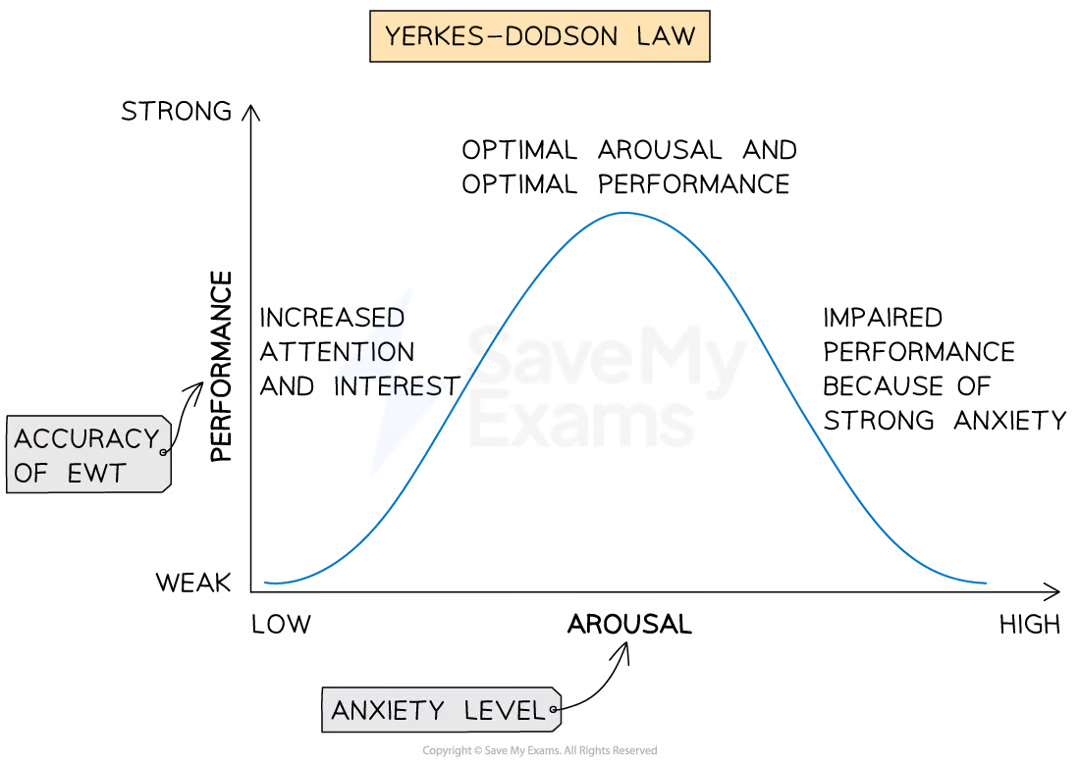
Y_____ & D_____ (1908) proposed that there is a relationship between what -This is called Yerkes-Dodson Law (also known as what) and can be used to explain the contradictory findings when related to the accuracy of EWT:
When a crime is witnessed, a person becomes e______ (anxiety) and p_____ (adrenaline release) aroused
Low levels of arousal (anxiety) are associated with what
As arousal increases p_____ increases up to an o_____
After this point, as a____ continues, what begins to decrease
Explaining the contradictory findings- why does anxiety have a positive and a negative effect on recall
Yerkes & Dodson (1908) proposed that there is a relationship between arousal (how alert, awake, or emotionally stimulated you are) and performance -This is called Yerkes-Dodson Law (also known as the inverted-U theory) and can be used to explain the contradictory findings when related to the accuracy of EWT:
When a crime is witnessed, a person becomes emotionally (anxiety) and physiologically (adrenaline release) aroused
Low levels of arousal (anxiety) are associated with low levels of performance (recall and accuracy of EWT)
As arousal increases performance increases up to an optimum
After this point, as arousal continues, performance begins to decrease
Evaluations -strengths
✓ -studies support the idea that anxiety has a negtive effect on the accuracy of recall:
V_____ & M____ (20___) found that participants' recall of what was less accurate with h____-anxiety compared to l___-anxiety
why is does this study have high validity
✓- studies support the idea that anxiety has a positive effect on the accuracy of recall:
C_____ & H____ (19___) found higher recall in witnesses to what
Victims of the r____ (high anxiety) had better recall of the details of the robbery compared to who (low anxiety)
This suggests that anxiety improves the accuracy of EWT and supports the study of Yuille & Cutshall
Evaluations -strengths
✓ -studies support the idea that anxiety has a negtive effect on the accuracy of recall:
Valentine & Mesout (2009) found that participants' recall of actors in the London Dungeons was less accurate with high-anxiety compared to low-anxiety
This study used an objective measure of heart rate to measure anxiety and so has high validity
✓- studies support the idea that anxiety has a positive effect on the accuracy of recall:
Christianson & Hubinette (1993) found higher recall in witnesses to a real-life bank robbery
Victims of the robbery (high anxiety) had better recall of the details of the robbery compared to bystanders (low anxiety)
This suggests that anxiety improves the accuracy of EWT and supports the study of Yuille & Cutshall
Evaluations -limitations
✗-One limitation of the study by Johnson and Scott is that it may not done what
participants may be focused on the weapon because they were s_____ at what they saw rather than scared.
P____ (19____) conducted an experiment that found that EWT is less accurate when what is involved as well as weapons
Eyewitness accuracy was significantly poorer when
This suggests that the weapon focus effect is due to u____ rather than anxiety/threat and therefore tells us nothing specifically about the effects of anxiety on EWT.
✗- Research support (Christianson and Hübinette) lacks c___
Christianson and Hübinette interviewed their participants how long after the event
The researchers therefore had no control over what
Therefore it is possible that a lack of control over c____ v____ may i____ their support.
✗-Problems with inverted-U theory
it ignores twhat
. It focuses on just p___ a____ and assumes this is the only aspect linked to EWT. But the way we t____about the stressful situation (le. cognitive) may also be important.
Evaluations -limitations
✗-One limitation of the study by Johnson and Scott is that it may not have tested anxiety.
participants may be focused on the weapon because they were surprised at what they saw rather than scared.
Pickel (1998) conducted an experiment that found that EWT is less accurate when unusual objects are involved (such as chickens) as well as weapons
Eyewitness accuracy was significantly poorer in the high unusualness conditions (chicken and handgun).
This suggests that the weapon focus effect is due to unusualness rather than anxiety/threat and therefore tells us nothing specifically about the effects of anxiety on EWT.
✗- Research support (Christianson and Hübinette) lacks control
Christianson and Hübinette interviewed their participants several months after the event (four to 15 months).
The researchers therefore had no control over what happened to their participants in the intervening time (eg, post-event discussions).
Therefore it is possible that a lack of control over confounding variables may , invlaidate their support.
✗-Problems with inverted-U theory
it ignores the fact that anxiety has many elements - cognitive, behavioural, emotional
. It focuses on just physical arousal and assumes this is the only aspect linked to EWT. But the way we think about the stressful situation (le. cognitive) may also be important.