Chapter 3: Macromolecules
 Call Kai
 Learn
Learn Practice Test
 Spaced Repetition
 Match
Match Flashcards
 Knowt Play
1/83

Name | Mastery | Learn | Test | Matching | Spaced | Call with Kai | Chat |
|---|
No analytics yet
Send a link to your students to track their progress
84 Terms
Polymers
Molecules made of smaller molecules called monomers; in macromolecules, these contain carbohydrates, nucleic acids, and proteins as they form long chains
Residues
The name for monomers when inside a polymer
Lipids
Non-monomers characterized by insolubility and aggregation in water, formed out of C—C and C—H bonds
Have variable melting points due to size and packing
Fatty acid
A non-polar hydrocarbon chain with a polar terminal carboxyl functional group, thus giving it amphipathic traits
Phospholipid
Fatty acids bound to glycerol that also contain an amphipathic phosphate; these help form water-excluding bilayers as a result of aggregation and can transport materials with proteins
Lipoproteins
Structures with hydrophobic interiors and hydrophilic exteriors to transport lipids like triglycerides and cholesterol in water
Glycerol
A three-carbon molecule with three hydroxyl groups
Saturation
Possessing this gives a lipid a straight, long chain with only single bonds for hydrogen and carbon, allowing for higher melting points
Without this, lipids can have double bonds with carbons and be more loosely packed, giving it lower melting points
Triglycerides
Lipids with 3 fatty acids linked to glycerol via condensation; these are the most common and are best for energy storage
Wax
A lipid with a long-chain alcohol bound to a fatty acid; these are very hydrophobic
This coats the leaves of plants to reduce water loss and protect against pathogens
Carotenoid
Lipids with a repeating, branched five-carbon unit; these enable light absorption
Steroid
Lipids with a 17-carbon atom core in four fused rings
Some hormones are a type of these, functioning as signals
White fat
This type of fat stores energy and provides insulation in mammals
Brown fat
This type of fat gets its color from iron-rich mitochondria and regulates temperature in infants
Carbohydrates
A group of molecules varying in size, properties, and functions, with the chemical formula Cm(H2O)n and a hydroxyl group connected to C atoms
Those with less than 12 carbons are simple sugars
Can be small or joined together
Monosaccharides
The simplest carbohydrates, with a linear or ring formation formed by 5 or 6 carbons
Comprised of structural or stereoisomers, differing in arrangement for binding
Polymer structures depend on these
Disaccharides
Two monosaccharides joined in a condensation reaction
Linked by a glycosidic bond formed by two hydroxyl groups that form water and oxygen
Like monosaccharides, these can be broken down for energy or bonded to other macromolecules
Oligosaccharides
Three to ten monosaccharides, modified by their functional groups
Often covalently bonded to proteins or lipids for functions or solubility, and can be found on the outsides of cells as signals
Polysaccharides
Hundreds to thousands of monosaccharides, joined by glycosidic bonds and arranged in chains or branches
Branching depends on function and location, often for energy storage
Hydrogen bonds can form in parallel groups, creating strength (as in cellulose)
Joined via 1,4 glycosidic bonds for linear forms or 1,6 glycosidic bonds for branching forms (number denotes carbon order)
Starch
The principal energy storage compounds for plants
Glycogen
The principal energy storage compounds for animals, fungi and bacteria
These are insoluble, but can have glucose ends hydrolyzed and broken down
Grouping of these prevent osmotic pressure from building up
Nucleic acids
Polymers that store and express genetic information via nucleotide monomers, grouped into DNA (with deoxyribose) and RNA (with ribose)
DNA encodes for RNA, which encodes for protein types

Nucleotide
A single unit of a nucleic acid, made of a monosaccharide, a nitrogen-containing base (linked to the 1’ carbon), and one to three phosphate groups (linked to the 5’ carbon)
Can be joined in oligonucleotides for basic regulation as RNA (3 to 20 monomers) or polynucleotides for heredity in DNA (hundreds of millions of monomers)

Base
Nitrogen-containing molecules that form the genetic code for DNA and RNA, classified as pyrimidines (single rings) or purines (double rings)
Linked to the 1’ carbon
Nucleoside
A nitrogenous base and ribose without a phosphate group
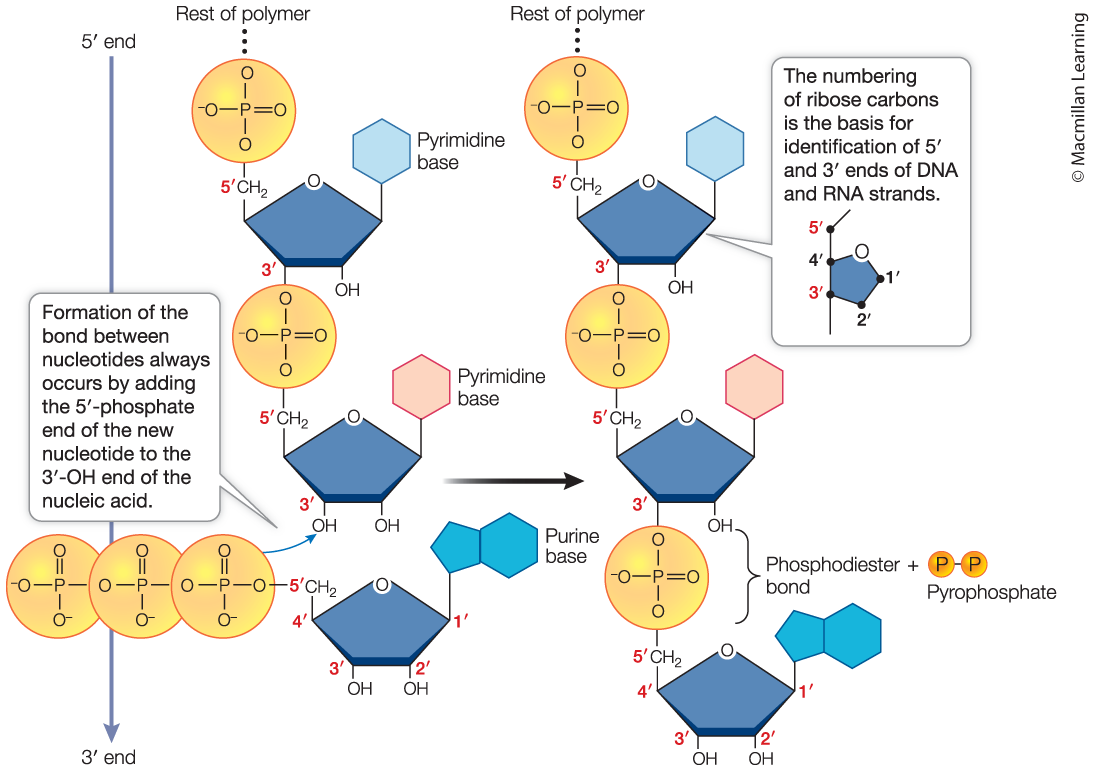
Phosphodiester bond
This is formed to create the “sides” in the sugar-phosphate bond, where the 3’ carbon atom on the previous nucleotide is linked to the triphosphate on the next 5’ carbon atom
Requires more than one phosphate due to an increase in free energy
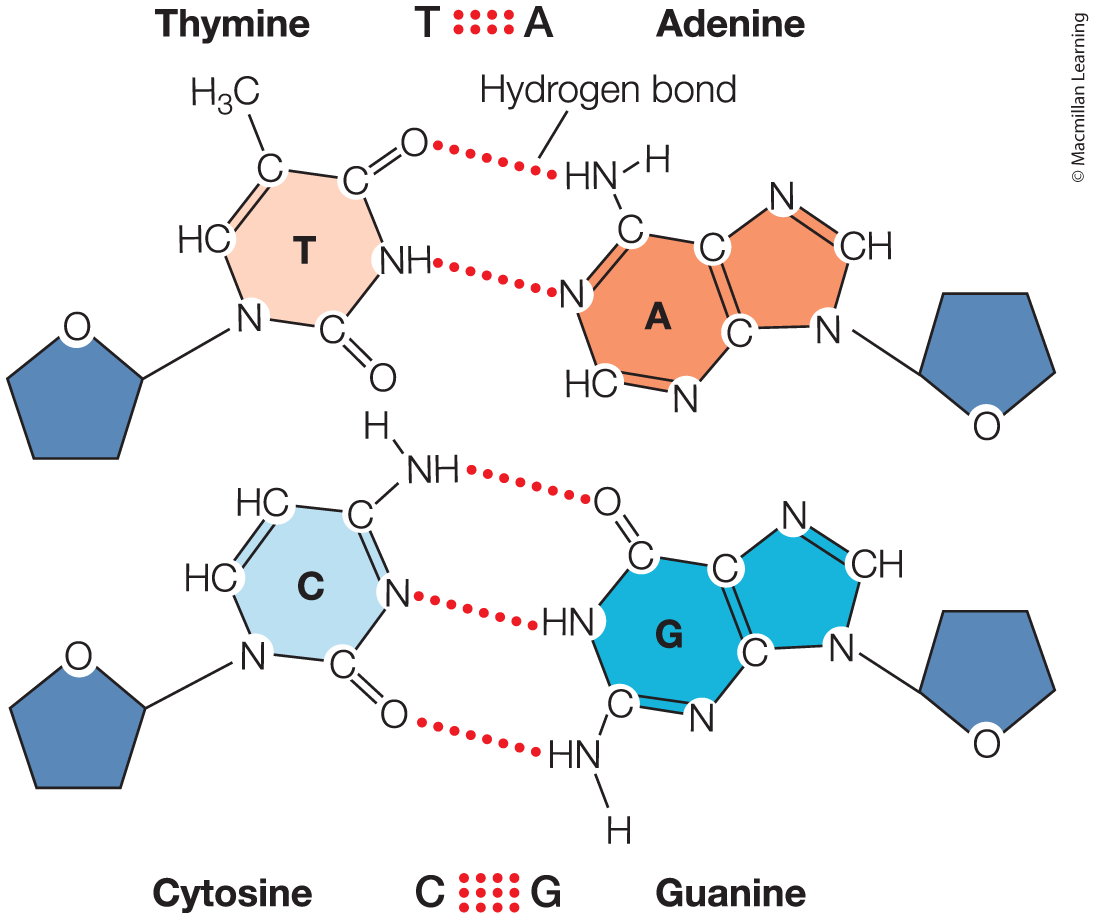
Complimentary base pairing
When two nitrogenous bases in DNA or RNA pair with their complimentary parts through hydrogen bonds; bonds between guanine and cytosine are stronger than those between adenine, thymine, or uracil with more bonds
These bonds across millions of bases collectively create an attraction that is strong enough to remain together but can be separated with some energy
Required for transcription and translation, which are performed in opposite direction
Deoxyribonucleic acid (DNA)
A double-stranded molecule with informational and complimentary base pairs in the middle, twisting into a helical structure
The expression of this is determined by its function and position in the body despite each cell containing all of this molecule’s instructions
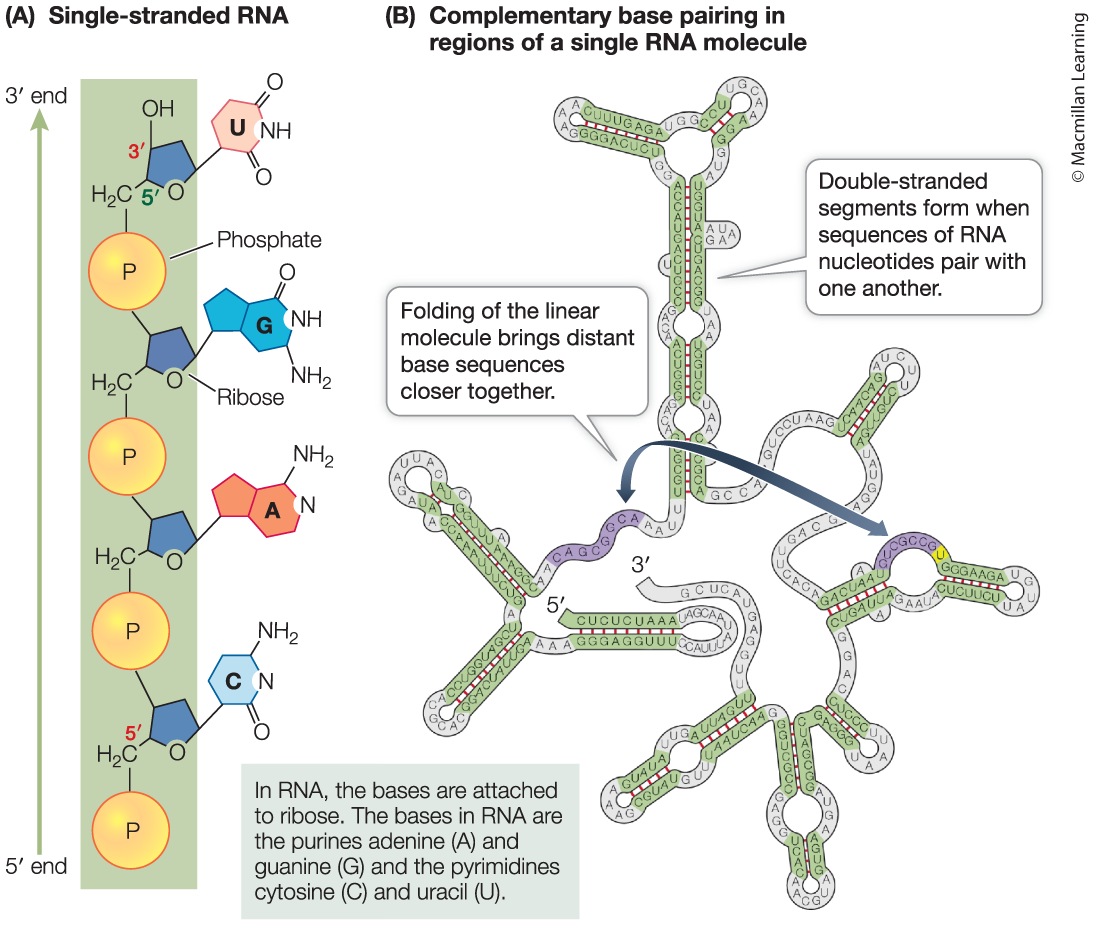
Ribonucleic acid (RNA)
A single-stranded molecule that can fold back, stabilized by complimentary base pairing
Created as a result of transcription from DNA to signal for protein production in translation in smaller groups
DNA replication
The process where DNA is copied onto new DNA molecules for transmission to daughter cells and offspring
Proteins
Polymers made up of tens to tens of thousands of monomers called amino acids, essential to the functioning of life due to their numerous abilities
Amino acid
A single monomer of a protein that contains an amino and carboxyl group; these can be classified into twenty different types with charge, polarity, size, shape, and functional differences
Like nucleotides, these form proteins sequentially, with carboxyl groups chaining with incoming amino groups to form peptide bonds
Some are required to be obtained from the diet

Peptide bond
The bond between amino acids in a protein, formed by a carboxyl and amino group with a water molecule loss
Alpha carbon
The central carbon in an amino acid that can form four covalent bonds
Two are occupied by the carboxyl and amino groups
A third is occupied by a hydrogen atom
The fourth is occupied by the differing R group

R group
A functional group unique to each of the twenty amino acids
Ten are hydrophilic, with five having an electric charge attracting ions and another five having polarity attracting hydrogen bonds
Seven have nonpolar hydrocarbon chains, which can cluster together in the protein’s interior or interact with lipids
Three remain in a special category due to structural features
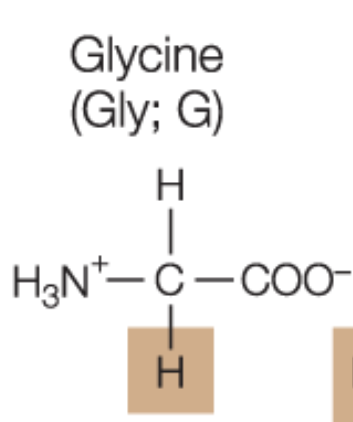
Glycine
A special R group consisting of a hydrogen atom
This allows for tight corners and flexibility in proteins

Cysteine
A special R group with a terminal SH group
Can react with another side chain or molecule to form a stabilizing covalent disulfide bridge
Oligopeptides
Short polymers of 20 or fewer amino acids; includes some hormones and other signaling molecules
Polypeptides
Very long polymers with a unique sequence of amino acids that ultimately comprise proteins
Primary structure
The precise sequence of amino acids in a protein; there are many of these due to the 20 amino acids available
Determined by covalent peptide bonds
Secondary structure
The stage of a protein’s structure that consists of regular, repeated spatial patterns in different regions of a polypeptide chain; the most common patterns are the alpha helix and beta pleated sheet
Alpha helix
A right-handed helical shape formed in secondary structures, with R groups coiling and extending from the peptide backbone to form hydrogen bonds within the coil
Beta pleated sheet
A secondary structure shape formed by extended and aligned amino acids, stabilized by hydrogen bonds between amino and carboxyl groups on the two chains
Tertiary structure
The stage of a protein’s structure that arises from the bending and folding of polypeptide chains, resulting in a three-dimensional structure with an interior and exterior capable of molecular interactions
Side chain interactions
These determine the shape of tertiary and quaternary structures, and include:
Cystine covalent disulfide bridges
Ionic interactions and bonds between charged side chains to ensure correct formations
Hydrogen bonds
van der Waals interactions between hydrophobic side chains
Subunits
Two or more polypeptide chains folded into a unique tertiary structure, these affect quaternary structure folding
Quaternary structure
These result from subunit binding and interactions as well as side chain interactions
May form beta pleated sheets between separate polypeptide chains, which can lead to abnormalities if overly aggregated
Denaturing
Occurs when a protein is heated or has its molecular structure disrupted
Can often be reversed if cooled or the disruptive force is removed, requiring the primary structure to remain intact and unbonded from unoriginal polypeptides
May also occur due to pH, polar solutes, ionic bonds, and nonpolar substances that affect chemical reactions
Enzymes
Catalytic molecules that increase the rate of biochemical reactions by lowering the activation energy needed
These can bind to reactants to participate in the reaction yet maintain their chemical form
Generally specialized to bind to only one or a few closely related reactants in one reaction
Produced and regulated according to needs of environment and system
Structural and motor proteins
Proteins that provide physical stability and enable movement in the cell
Signal and regulatory proteins
Proteins that control the rates of numerous biological processes
Receptor proteins
Proteins that receive and respond to molecular signals from inside and outside the organism
Protein bonding
This occurs at specific sites on the protein determined by its three-dimensional shape, where side chains bond with molecules or ions

Ligand
A molecule or ion that binds to another molecule, like a protein, through numerous weak bonds that determine binding affinity
Addition of these can cause conformational changes which affect protein functions
Binding affinity
The interaction strength between a ligand and protein molecule
Conformational change
A change in the shape of a protein following the binding of a ligand, affecting its function

Side chain modification (R group modification)
Protein structure modifications through amino acid and chemical group bonds

Cofactor
An additional molecule that some proteins require to function, varying in bond strength either for tight or loose bonds
Seen with ATP as it is converted to and from ADP

Prosthetic groups
Cofactors that are tightly bound to a protein with covalent bonds

Coenzymes
Cofactors that are loosely bound to enzymes

Proteolysis
The breaking apart of a bond in a protein for a change in activation state as needed
Reaction rate
This can be affected by temperature, concentrations, free energy, and activation energy
Activation energy (Ea)
The energy needed to successfully start and complete a reaction
This can be met with higher temperatures or molecular reorganization for higher interaction likelihood
Most common way of meeting this in living systems is lowering it via enzymes

Catalysis
The ability to increase reaction rates without chemical changes; enzymes can do this repeatedly and rapidly up to a 103 to 108 speedup
Substrates
The reactants in an enzyme-catalyzed reaction
Active site
The site on the enzyme where specific substrate molecules bind
Typically only a small part of the protein
Relies on hydrogen bonds, van der Waals interactions, and charged groups for binding

Conformation
The three-dimensional shape of an enzyme
With its chemical properties, one enzyme is made to be highly specific
This may change during a reaction as an example of induced fit
Enzyme-substrate complex (ES)
This is created by the binding of substrates to the active site of an enzyme, held together by chemical bonds, in order to give rise to products

Induced strain
Method of inducing change through an enzyme by stretching bonds in the substrate, making them easier to break with greater potential energy
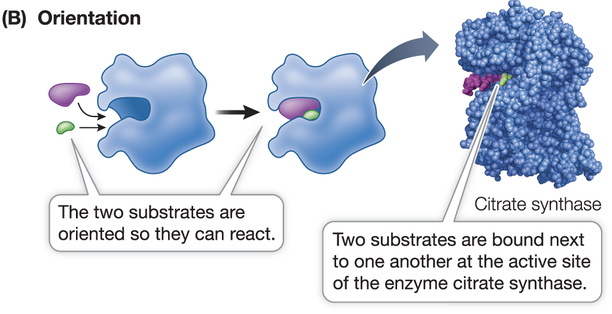
Substrate orientation
Method of inducing change through an enzyme by orienting two substrates to facilitate reactions
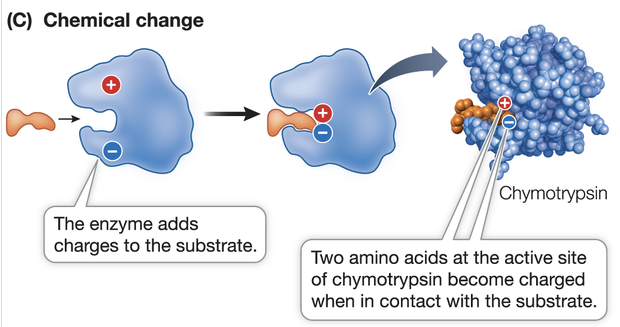
Chemical modification
Method of inducing change via an enzyme via the involvement of the side chains (R groups) in the reaction for manipulation of products

Metabolic pathway
A series of reactions in which the product of one reaction is a substrate for the next for the breakdown or synthesis of molecules
Catabolic pathway
A metabolic pathway that breaks down molecules and releases energy
Anabolic pathway
A metabolic pathway that synthesizes molecules from simpler ones, building up potential energy
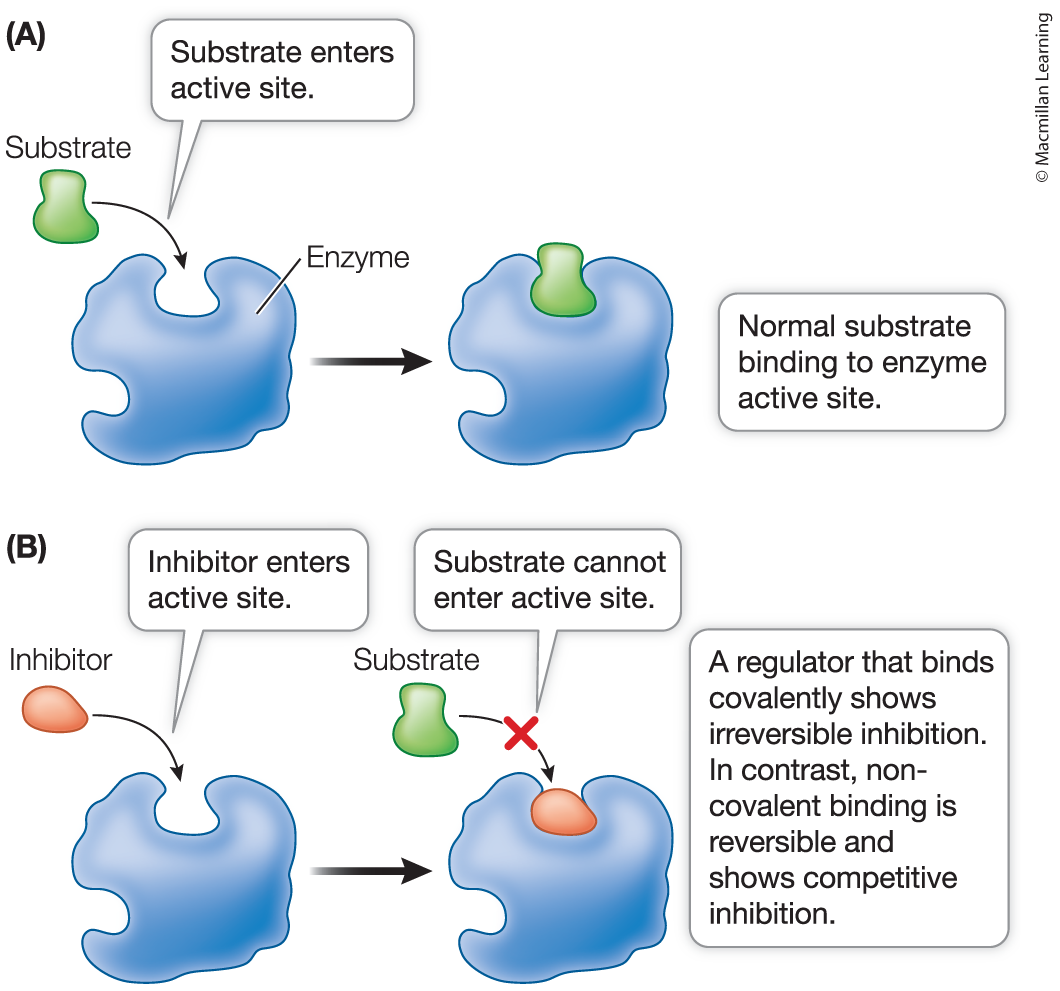
Inhibitor
A molecule that prevents the entry of a molecule into the active site, lowering the rate of reaction
Irreversible inhibition
When an inhibitor covalently binds to an active site of an enzyme and fails to leave, disabling the enzyme
Rare in nature but used in medicines
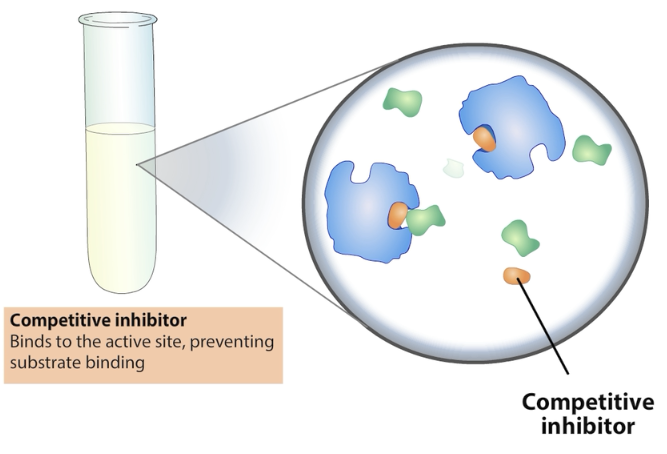
Competitive inhibitor
An inhibitor of an enzyme that binds to the active site and prevents substrate binding normally, decreasing the rate of reaction as none occur
These are reversible and can be countered with greater substrate concentration

Uncompetitive inhibitor
An inhibitor of an enzyme that binds to the complete enzyme-substrate complex, preventing the release of products
Cannot be countered with greater substrate concentration due to attraction to already-bound enzyme
Can be unbound, allowing for occasional formation of products

Noncompetitive inhibitor
An inhibitor of an enzyme that binds outside of the active site, changing the enzyme structure so that normal binding cannot occur
Cannot be countered with greater substrate concentration due to attraction to enzyme itself (requires greater enzyme concentration)
Can be unbound with reversible effects
Is a type of allosteric regulation
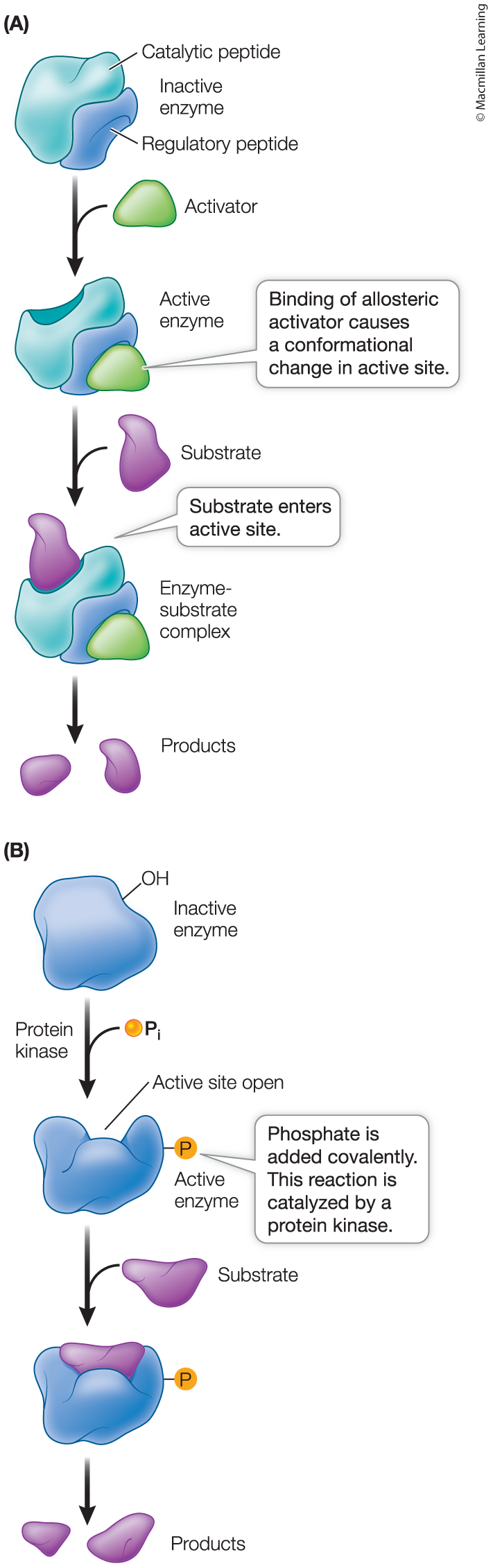
Allosteric regulation
Type of regulation where molecules bind to an enzyme outside of the active site and modify the enzyme’s shape, allowing for a change in activity
This can be done non-covalently and reversibly
Seen with noncompetitive inhibitors
Allosteric site
The binding location of molecules involved in the allosteric regulation of enzymes
These are typically on different peptides of the protein
Phosphorylation
The process of modifying an amino acid by the addition of a phosphate group
Can induce changes like increased hydrophilicity
Is reversible
Kinase
A class of enzymes that catalyzes the addition of phosphate groups to proteins
Phosphatase
A class of enzymes that catalyzes the removal of phosphate groups from proteins