fluid flow
 Call Kai
 Learn
 Practice Test
 Spaced Repetition
 Match
 Flashcards
 Knowt Play
1/41

There's no tags or description
Looks like no tags are added yet.
42 Terms
laminar flow
Smooth, orderly, parallel layers
Occurs at low velocities or high viscosities

turbulent flow
Chaotic, with eddies and mixing
Common at high velocities or low viscosity

Re number to differentiate type of flow
low Re < 2000 = laminar flow
high Re > 4000 = turbulent
2000 < Re < 4000 = transitional

Newtonian fluid
shear stress is directly proportional to shear strain
gives constant dynamic viscosity
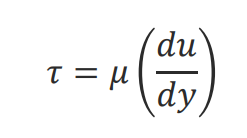
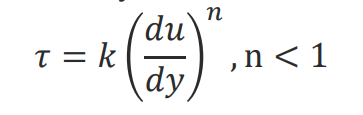
pseudoplastic fluid
Shear thinning
viscosity decreases with shear rate
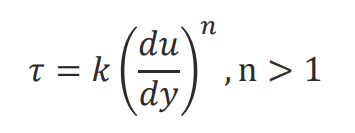
dilatant fluid
shear thickening
Viscosity increases with increasing shear rate
bingham plastic
does not flow until, a minimum yield stress is exceeded
after that behaves likes Newtonian fluid

viscous flow
flows in which frictional effects are significant
inviscid flow
theoretical flow where viscosity is assumed to be zero
no internal resistance to flow
steady flow
fluid properties (T, P, u, 𝜌) do not change with time at a point in space
It is function of space only
unsteady flow
Fluid properties change with respect to time and space
internal flow
Flow confined by solid boundaries
external flow
flow over a surface
Eulerian approach
Observes fluid flow at fixed locations or control volumes in space over time
lagrangian approach
Tracks individual fluid particles or parcels and monitors their properties as they move through space and time
fluid particle
small deforming volume carried by the fluid flow that
Always contain the same fluid particles
Is large enough so that its properties can be well defined
Is small enough so that it can quickly adjust to changes
substantial derivative (material derivative)
rate of change of a property (temperature, velocity, concentration) of a fluid particle as it moves through the flow field
Material position vector (𝑥𝑝, 𝑦𝑝, 𝑧𝑝) of a fluid in Lagrangian frame
= position vector (x,y,z) in Eulerian frame
streamline (3D flow)
tangent to the velocity vector at one instant
integrate to get the equation of a streamline
eulerian description
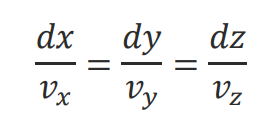
streamline (2D flow)

pathline integral form
actual path travelled by an individual fluid particle over some time period
lagrangian concept
final position = starting position + total distance travelled by adding up velocity over that time span
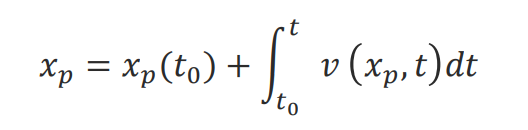
pathline differential form

streakline integral form
locus of all particles that have passed through a given fixed point in space
multi particle lagrangian concept

streakline differential form

observation time vs. particle release time in streaklines
observation time (t) - instant flow is frozen or photographed acting as upper integral limit
particle release time (t’) - past instant individual particle was injected at source acting as lower integral
coincidence of streamlines, pathlines, and streaklines
steady flow - all three lines are completely identical and coincide
unsteady flow - all three lines differ bc velocity varies with time
crossing of flow visualisation lines
streamlines cannot cross each other at a single instant
pathlines can cross themselves and other pathlines at different times
streaklines can cross themselves and other streaklines
reynolds transport theorem (RTT)
RTT is a system to control volume transformation
lagrangian to eulerian transformation
allows us to apply laws of physics to real world devices like pumps, turbines, nozzles, reactors etc
handles both unsteady changes inside the control volume and fluxes across its boundaries
if forces due to compressibility is negligible
reynold’s equation of motion

if the flow is not turbulent
navier stokes equation

if the flow is assumed to be ideal (viscosity is negligible)
Euler’s equation of motion

mass
pdAds
eulers equation of motion

bernoullis equation
obtained by integrating eulers equation

bernoullis equation pressure form
multiplied by pg

bernoullis equation energy form
multiplied by g

bernoullis equation head form

pressure head
e𝑛𝑒𝑟𝑔𝑦 𝑑𝑢𝑒 𝑡𝑜 𝑝𝑟𝑒𝑠𝑠𝑢𝑟𝑒 𝑚𝑒𝑎𝑠𝑢𝑟𝑒𝑑 𝑎𝑡 𝑠𝑡𝑎𝑡𝑖𝑐 𝑝𝑜𝑖𝑛𝑡 A

velocity head
𝑒𝑛𝑒𝑟𝑔𝑦 𝑑𝑢𝑒 𝑡𝑜 𝑚𝑜𝑡𝑖𝑜𝑛, 𝑘𝑖𝑛𝑒𝑡𝑖𝑐 𝑒𝑛𝑒𝑟𝑔y

continuity equation
A1v1 = A2v2