MGT 465- Exam 3 (Set 1)
 Call Kai
 Learn
 Practice Test
 Spaced Repetition
 Match
 Flashcards
 Knowt Play
1/29

Earn XP
Description and Tags
Leadership Notes & Key Terms
30 Terms
charisma
A special personal magnetic charm or appeal that arouses loyalty and enthusiasm in a leader-follower relationship.
charismatic
A person who possesses legitimate power that arises from “exceptional sanctity, heroism, or exemplary character.”
consideration
A “relationship-oriented” leader behavior that is supportive, friendly, and focused on personal needs and interpersonal relationships.
contingency theory of leadership
A theory advanced by Dr. Fred E. Fiedler that suggests that different leadership styles are effective as a function of the favorableness of the leadership situation least preferred.
designated leader
The person placed in the leadership position by forces outside the group.
emergent leader
The person who becomes a group’s leader by virtue of processes and dynamics internal to the group.
formal leader
That individual who is recognized by those outside the group as the official leader of the group
great man theory of leadership
The belief that some people are born to be leaders and others are not.
informal leader
That individual whom members of the group acknowledge as their leader
initiating structure
A “task-oriented” leader behavior that is focused on goal attainment, organizing and scheduling work, solving problems, and maintaining work processes.
leadership
A social (interpersonal) influence relationship between two or more persons who depend on each other to attain certain mutual goals in a group situation.
effective leaders of groups need to address
Maintenance needs- the ability of individuals to fit in and work together
Task needs- group’s ability to progress towards goal attainment
least-preferred coworker (LPC)
the person with whom the leader least likes to work
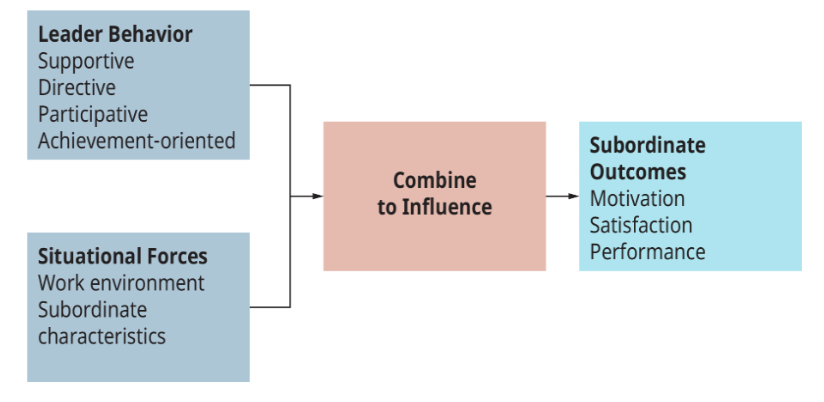
path-goal theory of leadership
A theory that posits that leadership is path- and goal-oriented, suggesting that different leadership styles are effective as a function of the task confronting the group.
transformational leader
A leader who moves and changes things “in a big way” by inspiring others to perform the extraordinary
visionary leader
A leader who influences others through an emotional and/or intellectual attraction to the leader’s dreams of what “can be.”
Leadership process
Leader: takes charge of or guides activities of others
Follower: either rejects leadership or accepts it by surrendering to fulfill leader’s needs
Context: situation surrounding leader and follower
Process: complex, interactive, and dynamic working relationship between leader and followers.
Consequences: whether maintenance and task needs have been fulfilled

Sources of Power
Reward power: based on leader’s ability to bestow rewards or outcomes
Coercive power: based on leader’s ability to punish my inflicting pain by withholding or taking away something valuable.
Referent power: based on people’s desire to associate or be accepted by the leader
Expert power: based on leader’s expertise and willingness to share expert knowledge
Legitimate power: the power that a leader has because others believe that the leader has the “right” to influence them and that they ought to obey
Leader-Follower Power Relationship
Different types of power result in different forms of compliance

Theory X
Assumption:
people dislike work and are incapable of exercising self-direction & self-control
Consequence:
exert controlling leadership style
Theory Y
Assumption:
People have creative capacities, and ability & desire to exercise self-direction & self-control
Consequence:
Members are allowed significant amount of discretion at job and encouraged to participate in decision-making
Directive/Permissive Leadership Styles

Directive autocrat
unilateral decisions & close supervision – appropriate for quick decisions and inexperienced members
Permissive autocrat
retains decision-making power but allows discretion in their execution – recommended for a limited time for decisions but routine tasks and experienced members
Directive democrat
participative decision-making but supervise execution – appropriate when members have valuable input but execution requires coordination.
permissive democrat
Member involvement in both decision-making and execution – recommended when there is no time constraints, and members can improve output quality.
characteristics possessed by successful leaders
Drive
Leadership motivation
Honesty & integrity
Self-confidence
Cognitive ability
Knowledge of business
Other traits such as creativity, flexibility etc.
Ohio State University Studies
Primary dimensions of leadership behavior
Consideration- relationship-oriented leader behavior – focuses on relationship with members
Initiating structure- task-oriented leader behavior– focuses on task needs
University of Michigan Studies
Types of leader behavior
Employee- member centered behavior – consideration and support for members
Job-centered behavior– focuses on supervisory functions needed for task performance
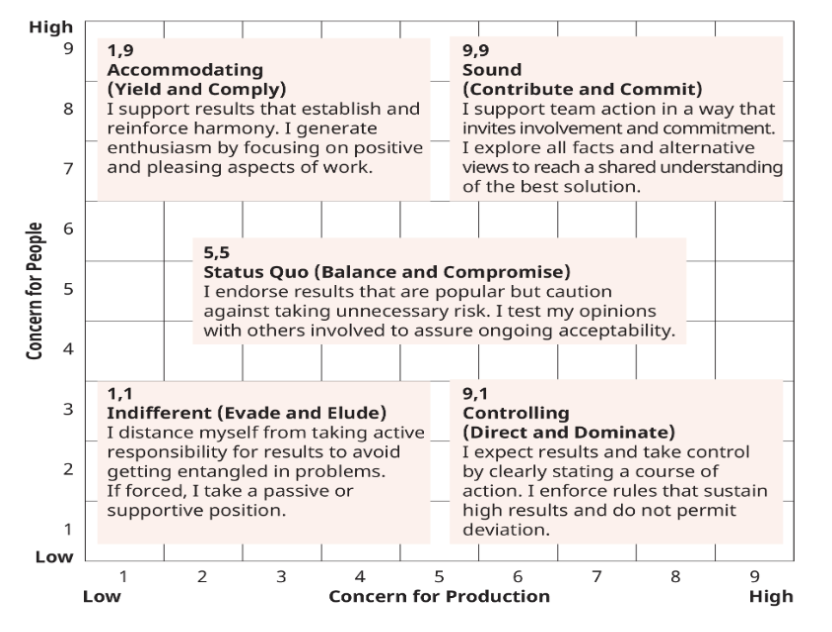
Blake and Mouton’s Managerial Grid
Classification of styles of leadership based on concern for results (production) and concern for people
Path-Goal Leadership Model
Effective leaders provide members with a path to a valued goal