anatomy bojrab ch 3
 Call Kai
 Learn
 Practice Test
 Spaced Repetition
 Match
 Flashcards
 Knowt Play
1/297

There's no tags or description
Looks like no tags are added yet.
298 Terms
cells
Cells are the structural units of all living things
The human body has 50 to 100 trillion cells
cell theory
The cell is the smallest unit of life
All organisms are made of one or more cells
Cells arise only from other cells

cell diversity
-Over 250 different types of human cells
-Types differ in size, shape, and subcellular components; these differences lead to differences in functions

generalized cell
All cells have some common structures and functions
3 basic parts of human cells
Part 1. Plasma membrane: flexible outer boundary
Part 2. Cytoplasm: intracellular fluid containing organelles
Part 3. Nucleus: D N A containing control center

structure of the generalized cell (picture)
be able to write 4/5 sentences about each

extracellular materials
Substances found outside cells
types of extracellular fluids
body fluids, including:
Interstitial fluid: cells are submersed (bathed) in this fluid
Blood plasma: fluid of the blood
Cerebrospinal fluid: fluid surrounding nervous system organs
examples of cellular secretions
saliva, mucus, gastric fluids

extracellular matrix function
substance that acts as glue to hold cells together
function of plasma membrane
acts as active barrier separating intracellular fluid from extracellular fluid
plays dynamic role in cellular activity by controlling what enters and leaves the cell
AKA cell membrane

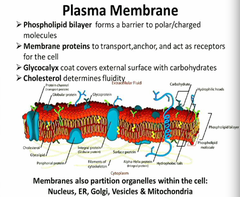
fluid mosaic model definition
depicts a moving membrane made of many pieces

parts of fluid mosaic model
bilayer of phospholipids with smaller amounts of cholesterol
embedded membrane proteins

Glycocalyx
The external surface of a plasma membrane that is important for cell-to-cell communication and made of surface sugars

cell junctions
connections between cells that hold the cells together as a unit

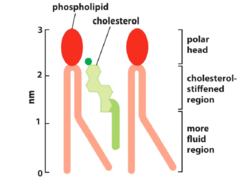
lipid bilayer parts
phosphate heads (polar and hydrophilic)
phosphate tails (nonpolar and hydrophobic)
20% cholesterol

function and location of cholesterol in the lipid bilayer
Located between the phospholipid tails
Increases stiffness of the membrane
membrane proteins
•Allow cell communication with environment
•Make up about half the mass of plasma membrane
•Most have specialized membrane functions
•Some float freely, and some are tethered to intracellular structures

two types of membrane proteins
integral and peripheral

integral proteins structure
Inserted into membrane; most are transmembrane proteins (span membrane)
Have both hydrophobic region that interact with lipid tails and hydrophilic regions that interact with water inside and outside the cell
integral proteins functions
Transport proteins (channels and carriers), enzymes, or receptors.
peripheral proteins location
loosely attached to integral proteins or anchored to the membrane
peripheral proteins function
motor proteins for shape change during cell division and muscle contraction, cell-to-cell connections
plasma membrane (picture)
functions of membrane proteins
a) transport
b) receptors for signal transduction
c) enzymatic activity
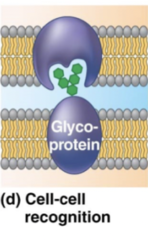
d) cell to cell recognition
e) cell to cell joining
f) attachment to the cytoskeleton and extracellular matrix
Transport Proteins
allow cells to control which substances enter or exit the cell.
A protein that spans the membrane may provide a hydrophilic channel across the membrane that is selective for a particular solute.
Others move a substance from one side to the other by changing shape. Pumps use the power of ATP to drive the shape change; carriers do not require ATP.

Receptor proteins in the membrane
allow a cell to receive information from other cells.
A receptor's extracellular binding site fits the shape of a specific chemical messenger, such as a hormone.
Binding the chemical messenger causes the protein to change shape, which initiates a chain of chemical reactions in the cell. This is called signal transduction and effectively moves the message from outside of the cell to inside it.

enzymes in the membrane
allow cells to transform one substance into another.
The active site of the enzyme may face the solution on either side of the membrane.
may catalyze sequential steps of a metabolic pathway

cell to cell recognition proteins in the membrane
Some proteins in the membranes of adjacent cells allow them to recognize each other through direct physical contact.
Some glycoproteins serve as identification tags that are specifically recognized by other cells.
This type of cell-cell binding is usually short-lived
glycoproteins
proteins bonded to short chains of sugars which help to make up the glycocalyx
cell-to-cell joining proteins in the membrane
Membrane proteins of adjacent cells may be hooked together in various kinds of long-lasting intercellular junctions.
Some membrane proteins (cell adhesion molecules, or CAMs) of this group provide more short-lived binding sites that guide cell migration and other cell-to-cell interactions.

attachment to the cytoskeleton and extracellular matrix proteins in the membrane
Some membrane proteins anchor elements of the cytoskeleton (cell's internal framework) and the extracellular matrix (fibers and other substances outside the cell).
Helps maintain cell shape, fixes the location of certain membrane proteins, and plays a role in cell movement.

Glycocalyx
consists of sugars (carbohydrates) sticking out of cell surface
Some sugars are attached to lipids (glycolipids) and some to proteins (glycoproteins)

glycocalyx function
•Every cell type has different patterns of this "sugar coating"
-Functions as specific biological markers for cell-to-cell recognition
-Allows immune system to recognize "self" versus. "nonself"
cancer affecting the glycocalyx
•Glycocalyx of some cancer cells can change so rapidly that the immune system cannot recognize the cell as being damaged.
•Mutated cell is not destroyed by immune system so it is able to replicate.
intercellular junctions
Intercellular junctions allow adjacent cells to adhere or communicate

three types of cell junctions
Tight junctions
Desmosomes
Gap junctions
tight junction structure
Integral proteins on adjacent cells fuse to form an impermeable junction that encircles whole cell

tight junction function
Prevent fluids and most molecules from moving in between cells
Create two compartments, one on each side of the layer of cells
Desmosomes (anchoring junctions) structure
Rivet-like cell junction formed when linker proteins (cadherins) of neighboring cells interlock like the teeth of a zipper
Linker protein is anchored to its cell through plaques
Keratin filaments connect plaques intercellularly for added anchoring strength

plaques
thickened "button-like" areas on inside of plasma membrane that anchors linker protein to its cell
desmosomes (anchoring junctions) function
Help keep cells from tearing apart
gap junctions structure
connexons form tunnels that allow small molecules to pass from cell to cell

connexons
In a gap junction, a protein channel linking adjacent animal cells.
gap junctions
Used to spread ions, simple sugars, or other small molecules between cells
Allows electrical signals to be passed quickly from one cell to next cell
Used in cardiac and smooth muscle cells

Two essential ways substances cross plasma membrane
passive transport
active transport
passive transport simple definition
no energy is required
active transport simple definition
energy (ATP) is required
passive transport reasoning
-All molecules have random, high-speed movement due to their intrinsic kinetic energy that result in collisions between molecules
-Molecules in higher concentration areas collide more, resulting in molecules being scattered to lower concentration areas
3 types of passive transport
simple diffusion, facilitated diffusion, osmosis
diffusion
natural movement of molecules from areas of high concentration to areas of low concentration aka moving down a concentration gradient
3 factors that influence speed of diffusion
Concentration—the greater the difference of concentration between two areas, the faster diffusion occurs
Molecular size—smaller molecules diffuse faster
Temperature—higher temps increase kinetic energy which resultis in faster diffusion
system reaching equilibrium in osmosis
The system reaches equilibrium when there is no net movement of molecules in one direction
selectively/differentially permeable membrane
-Allows nutrients to enter the cell, but prevents many undesirable substances from entering
-Keeps valuable cell proteins and other necessary substances in the cell, but allows wastes to exit
Hydrophobic core of plasma membranes function
stops diffusion and creates concentration gradients by acting as selectively permeable barriers
molecules that can pass through the plasma membrane unassisted
Lipid-soluble molecules and small molecules
molecules that require assistance crossing the plasma membrane
Water-soluble molecules and large molecules
osmosis
Movement of water across the plasma membrane
plasma membrane damage effects
substances diffuse freely into and out of cell, compromising concentration gradients
Example: burn patients lose precious fluids, proteins, and ions that weep from damaged cells
simple diffusion
substances diffuse directly through the lipid bilayer
Nonpolar lipid-soluble (hydrophobic) substances diffuse directly through phospholipid bilayer
Examples: oxygen, carbon dioxide, steroid hormones, fatty acids
Small amounts of very small polar substances, such as water, can even pass
facilitated diffusion
transport across the plasma membrane with assistance of carrier or channel protein
Certain hydrophobic molecules (e.g., glucose, amino acids, and ions) are transported passively with assistance down their concentration gradient
carrier mediated facilitated diffusion (simple)
occurs when substances bind to protein carriers
channel mediated facilitated diffusion (simple)
substances move through water filled channels
carriers
transmembrane integral proteins that transport specific polar molecules, such as sugars and amino acids, that are too large for membrane channels
-Binding of molecule causes carrier to envelope it and change shape that results in molecule being moved across membrane
carriers are saturated
all carriers are bound to molecules and are busy transporting
channels
transmembrane proteins with aqueous-filled cores that transport molecules, such as ions, down their concentration gradient
Specificity based on pore size and/or charge
leakage channels
channels which are always open
gated channels
channels which are controlled by chemical or electrical signals
osmosis importantance
Extremely important in determining the distribution of water in the various fluid-containing compartments of the body
Aquaporins
A transport protein in the plasma membrane of a plant or animal cell that specifically facilitates the diffusion of water across the membrane
osmosis occurs when…
whenever the solute concentration differs on the two sides of a membrane
true or false: water can diffuse across the plasma membrane without AQPs
true- water can diffuse through lipid bilayer (even though water is polar, it is so small that some molecules can sneak past nonpolar phospholipid tails)
osmolarity
total concentration of all solute particles in a solution
true or false: when solute concentration goes up, water concentration goes up
False: water concentration goes down when solute concentration goes up and vice versa
units of osmolarity
osmoles/L (osmol/L)
Influence of Membrane Permeability on Diffusion and Osmosis
When solutions of different osmolarities are separated by a membrane permeable to all molecules, diffusion of solutes and osmosis of water occur cross membrane until equilibrium of solutes and water is reached
•When solutions of different osmolarities are separated by a membrane that is permeable only to water, only osmosis (not diffusion) will occur until equilibrium is reached
-Water will have net movement across membrane until osmolarity is same on both sides
hydrostatic pressure
the back pressure exerted by water against the cell wall
osmotic
the tendency of water to move into the cell by osmosis
true or false- When hydrostatic pressure equals osmotic pressure, no further net movement of water occurs
true -Water trying to exit equals water trying enter
cell walls in plants vs animals
•Plant cells are surrounded by strong cell walls that limit hydrostatic pressure levels, which limits osmotic pressure
•Animal cells do not have cells walls, and therefore cannot limit hydrostatic and osmotic pressures
-Osmotic imbalances cause animal cells to swell or shrink (due to net water gain or loss)
tonicity
ability of a solution to change the shape, or plasma membrane tension, of cells by altering the cells' internal water volume
isotonic solution
has same osmolarity as inside the cell, so volume remains unchanged
hypertonic solution
has higher osmolarity than inside cell, so water flows out of cell, resulting in cell shrinking
crenation
cell shrinking
Hypotonic solution
has lower osmolarity than inside cell, so water flows into cell, resulting in cell swelling
lysing
cell bursting
tonicity

would you rather drown in saltwater or freshwater?
saltwater bc cells will shrivel and can rehydrate
Two major active membrane transport processes
Active transport
Vesicular transport
ATP
required when…
Solute is too large for channels
Solute is not lipid soluble
Solute is not able to move down concentration gradient
primary active transport
▪Energy to do work comes directly from hydrolysis of A T P by transport proteins called pumps
▪Energy from hydrolysis of A T P causes change in shape of transport protein, which causes solutes (ions) bound to protein to be pumped across membrane
examples of pumps (primary active)
calcium, hydrogen (proton), Na+ -K+ pumps
secondary active transport
Energy stored in concentration gradients of ions created by primary active transport pumps
Always move more than one substance at a time using a cotransport protein
cotransport protein
movement of more than one substance at a time
sodium-potassium pump
the pump protein is an enzyme Na+-K+ ATPase that pumps 3Na+ out of the cell and 2K+ into cell for each ATP molecule used
leakage channels located in plasma membranes result in leaking of Na+ into the cell and leaking K+ out of the cell
most studied pump
sodium potassium pump
sodium potassium pump location
located in all plasma membranes, but especially in excitable cells (nerves and muscles)
true or false: only Na+ travels down the concentration gradient
false: in the sodium potassium pump system, both Na+ and K+ travel down their concentration gradients
electrochemical gradients
maintained by the Na K pump, and involves both concentration and electrical charge of ions, which is essential for functions of muscle and nerve tissues
primary active transport (picture)
must know
