Microbio: Module 3: Archael Cell Structure
 Call Kai
 Learn
Learn Practice Test
 Spaced Repetition
 Match
Match Flashcards
 Knowt Play
1/21

There's no tags or description
Looks like no tags are added yet.
Name | Mastery | Learn | Test | Matching | Spaced | Call with Kai | Chat |
|---|
No analytics yet
Send a link to your students to track their progress
22 Terms
4.1 Archaea Are Diverse but Share Some Common Features
In the past, archaea and bacteria were jointly referred to as _____.
Archaea highly diverse with respect to what? (4 things)
what they best known for growth in? (4 things)
prokaryotes
morphology, physiology, reproduction, and ecology
best known for growth in anaerobic, hypersaline(super salty), pH extremes, and high-temp habitats
4.1 Archaea Are Diverse but Share Some Common Features
Comparison of Bacterial and Archaeal Cells
describe Archaea’s plasma membrane lipids
describe archaea’s cell wall constitutents. Most have what? are their peptidoglycans?
Are their capsule or slime layers?
know red

4.1 Archaea Are Diverse but Share Some Common Features
Archaeal Shape, Arrangement, and Size
wht shapes are common?
what forms haven’t been discovered yet?
Unique ___ and ___ shape have been observed.
Cocci and rods are common shapes.
Other shapes can also exist.
• No spirochete-like or mycelial forms discovered yet.
• Unique branched and flat shapes have been observed.
Sizes vary
• Rods = 1 to 2 μm wide × 1 to 5 μm long
• Cocci = 1 to 3 μm in diameter
Smallest observed is 0.2 μm in diameter.
Largest (so far) is a multicellular form that can reach 30 mm
in length!
4.1 Archaea Are Diverse but Share Some Common Features
Other Shapes and Aggregations (Bacteria)
name 6 same as bacteria
Bacilli (s., bacillus)—rods
• The length-to-width ratio differ.
• Coccobacilli—short and wide.
Vibrios—comma shaped
Spirilla—rigid spiral-shaped
Spirochetes—flexible spiral-shaped
Mycelium—network of long filaments (hyphae).
Pleomorphic—organisms that are variable in shape.
4.2 Archaeal Cell Envelopes Are Structurally Diverse
Archaeal Cell Envelopes
how do they differ fr bacterial cell envelopes?
describe cell wall?
describe their components outside plasma membrane.
Differ from bacterial cell envelopes in the molecular makeup and organization.
• S-layer may be only component outside plasma membrane.
• Some lack cell wall.
• Slime layers are observed to mediate cell-cell interactions
but little is known about composition and regulation
4.2 Archaeal Cell Envelopes Are Structurally Diverse
Plasma Membrane Structure is Dynamic (Bacteria)
Plasma membrane is a thin structure (7 to 8 nm) composed of 2 lipid sheets.
Amphipathic lipids
• Hydrophilic—Polar ends that interact with water.
• Hydrophobic—Non-polar tails that are insoluble in water and interact with each other.
Bilayer forms spontaneously
in aqueous environment.
• Hydrophilic on surface.
• Hydrophobic ends buried
4.2 Archaeal Cell Envelopes Are Structurally Diverse
Archaeal Membranes
how are the hydrocarbons attached to glycerol compared to bacteria?
is membrane bilayer?
Composed of unique lipids.
• Hydrocarbons derived from isoprene units (5-carbon, branched molecules).
• Hydrocarbons attached to glycerol by ether linkages rather than ester linkages.
Some have a monolayer structure instead of a bilayer structure.
4.2 Archaeal Cell Envelopes Are Structurally Diverse
Archaeal Membrane Lipids
what are the two major types? What are they attached to?
which is more rigid, diethers or traethers?
which makes a bilayer and monolayer?
Two major types:
Glycerol diether lipids—hydrocarbons (20 carbons) attached to glycerol.
C20 diethers make a bilayer.
Diglycerol tetraether lipids—2 hydrocarbons (40 carbons) attached to 2 glycerol.
• Tetraethers are more rigid than diethers.
• C40 diethers make a monolayer.
Polar phospholipids, sulfolipids, glycolipids, and unique lipids are also found in archaeal membranes
4.2 Archaeal Cell Envelopes Are Structurally Diverse
Archaeal Lipids and Membranes
what does it look like hydrocarbon wise and what is it attached to with what?
Bacteria/Eukaryotes
Fatty acids attached to glycerol by ester linkages.
Archaea
Branched chain hydrocarbons attached to glycerol by ether linkages

4.2 Archaeal Cell Envelopes Are Structurally Diverse
Archaeal Cell Envelope Compositions know diff between archaea and bacteria; branching;linkage? bilayerC20 and C40
whats the most common cell-envelope for archael cells? what is it composed of?
• Most common cell envelope is an S-layer composed of many copies of a single protein.
• Some could have an extra protein or carbohydrate layer above, below or in place of the S-layer.
• A few have a double membrane.

4.2 Archaeal Cell Envelopes Are Structurally Diverse
Archael S-Layer Structure
S-layer can be up to 70 nm thick.
Tethered to the plasma membrane.
• Resembles a protein canopy from the side or a geometric pattern on the top.
S-layer proteins decorated with carbohydrates for stabilization.

4.2 Archaeal Cell Envelopes Are Structurally Diverse
Archaeal Extracellular Vesicles and Nanotubes
Vesicles composed of the plasma membrane and the surrounding cell wall material, or simply the S-layer.
Cargo packed within includes cytoplasmic contents, proteins, and nucleic acids.
Thought to be important for intracellular gene transfer in thermophiles to protect DNA from denaturing in high temperatures.
4.2 Archaeal Cell Envelopes Are Structurally Diverse
Archaeal Cells and Nutrient Uptake
what mechanisms do archael cells use to get nutrients?
whats phosphoenolpyruvate?
Archaeal cells use many of the same mechanisms for nutrient uptake exhibited in bacteria.
Passive and facilitated diffusion
Active transport (primary and secondary)
The phosphoenolpyruvate: sugar phosphotransferase system (PTS) group translocation mechanism has been found in some archaea.
4.2 Archaeal Cell Envelopes Are Structurally Diverse
Methods for Uptake of Nutrients Bacteria
what transport mechanisms can bacteria microorganisms use?
Microbes can only take in dissolved particles across a selectively permeable membrane.
Microorganisms use transport mechanisms.
• Passive diffusion
• Facilitated diffusion
• Primary and secondary active transport
• Group translocation
4.2 Archaeal Cell Envelopes Are Structurally Diverse
Facilitated versus Passive Diffusion Bacteria
both dont use energy
plateau of red line at top means the carrier proteins are completely saturated (busy) think of a store with only two cashiers and 100 customers. once carrier protein is wrking fully the rate of transport cant get faster

4.2 Archaeal Cell Envelopes Are Structurally Diverse
Primary/Secondary Active Transport Bacteria
use energy? where they get E? with concentr gradient or against?
uniporters?
ABC transporters? what are they made of?
Use energy from ATP hydrolysis to move substances against concentration gradient without
modifying them.
Uniporters—single molecule
transported across membrane.
ATP-binding cassette (ABC) transporters
Consist of:
• 2 hydrophobic membrane spanning domains.
• 2 cytoplasmic associated ATP-binding domains.

4.2 Archaeal Cell Envelopes Are Structurally Diverse
Group Translocation Bacteria
r they energy dependent?
what does it do to mlcl?
name example of one group translocation bacteria
Energy dependent transport that chemically modifies the molecule as it is brought into cell.
Best known translocation system is phosphoenolpyruvate: sugar phosphotransferase system (PTS).
• Imports sugars while phosphorylating them.

4.3 Archaeal Cytoplasm is Similar to Bacterial Cytoplasm
Archaeal versus Bacterial Cytoplasm
Very similar—lack of membrane-enclosed organelles.
May contain inclusion bodies (that is, gas vacuoles).
All the usual components:
• Ribosomes
• Nucleoid region
• Plasmids
Some structures, however, may be different.
Ribosomes
Archaeal ribosomes are the same size as bacterial ribosomes.
70s constructed of a 50S and 30S subunit.
Composition of archaeal ribosomes differs from bacterial ribosomes.
rRNA molecule is similar size to bacteria; however, the nucleotide sequence is different.
Protein composition differs.
Archaeal ribosomes have more r-proteins.
The different composition makes archaeal ribosomes unaffected by antibiotics that target the ribosome.
Archaea more similar to eukarya than to bacteria
Nucleoid
Nucleoid–region in the cytoplasm that contains the circular chromosome and nucleoid-associated proteins (NAPs).
Irregularly shaped region in bacteria and archaea.
Usually not membrane bound (few exceptions).
Some evidence for polyploidy in archaea.
Supercoiling and nucleoid-associated proteins
Aid in folding and chromosome condensation.
Histones organize the chromosome into nucleosomes that are related to those in eukaryotes.
4.4 Many Archaea Have External Structures Used for Attachment and Motility
Archaeal External Structures
Pili
Composed of pilin proteins that are made in the cytoplasm
and then anchor to a protein complex in the plasma
membrane.
Two archaeal pili:
Cannulae—hollow, tube-like structures on surface of thermophilic archaea.
Shown that daughter cells that arise from cell division remain connected to each other by cannulae.
Hami—resemble grappling hooks.
May function to attach cells to surfaces.
Seen in biofilm communities
4.4 Many Archaea Have External Structures Used for Attachment and Motility
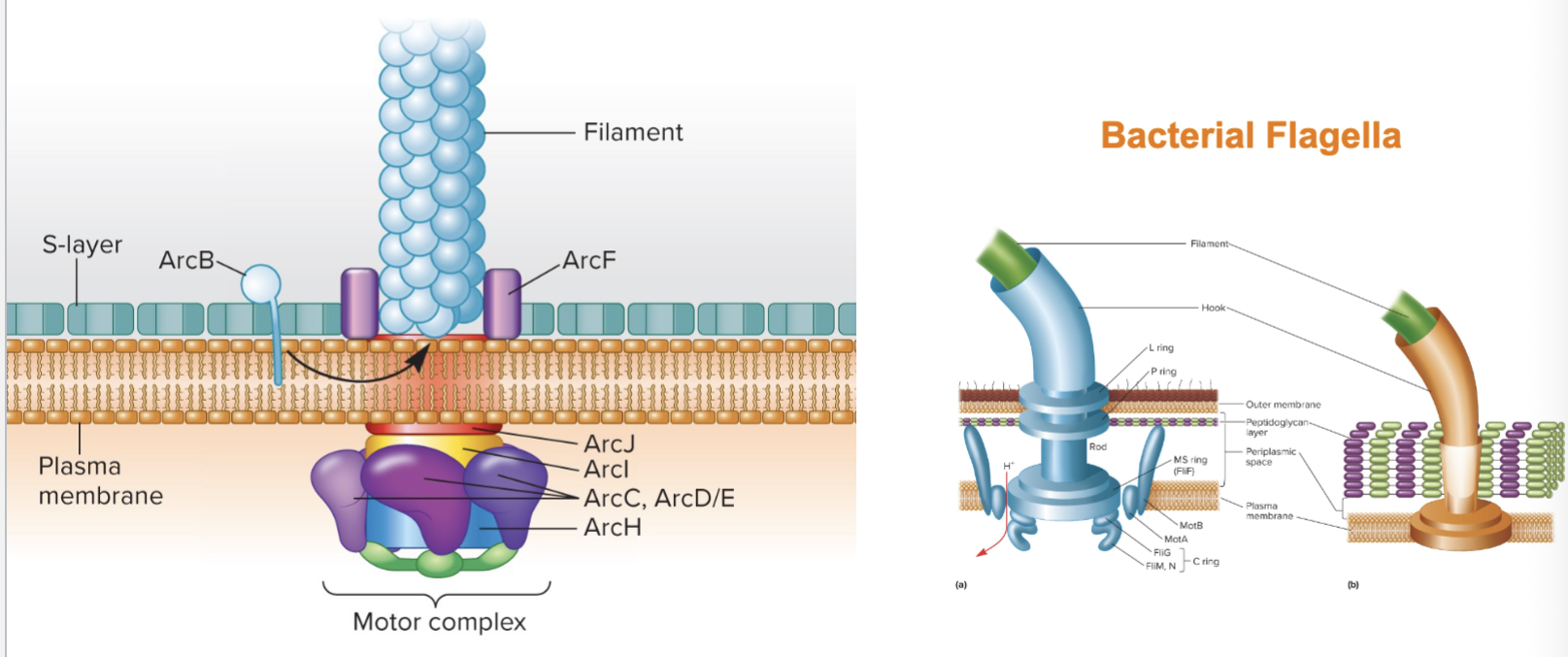
Archaella and Motility
know red part dont focus on extra stuff like ArcB,ArcF, etc
Flagella are thinner than bacteria.
Some made of more than one type of protein.
Filament is not hollow.
Rotation:
Powered by ATP hydrolysis instead of proton motive force.
Direction moves cell forward or backwards rather than runs and tumbles.
Swimming motility has extremely fast speeds.