Forensic Microscopy Exam 1
 Call Kai
 Learn
Learn Practice Test
 Spaced Repetition
 Match
Match Flashcards
 Knowt Play
1/24

There's no tags or description
Looks like no tags are added yet.
Name | Mastery | Learn | Test | Matching | Spaced | Call with Kai | Chat |
|---|
No analytics yet
Send a link to your students to track their progress
25 Terms
Resolution
Minimum distance between two features the microscope can differentiate
Limited by Aberrations + Diffraction
Airy Pattern
minimum point of light that can be sustained by a circular aperture due to diffraction
Rayleigh Criterion
𝑹 = 0.61𝝀 / 𝑵𝑨obj
Abbé Criterion
𝑹 = 1.22𝝀 / 𝑵𝑨obj + 𝑵𝑨cond
Field of View
Diameter of the circle detected
FOV (mm) = Field number of eyepiece / magnification of objective
Abberations: Errors of Focus
No image point for any object point in a focal plane
Defocus, decenter and tilt
Longitudinal chromatic aberration
Spherical aberration
Field curvature
Astigmatism
Abberations: Errors of Magnification
No equal image scale across the image plane
Lateral chromatic aberration
Coma
Distortion
Astigmatism
Defocus
Detector not in the focal plane
Error of Focus
Decenter
The optical element is not centered on the optical axis
Error of Focus
Tilt
The optical element is not perpendicular to the optical axis
Error of Focus
Longitudinal Chromatic Aberration
Different colors focus at different points (due to dispersion – RI depends on wavelength)
Error of Focus
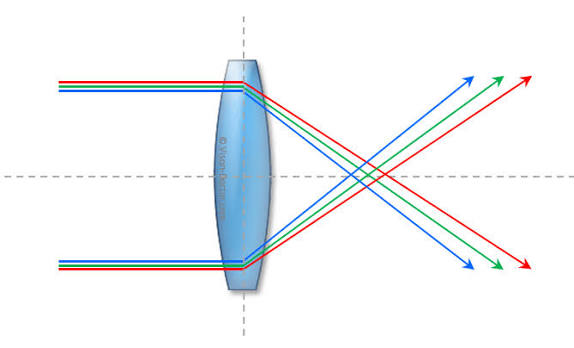
Lateral Chromatic Aberration
Different colors image at different height (leading to different magnification)
Error of magnification
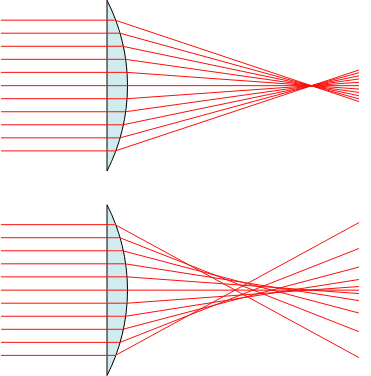
Spherical Aberration
Variation of focus with aperture
Error of Focus
Coma
Variation of magnification with aperture
Correct by using diaphragm
Error of magnification

Field Curvature
The plane for imaging is not flat
Error of Focus

Distortion
Failure to magnify the image equally as the distance increases from the axis
Error of magnification

Astigmatism
The image of a point out of axis has two different focal points because of the asymmetry of the lens
Snell’s Law
𝒏𝟏 𝐬𝐢𝐧 𝒊 = 𝒏𝟐 𝐬𝐢𝐧 𝒓
Light bends more in the higher RI
Critical Angle
sin(ic) =𝑛2/𝑛1
𝑛2 is always the smaller angle
The Becke Line
Moves toward the higher refractive index medium
The Lens Equation
𝟏/𝒒 − 𝟏/𝒑 = 𝟏/𝒇
𝒒: distance from the image to the lens
𝒑: distance from the object to the lens
𝒇: focal length (from the focal point to the lens)
The Eye Image formation
Cornea + lens=convex lens
Focal lens is adjustable by the muscles
Image always formed on the retina
Magnification Equation
M = q/p
-M means image is reversed orientation
M< 1 means the image is smaller than the object
Illuminating Light Path
Light source
Condenser diaphragm
Objective exit pupil
Iris
Imaging Light Path
Field of view diaphragm
Sample
Real intermediate image
Retina