Reading Science

0.0(0)
Studied by 1 person
call kaiCall Kai
learnLearn
examPractice Test
spaced repetitionSpaced Repetition
heart puzzleMatch
flashcardsFlashcards
GameKnowt Play
Card Sorting

1/6

flashcard set

Earn XP

Description and Tags

Seven Digital Notecards

7 Terms

1
New cards

The Brain and How We Read

Reading is not an ability humans are born knowing how to do. The brain learns to read by adapting networks that already help us see, recognize patterns, speak, and understand language. Stanislas Dehaene describes this as neuronal recycling: parts of the brain used for visual recognition become specialized through reading instruction and practice to recognize written letters and familiar letter patterns.

The visual word form area (VWFA) is located in the left ventral occipitotemporal region, often described as part of the underside of the left occipital-temporal area. It becomes especially responsive to familiar written letter strings. This helps readers recognize words efficiently across changes in font, size, and capitalization. It does not work alone; it connects visual information with language and sound systems.

Reading involves networks across the brain. Occipital regions process visual information from print. Temporal regions contribute to speech sounds, word knowledge, and language comprehension. Parietal regions help connect letters with speech sounds and support aspects of phonological processing. Frontal regions, including areas involved in speech planning and articulation, contribute to producing and organizing speech sounds and can be involved when readers sound out words.

When a student reads an unfamiliar word, the brain coordinates seeing the letters, connecting letters to sounds, blending sounds, accessing word meanings, and fitting the word into the sentence. With accurate practice, familiar words become easier to recognize automatically, freeing attention for understanding the text. Reading therefore a coordinated network process, not the job of one isolated “reading center.”

Teachers can support this process through explicit instruction in phonemic awareness and phonics, opportunities to read words and connected text, vocabulary development, and meaningful discussion. Students may need different amounts or kinds of practice. A supportive, systematic approach helps students form reliable connections among spellings, pronunciations, and meanings.

Teaching Connection: Use this model to explain why reading instruction should connect print, speech sounds, word meanings, and comprehension. Brain regions work as an interacting networks; the diagram is a simiplifed overview.

<p>Reading is not an ability humans are born knowing how to do. The brain learns to read by adapting networks that already help us see, recognize patterns, speak, and understand language. Stanislas Dehaene describes this as neuronal recycling: parts of the brain used for visual recognition become specialized through reading instruction and practice to recognize written letters and familiar letter patterns. </p><p>The visual word form area (VWFA) is located in the left ventral occipitotemporal region, often described as part of the underside of the left occipital-temporal area. It becomes especially responsive to familiar written letter strings. This helps readers recognize words efficiently across changes in font, size, and capitalization. It does not work alone; it connects visual information with language and sound systems. </p><p>Reading involves networks across the brain. Occipital regions process visual information from print. Temporal regions contribute to speech sounds, word knowledge, and language comprehension. Parietal regions help connect letters with speech sounds and support aspects of phonological processing. Frontal regions, including areas involved in speech planning and articulation, contribute to producing and organizing speech sounds and can be involved when readers sound out words. </p><p>When a student reads an unfamiliar word, the brain coordinates seeing the letters, connecting letters to sounds, blending sounds, accessing word meanings, and fitting the word into the sentence. With accurate practice, familiar words become easier to recognize automatically, freeing attention for understanding the text. Reading therefore a coordinated network process, not the job of one isolated “reading center.”</p><p>Teachers can support this process through explicit instruction in phonemic awareness and phonics, opportunities to read words and connected text, vocabulary development, and meaningful discussion. Students may need different amounts or kinds of practice. A supportive, systematic approach helps students form reliable connections among spellings, pronunciations, and meanings. </p><p><strong>Teaching Connection: </strong> Use this model to explain why reading instruction should connect print, speech sounds, word meanings, and comprehension. Brain regions work as an interacting networks; the diagram is a simiplifed overview. </p>
2
New cards

The Simple View of Reading

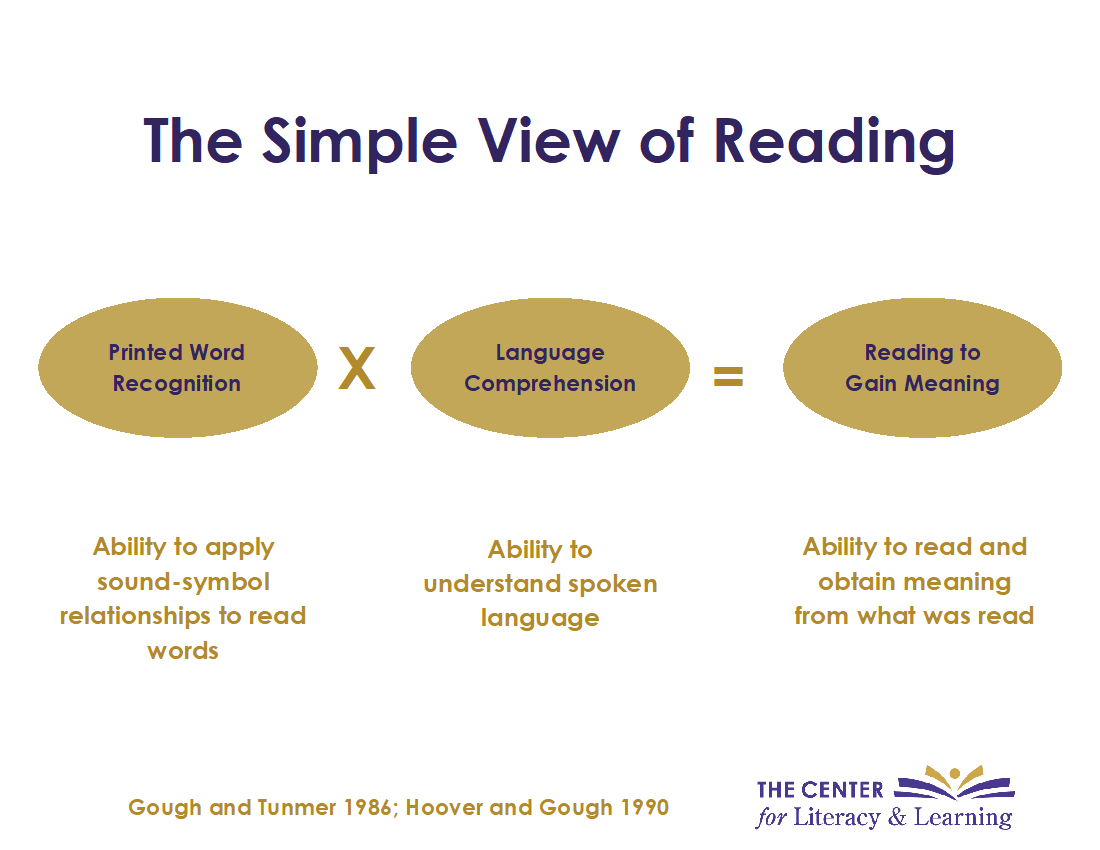
The Simple View of Reading (SVR), associated with Gough and Tunmer, explains reading comprehension through two broad abilities: word recognition/decoding and language comprehension. The model is commonly written as Reading Comprehension = Decoding x Language Comprehension. The multiplication sign matters: both abilities are needed, and a serious weakness in either can limit overall reading comprehension.

Decoding is the ability to identify printed words accurately, including using knowledge of letter-sound relationships to read unfamiliar words. In instruction, this includes phonics and applying sound-symbol knowledge to words. As word recognition become more accurate and automatic, students can use less mental effort identifying each word.

Language comprehension is the ability to understand language, whether heard or read. It includes vocabulary, background knowledge, grammar and sentence structure, reasoning, and understanding how ideas connect. A student may decode words accurately but still struggle to understand a passage if the vocabulary or concepts are unfamiliar.

The two components can develop unevenly. A student with strong oral language but weak decoding may understand a story read aloud but struggle to read it independently. A student who reads words accurately but has limited vocabulary or background knowledge may sound fluent without understanding much of the text. Teachers should assess both areas rather than assuming every reading difficulty has the same cause.

The SVR is a broad framework, not a complete reading curriculum or a precise diagnostic test by itself. It helps teachers ask whether a students needs support with word reading, language comprehension, or both. Effective teaching builds accurate word recognition while also expanding vocabulary, knowledge, oral language, and comprehension strategies.

Teaching Connection: Use assessment to identify which part needs support. Students need both the ability to read the words and the ability to understand the language.
<p>The Simple View of Reading (SVR), associated with Gough and Tunmer, explains reading comprehension through two broad abilities: word recognition/decoding and language comprehension. The model is commonly written as Reading Comprehension = Decoding x Language Comprehension. The multiplication sign matters: both abilities are needed, and a serious weakness in either can limit overall reading comprehension. </p><p>Decoding is the ability to identify printed words accurately, including using knowledge of letter-sound relationships to read unfamiliar words. In instruction, this includes phonics and applying sound-symbol knowledge to words. As word recognition become more accurate and automatic, students can use less mental effort identifying each word.</p><p>Language comprehension is the ability to understand language, whether heard or read. It includes vocabulary, background knowledge, grammar and sentence structure, reasoning, and understanding how ideas connect. A student may decode words accurately but still struggle to understand a passage if the vocabulary or concepts are unfamiliar.</p><p>The two components can develop unevenly. A student with strong oral language but weak decoding may understand a story read aloud but struggle to read it independently. A student who reads words accurately but has limited vocabulary or background knowledge may sound fluent without understanding much of the text. Teachers should assess both areas rather than assuming every reading difficulty has the same cause.</p><p>The SVR is a broad framework, not a complete reading curriculum or a precise diagnostic test by itself. It helps teachers ask whether a students needs support with word reading, language comprehension, or both. Effective teaching builds accurate word recognition while also expanding vocabulary, knowledge, oral language, and comprehension strategies. </p><p><strong>Teaching Connection: </strong>Use assessment to identify which part needs support. Students need both the ability to read the words and the ability to understand the language.</p>
3
New cards

Four-Part Processing Model for Word Recognition

The Four-Part Processing Model describes four connected processors involved in recognizing written words: orthographic, phonological, meaning, and context. These processors work together and influence one another. The model is useful for understanding why skilled word recognition involves more than looking at a word or guessing what might fit.

The orthographic processor attends to the visual form of print: letters, letter sequences, and spelling patterns. For example, it helps a reader notice the letters in “ship” and recognize that the word begins with the letter pattern sh. Familiarity with spelling patterns helps readers distinguish similar-looking words.

The phonological processor deals with speech sounds. Readers connect graphemes (letters or letter groups) with phonemes (individual speech sounds) and blend the sounds to read words. For example, a reader can connect sh-i-p with /sh/ /i/ /p/ and blend the sounds into “ship.” Phonemic awareness and phonics instruction support the intended meaning of ship.

Context and meaning are useful, but they should not replace attention to the letters in the word. Readers may use context to check whether a word makes sense, yet reliable word recognition depends on learning how print represents spoken language. During instruction, teachers can invite students to examine the letters, say and blend the sounds, explain the word’s meaning, and then discuss how it fits the sentence.

Teaching Connection: Have students use all the letters in a word, connect them to sounds, explain meaning, and then check the sentence. Do not teach context as a substitute for decoding.

<p>The Four-Part Processing Model describes four connected processors involved in recognizing written words: orthographic, phonological, meaning, and context. These processors work together and influence one another. The model is useful for understanding why skilled word recognition involves more than looking at a word or guessing what might fit.</p><p>The orthographic processor attends to the visual form of print: letters, letter sequences, and spelling patterns. For example, it helps a reader notice the letters in “ship” and recognize that the word begins with the letter pattern sh. Familiarity with spelling patterns helps readers distinguish similar-looking words. </p><p>The phonological processor deals with speech sounds. Readers connect graphemes (letters or letter groups) with phonemes (individual speech sounds) and blend the sounds to read words. For example, a reader can connect sh-i-p with /sh/ /i/ /p/ and blend the sounds into “ship.” Phonemic awareness and phonics instruction support the intended meaning of ship. </p><p>Context and meaning are useful, but they should not replace attention to the letters in the word. Readers may use context to check whether a word makes sense, yet reliable word recognition depends on learning how print represents spoken language. During instruction, teachers can invite students to examine the letters, say and blend the sounds, explain the word’s meaning, and then discuss how it fits the sentence. </p><p><strong>Teaching Connection: </strong>Have students use all the letters in a word, connect them to sounds, explain meaning, and then check the sentence. Do not teach context as a substitute for decoding. </p>
4
New cards

Scarborough’s Reading Rope

Scarborough’s Reading Rope represents skilled reading as several strands woven together. The strands become more coordinated and automatic with practice. The rope has two broad sections: word recognition and language comprehension. Skilled reading comprehension depends on both sections becoming strong and working together.

The word-recognition strands are phonological awareness, decoding, and sight recognition of familiar words. Phonological awareness is awareness of the sound structure of spoken language. Decoding involves applying knowledge of letters and spelling patterns to read words. Sight recognition means recognizing a familiar word quickly and automatically because its spelling, pronunciation, and meaning are connected in memory; it does not simply mean memorizing words by their overall shape.

The language-comprehension strands are background knowledge, vocabulary, language structures, verbal reasoning, and literacy knowledge. Background knowledge helps readers understand what a text is about. Vocabulary is knowledge of word meanings. Language structures include grammar and how sentences are organized. Verbal reasoning includes inference and understanding nonliteral language, while literacy knowledge includes understanding genres, text features, and how print works.

The two groups are interdependent. Strong decoding with weak language comprehension may lead a student to read aloud accurately without understanding the passage. Strong language comprehension with weak decoding may allow a student to understand a read-aloud but not independently read the same text. The rope metaphor shows that weaknesses in one or more strands can affect the whole reading process.

Teachers can use the Reading Rope to plan balanced instruction and investigate students’ needs. Instruction may include phonemic awareness, systematic phonics, practice reading connected text, fluency, vocabulary, background knowledge, oral language, and comprehension. The rope is a conceptual framework, not a checklist that replaces assessment or individualized teaching.

Teaching Connection: Use the rope to plan instruction across both word recognition and language comprehension. If a student struggles, look for the specific strand or strands needing additional support.

<p>Scarborough’s Reading Rope represents skilled reading as several strands woven together. The strands become more coordinated and automatic with practice. The rope has two broad sections: word recognition and language comprehension. Skilled reading comprehension depends on both sections becoming strong and working together. </p><p>The word-recognition strands are phonological awareness, decoding, and sight recognition of familiar words. Phonological awareness is awareness of the sound structure of spoken language. Decoding involves applying knowledge of letters and spelling patterns to read words. Sight recognition means recognizing a familiar word quickly and automatically because its spelling, pronunciation, and meaning are connected in memory; it does not simply mean memorizing words by their overall shape. </p><p>The language-comprehension strands are background knowledge, vocabulary, language structures, verbal reasoning, and literacy knowledge. Background knowledge helps readers understand what a text is about. Vocabulary is knowledge of word meanings. Language structures include grammar and how sentences are organized. Verbal reasoning includes inference and understanding nonliteral language, while literacy knowledge includes understanding genres, text features, and how print works.</p><p>The two groups are interdependent. Strong decoding with weak language comprehension may lead a student to read aloud accurately without understanding the passage. Strong language comprehension with weak decoding may allow a student to understand a read-aloud but not independently read the same text. The rope metaphor shows that weaknesses in one or more strands can affect the whole reading process. </p><p>Teachers can use the Reading Rope to plan balanced instruction and investigate students’ needs. Instruction may include phonemic awareness, systematic phonics, practice reading connected text, fluency, vocabulary, background knowledge, oral language, and comprehension. The rope is a conceptual framework, not a checklist that replaces assessment or individualized teaching. </p><p><strong>Teaching Connection: </strong>Use the rope to plan instruction across both word recognition and language comprehension. If a student struggles, look for the specific strand or strands needing additional support.  </p>
5
New cards

Ehri’s Phases of Word-Reading Development

Linnea Ehri described phases that explain how children develop the ability to recognize written words. The phases are pre-alphabetic, full alphabetic, and consolidated alphabetic. They describe changes in how readers use knowledge of letters and sounds to connect a word’s spelling, pronunciation, and meaning. They are a flexible model, not rigid age-based steps that every child follows at exactly the same rate.

In the pre-alphabetic phase, children may recognize familiar environmental print or logos using visual features, context, or memory rather than letter-sound connections. For example, a child might recognize a favorite cereal box without actually reading the printed word. Teaching can build alphabet knowledge and awareness that print represents language.

In the partial alphabetic, children know some letter-sound relationships but may use only a few sounds, often at the beginning or end of a word. They may confuse words that start with the same letter or guess using context. Instruction should strengthen phonemic awareness and teach students to attend to all letters and their sounds.

In the full alphabetic phase, children can use more complete letter-sounds connections to decode words. They may sound out a word slowly, matching graphemes with phonemes and blending words and texts can help strengthen these connections.

In the consolidated alphabetic phase, readers recognize larger letter patterns, syllables, and meaningful words parts such as prefixes, roots, and suffixed. This allows them to read many longer words more efficiently. Repeated accurate encounters with words help orthographic mapping - the process by which spelling, pronunciation, and meaning become bonded in memory - so words can eventually be recognized automatically.

Teaching Connection: Observe what a learner actually does with print instead of assigning a phase based only on age or grade. Match instruction to the student’s current knowledge and monitor progress.

<p>Linnea Ehri described phases that explain how children develop the ability to recognize written words. The phases are pre-alphabetic, full alphabetic, and consolidated alphabetic. They describe changes in how readers use knowledge of letters and sounds to connect a word’s spelling, pronunciation, and meaning. They are a flexible model, not rigid age-based steps that every child follows at exactly the same rate. </p><p>In the pre-alphabetic phase, children may recognize familiar environmental print or logos using visual features, context, or memory rather than letter-sound connections. For example, a child might recognize a favorite cereal box without actually reading the printed word. Teaching can build alphabet knowledge and awareness that print represents language. </p><p>In the partial alphabetic, children know some letter-sound relationships but may use only a few sounds, often at the beginning or end of a word. They may confuse words that start with the same letter or guess using context. Instruction should strengthen phonemic awareness and teach students to attend to all letters and their sounds. </p><p>In the full alphabetic phase, children can use more complete letter-sounds connections to decode words. They may sound out a word slowly, matching graphemes with phonemes and blending words and texts can help strengthen these connections. </p><p>In the consolidated alphabetic phase, readers recognize larger letter patterns, syllables, and meaningful words parts such as prefixes, roots, and suffixed. This allows them to read many longer words more efficiently. Repeated accurate encounters with words help orthographic mapping - the process by which spelling, pronunciation, and meaning become bonded in memory - so words can eventually be recognized automatically. </p><p><strong>Teaching Connection: </strong>Observe what a learner actually does with print instead of assigning a phase based only on age or grade. Match instruction to the student’s current knowledge and monitor progress.</p>
6
New cards

Five Strands of Reading

The five strands, often called the Big Five components of reading, are phonemic awareness, phonics, fluency, vocabulary, and comprehension. Together, they describe major areas that effective reading instruction addresses. They are connected skills rather than separate subjects that can be taught once and then forgotten.

Phonemic awareness is the ability to hear and manipulate individual sounds (phonemes) in spoken words. For example, a student can identify the sounds /m/ /a/ /p/ in “map” or change /m/ /o/ /t/ to make “tap.” Phonemic awareness activities are primarily oral, although letters can be introduced to connect sounds with print.

Phonics teaches relationships between letters or letter groups and speech sounds. Students use this knowledge to decode printed words and encode words when spelling. Explicit, systematic instruction helps students learn common patterns and apply them to unfamiliar words. For example, a student learns to blend the sounds represented by c-a-t to read “cat".”

Fluency is accurate, reasonably effortless reading with appropriate rate and expression. Fluent reading supports comprehension because readers can devote more attention to meaning rather than laboriously identifying every word. Fluency should not be reduced to speed alone; accuracy and phrasing matter. Vocabulary is knowledge of words and their meanings, including how words are used in different contexts. Teachers can teach important words directly and build vocabulary through conversation, read-aloud, and varied texts.

Comprehension is constructing meaning from text. It depends on accurate word recognition, vocabulary, background knowledge, language understanding, reasoning, and monitoring whether the text makes sense. Teachers can model thinking aloud, ask questions, discuss ideas, summarize, and help students make inferences. All five strands should be considered when planning instruction and assessing reading process.

Teaching Connection: Use a variety of instruction and assessments. A student may be strong in one strand and need support in another, so avoid assuming one activity will solve every reading difficulty.

<p>The five strands, often called the Big Five components of reading, are phonemic awareness, phonics, fluency, vocabulary, and comprehension. Together, they describe major areas that effective reading instruction addresses. They are connected skills rather than separate subjects that can be taught once and then forgotten.</p><p>Phonemic awareness is the ability to hear and manipulate individual sounds (phonemes) in spoken words. For example, a student can identify the sounds /m/ /a/ /p/ in “map” or change /m/ /o/ /t/ to make “tap.” Phonemic awareness activities are primarily oral, although letters can be introduced to connect sounds with print. </p><p>Phonics teaches relationships between letters or letter groups and speech sounds. Students use this knowledge to decode printed words and encode words when spelling. Explicit, systematic instruction helps students learn common patterns and apply them to unfamiliar words. For example, a student learns to blend the sounds represented by c-a-t to read “cat".”</p><p>Fluency is accurate, reasonably effortless reading with appropriate rate and expression. Fluent reading supports comprehension because readers can devote more attention to meaning rather than laboriously identifying every word. Fluency should not be reduced to speed alone; accuracy and phrasing matter. Vocabulary is knowledge of words and their meanings, including how words are used in different contexts. Teachers can teach important words directly and build vocabulary through conversation, read-aloud, and varied texts. </p><p>Comprehension is constructing meaning from text. It depends on accurate word recognition, vocabulary, background knowledge, language understanding, reasoning, and monitoring whether the text makes sense. Teachers can model thinking aloud, ask questions, discuss ideas, summarize, and help students make inferences. All five strands should be considered when planning instruction and assessing reading process. </p><p><strong>Teaching Connection: </strong>Use a variety of instruction and assessments. A student may be strong in one strand and need support in another, so avoid assuming one activity will solve every reading difficulty. </p>
7
New cards

History of Reading Instruction and the Three-Cueing System

Reading instruction has included different approaches over time. Phonics-oriented approaches explicitly teach relationships between letters and sounds. Whole-language approaches emphasized meaningful reading and writing in authentic texts, often with less direct emphasis on phonics. In practice, classrooms have used different combinations of these ideas, and the history is more complex than a simple argument between two people or two methods.

The Three-Cueing System is commonly described as using semantic cues (meaning and context), syntactic cures (grammar and sentence structure), and graphophonic cues (letter-sound relationships) to identify words. For example, when a word is unfamiliar, a student might ask what word makes sense in the sentence, what word fits grammatically, and what the letters suggests.

A key concern is when cueing strategies teach children to guess a word from pictures, context, or the first letter instead of attending to the full spelling. Many words can fit a sentence or picture, so context alone cannot reliably identify the printed word. Students need explicit teaching and practice in decoding the written word, including using all the letters and known spelling patterns.

Evidence-based reading instruction emphasizes explicit, systematic instruction in foundational skills such as phonemic awareness and phonics, while also developing fluency, vocabulary, background knowledge, oral language, and comprehension. Context remains important for understanding and checking meaning, but it should not replace decoding. Skilled readers use context to understand text, not as a dependable substitute for identifying words.

Teachers should respond to errors by directing attention to the print: “Look at all the letters,” “Say the sounds,” or “Blend the words.” Then they can ask whether the word makes sense in the sentence. Students also need rich texts, read-alouds, and discussion to build knowledge and a love a reading. The goal is not phonics alone; it is accurate word recognition combined with strong language comprehension.

Teaching Connection: Teach students to decode the word from print and then check meaning in context. Avoid implying that context is useless; the concern is using guessing instead of learning how the written word represents sounds.

<p>Reading instruction has included different approaches over time. Phonics-oriented approaches explicitly teach relationships between letters and sounds. Whole-language approaches emphasized meaningful reading and writing in authentic texts, often with less direct emphasis on phonics. In practice, classrooms have used different combinations of these ideas, and the history is more complex than a simple argument between two people or two methods. </p><p>The Three-Cueing System is commonly described as using semantic cues (meaning and context), syntactic cures (grammar and sentence structure), and graphophonic cues (letter-sound relationships) to identify words. For example, when a word is unfamiliar, a student might ask what word makes sense in the sentence, what word fits grammatically, and what the letters suggests. </p><p>A key concern is when cueing strategies teach children to guess a word from pictures, context, or the first letter instead of attending to the full spelling. Many words can fit a sentence or picture, so context alone cannot reliably identify the printed word. Students need explicit teaching and practice in decoding the written word, including using all the letters and known spelling patterns. </p><p>Evidence-based reading instruction emphasizes explicit, systematic instruction in foundational skills such as phonemic awareness and phonics, while also developing fluency, vocabulary, background knowledge, oral language, and comprehension. Context remains important for understanding and checking meaning, but it should not replace decoding. Skilled readers use context to understand text, not as a dependable substitute for identifying words. </p><p>Teachers should respond to errors by directing attention to the print: “Look at all the letters,” “Say the sounds,” or “Blend the words.” Then they can ask whether the word makes sense in the sentence. Students also need rich texts, read-alouds, and discussion to build knowledge and a love a reading. The goal is not phonics alone; it is accurate word recognition combined with strong language comprehension. </p><p><strong>Teaching Connection: </strong>Teach students to decode the word from print and then check meaning in context. Avoid implying that context is useless; the concern is using guessing instead of learning how the written word represents sounds. </p>



