Arterial Insufficiency
 Call Kai
 Learn
 Practice Test
 Spaced Repetition
 Match
 Flashcards
 Knowt Play
1/18

There's no tags or description
Looks like no tags are added yet.
19 Terms
What is critical limb ischemia (aka chronic limb-threatening ischemia or CLTI)?
Reduction in distal tissue perfusion BELOW the resting metabolic requirement (usually associated w/ atherosclerosis in those w/ diabetes) --> PAD + rest pain, gangrene, or ulceration of the LE --> requires revascularization to ensure that the max. amount of arterial perfusion is present to support wound healin
What are the critical phases of ischema?
1 = collateral circulation is insufficient for the metabolic needs of the affected extremity (greater risk of infection and poor healing)
2 = activity or exercise starts to cause relative ischemia and pain (intermittent claudication)
3 = patient may experience rest pain, gangrene, or nonhealing wounds
What is the difference between macrocirculation and microcirculation?
Macrocirculation = large arteries >0.5 mm
Microcirculation = smaller capillaries and arterioles
When should a vascular assessment be performed?
A vascular assessment should be performed to examine (suspected or confirmed) arterial wounds, arterial insufficiency, PAD, etc. (i.e., vascular conditions)
Components: capillary refill test, palpation of pulses, skin inspection, doppler, bedside ABI
What should encompass a skin assessment/inspection of arterial wounds?
Skin quality (shiny, thin, cracked), hair (hairless), edema (minimal -- unless a mixed etiology), skin color (pale, deep red rubor), toenails (thick, flakey)
How do you interpret the results of a bedside ABI?
Poorly compressible >1.2
Normal 1.0 - 1.2
Mild obstruction 0.8-1.0
Mod obstruction 0.5-0.79
Severe obstruction
What are the most common causes of peripheral arterial disease (PAD)?
Patho: insufficient blood flow due to narrowed or blocked arteries --> tissue ischemia and necrosis
Risk factors:
- Diabetes (sugar = bumper cars on arterial walls)
- Smoking (raises BP, causes vasoconstriction, delays tissue healing, deteriorates the tissue)
- Advanced age
- Personal hx of a heart attack, stroke, or TIA; family hx of PAD
- HTN
- Overweight
- High cholesterol
- Physically inactive
Distinguish between modifiable and non-modifiable risk factors of atherosclerosis (and subsequently arterial wounds).
Modifiable: smoking, HTN, HLD, obesity
Non-modifiable: age, family history, air pollution (unless you move to another city I suppose), diabetes (however, your blood sugar itself is modifiable)
Where are arterial insufficiency wounds typically located?
Below the ankle -- foot, heel, MT heads, tips of toes, "bunion" areas, possible superior to lateral malleolus or anterior lower leg, dorsal aspect of hands or fingers
Can you describe the common characteristics of an arterial wound?
Presentation: shallow, 'punched out,' regularly shaped/round
Drainage: minimal to none, dry and hard wound bed
Tissue: black/brown eschar, pale granulation tissue, mixed

Differentiate b/w arterial and neurogenic claudication.
Arterial:
- gradual onset
- described as pulsating, cold to the touch, cramping, aching, N/T, PAINFUL (usually in the calves)
- aggravated by physical activity or exercise
- eased by rest
Neurogenic:
- gradual onset
- described as vague cramping, aching, burning (usually in the LE); "Grocery cart sign"
- aggravated by lumbar extension
- eased by lumbar flexion
What is "rest pain"?
Patient elevates their legs --> they CANNOT tolerate it --> may dangle their legs to get their blood flow where it needs to go
What is wet gangrene? What should we do if wet gangrene is noted?
Drainage, odor, edema, erythema @ the arterial wound site
Less clear demarcation, URGENT REFERRAL (high risk of infection)
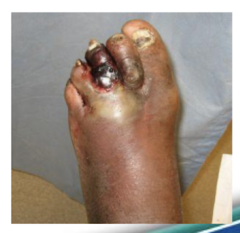
Can you differentiate between wet and dry gangrene? How should we best proceed with the plan of care?
Dry = mummification, no drainage, little/no odor; clear demarcation --> protect and monitor
Wet = drainage, odor, edema, erythema; less clear demarcation --> urgent referral
How can we differentiate between a healable and unhealable arterial ulcer?
Arterial insufficiency ulcers are considered "unhealable" until proven otherwise!!
Unhealable ulcers: keep dry, no moist wound promotion
Healable ulcers: ABI >0.5, consult vascular physician
List wound care principles.
1. "Unhealable" until proven otherwise
2. Wet gangrene = vascular ASAP, dry gangrene = protect, offload, monitor
3. Monitor for infection
4. ROM and exercise programs as appropriate
List wound care precautions for a HEALABLE ulcer.
1. Expect slower progress
2. Moist wound environment w/ caution
3. Avoid adhesives
4. PT role: ID, refer, protect,monitor, educate (wound care, exercise, treatment after revascularization or amputation)
When is debridement contraindicated?
Poor blood supply = sharp debridement is typically contraindicated UNTIL given the "A-okay" by the vascular surgeon
No debridement if ABI
List components of post-revascularization care.
1. Verify and frequently monitor vascular stats
2. Shift goal toward healing -- moist wound environment and debridement
3. Amputation care: wrapping, shaping, prosthetics -- ROM, strengthening, mobility, balance, offloading