PLN3 PRELIM: Comprehensive Planning Process
 Call Kai
 Learn
Learn Practice Test
 Spaced Repetition
 Match
Match Flashcards
 Knowt Play
1/64

There's no tags or description
Looks like no tags are added yet.
Name | Mastery | Learn | Test | Matching | Spaced | Call with Kai | Chat |
|---|
No analytics yet
Send a link to your students to track their progress
65 Terms
Structure and Framework

Framework: Physical Plans
City/Municipal, Provincial, Regional, and National
City/ Municipal Physical & Socio-economic Plans
Comprehensive Land Use Plan (CLUP) | Comprehensive Development Plan (CDP)
: Physical Framework Plan for Metropolitan Manila, Metropolitan Manila Development Authority
Provincial Physical & Socio-economic Plans
Provincial development and Physical Framework
: National Framework for Physical Planning, National Economic and Development Authority
Regional Physical & Socio-economic Plans
Regional Physical Framework Plan | Regional Development Plan:
: National Framework for Physical Planning, National Economic and Development Authority
National Physical & Socio-economic Plans
National Framework for Physical Planning | Medium term Philippine Development Plan
: Medium-Term Philippine Development Plan, National Economic and Development Authority
The National Framework for Physical Plan evolved from the National Physical Framework Plan (NPFP)
Settlements Development, Production Land Use, Protection Land Use, and Infrastructure Development.
Main Department and national Government Agencies
Involved in the Philippine Physical and Sectoral Planning

DILG
Department of the Interior Local Government

NEDA
National Economic Development Authority

DENR
Department of Energy and Natural Resources

DA
Department of Agriculture

DPWH
Department Public Works and Highways

DHSUD
Department of Human Settlements and Urban Development

HLURB
Housing and Land Use Regulatory Board

MMDA
Metro Manila Development Authority

LGU
Local Government Unit
Department of Human Settlements and Urban Development (DHSUD)
Kagawaran ng Pananahanang Pantao at Pagpapaunlad ng Kalunsuran is the central government authority on the management of Housing, Human Settlements and Urban Development
Department of Human Settlements and Urban Development (DHSUD)
Created through Republic Act (RA) 11201 in February 14, 2019, DHSUD performs the consolidated functions of the defunct Housing and Urban Development Coordinating Council (HUDCC) and Housing and Land Use Regulatory Board (HLURB), except adjudication.
Department of Human Settlements and Urban Development (DHSUD)
As the sole and main planning and policy making, regulatory, program coordination and performance monitoring entity for all housing, human settlement and urban development, DHSUD primarily focuses on providing access to decent, affordable, resilient and sustainable housing communities to all Filipinos, particularly the underprivileged and those in the low-income bracket
Housing and Land Use Regulatory Board (HLRUB)
is the government agency mandated to provide assistance to local government units in the preparation and approval of their comprehensive land use plans (CLUPs), regulate housing, land use development and homeowners associations
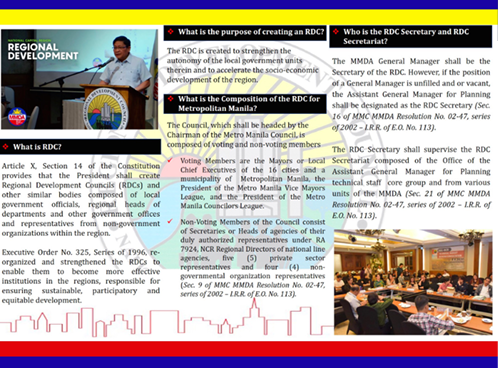
RDC
Regional Development Council
Metro Manila Development Authority (MMDA)
Formulate, coordinate and regulate the implementation of medium and long-term plans and programs for the delivery of metro-wide services, land use and physical development within Metropolitan Manila, consistent with national development objectives and priorities;
Metro Manila Development Authority (MMDA)
The MMDA shall set the policies concerning traffic in Metro Manila, and shall coordinate and regulate the implementation of all programs and projects concerning traffic management specifically pertaining to enforcement, engineering and education
Local Government Unit (LGU)
Local Government Code of 1991
Local Government Unit (LGU)
Declaration of Policy. – “It is hereby declared the policy of the State that the territorial and political subdivisions of the State shall enjoy genuine and meaningful local autonomy to enable them to attain their fullest development as self-reliant communities and make them more effective partners in the attainment of national goals.
Local Government Unit (LGU)
Toward this end, the State shall provide for a more responsive and accountable local government structure instituted through a system of decentralization whereby local government units shall be given more powers, authority, responsibilities, and resources. The process of decentralization shall proceed from the national government to the local government units.”
Local Government Unit (LGU)
“The capabilities of local government units ,especially the municipalities and Barangays, shall been enhanced by providing them with opportunities to participate actively in the implementation of national programs and projects; “
Local Government Unit (LGU)
“Local government units shall share with the national government the responsibility in the management and maintenance of ecological balance within their territorial jurisdiction, subject to the provisions of this Code and national policies; “
Reference Plans of Cities and Municipalities
The Comprehensive Land Use Plan (CLUP) and the CDP
CLUP and CDP
Are distinct and separate, yet the two plans are intimately related
Reference Plans of Cities and Municipalities
The term “comprehensive” in the CLUP is understood in its geographical, territorial sense, while the term “comprehensive” in the CDP has to be understood in the sense of “multi-sectoral” development.
Comprehensive Land Use Plan (CLUP)
The CLUP can well be regarded as the plan for the long-term management of the local territory. As the skeletal-circulatory framework of the territory’s physical development, it identifies areas where development can and cannot be located and directs public and private investments accordingly.
Comprehensive Land Use Plan (CLUP)
The Code has correctly assigned responsibility for the CLUP to the Sanggunian considering that most if not all of the instruments for implementing the CLUP involve regulating the use of lands that are mainly privately held and this requires the exercise of the political powers of the LGU through legislative action by the Sanggunian.
Metro Manila Districts, Cities and Municipalities
Manila, (1st District)
Mandaluyong, Marikina, Pasig, Quezon City, San Juan, (2nd District)
Caloocan, Malabon, Navotas, Valenzuela, (3rd District)
Las Pinas, Makati, Muntinlupa, Paranaque, Pasay, Pateros, and Taguig (4th District)

Review and Approval Process of CLUP for Metro Manila LGUs

Land Use Planning
It is the “rationale approach of allocating available land resources as equitably as possible among competing user groups and for different functions”
Objectives of Land Use Planning
Promote efficient acquisition, utilization, and disposition of land according to the best use as well as prevent premature and wasteful development.
Identify the intrinsic value and use limits of environmentally critical areas such as those included in the National Integrated Protected Areas System (NIPAS), Network of Protected Agricultural Areas, Critical terrestrial, aquatic ecosystems, and coastal zones for preservation, conservation, & rehabilitation.
Identify, conserve, and protect areas of ecological, aesthetic, and historical significance.
Provide an efficient settlement pattern for better access to basic services.
Prevent population habitation and high-risk activities from taking place in environmentally critical areas.
Influence the public and private sectors in the proper use, management, and disposition of land.
Importance of Land Use Plans
To guide the use and re-use of land, prevent the abuse and non-use of land, and correct the misuse of land.
To optimize the use of both public and private land; to assist in resolving possible conflicts that may arise from the competition for a share of the LGU's limited land resource.
Who prepares Land Use Plans
Local Government Units (LGUs) through their respective City/Municipal Planning Offices prepare their Comprehensive Land Use Plans (CLUPs) and Zoning Ordinances (ZOs) pursuant to Republic Act No. 7160 (Local Government Code).
HLURB Review: Said CLUPs and ZOs shall be reviewed and ratified by the Housing and Land Use Regulatory Board (HLURB) to ensure compliance with national standards and guidelines (RA No. 7160).
Metro Manila Assistance: In Metro Manila, the Metropolitan Manila Development Authority (MMDA) assists in the review of the CLUPs and ZOs (Executive Order No. 72-HLURB Law).
Land Use Planning
Laws that ensure rational land use and sustainable urban and regional development - -
Executive Order No. 72 – providing for the preparation and implementation of the Comprehensive Land Use Plans (CLUPs) of Local Government Units pursuant to the Local Government Code of 1991 and other pertinent laws.
Memorandum Circular No. 54 – prescribing the guidelines of Sec. 20, R.A. 7160, authorizing cities/municipalities to reclassify lands into non-agricultural uses.
Executive Order No. 124 – establishing priorities and procedures in evaluating areas for land conversion in regional agricultural/industrial centers, tourism development areas and sites for socialized housing
Land use Classifications (General & Specific)
Residential, Commercial, Industrial, Institutional, Parks & Open Spaces, Roads & Utilities
Zoning Ordinance
“Zoning is a planning control tool for regulating the built environment and creating functional real estate markets.
Zoning Ordinance
It does so by dividing land that comprises the statutory area of a local authority into sections, permitting particular land uses on specific sites to shape the layout of towns and cities and enable various types of development. Zoning has a relatively short history as a tool for land-use planning. It determines the location, size, and use of buildings and decides the density of city blocks (City of New York 2015a).
Land Use and Zoning Map

Comprehensive Development Plan (CDP)
Is the action plan utilized by every local administration to develop and implement priority sectoral and cross-sectoral programs and projects in the proper locations to put flesh on the skeleton as it were, gradually and incrementally, until the desired shape or form of development is eventually attained over the long term.
Comprehensive Development Plan (CDP)
Reference plans are the individual barangay development plans
Long-Term Framework Plan
A 9-year spatial framework plan that sets policies for physical development and land use, serving as the blueprint for long-term growth.
Comprehensive Land Use Plan (CLUP)
A long-term plan under the framework level that outlines spatial policies across four core areas: Settlement, Protection, Production, and Infrastructure Policies.
Zoning Ordinance
A primary regulatory instrument derived from the CLUP that enforces spatial and land-use regulations within a municipality or city.
Other Regulatory Measures
Legal tools and enforcement mechanisms (alongside Zoning Ordinances) used to implement the policies set in the CLUP.
Multi-year, Multi-sectoral Development Plan
A 6-year operational planning framework—primarily the Comprehensive Development Plan (CDP)—that addresses socio-economic and sectoral development goals.
Comprehensive Development Plan (CDP)
A 6-year multi-sectoral development plan covering five core sectors: Social Development, Economic Development, Environmental Management, Infrastructure Development, and Institutional Development.
Term-Based Agenda
A priority agenda aligned with the local chief executive's 3-year term, operationalized through the Executive-Legislative Agenda (ELA).
Executive-Legislative Agenda (ELA)
A term-based planning document that harmonizes executive priorities and legislative actions to support the goals of the CDP and CLUP.
Implementation Instruments
Mechanisms used to carry out the ELA and CDP, consisting of the Local Development Investment Program (LDIP), Capacity Development Program, Monitoring and Evaluation Strategy, and Legislative Requirements and Support
Local Development Investment Program (LDIP)
A multi-year capital investment plan linked to implementation strategy that prioritizes local public sector projects for funding.
Annual Investment Program (AIP)
The annual slice of the LDIP that details specific programs, projects, and activities scheduled for funding in a given fiscal year.
Annual Budget
The financial instrument that allocates local funds to enact the priorities specified in the Annual Investment Program (AIP).
Planning Outputs
The immediate tangible deliverables resulting from implementation, including improved public services, new or improved public facilities/infrastructure, and increased public awareness and participation.
Planning Outcomes
The ultimate long-term impacts achieved through execution, such as positive changes in constituent well-being, the physical environment, and local institutional capacity.
Relevance of CLUP and CDP on Architectural Projects
the two most important reference plans in physical planning and development projects that requires a more thorough analysis and strategic approach
Relevance of CLUP and CDP on Architectural Projects
For Complex Projects in design and architecture, the base map data, geographical data and analysis, vulnerability studies, site potentials and constraints can be found in the CLUP.
Relevance of CLUP and CDP on Architectural Projects
The Zoning Ordinance with attached Zoning Map will be a good guideline reference for the allowable and restrictions of your development, allotted land use and zoning classification
Relevance of CLUP and CDP on Architectural Projects
For architectural complex projects e.g. airport, university, hospitals, a crafting of a master plan will be necessary