WK 2: Tests & Measures — Goni & MMT
 Call Kai
 Learn
Learn Practice Test
 Spaced Repetition
 Match
Match Flashcards
 Knowt Play
1/125

Earn XP
Description and Tags
based off goni & MMT lectures!
Name | Mastery | Learn | Test | Matching | Spaced | Call with Kai | Chat |
|---|
No analytics yet
Send a link to your students to track their progress
126 Terms
What is a one joint muscle?
A muscle that only crosses 1 joint
(ex. brachialis, gluteus maximus, soleus)

What is a 2 joint muscle?
A muscle that crosses 2 joints
(ex. biceps brachii, quadriceps, hamstrings)

What is a multi-articular muscle?
A muscle that crosses more than 2 joints
(ex. flexor digitorum profundus)

What is muscle strength?
The maximum amount of tension that a muscle or muscle group can voluntary exert in one maximal effort
What is muscle torque?
The tendency of a *force to turn a lever around an axis of rotation
*Force could be gravity, muscle tension, or an external resistance
What are the 3 primary types of contractions?
Name them & define them
Isometric = tension occurs in the muscle, but no movement occurs & the muscle length doesn’t change
Isotonic = muscle develop constant tension against a load or force w/ movement occurring & muscle length changing
Isokinetic = muscle contracts at a constant rate of movement (velocity/same speed)
What are the 2 types of isotonic contractions?
Name them & define them
Concentric = tension develops in the muscle as it shortens; origin & insertion come closer together as muscle contracts
Eccentric = tension develops in the muscle as it lengthens; origin & insertion move further apart
What is muscle endurance?
The ability of a muscle/muscle group to perform repeated contractions against a resistance OR maintain an isometric contraction for a period of time
What is muscle fatigue?
Diminish response of the muscle to generate force
What are the 4 causes of muscle fatigue?
Lack of energy stores or oxygen
Decrease in conduction impulses at myoneural junction
Protective inhibitory influences from the CNS
Overwork
What is overwork?
A phenomenon that causes temporary or permanent loss in strength in an already weakened muscle
What does it mean when a muscle is “fully lengthened”?
What does it mean when a muscle is “midway”?
What does it mean when a muscle is “fully shortened”?
Full stretch to halfway through the full range
Halfway through the full range to fully shortened
Spans from midpoint to end range
What is the prime mover or agonist muscle?
Muscle/muscle group that makes major contribution to the movement at the joint
(ex. during a bicep curl, the biceps brachii is the prime mover)
What is a synergist?
Muscle/muscle group that works with agonist to produce desired effect
(ex. during a bicep curl, the brachialis is the synergist)
What is an antagonist?
Muscle/muscle group that has an opposite action to the agonist; it may relax to allow movement or contract concurrently to control/slow movement
(ex. during a bicep curl, the triceps brachii is the agonist)
What are the 10 factors that affect strength?
Age — strengths peaks in your 20s
Gender
Muscle size
Speed of muscle contraction — slow & controlled + going through full ROM = max muscle gains
Type of contraction — concentric, eccentric, isometric
Diurnal variation — strength follows a regular daily cycle, so you should attempt to test/retest MMT at the same time of day
Temperature — warmer muscles generate way more force
Previous training effect — familiarity of test situation + enhanced neuromuscular recruitment may occur
Fatigue — strength ↓ as muscle fatigues
Other: motivation, pain, UE/LE dominance, body type
How does joint position affect muscle strength?
Changes the angle of pull = change in joint position changes the distance between the axis of rotation (fulcrum), the muscle force, & the torque
Length-tension relationship = muscles can contract w/ greater force when in mid-range
Evidence of a muscle contraction (whether you can see or feel the muscle working)
Ability to move against gravity (whether the limb moves up against gravity or needs a gravity-minimized position)
Amount of manual resistance (how much pushing force from the clinician the muscle can hold against)
The patient can complete full available range of motion (ROM) against gravity and hold the position against strong manual resistance applied by the examiner
The muscle can complete full available range of motion against gravity and yield only to nearly strong (mod-max) resistance.
What is considered a 4-/5 (Good minus) as an MMT grade?
The muscle achieves full available ROM against gravity, but can only withstand nearly moderate (min-mod) manual resistance before breaking
The muscle completes full available range of motion against gravity and can hold against only slight manual resistance.
What criteria defines an MMT grade of 2/5 (Poor)?
The muscle achieves full available range of motion in a gravity-minimized position with no added manual resistance.
What defines an MMT grade of 0/5 (Zero)?
Completely absent muscle activity, no observable movement and no palpably detectable muscle contraction.
What is the difference between testing in an against-gravity position vs. a gravity-minimized position?
Against-gravity position = requires lifting the body part straight up against the earth's pull (used for testing grades 3 to 5) + applying resistance
Gravity-minimized position = limb is positioned parallel to the ground (ex. supported on a table) so gravity doesn't resist the motion (used for weak muscles, grades 0 to 2) + no resistance applied
How does the length-tension relationship affect muscle strength during testing?
Muscles generate maximum contractile force when tested at their mid-range length because the sarcomeres (actin and myosin cross-bridges) have optimal overlap
What is the optimal angle of muscle pull for generating maximum joint movement torque?
90 degrees relative to the lever arm (bony segment)
At 90 degrees, 100\% of the muscle force produces rotational force (torque) around the joint axis
Why is isometric MMT typically performed in the mid-range (halfway point) of a joint's motion?
This position combines optimal muscle length-tension with favorable muscle pull angle, allowing the muscle to demonstrate peak force output
What are the 4 contraindication to MMT?
if test will disrupt tissue healing
post-cardiac surgeries w/ sternal precautions
severe, acute pain
acute inflammation
What are the 4 precautions to MMT?
following neurosurgery
following abdominal, eye, or IVD pathology
hernias
when overwork/severe fatigue is a concern
With a pt who has sternal precautions ('Move in the Tube'), what 4 upper body movements are not allowed?
No shoulder horizontal abduction
No excessive shoulder extension
No shoulder elevation above 90 degrees
No pushing/pulling heavy loads
*these stress and pull apart the healing sternum
Case Scenario: A patient 6 weeks post rotator cuff repair flexes their shoulder to 90 degrees against gravity, but the arm breaks immediately when resistance is applied. What is the MMT grade?
3/5 (Fair)
pt moved through full available range of motion against gravity, but could not hold against any added manual resistance
During shoulder flexion MMT (w/ gravity), where should the clinician place their stabilizing hand?
Proximal to the joint, over the ipsilateral shoulder girdle (clavicle and scapula) to prevent shoulder shrugging or trunk compensation

What 2 compensatory movements might a patient use during shoulder flexion (w/ gravity) MMT?
Scapular elevation (shoulder shrugging using upper trapezius)
Leaning the trunk backward (using spinal extension/momentum to lift the arm)
*shows weakness of anterior deltoid
Case Scenario: A patient recovering from an incomplete spinal cord injury attempts gravity minimized hip flexion. No visible leg movement occurs, but you feel a slight flicker in the quadriceps. What grade is present?
1/5 (Trace)
There is palpable muscle activity without actual joint movement.
Why is identifying a Grade 1/5 (Trace) muscle contraction clinically significant in spinal cord injury recovery?
It proves that motor nerve pathways across the spinal lesion are intact or re-innervating (they’re working!), showing active neurological recovery rather than complete motor paralysis
If a patient achieves Grade 1/5 in sitting for hip flexion, what test position should be tried next to evaluate gravity-minimized active movement?
Side-lying position with the upper leg supported, allowing hip flexion without having to lift the weight of the leg against gravity

Case Scenario: During hip abduction MMT, the patient rotates their pelvis backward and flexes the hip while lifting the leg. Is this test valid?
No, because the pt substituted w/ the tensor fasciae latae (TFL) and hip flexors instead of isolating the gluteus medius
How should a clinician correct improper substitution during hip abduction MMT?
Reposition the leg into slight extension with neutral rotation, firmly stabilize the pelvis to block pelvic rotation, and instruct the patient to lift straight up towards the ceiling
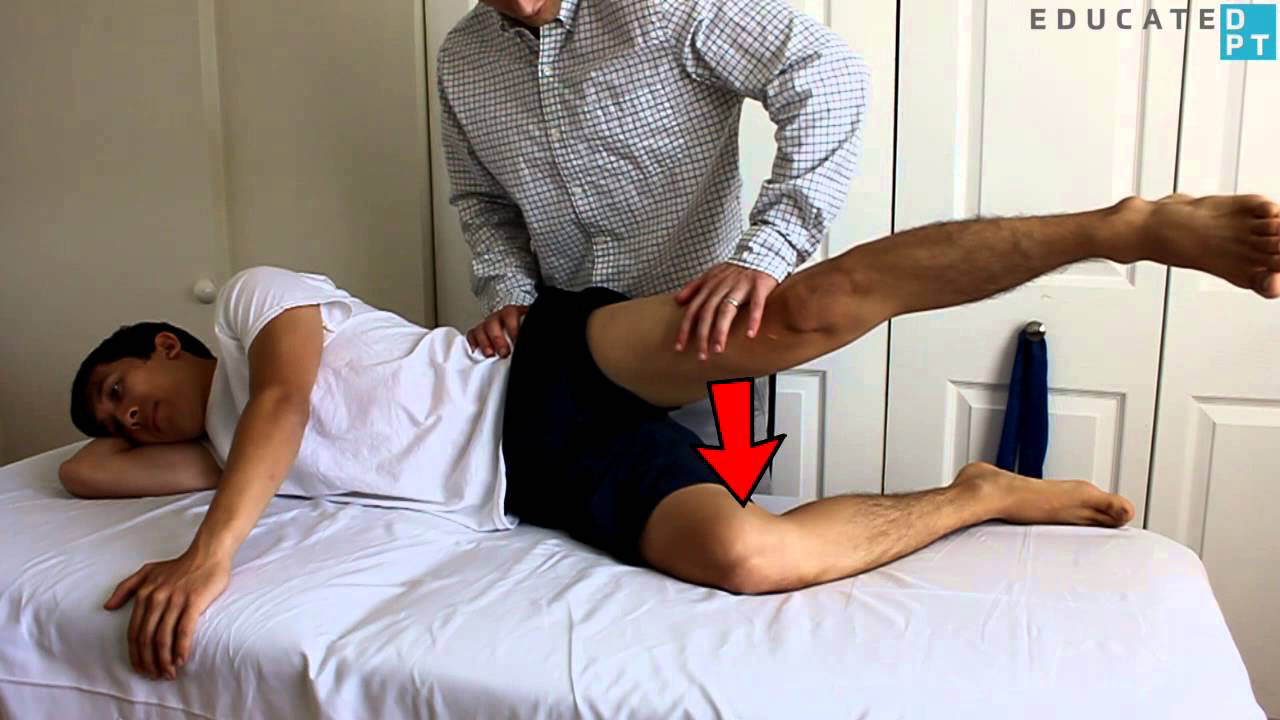
How should a therapist explain to a patient why their movement effort was corrected during strength testing?
Explain clearly that while they are moving their limb, extra muscles are helping out
The goal of the test is to isolate the specific target muscle so treatment can focus on strengthening the exact spot that needs help
Are standard 0-5 numerical MMT grades recorded during a quick myotome screen?
No; myotomes are documented as Intact (normal nerve drive) or Impaired/Weak, rather than assigning MMT grades
Knowledge Question: A patient completes full shoulder abduction against gravity, but breaks under manual resistance. What MMT grade is assigned?
3/5 (Fair)
Moving through full range against gravity without tolerating manual resistance is the definition of Grade 3
Knowledge Question: A PT evaluation records a patient's hip abduction MMT as 2/5. What position was the patient placed in for this grade?
Supine position
a gravity-minimized position where the leg slides outward on the treatment table


“Pt lying prone raising arm up into shoulder extension”
What muscle motion + muscles are being tested here, and what initial baseline grade is achieved if the patient completes full ROM against gravity?
Shoulder Extension against gravity
Testing posterior deltoid, latissimus dorsi, and teres major
3/5 = movement occurs through full available ROM against gravity before applying resistance

“Pt experiencing patellar knee pain during squatting and step descent”
A patient reports pain below the kneecap when coming down stairs. What prime mover muscle group is involved, and what muscle contraction phase causes difficulty during stair descent?
Prime Mover = Quadriceps
Contraction Phase = Eccentric contraction
Descending stairs requires the quadriceps to actively lengthen under load to lower the body weight smoothly
Clinical Application: If a patient scores 5/5 on an IE for quadriceps MMT but still struggles controlling step descent during therapy, why might this occur?
Traditional MMT observes static isometric strength in sitting, whereas stair descent requires dynamic eccentric control

What is the correct position for against gravity wrist extension MMT?
What direction of manual force do you apply through the wrist to test the strength of the extensors for against gravity wrist extension MMT?
Forearm fully resting pronated on the surface with hand extended over the edge
Towards the floor (into flexion)

How do muscle muscle contraction types compare in their ability to generate maximal tension force?
Eccentric generates the highest force potential
Isometric generates moderate force potential
Concentric generates the lowest force potential
Eccentric > Isometric > Concentric
Define the four ranges of muscle work shown in this picture
Full range = from fully lengthened to fully shortened position
Outer range = from fully lengthened to midpoint of ROM
Inner range = from midpoint of ROM to fully shortened
Middle range = central point of range, spanning across the midpoint
How do intra-tester and inter-tester reliability compare in MMT?
Intra-tester reliability (same examiner re-testing) is higher than inter-tester reliability (different examiners testing)
What major factor limits the maximum strength grade (5/5) a clinician can measure during MMT?
The clinician's own physical strength; the pt may be stronger than you!
What is the difference between individual muscle testing and group muscle testing?
Individual Muscle Testing = Isolates a specific muscle
Group Muscle Testing = Tests multiple muscles that share the same joint action together (e.g., testing all wrist flexors)
Where should stabilization hand force be placed during an MMT?
Near the proximal origin of the muscle/joint being tested to prevent compensation and provide a firm anchor
Where should manual resistance hand force be placed during an MMT?
Just distal to the tested joint, taking care never to cross two joints with resistance hand placement
What is the break test procedure, and how long must resistance be held?
Joint is placed in mid-range
Manual pressure is applied gradually (minimum, moderate, to maximum) until the muscle breaks hold
pressure must be held for 3 to 5 seconds
Why do patients perform muscle substitutions or compensations during MMT?
When a target muscle is weak, neighboring strong muscles recruit to achieve joint motion, often without the patient realizing it
What 9 pieces of information can an examiner gather by assessing Active Range of Motion (AROM)?
Patient willingness to move
Level of consciousness
Ability to follow instructions
Attention span
Coordination
Joint range of motion (ROM)
Pain provocation
Ability to perform functional activities
Muscle strength
Resistance or sensation transmitted to the therapist's hands at the extreme limit of passive range of motion (PROM), indicating which anatomical structure (bone, muscle, ligament, or capsule) limits further movement
What is a normal 'hard' end feel, and what is a classic anatomical example?
Painless, abrupt stop occurring when bone contacts bone
ex. elbow extension; olecranon process contacts the olecranon fossa

What is a normal 'soft' end feel, and what is a classic anatomical example?
Yielding compression felt when two soft body surfaces press together (soft tissue approximation)
ex. elbow flexion; bicep muscle belly compresses against the forearm

What is a normal 'firm' end feel, and what structures produce it?
Firm or springy sensation with slight give produced by the tension of stretched muscles, ligaments, or joint capsules
*think of stretching leather or the max stretch of a TB
What characterizes an abnormal 'hard' end feel, and what clinical conditions cause it?
An abrupt hard stop or bony grating sensation occurring before the expected end range or in a joint that normally does not have a hard stop
causes = degenerative joint disease (DJD), fracture, or joint dislocation
What is an abnormal 'soft-boggy' end feel, and what does it indicate clinically?
Mushy, squishy sensation felt during passive movement
indicates the presence of intra-articular fluid, such as joint effusion, synovitis, or tissue edema
What is an abnormal 'firm' end feel, and what tissue changes cause it?
A hard arrest to movement with slight give occurring earlier in the range than normal
indicates pathological shortening or tightness of muscles, joint capsule, or ligaments
What is an abnormal 'springy block' end feel, and what mechanical pathology causes it?
A distinct rebound effect seen or felt at the limit of movement
Indicates internal derangement within the joint, such as a torn meniscus or loose cartilage body blocking complete joint clearance
What is an abnormal 'empty' end feel?
Pt stops passive movement due to severe pain before the therapist feels any physical mechanical resistance or tissue restriction
ex. acute bursitis or severe joint inflammation
What is an abnormal 'spasm' end feel?
A sudden, involuntary muscular stop to passive movement, frequently accompanied by pain
often linked to acute tissue injury or underlying neurological conditions

A fibrous, pouch-like envelope found on synovial joints that encloses the joint cavity, providing passive stability while containing synovial fluid
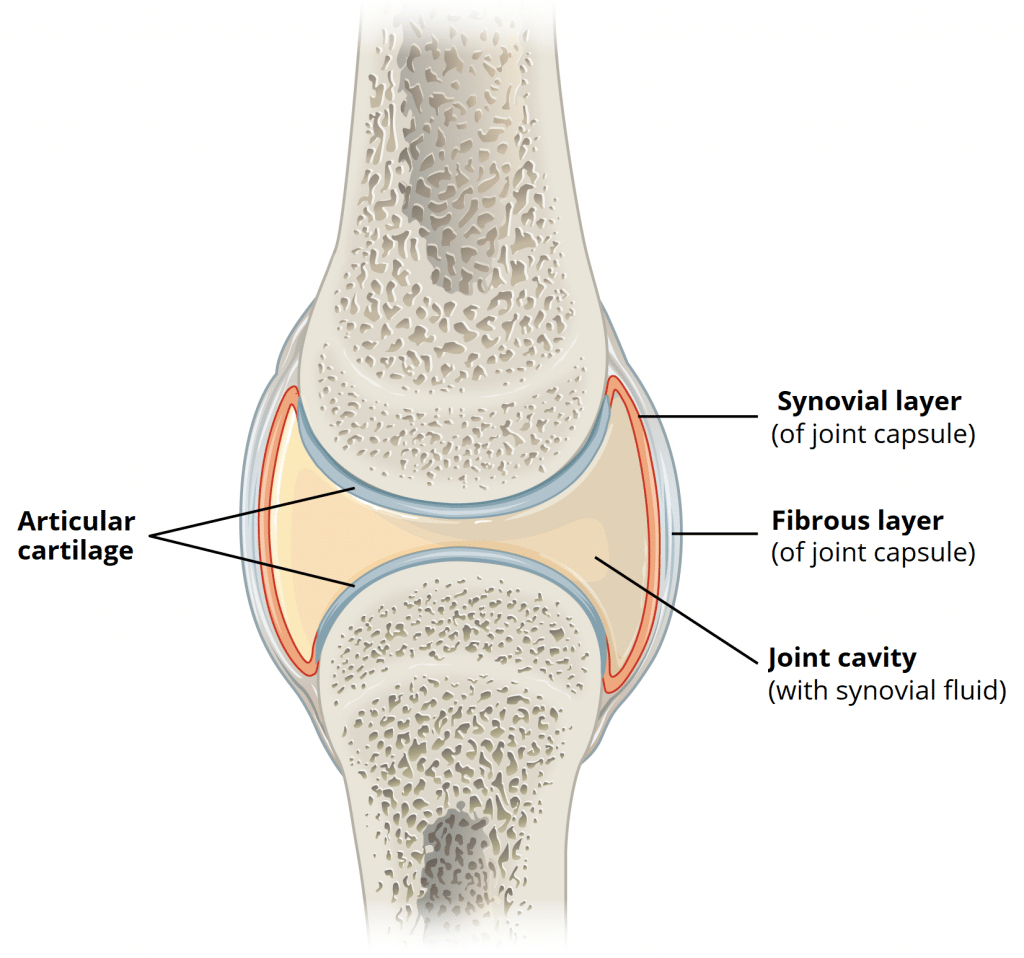
What is a 'capsular pattern' of restriction?
When does it occur? Where does it occur?
A pattern of passive range of motion (PROM) restriction specific to a joint
occurs when the entire joint capsule is inflamed, adherent, or tight
happens in joints that rely on muscular control rather than pure ligamentous support

What are the 4 key features of a close-packed position & clinically, when is it used?
Maximum congruity
Relative compression/approximation
maximal joint stability
maximal tautness of major ligaments (no further motion available in that direction)
used to assess the structural integrity of ligaments and the joint capsule


What are the key features of a joint's loose-packed position & clinically, when is it used?
least congruity
joint surface distraction
minimal stability
slackened ligaments
this position is ideal for performing manual joint mobilization techniques

What are the 4 contradictions to testing ROM?
Suspected joint subluxation or dislocation
Acute fracture
disruption to healing tissues
Presence of myositis ossificans (bone forming inside muscle or soft tissue) or ectopic ossification (bone forming where it shouldn’t)
What are the 4 precautions to ROM testing?
pain
osteoporosis (fragile bone structure)
Hypermobile joints
prolonged immobilization
What is hypomobility, and what are its 3 causes?
A reduction in normal joint movement compared to established norms or the contralateral healthy joint
Causes:
mild muscle shortening
structural contractures
connective tissue diseases such as Scleroderma (hardening/thickening of CT) or Dupuytren's contracture
What is a contracture?
Adaptive shortening of soft tissues that surround or cross a joint (skin, fascia, muscle, capsule), resulting in significant resistance to active or passive stretch & limited ROM
Described by the motion/action of the shortened muscle (ex. elbow fraction contraction)
What is a myostatic contracture?
Muscle shortening without specific tissue pathology
What is a pseudomyostatic contracture?
A limitation in ROM caused by central nervous system hypertonicity (muscle spasticity or rigidity)
What is an arthrogenic or periarticular contracture?
Intra-articular structural pathology (synovial adhesions, chronic joint inflammation osteophyte formation) leading to limited ROM
What is a fibrotic (irreversible) contracture, and how does it differ from other contracture types?
Permanent, non-reversible loss of soft tissue extensibility due to extensive fibrotic changes and scar tissue replacing normal tissue, making it non-correctable even with surgical or conservative stretching
What is hypermobility? What’s the difference between generalized and localized hypermobility?
Joint ROM exceeding normal standard limits or in comparison to the contralateral side
Generalized hypermobility = multiple joints; often congenital, as in Ehlers-Danlos Syndrome
Localized hypermobility = one joint as a compensatory reaction to stiffness in an adjacent joint
A 9-point screening tool used to assess generalized joint laxity
What 4 primary factors dictate joint stability?
Joint integrity
Elastic energy
Passive stiffness
Muscle activation
Why is the hip joint structurally more stable than the glenohumeral joint?
Hip joint is a ball-and-socket joint w/ a deep bony socket (acetabulum) vs. the GH joint has a shallow glenoid cavity that offers minimal articular containment
Resistance generated by the resting tension of muscles and fascial layers surrounding a joint; increases naturally as a joint approaches its end ROM
Increases active stiffness in the muscles & the joint it crosses.
Timing and magnitude of agonist, antagonist, & synergist contractions are important for proper joint function
What is the difference between joint instability and joint hypermobility?
Joint instability = functional loss and is typically symptomatic
Hypermobility = excessive movement range, predisposes to instability but is often asymptomatic
What is articular joint instability?
Abnormal patterns of coupled & translatory movement (ex. uneven wear & tear of meniscus)
What is ligamentous joint instability?
Instability that can lead to multiple planes of abnormal motion (ex. chronic ankle sprains)
Why do physical therapists test ROM in both standard and functional positions?
Standard positioning = gravity can assist movement to assess maximum available structural ROM
Functional positioning = movement against gravity, helping the clinician evaluate if muscle weakness contributes to limited ROM
The clinical measurement of joint angles using a goniometer
Intra-tester reliability = same examiner performing repeat measurements is higher than
inter-tester reliability = different examiners taking measurements
Intra-tester is more reliable than inter-tester
What is the acceptable degree difference for inter-tester reliability (different clinicians) in goniometric measurements?
3-5 degrees

What are the 3 components of a universal goniometer?
axis
stationary arm
moving arm
