Disorders of chest wall, pleura, and lung inflation
 Call Kai
 Learn
 Practice Test
 Spaced Repetition
 Match
 Flashcards
 Knowt Play
1/22

There's no tags or description
Looks like no tags are added yet.
23 Terms
What are the disorders of the chest wall and pleura?
Chest wall and pleura disorders:
Chest wall restriction
Flail chest
What volume does chest wall restriction decrease?
Chest wall restriction decreases tidal volume
What is tidal volume?
Tidal volume is the amount of air you breathe in and out during a relaxed breath
What are some examples of chest wall restriction causes?
Obesity
Neuromuscular disease
Trauma to the chest wall (flail chest)
What is Flail chest?
Flail chest is when the chest wall moves in with inspiration and out with expiration

What is the movement of flail chest called?
Paradoxic movement
What are the disorders of lung inflation?
Lung inflation disorders:
PP-E-ABC
Pneumothorax
Pleural effusion
Empyema
Atelectasis
Bronchiectasis
Cystic Fibrosis
What is Pneumothorax? What is it caused by?
Pneumothorax is the presence of air in the pleural space, caused by a rupture in the visceral or parietal pleura
What are the two types of Pneumothorax?
Open Pneumothorax
Tension Pneumothorax
What is Open Pneumothorax?
Open Pneumothorax is when there is an open hole in the chest wall

What is Tension Pneumothorax?
Tension Pneumothorax is when there is an open hole in the chest wall that creates a flap.
When you inhale, air goes in. But when you exhale, the flap closes the hole.

How is Pneumothorax treated?
Pneumothorax is treated through the insertion of a needle or chest tube to remove the excess air
What is Pleural effusion?
Pleural effusion is the presence of excess fluid in the pleural space

What is Empyema?
Empyema is when the pleural effusion gets infected with pus
What is Atelectasis?
Atelectasis is the collapse of lung tissue
What is the four ways that collapse of lung tissue occur?
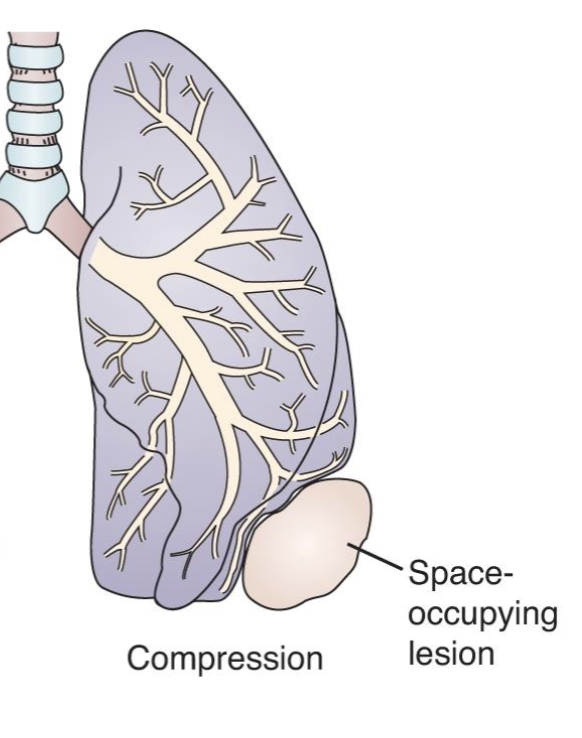
External compression
Obstructed airways
Inhalation of concentrated oxygen
Decreased production of surfactant
What is an example of external compression?
A tumor
How do obstructed airways lead to the collapse of lung tissue?
When air is absorbed from obstructed alveoli, the lung collapses

How can anesthesia lead to decreased production of surfactant?
Anesthesia during surgery combined with shallow breathing leads to decreased production of surfactant
What is Bronchiectasis?
Bronchiectasis is the permanent dilation of the bronchi

What diseases can cause Bronchiectasis?
Tuberculosis and cystic fibrosis can cause bronchiectasis
What is Cystic Fibrosis?
Cystic fibrosis is the mutation of chloride channels, causing thick mucous in the airways
If mucous accumulates in cystic fibrosis, what can it lead to?
Mucous accumulation can increase the risk of infections