voltage and current division week 4
0.0(0)
Studied by 0 people Call Kai
 Learn
 Practice Test
 Spaced Repetition
 Match
 Flashcards
 Knowt Play
Card Sorting
1/5

There's no tags or description
Looks like no tags are added yet.
6 Terms
1
New cards
what is the voltage across any resistor?
v(x) = R(x) / (R1 + R2 +… + Rn) • v(source)
2
New cards
how can you prove voltage division?

3
New cards
what is a key takeaway about voltage division?
Σv(supply) = Σv(consumed)
→ the sum of the voltage across the resistors equals the source voltage
for the same current value, the larger the resistance, the larger the voltage across the resistor
4
New cards
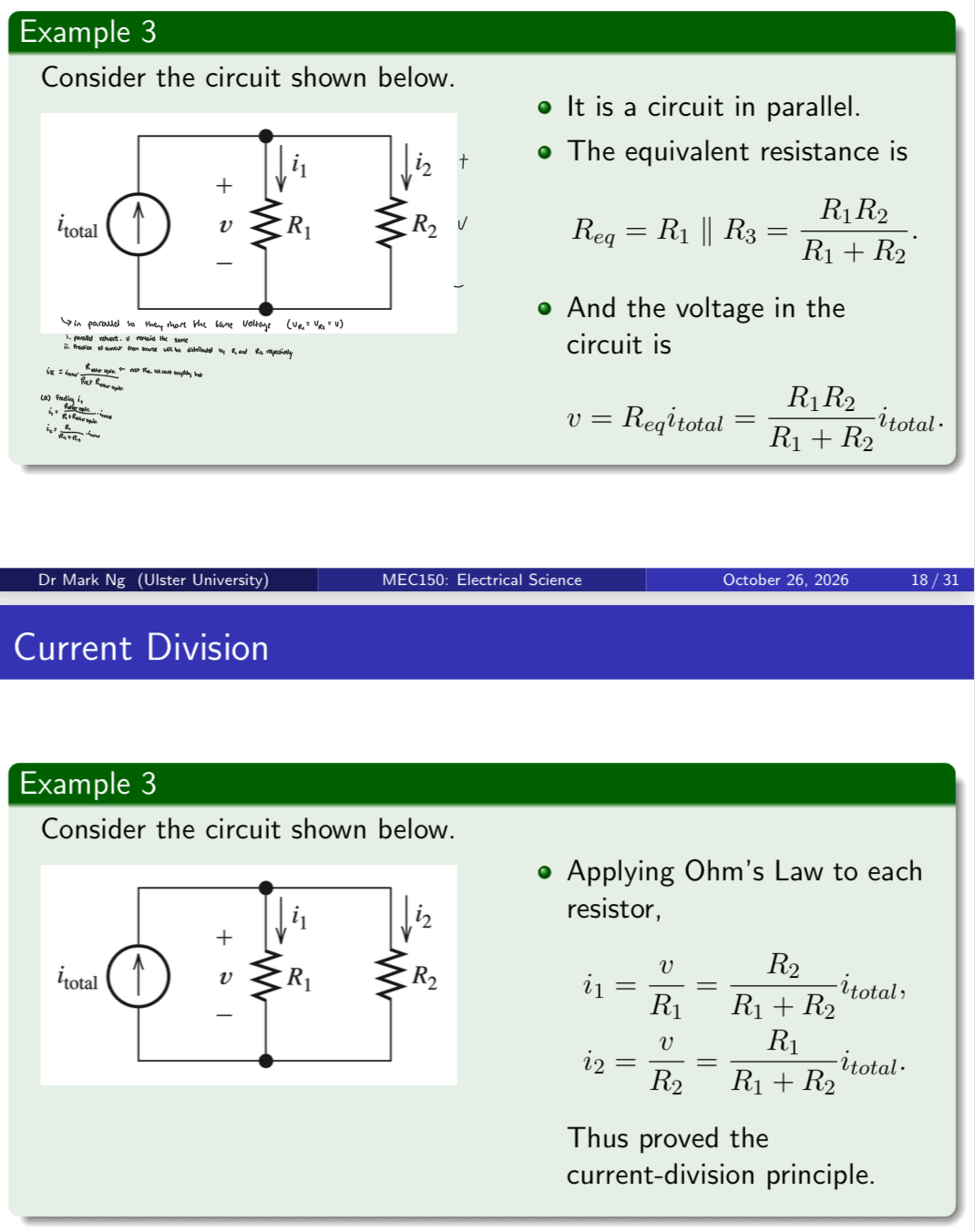
what is the current across any resistor?
i(x) = R(other eq)/(R(x) + R(other eq)) • i(source)
5
New cards
how can you prove current division?
6
New cards
what is a key takeaway about current division?
Σi(into node) = Σi(out of node)
→ the sum of the currents through the resistors must equal the source current
the larger the resistance, the smaller the current through the resistor