Community & Ecosystems Midterm
 Call Kai
 Learn
 Practice Test
 Spaced Repetition
 Match
 Flashcards
 Knowt Play
1/35

There's no tags or description
Looks like no tags are added yet.
Name | Mastery | Learn | Test | Matching | Spaced | Call with Kai | Chat |
|---|
No analytics yet
Send a link to your students to track their progress
36 Terms
Progressive Utilitarian Conservation Ethic
1900s, Gifford Pinchot pushed for equal use of natural resources for present and future generations
Environmental Awakening
1960-70s, resource management included interests other than extraction and capitalization
Aspects of present day ecosystem management (5)
non-equilibrium prospective
holistic, large-scale considerations
embraces uncertainty
adaptive management
consensus building: partnerships and collaboration
Population ecology
patterns and process involving single-species groups of individuals
Community ecology
maintenance, origin, and consequences of biological diversity within communities
place based
study of interactions between two interacting species
Ecosystem ecology
one or more communities together with their abiotic surroundings
Functional group
collection of species that use similar resources in a similar way
Assemblage
set of taxonomically similar group
Annie Alexander
established first vertebrae museum
Competition types (5)
consumption: consuming the same resource
preemption: physical resource is occupied
overgrowth: one organism grows over another
territoriality: aggressive behavior, exclusion of space
encounter: non-territorial encounter
Competitive exclusion principle
no two spieces can compete to occupy the same niche
Colonial Sea Anemones case study
Competing sea anemone colonies are territorial, and create unclaimed space from death of “soldier” anemones
showed how competitive mechanisms disadvantage both groups
Intertidal zone case study
Intraspecific competition
competition within one species

Lotka Volterra model - Model for interspecific competition, describes predator-prey dynamics
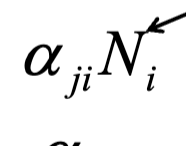
population size of the competitor (i) weighted by competition coefficient

Competition coefficient that measures intraspecific competition relative to interspecific competition

What species wins in this, i or j?
i

What species wins in this?
Coexistence
Trade-off theory
species cant evolve to resistance to predation without trading abilities such as competitive abilities
HSS/ "Why is the World Green” Hypothesis
points to predators as being big driver of community dynamics
predators keep herbivores in check
function of trophic levels
Keystone predation
predation increases species richness
when predators feed on competitive dominant, it gives opportunity for other species
density dependent
Predation case study (Paine)
top-down predation maintains community structure and species diversity in rocky intertidal ecosystems
Without Piaster, the competitive dominant mussel outcompeted the other species
Predation: Jane Lubchenco 1978
Green algae was competitive dominant, snails prey on the algae
Snail predation on green algae allows red algae to grow
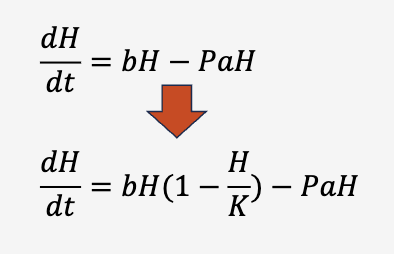
Prey Lotka Volterra variables
H = Number of prey
P = number of predators
b = per capita birth rate of prey
a = per capita attack rate
K = carrying capacity
aH = per capita consumption rate

Predator Lotka Volterra variables
e = conversion efficiency of consumed prey into new predators
-s = rate at which predators die in absence of prey
aH = per capita consumption rate
P = number of predators
4 Categories of mutualism
Energetic: energy obtained by one mutualist is made available to another
Nutritional: transfer of nutrients, such as nitrogen phosphorous
Protective: one mutualist provides active or passive defense
Transport: involves movement of gametes, propagules, or individuals
Indirect mutualism case study Dodson et al.
ponds have mole salamanders, and phantom midges
both feed on zooplankton
salamanders eat large, midges eat small
without the salamanders, the zooplankton grow too large for the midges to eat
Indirect mutualism
Benefits of the mutualism depends on a third species being present

Competition
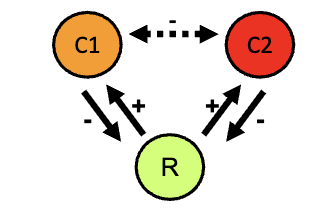
Consumptive competition

Indirect mutualism

Keystone Predation

Apparent competition

mutualism

Indirect mutualism