Chapter 4 & 5
 Call Kai
 Learn
 Practice Test
 Spaced Repetition
 Match
 Flashcards
 Knowt Play
1/31

There's no tags or description
Looks like no tags are added yet.
32 Terms
Single-gene diseases
A trait caused by a mutation in a single gene (monogenic)
Also called Mendelian
RARE
Phenotypes of single genes are influenced by other genes and environmental factors
Modes of inheritance
Patterns in which single-gene traits and disorders occur in families
Passing of trait: Gene is on an autosome (chromosomes 1-22) or on a
sex chromosome (X and Y)
Dominant
Recessive
Autosomal
X or Y linked
Autosomal Dominant:
Autosomal Dominant: one autosomal allele causes a phenotype (Marfan Syndrome)
Can affect both sexes
Does NOT skip generations
Affected individual has an affected parent, unless is a new mutation
EX: Huntington Disease, Polydactyly (extra finger/toes)

Marfan Syndrome
EX for Autosomal Dominant Trait
1 in 10,000 people
25% have no family history = high mutation rate
Fibrillin (gene FBN1) mutated: weaken connective tissue
Affects: Skeletal system, cardiovascular system, heart and eyes
Tall and thin with long arms, legs and thin fingers
Weakened connected tissue at base of the aorta causes it to enlarge and rupture
Autosomal Recessive:
Autosomal Recessive: 2 autosomal alleles needed to cause a phenotype
Can affect both sexes
CAN skip generations
Affected individual has parents who are affected or carriers (heterozygotes)
EX: Cystic Fibrosis, Albinism (deficiency in melanin)

Cystic Fibrosis
Autosomal Recessive
Fatal genetic disorder with abnormal secretions of the exocrine glands
CFTR gene: encodes for the production of chloride membrane channel protein
Involved in secretion of sweat, mucus, and digestive juices
Mutation: Non-functional membrane protein that causes mucus build up in the lungs, causing infection
Consanguinity
Blood relatives having children together
Autosomal Recessive conditions more likely to appear
Related parents may carry same alleles inherited from an ancestor
Monohybrid Cross
Follows one trait
Dominant trait: observed
Recessive trait: masked

Law of Segregation
Alleles of a gene are distributed into separate gametes during meiosis

Genotype
Organism’s alleles
Phenotype
Outward expression of an allele combination
Wild type
Most common phenotype in a population for a particular gene.
recessive or dominant
Law of Independent Assortment
Two gene on different chromosomes, the inheritance of one gene does NOT influence the other gene
Two gene far apart on the same chromosome: many crossovers happen between them
Random alignment of chromosome pairs during metaphase 1 of meiosis
Hemizygous
Males only have one X chromosome, so hemizygous for x-linked traits
Single copy of a gene instead of 2 copies
X-Linked Recessive
More common than X-linked dominant
Hemizygous males and homozygous recessive females are AFFECTED
More COMMON in MALES, some are exclusive in males
Affected males: pass affected allele to ALL DAUGHTER, none to sons
Color Blindness
X-linked RECESSIVE
Defective color vision from reduction or absence of visual pigments
3 forms: red, green, blue blindness
8% US Male affected
Defect in the Retina
Y chromosome
Only males have Y chromosomes
Pass from father to son
All y-linked genes are expressed (hemizygous for genes on Y chromosome)
Only 60 Y-linked traits identified
Pedigree Analysis
Diagram showing relationships in a family to show inheritance of a trait
Proband (P): first person in a family to be identified with a genetic condition (seeks medical care)
Loss of Function
Recessive Traits: more severe, produce symptoms earlier than dominant disorders
EX: No proteins made
Gain of Function
Dominant Traits
Ex: Different (toxic) form of protein made (HD)
Lethal Allele
variant forms of a gene that cause the death of the organism that carries them
EX: Achondroplasia- long trunk, short limbs, large head, flat face
New mutation
Gain of function (FGFR3) normally inhibits growth of the long bones of arms/legs
Homozygous recessive lethal: 25% die or spontaneous abortion
Removes expected progeny class from a specific cross
Multiple Alleles
Individual carries 2 alleles for each autosomal gene
Gene can have multiple alleles
Different allele combinations = variations in the phenotype
Compound Heterozygote: 2 different recessive alleles for the same gene
THREE OR MORE ALTERNATIVE FORMS
Incomplete dominance
Heterozygous phenotype is intermediate between those of the two
homozygotes
EX: Familial Hypercholesterolemia (FH)
Heterozygote has approximately HALF the normal number of receptors
in the liver to take up LDL cholesterol
Homozygous for the mutant allele totally lacks the receptor, and so
their serum cholesterol level is very high
EX: Hair follicle development
EDAR gene: develops hair follicles
“G” allele = East asian
“A” allele = European and African
GG = Thick hair, AA = very thin hair, AG = hair with diameter in between
Codominance
Heterozygous phenotype results from the expression of both
alleles
ABO gene encodes a cell surface glycoprotein
IA: A antigen
IB: B antigen
i(Io): no antigens
IA & IB are codominant and both are dominant to i
Blood type AB

Epistasis
A gene masking or affecting the expression of another gene
EX: Bombay Phenotype
H gene is epistatic to the I gene
H protein: places a molecule at the cell surface to which the A or B antigens are attached
hh genotype = no H protein
no H protein → A or B antigens can NOT be attached to the surface of the RBC
All hh genotypes = phenotype of type O, even though the ABO blood group can be anything (A, B, AB, or O)
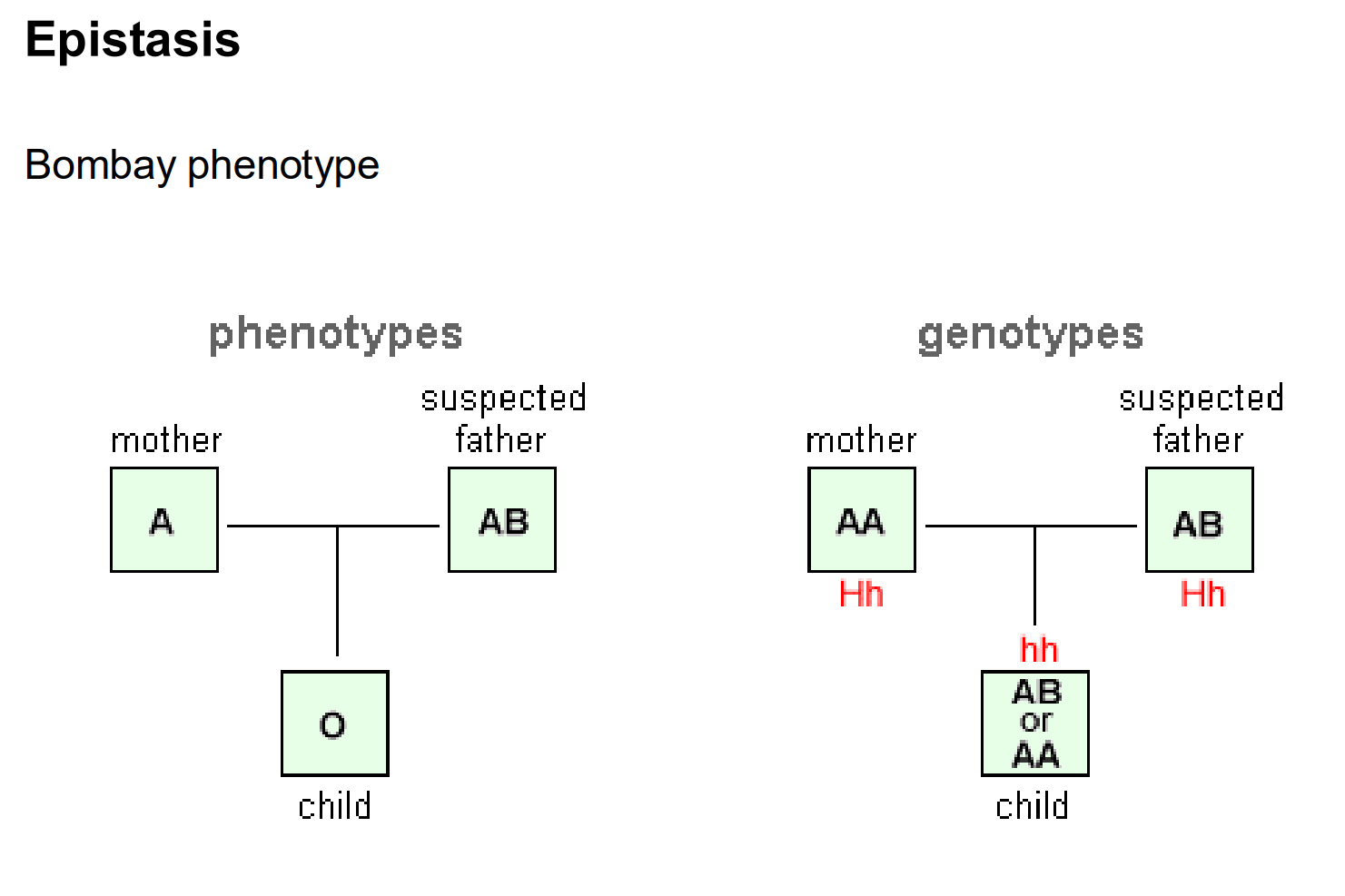
Penetrance
All-or-none expression of a single gene. It tells us whether a person with the gene will show the trait.
Percentage of individuals with a genotype who have an associated phenotype
Incompletely penetrant: genotype where some people do NOT express the phenotype
Expressivity
Severity or degree of a phenotype
Symptoms vary in intensity among different people
Pleiotropy
Single-gene disease with several symptoms or a gene that controls several functions (AFFECTS MORE THAN ONE TRAIT)
Has more than one effect, causing different symptom subset in different people
Influences 2 or more unrelated traits
EX: Marfan Syndrome
fibrillin: Defect in elastic connective tissue
Lens dislocation, long limbs, spindly fingers, caved-in chest
Serious symptom = weakening of aorta, can suddenly burst
Genetic Heterogeneity
Different genes can produce identical phenotypes
Genes encode enzymes that catalyze the same biochemical pathway, or different proteins that are part of the same pathway
EX:
Osteogenesis imperfecta (abnormal collagen → weak bones): At least 18 genetically distinct forms are recognized
Retinal dystrophies: caused by mutations in more than 270 genes (many routes to blindness)
Phenocopy
Trait that appears inherited but is caused by the environment
Symptoms that resemble an inherited trait or occur within families
EX: Infection (AIDS) - can be passed from mother to child, looks inherited
Mitochondrial Disorders
Mitochondrial genes encode proteins involved in protein
synthesis and energy production
Mitochondrial Diseases (mutations in mtDNA)
Mitochondrial myopathies: weak and flaccid muscles
Leber optical atrophy: Impaired vision
Woman with disease can avoid transmitting to children by replacing mitochondria from a donor
Mitochondrial DNA
Cell has thousands of mitochondria
Each mitochondria has copies of it mini chromosome
mtDNA does NOT cross over
Mutates faster then DNA in nucleus
Fewer types of DNA repair and DNA-damaging oxygen free radicals are produced in the energy reaction
Mitochondrial genes are NOT wrapped in proteins
Mitochondrial gene are NOT interrupted in DNA sequences that do not encode protein
Mitochondrial Genes are passed from mother to all of her offspring
