Cancer Clinical Pharmacy 1 - Pathophysiology & Epidemiology
 Call Kai
 Learn
 Practice Test
 Spaced Repetition
 Match
 Flashcards
 Knowt Play
1/29

There's no tags or description
Looks like no tags are added yet.
30 Terms
What is cancer?
The process by which abnormal cells divide uncontrollably with the ability to invade nearby tissues
3 main categories of cancer
Carcinomas
Sarcomas
Blood cancers
Carcinomas
Cancers that start in the epithelial tissues:
Skin
Lining of all organs of the body
Lining of the body cavities (chest / abdomen)
Carcinomas are divided into different types depending on which epithelial cells are affected:
Squamous cell carcinoma
Adenocarcinoma
Transitional cell carcinoma
Basal cell carcinoma
Carcinomas
Squamous cell carcinomas
Appear in flat cells which cover the surface of a membrane
E.g. skin
E.g. lining of the throat or oesophagus
Carcinomas
Adenocarcinomas
Affect glandular cells called adenomatous cells
Glandular cells produce fluids to lubricate passages
E.g. lining of the GI tract
Carcinomas
Transitional cell carcinomas
Affect cells in the transitional epithelium - a lining capable of expanding
E.g. lining of the bladder
Carcinomas
Basal cell carcinomas
Found in the deepest layer of skin cells, known as the basal layer
Sarcomas
Cancer in the bone or soft tissue
Approximately 100 different subtypes - can affect any part of the body e.g. fat, muscle, tendons, ligaments, lymph vessels, nerves
Most common in the trunk, legs and arms (as these are the areas the body grows the fastest)
Soft tissue sarcomas are far more common than bone
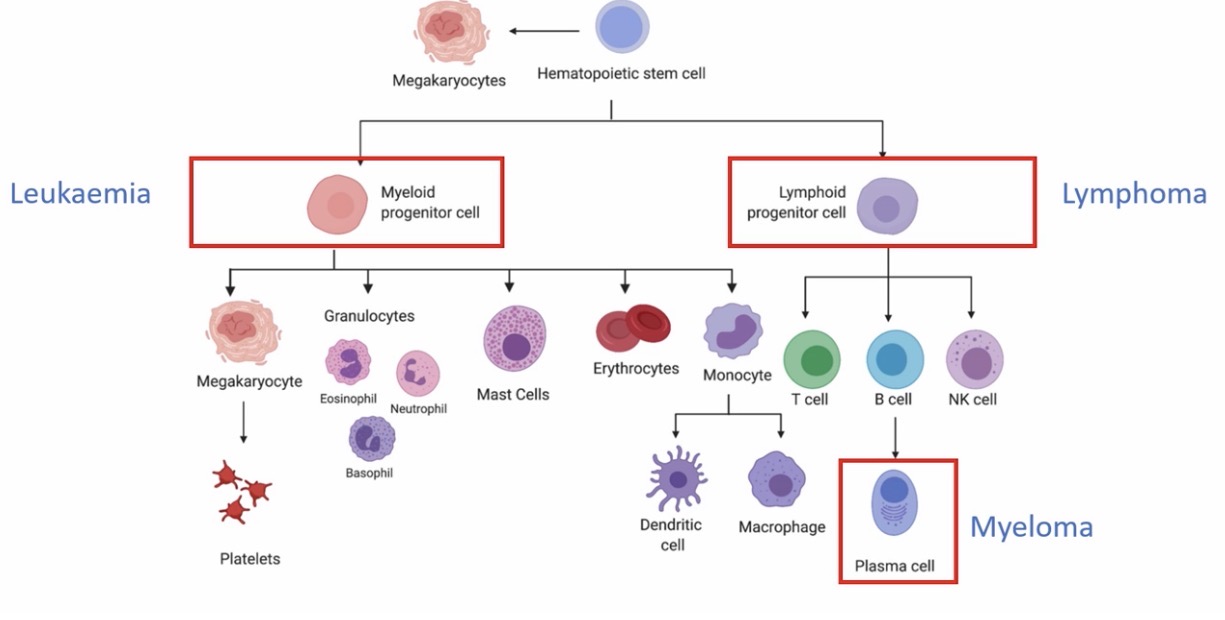
How are the difference blood cancers caused in haematopoiesis?
Haematopoiesis Is the process in which all cellular components of the blood are formed from haematopoietic stem cells (HSCs)
Leukaemia: An abnormal myeloid progenitor cell starts dividing uncontrollably
Lymphoma: An abnormal lymphoid progenitor cell starts diving uncontrollably
Myeloma: An abnormal plasma cell starts diving uncontrollably
1/3 of all worldwide cancers are linked to…
Smoking
Which WHO body specialises in cancer?
The International Agency for Research on Cancer (IARC)
What is the Global Cancer Strategy by the WHO
4 pillars:
Prevention
Early detection (screening)
Diagnosis and treatment
Palliative cancer
According to the Global Cancer Strategy, at least 1/3 of cancer cases are preventable by…
Reducing alcohol and tobacco use
Moderating diet
Immunising against HPV and viral hepatitis B
Early detection and treatment can reduce cancer mortality by a further 1/3
Most common types of cancer in the UK?
Breast
Prostate
Lung
Bowel
Changes in survival of cancer
50% of patients survive for 10 years or more
Survival has doubled in the last 40 years
Risk factors for cancer based on significance
Tobacco
Obesity
UV radiation
Occupation
Alcohol
Insufficient fibre
Infections
Ionising radiation
Processed meat
Breast cancer epidemiology
15% of new cancer cases in the UK each year are breast cancer
1 in 7 women will be diagnosed in their last time
75% of patients survive for 10 years or more after diagnosis
23% of cases are preventable - 8% linked to obesity, 8% linked to excessive alcohol consumption
Breast cancer has a genetic risk - if a women is a carrier of BRCA1 or BRCA2 gene, there is a 45-65% chance of developing breast cancer by 70
Prostate cancer epidemiology
14% of ALL new cancer cases (men and women) in the UK each year
1 in 6 men will be diagnosed in their lifetime
78% of patients survive for 10 years or more after diagnosis
Not considered to have significant risk factors - so uncertain what % of cases are considered preventable
Lung cancer epidemiology
13% of new cancer cases in the UK each year
2nd most common type of cancer for both men and women
10% of patients survive for 10 years or more after diagnosis
79% of cases are preventable - 72% caused by smoking, 5% caused by ionising radiation
Other contributing factors include workplace exposures e.g. asbestos and air pollution
Bowel cancer epidemiology
11% of new cancer cases in the UK each year
3rd most common type of cancer for both men and women
53% of patients survive for 10 years or more after diagnosis
54% of cases are preventable, influenced by one or more of the following:
28% linked to eating too little fibre
13% linked to eating processed meat
11% linked to obesity
6% linked to excessive alcohol consumption
7% linked to smoking
Top 3 most common cancers for men and women
Men:
Prostate
Lung
Bowel
Women:
Breast
Lung
Bowel
Prognosis depending on the stage of cancer
Nearly half of cancers are diagnosed at stage 3 or 4
1 year survival is significantly improved in early stage cancers (stage 1 rather than stage 4)
To improve overall cancer prognosis, need to find and treat the disease early
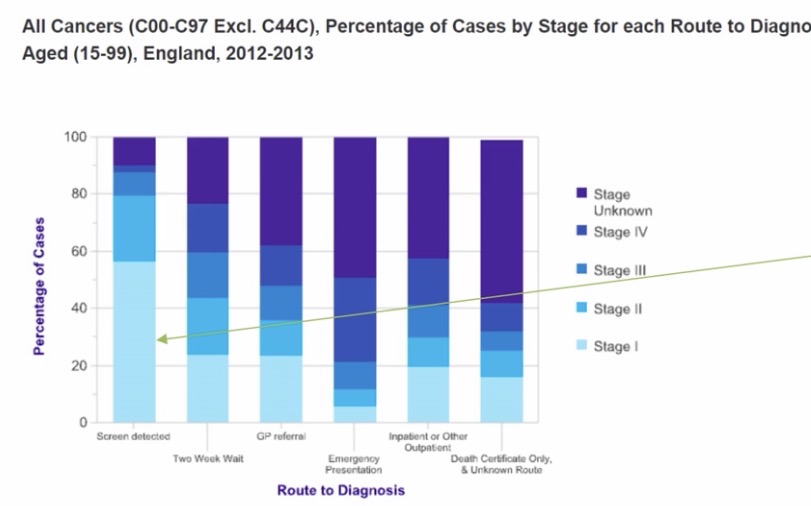
What does this graph show about how different methods of diagnosis are able to find cancer at different stages?
50% of cancers are found at stage 1, often before symptoms are experienced through screening
>50% of cancers are found at stage 4 through emergency presentation at the hospital
Steps for cancer referral pathway
Warning symptoms for cancer
Diagnosis (at the GP and further hospital tests)
Cancer Referral Pathway
Potential warning symptoms of cancer?
How do we know which symptoms are general symptoms and which are red flags for cancer?

Cancer Referral Pathway
Diagnosis
At the GP:
Blood tests - FBC, LFTs, U&Es, bone profile (calcium, phosphate) , tumour markers
Physical examination
Further referrals:
Biopsy - finds masses, lymph nodes
X-ray - chest
Ultrasound - breast lumps, gynaecological masses
Cancer Referral Pathway
Diagnosis
Tumour markers
Not always specific to the cancer, so results need to be analysed with additional tests
Examples:
PSA - prostate cancer (however, not entirely reliable)
CA125 - ovarian cancer
CA15-3 - breast cancer
CA19-9 - pancreas or bile duct cancer
Carcinoembryonic antigen (CEA) - bowel cancer
Cancer Referral Pathway
Diagnosis
Further scans
Computerised Tomography (CT) Scan - 3D image of the chose area using x-rays
Positron Emission Tomography (PET) scan - patient is injected with a radio-labelled fluorodeoxyglucose (18F-FDG) to identify metabolically active areas of the body
PET-CT scan - combination of the above techniques

From this PET scan which area of the body is shown to have cancer
Glucose divides rapidly so is taken up into rapidly dividing cells in areas of the body that are highly metabolically active
Both the brain, penis and heart have a natural high metabolic activity
However, the dark spots in the abdomen shows that the glucose has collected in the lymph nodes of the abdomen indicating that the patient has lymphoma in the abdomen