PR MANAGEMENT EXAM 1
 Call Kai
 Learn
Learn Practice Test
 Spaced Repetition
 Match
Match Flashcards
 Knowt Play
1/133

There's no tags or description
Looks like no tags are added yet.
Name | Mastery | Learn | Test | Matching | Spaced | Call with Kai | Chat |
|---|
No analytics yet
Send a link to your students to track their progress
134 Terms
PR is about hype
No. It requires truth as its foundation, along with verifiable performance and accuracy.
Public relations is about spin and deception
No. It helps people see the good things about an organization. This is only possible when the organization is actually doing good things.
Public relations is about publicity that shores up sagging newspaper readership
No. Publicity is only a small part of public relations, and today it is often achieved through a variety of media, including social media
Public relations is cleaning messes
No. It cleans messes, but also helps management avoid creating a mess.
Public relations is just a tool of big business
No. It’s used by schools, hospitals, churches, government, unions, sports, charities, etc.
Problems defining the field
The scope of activities is limitless
Practitioners’ activities are not uniform
It is vulnerable to the entry of anyone self-styled as a “public relations professional”
NOT a licensed profession
The Evolving Role(s) of Public Relations
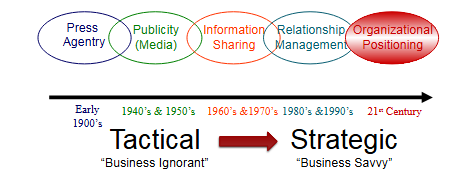
Evolution of Public Relations and Strategic Communication
How do I say it? (Business decision already made; Not in the room)
What do I say? (PR gaining respect and influence; Decision still made in another room)
What do I do? (In the room [where it happens])
Public Relations (PRSA definition)
a strategic communication process that builds mutually beneficial relationships between organizations and their publics
Defining PR
Strategic Communication
Intentional communication
Has a purpose
Has a plan
Alternatives are considered. Decisions are justified
Based on research
Operates within a particular environment
It is subject to evaluation
Can be informational or persuasive
PESO Model
Paid Media
Earned Media
Shared Media
Owned Media
Paid Media
Purchased by organization (advertising)
Pro: Message control
Con: High cost, trust issue
Ad & Commercial Sponsorship
Pay-per-click
Banner ad
Direct mail
Earned Media
Journalism based channels
Pro: High credibility
Con: Low control
Journalistic coverage
News Release
Review & Testimonial
Interview
Shared Media
Communication channels not controlled by the organization
Pro: Builds trust with your publics
Con: Difficult to predict audience’s reactions; thus, engagement is difficult to determine
Content created and shared on social media and other platforms
Likes and re-posts
Owned Media
Published or produced by organization
Pro: direct to public, avoiding media gatekeepers
Con: difficulty attracting audience
Website
Blog
Newsletter
Email
Interpersonal communication
RACE
Research
Action
Communication
Evaluation
ROSIE
Research
Objectives
Strategies
Implementation
Evaluation
ROPE
Research
Objectives
Programming
Evaluation
PR Process
Phase One: Formative Research
Phase Two: Strategy
Phase Three: Tactics
Phase Four: Evaluative Research
Research
the systematic gathering of information for the purposes of describing and understanding
Formative Research
gathers data on which communication programs and campaigns will be built
Formative Research Foci
The situation
The organization/client
The publics
Situation
Set of circumstances facing the organization
Situations are approached as an…
Opportunity- situation offers a potential advantage
Obstacle- situation limits the organization in realizing its mission
PR Situation Checklist
1) What is the central issue of the situation facing the organization?
2) What is the background of the situation?
3) What is the significance of the situation?
4) Checklist 1 (pp. 21-24) is useful
Issue
a matter of concern that may affect the organization
Issues Management
the process by which an organization tries to anticipate emerging issues and respond to them before they get out of hand, perhaps even before they break onto the scene (PREPARES FOR POTENTIAL EVENTS)
Monitoring
Evaluating
Risk Management
The process of identifying, controlling, and minimizing the impact of uncertain events on an organization (PREPARES FOR THREATS)
Crisis Management
The process by which an organization deals with out-of-control issues (REACTION TO ACTUAL OCCURRENCE)
Reputation Management
A continuing long-term process of how an organization seeks to influence the way its publics view and understand the organization
Benefits of Research
Helps managers make sense of the increasing fragmentation of audiences.
Keeps top-level management from losing touch with important stakeholders.
Helps differentiate between widespread beliefs and the impressions of a vocal minority
Can guide strategy so that funds and efforts are spent wisely
Can help prevent unintended effects
Types of PR Research
Strategic
Tactical
Strategic Research
systematic gathering of information about issues and publics that affect the organization
Tactical Research
information obtained to guide messaging (content and
dissemination)
Secondary Research
Systematically looks for existing information.
Research conducted by others
What information is already available?
Evaluate the information carefully
Possible Sources:
Organizational files/documents
Trade and professional associations
Libraries
Government records
Polling firms and other commercial information services
Online research
Primary Research
Research conducted by us
Be ethical (Silverman & Smith, pp. 29-31)
Methodologies (Silverman & Smith, pp. 42-60))
Surveys
Focus Groups
Interviews
Content Analysis
Participant Observation
Tracking
Media
Social Media
PR professionals must:
Consider the relationship of the organization to its environment
Demonstrate comfort with the various elements of the organization
Be a part of the decision process
Organization
an established group operating for a particular purpose
Two types of organizations
Commercial- For-profit businesses; local, regional, national, multinational
Noncommercial – Nonprofits, government, membership associations, nongovernmental organizations (NGOs)
Situation analysis
Research-based assessment of internal and external factors
Organization self awareness
What kind of organization are we?
What kind of organization do we want to be?
What kind of organization do people think we are?
SWOT Analysis

Public Relations Audit (our book)
Internal environment
External environment
Public Perception
Internal Environment
Performance.- quality, viability
Niche.- unique place, what makes it different from other organizations
Structure.- should include the place and role of public relations in the organization
Ethical base.- is there a stated ethical ideal?
Internal impediments.- limit the effectiveness of the organization and its public relations function
Public Perception
Visibility.- people’s knowledge of the organization (amount and quality)
Reputation.- how people evaluate the organization, the sense they have of it
External Environment
Supporters.- likely to help. Share interests/values with organization
Competitors.- do the same thing as the organization
Opponents.- are against the organization (See pp. 75-76)
External impediments.- external factors that limit/impede the organization’s effectiveness
Public
Interaction/Interdependency with organization
Share common issue/interest with organization
Market
People with similar characteristics that can help the organization achieve its “bottom line” (consumer-oriented goals)
Audience
People who pay attention to a medium and receive messages
through it
Stakeholders
Person or group that relates to the organization through its potential impact on the organization’s mission and objectives.
PRSA prefers to use “Public.” (see book on this)
Characteristics of Publics
Distinguishable.- can be differentiated/recognized as distinct
Homogeneous.-members share common traits and features
Important.-can impact the organization in a significant way
Large enough size.- large enough to warrant more than personal communication
Accessible to your organization.- able to interact and communicate with the organization
Customers
Receive products/services/ideas from the organization
Former, current, potential
Producers
Provide input for the organization
Personnel, suppliers, investors/donors/stockholders
Enablers
Set norms/standards for the organization (for ex: professional
organizations, government agencies)
Help make the organization successful (allies)
Limiters
Reduce/undermine the organization’s success
Opponents, competitors, hostile groups and opinion leaders
Intercessory Publics
Influential bridge between organization and its publics
Publics that are influential with a key public
Intercessory Individuals
Have a particular influence on a public
Influential role model
Generate word-of-mouth support
2-step flow theory.:
Influence opinion leader/influencer
Opinion leader influences public/other influencers
Influencers
Formal
Informal
Global
Local
Defining your key publics
Identify who is affected by the obstacles and/or opportunities that trigger the strategy/strategies/campaign. Focus on significant relationships
Name the public and then conduct research.
In some cases, research will yield new definitions of your publics.
Research will also help you prioritize your publics
Nonpublic
Does not share any issues with the organization
Latent public (inactive public)
Shares an issue with the organization, but it is not aware of it
Apathetic public
Knows that it faces an issue, but does not care about it.
Aware public
Knows the issue and its relevance, but is not organized yet to discuss it, or act on it
Active public
Discusses and acts on the issue.
Management by Objectives (MBO)
A strategic approach to enhance the performance of an organization.
Performance objectives are set at the beginning of a time period, plans are designed and implemented, and results are evaluated at the end of the time period.
Most public relations plans are written using MBO format.
Mission
An organization’s reason for existence
Defines the identity
The starting point for charting goals
Must resonate with the organization’s internal and external publics
Should express your organization's purpose in a way that inspires support and ongoing commitment
Goals
A statement rooted in the organization’s mission.
A desired end condition
Stated in general terms
Lacks measures
Relationship Management
focus on how the organization connects with its public
Type of goal
Ex: Develop enthusiastically satisfied customers all of the time
Reputation Management
identity and perception of the organization
Type of goal
Ex: Heighten the global visibility of the Grady College
Task Management
concerned with getting certain things done
Type of Goal
Ex: To sell products that sustain people and the environment
Objectives
Statement emerges from the organization’s goals
Should answer two questions:
What is to be accomplished?
When will it be accomplished?
Objectives should…
specify a single end result
be measurable
specify a target date
be realistic
also be challenging
be the reference point for evaluation
Hierarchy of Objectives
Awareness
Level of information
Understanding
Retention
Acceptance
Interest
Attitude and response
Action
Behavior
Writing Objectives
Specify the public
Direction
Specific effect (measurement and time)
Strategy
The overall approach to solve the problem and/or to take the organization where we want it to be.
Tactics
The actual actions/communications that allow the strategy to be implemented.
Proactive Strategies
Initiated by the organization
Implemented according to the organization’s planning
Proactive Strategy- Action
Organizational performance
Audience engagement
Special events
Alliance, Coalition, Partnership
Sponsorships
Strategic Philanthropy
Corporate Social Responsibility
Volunteerism
Activism
Organizational performance
Focus on what the organization does
Quality performance
Socially responsible
Special events
Designed to engage public(s)
Encourage interaction with organization
Can attract media attention
(Read about the difference with a publicity stunt)
Strategic Philnathropy
strategic donations
Volunteerism
Altruism, yes, but not only that
Better standing in the community
Studies show that volunteerism increases employee morale, retention, productivity and team building
Proactive Strategy- Communication
Publicity
Newsworthy information
Generating news
Celebrity Endorsement
News peg
Transparent communication
Publicity
Attention given by the news media to the organization
Provides third-party endorsement
Newsworthy information

Generating news
Important to have a strong visual element
Key: the ability to determine what is news an what isn’t
When to use traditional media and when to communicate directly through social media
Top 10 list of possible ways to generate news
1) Tie into an issue on the public or media agenda or link your info to news of the day.
2) Follow groups or individuals on social media and offer your organization’s comments.
3) Give an award to draw attention to your organization’s mission, values, and issues.
4) Hold a contest to involve others in your values and issues.
5) Select personnel to head a new program or begin a new project.
6) Comment on a local need or problem.
7) Conduct research and report on a local problem or localize a general/national report.
8) Launch a campaign, alone or with other organizations, to accomplish something.
9) Give a speech to a signifcant audience and tell the media about it.
10) Invite a celebrity to visit and/or address your organization on a topic of concern to you.
News peg

Reactive Strategies are triggered by…
Accusations
Criticism
Difficulties
Reactive Strategies
Pre-emptive action
Offensive response
Defensive response
Diversionary response
Vocal commiseration
Rectifying behavior
Deliberate inaction
Purpose of Reactive Strategies
Gain public understanding
Maintain/restore reputation
Maintain/restore trust and support
Action/Response should be consistent with organization’s…
Messages
Actions
Mission
Image
They should also be ethical
Three models of PR
Press agentry/public information
Asymmetric 2-way communication
Symmetric 2-way communication
Three approaches to communication
Information- flow of communication
Persuasion- attempts to influence
Dialogue- understanding as goal
Agenda-setting theory
Telling people not what to think, but what to think about
Priming theory
The relative prominence of issues in the media is the major determinant for the public’s beliefs about the state of the country/the organization, etc
Framing theory
How is the issue framed?
Cognitive dissonance theory
Inconsistency between beliefs/attitudes/actions causes discomfort
We try to reduce the discomfort
Selective exposure
Selective perception
Inoculation theory
Beliefs/attitudes that have been challenged are more resistant to change than those that have not been