ARTH 2861 - EAA: Quiz 2
 Call Kai
 Learn
 Practice Test
 Spaced Repetition
 Match
 Flashcards
 Knowt Play
1/56

There's no tags or description
Looks like no tags are added yet.
57 Terms

Pensive Bodhisattva (Maitreya – Korean Mireuk; Three Kingdoms period, early 7th century)
Gilt bronze, likely from the Silla kingdom, probably commissioned by royalty
Left foot rests on a lotus flower (metaphor for the Buddha); hand position represents inner-thinking/pensive thought
Triple-lobed lotus crown points to origin in the Korean peninsula
Likely depicts Maitreya, who will become the Buddha of the future
Drapery on legs are very fluid, linear; clothing (if covering his torso), clings to the body
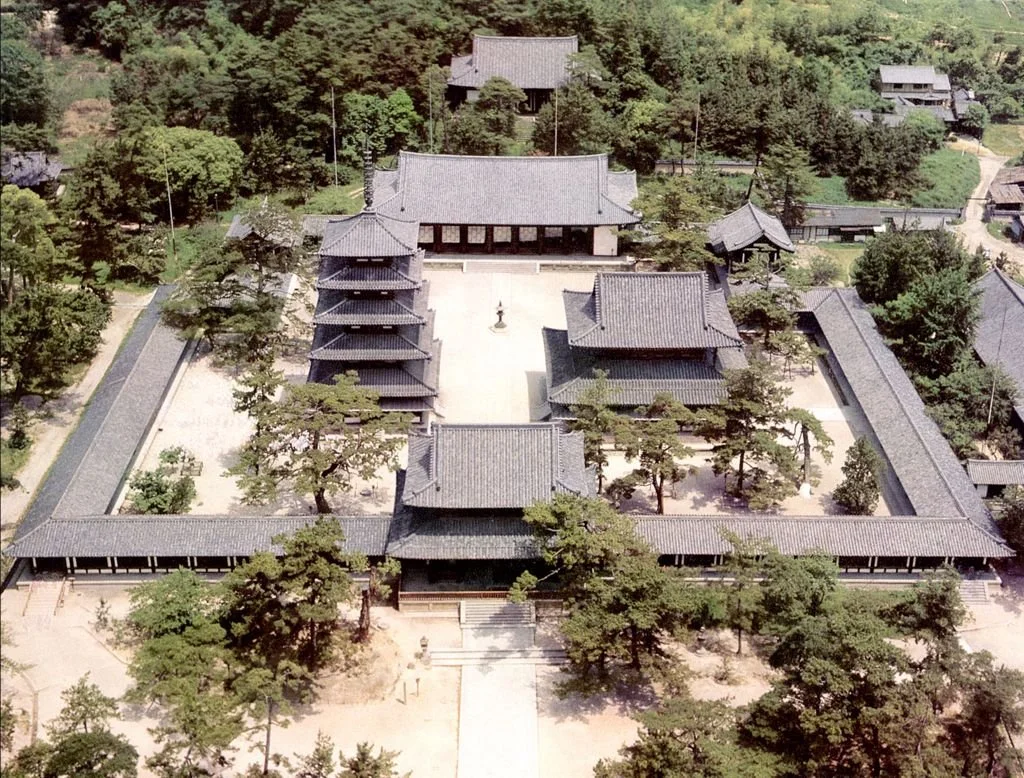
Horyuji (Nara Prefecture, Japan, Asuka period, 7th century)
Asuka period (552-645 CE); Early Nara (Hakuho) period (645-710 CE)
Asuka: a district of Yamato; under Empress Suiko, Buddhism spread through the efforts of the court
Compromise between Buddhism and Shinto; art and architecture styles imported from SW Korea chiefly, but of basically Chinese form

Plan of Horyuji (original plan, early 7th century and plan of the reconstruction)
Temple includes a gate, pagoda kondo (Golden Hall or Main Hall), and kodo (Lecture Hall), along with belfry (structure enclosing bells for ringing as part of a building), sutra repository (, sometimes a separate repository, and dormitories
Pagoda, Main Hall, and Lecture Hall are all enclosed within a cloister, in block plan, often with simple axial arrangement of buildings
Pagoda: stone platform, entrances facing the four cardinal directions, five-bay building (bays are the distances between the poles); originally five levels centered around a central pillar; cantilevered brackets that stretch out like arms to support the heavy load of the ceramic-tiled roof
Pillar serves to stabilize the building during horizontal, lateral movement earthquakes in Japan
Cloister creates a sacred precinct separate from the secular world for circumambulation
Five-story pagoda uses post-and-lintel construction, functions like a stupa, and features four sculpted tableau of Buddhist narratives

Tori Busshi, Shaka Triad (Shakyamuni) (Horyuji, Nara prefecture, Japan, Asuka period, dated to 623)
Gilt bronze, metallurgic skill required and royal patronage
Central sculpture in the kondo at Horyuji
Dedicated to Prince Shotoku and the Princess of Kashiwade
As visitors viewed it and thought on Buddhist teachings, the makers and those to whom it is dedicated to accrue karma
Outer robe is covering he shoulders; covered in a very schematic, fluid, linear way; waterfall pattern cascading over the pedestal
Two hands in mudra hand gestures with right hand raised to represent “no fear” and left hand pointing outward and downward to show “wish fulfillment”

Tamamushi Shrine (Horyuji, Nara prefecture, Japan, Asuka period, c. 650)
Cypress and camphor wood with lacquer
Semi-portable votive shrine that resembles the kondo at Horyuji
Features an icon inside sanctuary hall elevated on a pedestal with lacquer paintings of bodhisattvas, the Four Heavenly Kings, and jatakas
One painting is the Mahasattva jataka

Mahasattva Jataka (detail of the Tamamushi Shrine, Horyuji, Nara prefecture, Japan, Asuka period, c. 650)
Lacquer painting on wood; depicts three distinct moments simultaneously
Prince Mahasattva jumps to the ground where the mother tiger and her cubs devour his body; image is not distressing but an elegant self sacrifice

Ise Shrines (Ise Jingu)
Mie prefecture, rebuilt every twenty years, first known structure rebuilt c. 690, 62nd rebuilding in 2013; dedicated to chief deities of Shinto
Rebuilding represents the Shinto idea of “renewal”
Religion shamanistic; polytheistic, veneration of spirits (kami) in nature, sacrifices to deities and purifications
Alternate sites for the Ise Inner Shrine for the Sun Goddess Amaterasu
Buildings are located within four enclosures; the symmetrical arrangement of buildings reflect continental influence in plan; 4 walls with N-S orientation gate (toril – literally bird-perch), main hall (shoden), 2 treasuries (storehouses)
Shrine modeled after a storehouse, built on stilts; entrance on long side, built of cypress wood, miscanthus (kaya) reeds for roof; unpainted
Storehouse was on stilts as the rice culture that was emerging required that rice be stored away from moisture, and thus raised above the ground
Gable; gable-end pillars; roof billets; forked finials
Shrine is abode for the Sun goddess Amaterasu (first ancestor of the clan; no figural representation); one of the Japanese imperial regalia (the mirror) is placed inside

Plan of the Tang capital, Chang’an (present day Xi’an, China, Tang Dynasty, 618-906)
Former Sui capital, renamed during the Tang dynasty (“everlasting peace”); one of the three largest cities of the time
Size and wealth of city were due to trade (markets contained within)
Grid plan, rectangular, surrounded by a wall
Palance and administrative area in the north, residences around, markets on east and west; temples throughout the city, served as clinics, baths, parks, etc
Pagodas define the skyline; organization of city designed to control the populace; city plans became models for early Japanese capitals of Nara and Kyoto

Diagram of Tomb of Prince Yide (Tang dynasty, 706, Qianling, Shaanxi province)
Recessed niches
Lessened human sacrifices

Camel Carrying Musicians (excavated in 1957 from tomb of Xianyu TInghui, Xi’an, Shaanxi province, dated to 723)
Earthenware with three-color (sancai) glaze; style typical of Tang dynasty ceramics
Lead-based glazes (cannot be used for food or drink purposes)
Exemplifies Tang interest in the exotic (musicians appear to be Han Chinese and Central Asian); lute is from Mesopotamia; facial features are not endemic to the Chinese
Camels were primary transport method on the Silk Road; naturalistic depiction of both human figures and the camel

Colossal Vairochana and Attendants, Fenxian Si (“Temple of Honoring Ancestors”, Longmen caves (Cave 19), Henan province, China, Tang Dynasty, 660-76)
Limestone (very difficult to carve); carved into the cliffs of Longmen, or Dragon Gate, at the Temple of Honoring Ancestors; rock-cut, ushnisha, chakravartin
Vairochana: in mahayana buddhism, the buddha of all buddhas; supervising all buddhas of the universe; Buddha of great illumination
Two monks, two bodhisattvas, guardian deity, heavenly king; total grouping is 9;
Calm expressions because they’re at the highest spiritual level and are thus not affected by human emotions
Dwarf is representative of “ignorance” - the dude who’s stepping on the dwarf is thus eliminating ignorance from the kingdom/buddhism
Very naturalistic, idealistic portrayal of everyone
Drapery is thin, concentric, linear in structure/design
Sculptures were originally painted
Third Tang emperor Gaozong and his wife, Empress Wu, were the patrons

Amitabha Buddha Presiding over the Western Pure Land (detail of mural on north wall of Cave 217, Mogao (“Peerless”) Cave temples, Dunhuang, Gansu province, China, Tang dynasty, c. 713-66)
Parallel, orthogonal perspective to indicate spatial recession
Rubbing of a pictorial tomb tile from Eastern Han, China
In Mahayana Buddhism, Amitabha proposes rebirth in a Pure Land as an intermediary step towards release from samsara (endless cycle of death and rebirth)
Amitabha sits in the center on a lotus throne with a retinue of bodhisattvas
Mural, balustrade, illusionism
Eastern Han tomb tile with parallel orthogonal lines to indicate spatial recession; hierarchical representations of figures/objects
All platforms are floating on lotus flowers/ponds; lotus refers to purity, associated with Buddhism; the Pure land has music, dancers, waterbirds, architectural elements that resemble Tang palace architecture
Panorama style with the central buddha assembly in the middle and surrounded by palatial style architecture
Mural of Western Pure Land from Dunhuang
Amitabha’s Western Pure Land, Dunhuang Cave 320, 8th c., multiple-points convergent perspective

The Diamond Sutra (Tang dynasty, 868)
Woodblock print, ink on paper; Chinese developed woodblock printing very early on
The world’s earliest completed and dated (868) printed book
“Diamond” (sanskrit: vajra) refers to the sutra’s power to cut like a diamond blade through illusion to gain the actual truth
Scene preceding the text depicts the buddha beneath a jeweled canopy
Auspicious; music and dance; beautifully designed tiled floors
Manta (citing of some magical words before the text begins) listed to the side of the print

Metal and Ceramic Ewers in Central Asian Shape
Vessels
Gilt-silver ewer from 6th c. tomb in NW China, Tang
Three beaded rings: typical of central asian art
Silver-gilt ewer, Sasanian 6th-7th c.
Chinese ceramic ewer, 3-color glaze
Bird head shape, medallions, 3-color glaze
Tang Dynasty figurines in three-color glaze (sancai)
Foreign musicians on camels
Military and civil officials
Tomb guardians
Shosoin (the imperial storehouse of treasures), Todaiji, Nara, Japan
Donated by Empress Komyo after Emperor Shomu died in 756; located on the grounds of Todaji, reflects metropolitan culture of Tang China
Like storehouses, raised on stilts; similar to log-cabin style construction; covered in ceramic tiles for roof
Became a climate control unit; hot and humid in summer, cold and dry in the winter
Exotic, luxury goods of gold and silver, textiles, glass, ceramics, musical instruments, and foreign motifs; Nara now considered the eastern terminus of the Silk Road

Five-stringed lute (biwa) (Shosoin, Todaiji, Nara, Chinese, Tang dynasty, 8th century)
Red sandalwood and chestnut inlaid with mother-of-pearl, amber, and tortoiseshell
Foreign musician riding on a camel and holding the lute horizontally; motif of the subject of an exotic foreign musician playing music on a camel; signifier of the trade from the silk road

Seated Buddha at Seokguram Grotto (North Gyeongsang province, South Korea, Unified Silla period, c. 751-74)
Granite; height of the buddha is 11 ft. 2 in
Hand gesture is calling to the earth representing his enlightenment
Perfect dome surrounding, made of interlocking stone slabs, similar to a rotunda
Butterfly shaped pieces help secure the stone slabs together

Great Buddha Hall (Daibutsu-den) (Todaiji, Nara prefecture, Japan, original structure completed in 752, destroyed in 1180, reconstruction completed in 1707 with restorations in 1906-13)
The building that houses the vairochana icon (daibutsu means “great buddha”)
Shared language of tang palace architecture
Double-eave hip roof, complex array of brackets
Shows the connection between politics and religion
Facade, bay, hip roof
Buddha is always facing the south because the south is the auspicious cardinal direction

Vairochana Buddha (Daibutsu-den, Todaiji, Nara prefecture, Japan, original: Nara period, 743-52; reconstruction: seventeenth century)
Bronze; auspicious; commissioned by Emperor Shomu to promote religious piety that would bring the Buddha’s protection to the nation
Styles from several periods exist within the statue
Engraved lotus petals on pedestal show Nara period image of the historical Buddha; sw*stika symbol on chest; flowy, linear drapery; flames also are associated with purity

Ganjin (Jianzhen) (Toshodaiji, Nara, Japan, Nara period, mid-8th century)
Dry lacquer, painted
Buddhist monk Ganjin )688-763, Chinese: Jianzhen) presided over the ordination of Emperor Shomu and Empress Komyo
Founded Toshodaiji; portrait is naturalistic and painted
First true portrait of a person; made by his disciples
Becomes a practice in Zen Buddhism in particular, in which Buddhist monks/masters are honored through portraits through paintings and sculpture

Womb World Mandala (Toji, Kyoto, Japan, Heian period, late 9th century)
Hanging scroll, color on silk
Concentric squares, hierarchical scale, contrasting colors, iconography, and symmetry to illustrate abstract Buddhist concepts, register
Throws flowers onto the mandala, the buddha that the flower lands on will be connected to the individual who threw the flower
Cosmic Buddha in the center with the universe expanding outward
Refers to the womb of great compassion
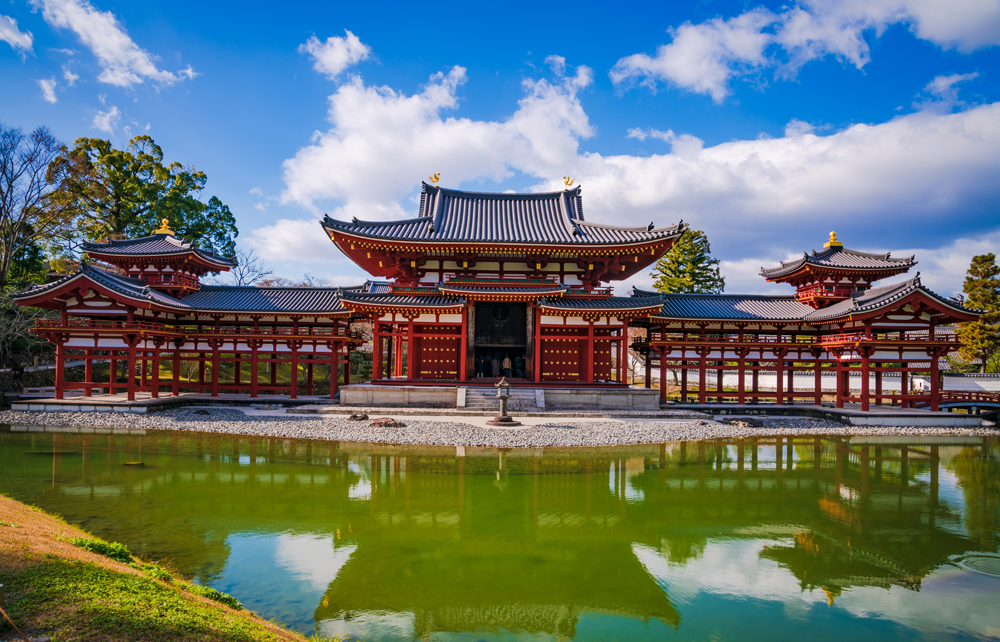
Phoenix Hall (Byodoin, Uji, Kyoto prefecture, Japan, c. 1053)
Claimed to represent a phoenix alighting, wings spread; use of pond of aesthetic effects and religious symbolism; interrelationship of the arts to produce an ideal, architectural representation of the Western Pure Land
3D representation of Amitabha’s PureLand
Facilitated visualization practices central to Pure Land Buddhism; act of envisioning the Pure Land and deliverance to that paradise would bring about raigo (descent and welcome of the Buddha) and rebirth
Gallery, hip-and-gabled roof
Watch towers
“Hall” gallery that the visitors can enter through
Mural paintings on the walls
Courtly elegance, very refined, very light
Man-made pond in the shape of a sanskrit syllable
Space within to circumambulate to pay respects to the buddha inside
Court women in particular would sit across the pond and pray and do rituals in hopes that they would be reborn into the Pure Land

Jocho, Amitabha Buddha (Phoenix Hall, Byodoin, Uji, Kyoto prefecture, Japan, c. 1053)
Gold leaf/gilt and lacquered cloth on cypress wood; multiple-block technique means that sculpture is designed, separate blocks are used and then carved to create major parts of the sculpture before being combined
Amitabha Buddha (Amida) as main icon
Sculptor was Jocho; Jocho perfected new sculptural technique—carved and joined together multiple pieces of wood (yosegi zukuri)
Concept of salvation for all: Amida’s descent (raigo) to receive the dying; invoking the name of the Buddha
Canopy is very elaborate
Amida’s snail-shell curls and ushnisha can be traced back to Nara period precedents in Japan and the Gupta period in north India
Bears the urna, has elongated earlobes, and hands in the muda of concentration
Late Heian Court Art
yamato-e (Japanese-type painting); kara-e (Chinese-type painting)
Mono no aware (melancholy, pathos, heightened awareness)
Onna-e (women’s pictures); otoko-e (men’s pictures
Narrative handscroll painting (emaki mono)
The Tale of Genji - diary of a court lady written by Lady Murasaki Shikibu (c. 978-1016); illustrated handscrolls executed c. 1120-40, attributed to Takayoshi example of onna-e; aristocratic, layers of paint, bright, intense colors; oblique perspective
Frolicking Birds and Animals (Choju Jimbutsu Giga); attributed to Toba Sojo (1052-1140), Kozan-ji, Kyoto example of otoko-e; caricature, satire, ink drawing

Scene 1 from the “Oak Tree (Kashiwagi)” chapter of The Tale of Genji (Late Heian period, c. 1120-50)
Womanizer, son to a low-level concubine, meaning that he can never become emperor
Handscroll, ink and color on paper; ground plane, motif, onna-e
Onset of mappo fueled aesthetic sensibility of mono no aware (awareness of the transience of things), which pervades The Tale of Genji
Set of handscrolls from the 12th century combines skills of papermaking, calligraphy, and painting
Voyeuristic and slightly uncomfortable angle + intense colors enhance the intensity of the painting

Scene 3 from the “Oat Tree (Kashiwagi)” chapter of The Tale of Genji (late Heian period, c. 1120-50)
Handscroll, ink and color on paper
Genji cradles the newborn baby (the child of Kashiwagi)
Emotional awkwardness represented indirectly by tipped up ground plane, placement of Genji at upper edge, sharp diagonal lines, and agitated draperies
Mono no aware refers to the pathos of things, the poignancy of life experiences

Scrolls of Frolicking Animals (Choju jinbutsu giga), attributed to Toba Sojo (detail from scroll 1, mid-12th century)
Handscroll, ink on paper; monochrome, isometric; otoko-e
Four-scroll set that depicts humans and anthropomorphic animals performing leisure activities and sacred rituals; satire depiction
This detail depicts a monkey abbot kneeling before a Buddhist altar, frog icon with mudra signaling not to fear, and various animals observing a religious ritual

Attributed to Dony Yuan, Wintry Groves and Layered Banks (Southern Tang dynasty; c. 950)
Hanging scroll; ink and color on silk; calligraphy, genre
One of the most important paintings associated with the Southern Tang kingdom
Represents early stage of Chinese landscape painting
Moist brush, layers of ink wash, and limited color create marshy landscape with mountains

Fan Kuan, Travelers among Streams and Mountains (Northern Song dynasty, c. 1000)
Variety of brushwork and texture strokes separation into foreground, middle ground (use of mist; mist comes from the waterfall on the right of the artwork), and distance
Hanging scroll, ink and colors on silk
Quintessential example of monumental landscape
Foreground and middle ground occupy a small area and small figures at the mountain’s base provide scale
Fan Kuan’s signature (lower right) suggests pride rising status of court painters; know that this is an authentic painting; he learns from nature
Both this landscape and Fan’s native Shaanxi province share rugged terrain
Uses sharp linework, crisp details; capturing the look of the mountains in different times of day and seasons → high degree of naturalism
Very Daoist principle of vastness of nature and the emphasis on the idea that humans only occupy a small space in nature; illustrated in the scale of the travelers to the rest of the natural landscape, the nature is the subject
Can also be interpreted through a Buddhist lens, in which the mountain is the “buddha” and the other parts of the landscape are the bodhisattvas done in hierarchical scale
Smudges of ink mixed with sharply, defined lines to define the contours of the mountain; texture strokes that are dot by dot edits, called raindrop texture strokes

Guo Xi, Early Spring (Northern Song dynasty, 1072)
Hanging scroll; ink and color on silk
Developed out of the work of Dong Yuan and Fan Kuan
Use of water, mist, clouds, “deep distance,” monumental scale
Diagonal composition in which the middle ground is defined by mist; creates a dynamic movement; foreground trees are much darker to contribute to the spatial depth
Atmospheric perspective: things in the distance look less distinct, hazier, faint
Hem-fiber strokes used to create a sense of texture and volume for the mountains
Usage of empty space
Tree branches are bare but are reaching out to capture the moisture in the air of early spring
The mountains climb up like a dragon
Seamlessly integrates multiple points of view
Firm but dynamic composition and naturalistic style; illusionism, format, screen painting
Subject is the season itself
Guo Xi’s Writing on Landscape
Guo Xi wrote a treatise on landscape painting entitled The Lofty Appeal of Forests and Streams
Characterizes landscape painting as an expression of longing to escape government duty to pursue self-cultivation
Saw the landscape as a way to express social norms

Zhang Zeduan, Peace Reigns along the River (detail showing a boat negotiating the rainbow bridge; Northern Song dynasty, late eleventh to early twelfth century)
Handscroll; ink and color on silk; isometric perspective, facade
Designed to be viewed by one person or a small group
Handcroll allows a sequential viewing process, so the painting is structured as a trip along the river
Documents idealized version of daily sights and commercial activities
Skilled ruled-line painting (he likely worked freehand)
Almost like propaganda; country is not doing well by the work was commissioned to portray the country as if it was prospering
Very detailed linework; monochromatic
Depiction of regular townspeople/common people instead of aristocrats

Su Shi, Poems Written on the Cold Food Festival (detail; Northern Song dynasty, 1082)
Handscroll; in on paper
Scholar-official of the Song court who was banished three times; he wrote this during his first banishment
Literati painters deliberately pursued awkwardness and abstraction
Su said painting should be expressive, not refined; emphasis on spontaneity and “naturalness,” de-emphasis of professional painterly skills and thus professional artists
Merging of painting with poetry and calligraphy
Subjects of literati painting associated with the virtues of gentlemen: bamboo, pine, orchid, plum blossoms, old rocks

Attributed to Emperor Huizong, Five-Colored Parakeet on Blossoming Apricot Tree (Northern Song Dynasty, c. 1110)
Originally oversize album leaves, now mounted as a handscroll; ink and color on silk
Oversized album leaf combines poetry, calligraphy, and panting (the three perfections) and attests to the emperor’s mastery of the three art forms
Fine brushes used to render the parakeet in heightened realism; five-colored parakeet
Inscription, auspicious, album

Narcissus Bowl (Northern Song dynasty, c. 1101-25; Ru ware)
The ru ware glaze is reminiscent of jade and was produced almost exclusively during Emperor Huizong’s reign; stoneware
Reduction atmosphere turns glaze into green-gray (like jade colored); oxidation atmosphere turns glaze into a brown
Any flaws in the application of glaze or firing would have been apparent—testament of skill

Ma Yuan, Apricot Blossoms, with an inscription by Empress Yang Meizi (1162-1232; Southern Song dynasty, early 13th century)
Album leaf; ink and colors on silk
Likes to use diagonals; subject he portrays is often in the corner
Stylistic similarities to Emperor Huizong’s Five-Colored Parakeet
Inscription was made by empress Yang Meizi (they collaborated frequently)
Blossoms are personified to invite the emperor to visit her bedchamber

Li Song, Knick-knack Peddler (Southern Song dynasty, 1210)
Fan mounted as an album leaf; ink and colors on silk; fan painting
Woman nursing her child and followed by another child
Monochromatic; a lot of linework to show detail; subjects are commoners, no longer aristocrats
Observation of the physical world
Inscription “three hundred items” is the artist’s claim of the number of objects depicted on the peddler’s racks
Vision is one of the themes
Idealized world of peace and plenty legitimizes imperial power
Belongs to the same genre as Zhuang Zeduan’s Peace Reigns along the River

Liu Guandao, Kublai Khan Hunting (1280; Yuan dynasty)
Hanging scroll; ink and color on silk
Court painting featuring Kublai Khan, his consort, and retainers on horseback
Kublai Khan (wearing the fur coat) with his empress; hunter with a bald head and bow and arrow, dark-skinned figures from southeast Asia, hunting dog; figure with pointed head could be central asian
People are from different ethnic groups → reflects the ethnic diversity in the Mongols
Evidence of multi-ethnic, multi-racial Yuan empire
Steppe landscape (grassland/desert-like) contrasts to Song-dynasty landscape paintings
Animals and activity of hunting evidence of Mongol culture
Emphasis on bravery, hunting, and similar activities, which contrasts the emphasis in the Song-dynasty on Confucian and Daoist values

Altar vases (The David Vases) (Yuan dynasty, 1351)
Porcelain with underglaze blue design
Porcelain of blue and white was first achieved during the Tang dynasty
Imported cobalt due to trade used for blue pigment
Kaolin clay that is very fine, requires a very high firing temperature (1300 centigrade)
Underglaze on clay → fired once at a high temperature → dipped or painted with clear/translucent glaze → fired again at a lower temperature so that clear glaze can be finished → result is that pigment can never be rubbed off because the cobalt underglaze layer is covered and protected by the clear glaze layer
Shipwrecks containing ceramics illustrates the great extent of trading
Can put flowers inside as offerings to deities
Dragons with four-claws, phoenix patterns on neck (symbols for emperor and empress, yin and yang, complimentary opposites)
Dedicatory inscriptions on the vases reinforce Daoist interpretations and give date in 1351
Both vases are divided into registers of different diameters, widths, and ornament
Blue-and-white porcelain gained popularity during the Yuan dynasty
Divided into registers with dragons, phoenixes, flower patterns and banana leaf patterns, and panels with further designs

The Mind Landscape of Xie Youyu (Yuan Dynasty, c. 1287)
Handscroll; ink and colors on silk
Mongol conquest of China posed dilemma for scholar-officials; this painting suggests Zhao’s dilemma through style and subject matter
Embrace abstract qualities that allude to earlier periods (archaism); tree branches are not very realistic, colors are brighter, less of a naturalistic portray
Blue-green colors recall scenes of Buddhist paradise from Tang dynasty

Guan Daosheng, Bamboo Groves in Mist and Rain (Yuan dynasty, 1308)
Handscoll; ink on paper
Literati style; emphasis on calligraphic quality of the brushwork
Guan was a literati painter like her husband, Zhao Mengfu
Shifts away from illusionism to abstraction
Preserves their own cultural and artistic identity during the time of Mongol conquest; Confucian values of bamboo bending in the wind but not breaking; bamboo near water (symbolic/allusion to grieving); bamboo is a multivalent symbol
Abstraction, colophon
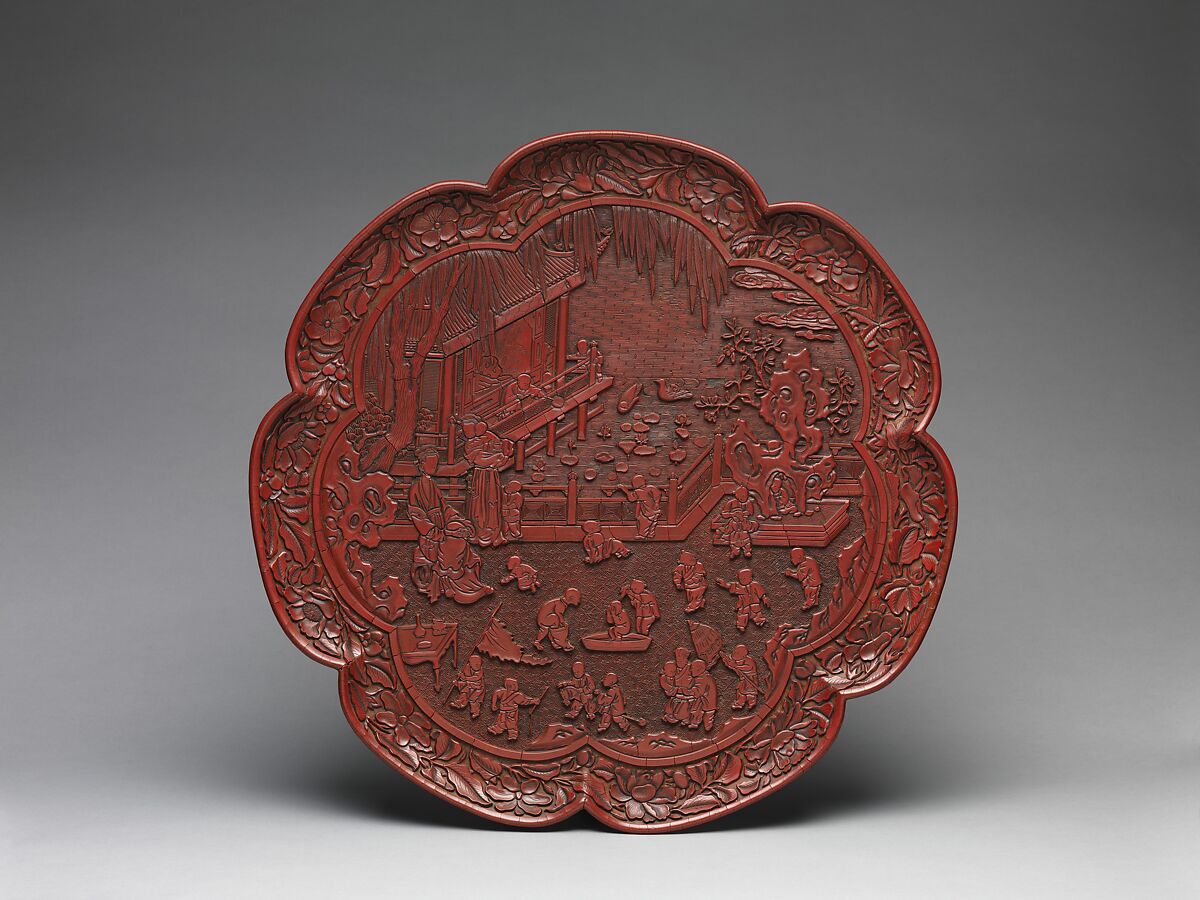
Tray with women and boys on a garden terrace (Yuan dynasty, 14th century)
Carved red lacquer
Central woman in a garden surrounded by young boys (not young girls, because young girls are not of value during this time)
Layers of lacquer are colored red with cinnabar, then carved to form the image
Continuity of subject matter and style from the Southern Song dynasty
Purchased by someone who is wealthy
Lacquer ware (like ceramics) were a desirable commodity, as evidenced by excavations of shipwrecks
Theme is fertility, specific towards having young boys, which aligns with the values of the culture
Floral design for the border

Ni Zan, The Rongxi Studio (Ming dynasty, 1372)
Hanging scroll; ink on paper
Literati painter who furthers abstract, monochromatic style, note the dry, spare brushwork]
Blank water, no mist, rustic pavilion, withered trees
Deliberately shuns beauty and visual excitement, instead captures the reserved aesthetic of pingdan
Style in keeping with his anti-Mongol stance
Pingdan: plain, bland, peaceful
Very sad, sorrowful painting → despair in a time of difficulty
The epitome of a literati artist, became idolized/put on a pedestal; self-expression

Portrait of Ni Zan (Yuan dynasty, c. 1340)
Handscroll
Contains a Chinese bronze on the table, a brush rest in the shape of a mountain, an ink stone, a few other various objects; screen painting with landscape in the style of a literati painting (trees on rocks, wide expanse of river, fisherman on boat, mountains in the back)
The single fisherman represents a recluse/hermit
Simple robe outlined, two attendants (one woman, one man)
Ni is seated on a platform bed/couch in front of a landscape screen
Servants and objects suggest Ni’s social standing and cultured taste

Bodhisattva Guanyin (Avalokiteshvara) in Water-Moon Form (Liao dynasty, 11th century)
Wood with traces of pigment
Guanyin is the bodhisattva of compassion; kind of became like a Madonna; “Guanshiyin” or “Guanyin” meaning “observing the sounds of the world” is the Chinese name for Avalokiteshvara
On the crown there is a little buddha; tiny Amitabha Buddha in the crown identifies Avalokiteshvara, the bodhisattva of infinite compassion and mercy
Royal ease position; relaxed posture of royal ease further indicates the manifestation of Guanyin
Position comes from the royal poses of indian princes
Iconography, effigy
Inside a Buddhist temple with supporting rock formations
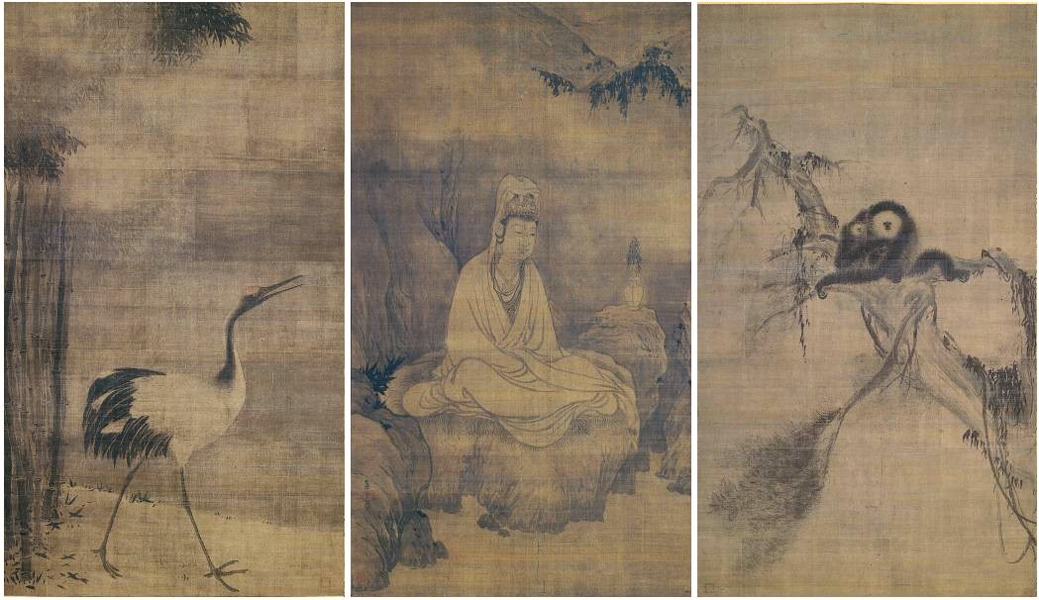
Fachang Muqi, White-Robed Guanyin, Gibbons, and Crane (Southern Song dynasty, thirteenth century)
Set of three hanging scrolls; ink and colors on silk
Guanyin wears a crown featuring Amitabha Buddha
Landscape evokes Guanyin’s Pure Land, Mount Potalaka
Absence of the pilgrim Sudhana and Guanyin’s white robe identifies him as the salvific, White-Robed Guanyin
Triptych, chakravartin, reliquary
Very impressionistic; hair of the monkey looks really fluffy; diagonal approach is very Southern Song; mist style (adds mysterious characteristics/feelings)
Crane and monkey (nature); sounds of both are associated with nature

Anige, White Stupa (Miaoying Temple, Beijing; Yuan Dynasty, 1279)
Stone with stucco and bronze
Jewels, parasol, thirteen stacked rings, stupa mound, rings of stylized lotus petals, two-tier base; plinth, four shrines in the corners, front hall
Built at the site of a ruined Liao-dynasty stupa where in 1271 Kublai Khan and Empress Chabi viewed Buddhist relics
Commissioned by Kublai Khan and designed by Nepalese artist Anige
Combines South Asian, Nepalese, and Chinese architectural features

Mandala of Vajrabhairava (c. 1330-32)
Silk tapestry (kesi); the silk tapestry medium and the imagery attest to Mongol aesthetic preferences and patronage (prefers textiles)
Vajrabhairava (wrathful, Angry manifestation of the bodhisattva of wisdom, destroys ignorance) is the central icon
Esoteric schools of Buddhism advocated visualization practices, facilitated by use of mandalas
Chief deity in the center in a square palace

Tea Bowl with Hare’s-fur glaze (Southern Song dynasty, stoneware with iron glaze)
Dark glaze of the bowl complements the bright green color of whisked, powdered tea (matcha!); pattern of glaze is similar to a hare’s fur; very thick runny glaze; mineral within the glaze will crystalize during the firing process, creating different patterns during firing such as the hare’s-fur pattern
Tea is a stimulant for sustaining lengthy Buddhist rituals and meditation (essentially providing the caffeine needed to stay awake during long rituals)
Tea bowls and black ware, more generally, are export commodity

Avatamsaka (Flower Garland) sutra (Korean: Hwaeomhyeong, Goryeo dynasty; 13th-14th century)
Gold and silver ink on indigo dyed paper
Palace-like structure; young boy who is in a praying gesture; attendants following the bodhisattva who is preaching; frontispiece

Seo Gubang, Water-Moon Waneum Bosal (Goryeo dynasty, 1323)
Color and gold on silk
Very delicate and detailed silk painting
Can portray lines of the fabric very fluidly, portrays transparency well
Lotus pedestal with corals, lotus buds, and other flowers surrounding the pedestal
Young boy at the edge, tiny scale compared to the god\
His hand has a rosary-like object
Gwaneum and Gwanse-eum literally means “to see the sounds of the world”
Gwaneum is a spiritual teacher, appearing here in a specific manifestation called Water Moon
The landscape elements, water and rocky outcropping, refer to mount potalaka (his sacred abode)

Kundika (Goryeo dynasty, c. late 12th-early 13th century)
Stoneware with inlays under celadon glaze; bronze repair
Cranes associated with longevity, lotus representing purity; auspicious symbolism
Water sprinkler that contains holy water; in the korean case, this water sprinkler is created out of celadon (reduction atmosphere), koreans learned about the celadon technique from the chinese, however, they added onto the technique by using inlays and carved sunken designs
Lotus pond design at the bottom of the sprinkler
Used in Buddhist purification rituals; the Kundika form was adapted from South Asia/India
Inlay technique was adapted from metalworking techniques
Color reminiscent of jade; motifs are decorative and symbolic
Celadon, earthenware, stoneware, porcelain, openwork, incised designs then filled in with slip

Ten-Story pagoda from the site of the Gyeongcheon Temple (late Goryeo dynasty, 14th century; inscription dated to 1348)
Carved in marble (unlike stone or wooden architecture); cross-shape; commissioned work
Received high ranking patronage
Pagoda, plinth, bays (space between the columns), post-and-lintel, Hip-and-gabled roof design, finial, relics associated with the symbolism of the pagoda
Three tiered base supports ten story pagoda
Middle tier of the base features sculpted narrative of the Tang-dynasty monk Xuanzang’s journey to the west (India)
Buddha assemblies and Buddhas in meditation appear on the ten stories of the pagoda

Portrait of Sin Sukhu (Joseon dynasty, second half of fifteenth century)
Hanging scroll; ink and colors on silk
Kind of formulaic style (meaning that all paintings typically follow a certain style or formula, making them appear the same visually)
Official’s hat, seated on a throne, feet on a little stool in front of the throne
Thin, fine lines that delineate the draperies
Subject is the scholar-official Sin Sukju
Combines generic conventions of formal portraiture with an individualized face

An Gyeon, Dream Journey to Peach-Blossom Land
Imaginary dream-like landscape; mainly monochrome (some greenish and blue/grey, some red for the leaves of the trees); mountain shapes with some shading and mist; references Song paintings in terms of style
Subject matter is based on a poem in early Chinese culture/literature; many allusions and references to early work
Poem: fisherman traveling along river, enters a village during spring time that is full of peach blossoms that are blossoming, this painting is the ideal of paradise (no warfare, trees are blossoming, people are happy); after he had left, he could never find his way back to the same village → an unreachable paradise that is like a paradise because after you leave, you cannot find it again; Peach-Blossom Land as a metaphor for paradise
Written in 1445

Ojukheon (Black Bamboo Studio) (Gangneung, Gangwon province, South Korea, Joseon dynasty, 15th century)
Black bamboo; hip-and-gabled roof; gray tiles for the roofing
Probably the house of a higher- or wealthier class individual
Lots of windows for natural light to come in
The residence of Sin Saimdang’s mother’s family
One of Korea’s oldest extant wooden buildings, an example of domestic architecture
Saimdang was a famous woman painter, also revered as a sagacious mother

Flask with Fish, Buncheong ware (1400-1499, Joseon dynasty)
Stoneware with underglaze carved decoration; beige colored with kind of a celadon/gold ish tint
Typically well-liked white porcelain in the Joseon dynasty; white is very auspicious
Circular disk shape, fish-designs incised into the disk; flask is associated with drinking
Buncheong ware came in a variety of shapes and styles
Whimsical vessel suggests artistic inventiveness
Unpretentious, imperfect qualities favored

Night Attack on the Sanjo Palace (details) (from the Illustrated Scrolls of the Events of the Heiji Era (Heiji monogatari emaki), Kamakura period, second half of thirteenth century)
Handscroll; ink and colors on paper
Troops and armored warriors holding weapons; palace ladies being trampled, people being thrown into wells, beheadings, very violent
Portrays events of the Heiji rebellion (1159-60), a conflict between the Taira and Minamoto clans
Kidnapping of the retired emperor Go-Shirakawa, the slaying of his military supporters and the burning of his palace
Complexity in depictions