BIO340 EXAM#2 CH7
 Call Kai
 Learn
Learn Practice Test
 Spaced Repetition
 Match
Match Flashcards
 Knowt Play
1/54

There's no tags or description
Looks like no tags are added yet.
Name | Mastery | Learn | Test | Matching | Spaced | Call with Kai | Chat |
|---|
No analytics yet
Send a link to your students to track their progress
55 Terms
Why are they different in the structure and function?
same genome in nearly all cells
differentiation without DNA sequence change
Example: neuron vs. liver vs. muscle
cell type differences reflect gene ______ programs, not genomic differences
expression
de-differentiate
A single plant can form a clone of progeny cells that later give rise to an entire plant
Housekeeping Genes
expressed in most cells (ex actin)
Specialized genes
cell-type specific (ex. liver enzyme)
cell identity
defined by gene expression
transcription regulators bind
CIS- regulatory genes
recognition via major groove of DNA
hydrogen bonds and ionic interactions
position and arrangement of ^(&^(&^(* determine
gene expression patterns
Most significant bindings are in the ___ groves
Major
different base pairs in DNA can be recognized from their edges without the need to open the double helix
THE TYPES OF HELIX PROTEINs
Dimerization
enchances thier bindings at CIS-reulatory sequences
dimer’s binding is ___
dynamic
can bind and unbind leading to transcription activation/inactivation of specific genes in response to signals
A eukaryotic gene control region includes many ___ sequences
cis-regulatory
Eukaryotic transcription work in___
groups
may be activators or repressors of transcription
Activators
promote the assembly of transcription
repressors
inhibit the assembly of transcription
DNA looping
allows distant enhancers to affect promoters
Coactivators and corepressors
so NOT bound to DNA directly
long noncoding DNA
also found in assemblies, these RNAs act as scaffolds to hold groups of proteins together
transcriptional synergy
greater than additive effect of multiple activators working together.

•Final transcriptional activity of the gene
results from competitions between
_______
activators and repressors
Eukaryotic repressor proteins can act by competitive DNA binding
activator and repressor have overlapping binding sites

Eukaryotic repressor proteins can act by making the activation surface
The binding and repressor site are close by, so the activator connects to the activation surface to the repressor
Eukaryotic repressor proteins can act by direct interaction with the general transcription factor
The repressor binds to the transcription factor, while nothing connects to the activator

Eukaryotic repressor proteins can act by recruiting chromatin remodeling complexes
chromatin remodeling complex surrounds chromatin and messes with the structure

Eukaryotic repressor proteins can act by recruitment of histone deacetylases
histone deacetylase attaches to the repressor and starts acetylation of histones

Eukaryotic repressor proteins can act by recruiting histone methyl transferase
Histone methyltransferase connects to repressor, starts histone methylation, and proteins bind to methylated histones

what controls the expression of the transcription regulators
Extracellular signals such as:
hormones
environmental conditions: temperature, pH, nutrient level
regulators act in
combinations
few regulators
combinatons
Cell fate depends on ___
regulatory combination
Transcription regulatory regulators are controlled by protein synthesis
the protein is synthesized only when needed

Transcription regulatory regulators are controlled by Ligand binding
ligand binding activates the protein

Transcription regulatory regulators are controlled by covalent modification
Covalent modification, such as phosphorylation, activates or inactivates it

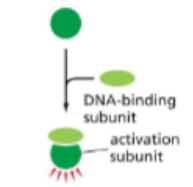
Transcription regulatory regulators are controlled by addition of a second subunit
A DNA-binding protein forms a complex with a separate activating protein
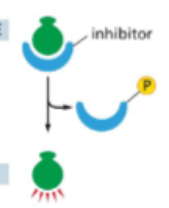
Transcription regulatory regulators are controlled by unmasking
An inhibitory protein is phosphorylated and released
Transcription regulatory regulators are controlled by stimulation of nuclear entry
Nuclear entry is stimulated by the removal of an inhibitor

Transcription regulatory regulators are controlled by release from membrane
proteolytic cleavage releases a regulator from a membrane
flow od transcription regulators
signal —> regulator activation —> gene expression change
each regulator contains ___ genes
many
master transcription regulator
regulates expression of multiple genes (liver / neutron)
regulatory
cell identify is ___, not genomic
Induced Pluripotent Stem Cells (ips Cells)
Differentiation is reversible
3 master regulators —> fibroblasts to pluripotent
Oct4, SOX 2, Ktf4
Transcription networks determine cell identity
resemble embryonic stem cells
iPS cells
differentiated cells
remain stable, and their daughter cells retain same idenity
Cell memory
Stable transmission of gene expression patterns
requires continued production of transcription regulators
positive feedback loops
master regulators activated a self-sustaining circuit
regulator passed to daughter cells
maintains identity through cell division
transcriptional attenuation
Premature termination of RNA synthesis
RNA structure determines termination
alternative RNA splicing
one gene —> multiple proteins
regulated splice site selection
increases protein diversity
pos and neg regulators: RNA-binding proteins
mRNA modification
RNA editing can change the meaning of the RNA message
Nucleotides in mRNA can be covalently modified
ex. A—> I and C—> U
changes codon
DNA sequence unchanged
Normal RNA export control
only processed mRNA exported
unspliced RNA retained and degraded
nuclear export is a quality-contorl checkpoint
HIV strategy
viral DNA integrated into the host genome
one last RNA transcript —> multiple spliced mRNAs
REC protein mechanism
rev binds rec respond element (RRE)
functional consequences
early phase: only spliced RNA is replicationexported
late phase: unspliced RNA exported
controls timing of viral replicarion
contributes to viral latency