Equip - Unit 3, Wk 10: Prime Factors
 Call Kai
 Learn
 Practice Test
 Spaced Repetition
 Match
 Flashcards
 Knowt Play
1/59

Earn XP
60 Terms
Prime Factors:
principle factors that the radiographer controls
mAs, kVp, distance
X-ray Quantity:
Number of x-ray photons in the beam; measured in mR (milliroentgen)
Factors that affect x-ray quantity/Quantitative Factors:
milliamperage-second (mAs) - primary controller!
kVp
distance (IR to the patient)
filtration
X-Ray Quality:
Penetrating ability of the x-ray beam
Penetrability:
Distance an x-ray beam travels in matter
High-energy (hard x-rays) photons travel farther and are more penetrating
Factors that affect x-ray quality/Qualitative Factors:
kilovoltage (kVp)
Filtration
Milliamperage (mA):
Number of electrons crossing the tube from the cathode to the anode per second
What is the mA and tube current relationship?
Directly proportional
-as the mA doubles, so does the # of electrons crossing the tube and shooting toward the target
As mAs increases, IR exposure _______
Increases (Directly proportional)
Why is x-ray measured in milli-seconds?
Helps decrease motion distortion because it is very short and fast
What is the unit of measurement for x-ray quantity?
mR
______ is the primary controller of x-ray quantity
mAs
As mAs doubles, x-ray exposure (mR) _______
If either the mA or the exposure time is _________, the mAs will double
doubles
doubles
Calculating mA:
mAs = s x mA
Make sure everything is in the correct units first, may have to convert
Solve:
60 mAs = 300 milliseconds (ms) x _____ mA
convert milliseconds to seconds by moving the decimal 3 places to the left
60 = 0.3x
Get x alone. 60/0.3 = 0.3x/0.3
60/0.3 = x
x = 200
200 mA
double check by plugging it in with the converted seconds
60mAs = 0.3 seconds x 200mA
What is the minimum mAs change value for a visible change with film/screen?
25-33%
Rule of thumb for mAs changes for repeat exposures:
Make adjustments in doubles or halves
-EX: a repeated image that’s underexposed at 10 mAs should be repeated at 20, 40, or 80, depending on severity of underexposure
All factors remaining constant, which of the following set of exposure conditions would yield an image with the HIGHEST image receptor (IR) exposure?
A. 100 mA, .50 sec, 40” SID
B. 150 mA, .25 sec, 44” SID
C. 300 mA, 125 ms, 40” SID
D. 200 mA, 187 ms, 56” SID
A
multiply mA by seconds (mA x time = mAs). In this case option A has the highest mAs
What does kVp control?
Primarily controls quality and secondarily affects the quantity of the x-ray beam emission
What does mA control?
Quantity (current of tube)
Why does kilovoltage also affect the quantity?
Because more interactions occur at the target as kVp (energy) increases, producing more X-rays
X-ray beam penetrability is primarily controlled by
kVp
As x-ray photon energy increases, the ___________ ability of the photon ______
penetrating
increases
As kVp is doubled the amount of x-ray photons increases approximately _______
four times
True or False:
kVp has a big impact on IR exposure
True
What does kVp change?
the amount of x-ray photons created at the anode
15% Rule:
Increase in kVp by 15% will cause doubling in IR exposure
Decrease in kVp by 15%, IR exposure will be reduced by one-half
Rule of thumb for kVp changes:
15% rule
True or False:
kVp has an effect on the speed and energy of the electrons in the x-ray tube
True
When kVp goes down, mAs goes ______
up
EX: decreasing kVp by 15% should be accompanied by doubling the mAs
True or False:
When kV is changed, it will affect the contrast of the digital image
False, technology nowadays is advanced to adjust contrast
-This statement is true for film
How to calculate kVp value:
Know if you are doubling or halving
kVp -/+ (kVp x 15%)
Fixed kVp Systems:
are best suited for use with digital image receptors
Use an optimal kVp that is not changed
Double or halve mAs for every 5 cm of subject thickness
A radiograph of an ankle is produced at 55 kVp at 2 mAs. What kVp would be required to halve the exposure to the IR?
A. 63 kVp
B. 47 kVp
C. 28 kVp
D. 25 kVp
B
15% of 55 = 8.25
55-8.25 = 46.75
round up, answer is 47 kVp
What to do to the technical factors to decrease dose?
Increase kVp, decrease mAs
The product of tube current and exposure time is equal to ______
x-ray beam quantity
Memorize
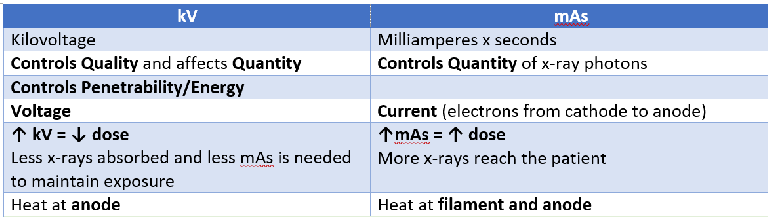
What to do to technical factors to increase dose?
increase mAs, increase dose
Distance and x-ray emission relationship
Inversely proportional (greater the distance, weaker the x-ray/intensity)
kV controls the heat at ____
anode
mAs controls the heat at ______ and _______
filament and anode
Easier version of the Inverse Square Law:

Inverse square relationship between intensity and distance:
As distance increases, radiation intensity and IR exposure decrease

When you double the distance, you _____ the intensity
1/4
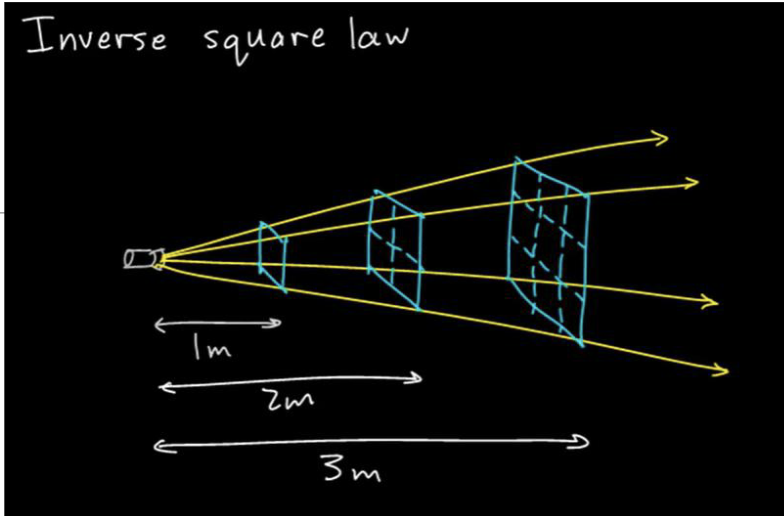
Changes in distance do not cause changes in mAs.
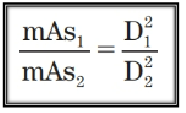
The radiographer must adjust the _____ to compensate for distance changes
mAs
Exposure Maintenance Formula:
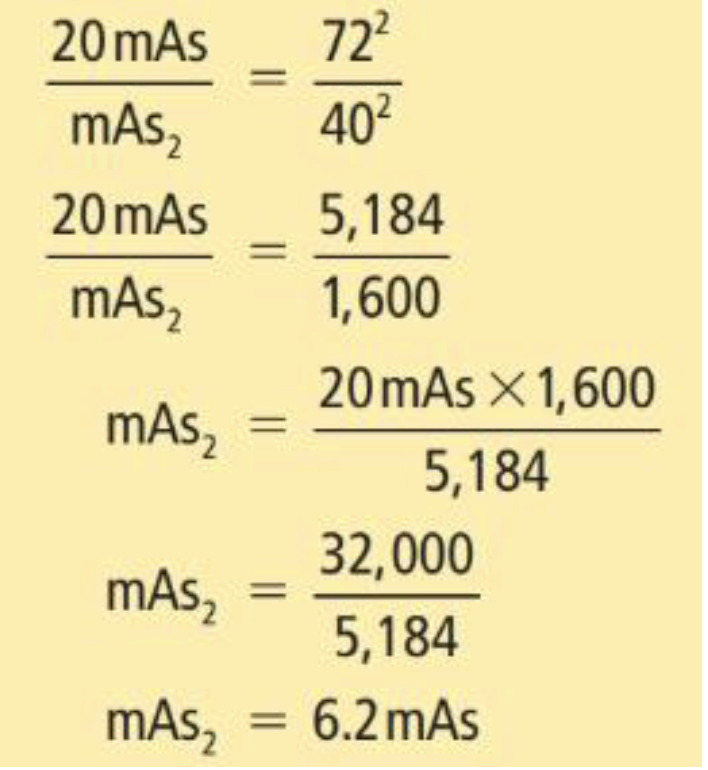
Exposure Maintenance Example
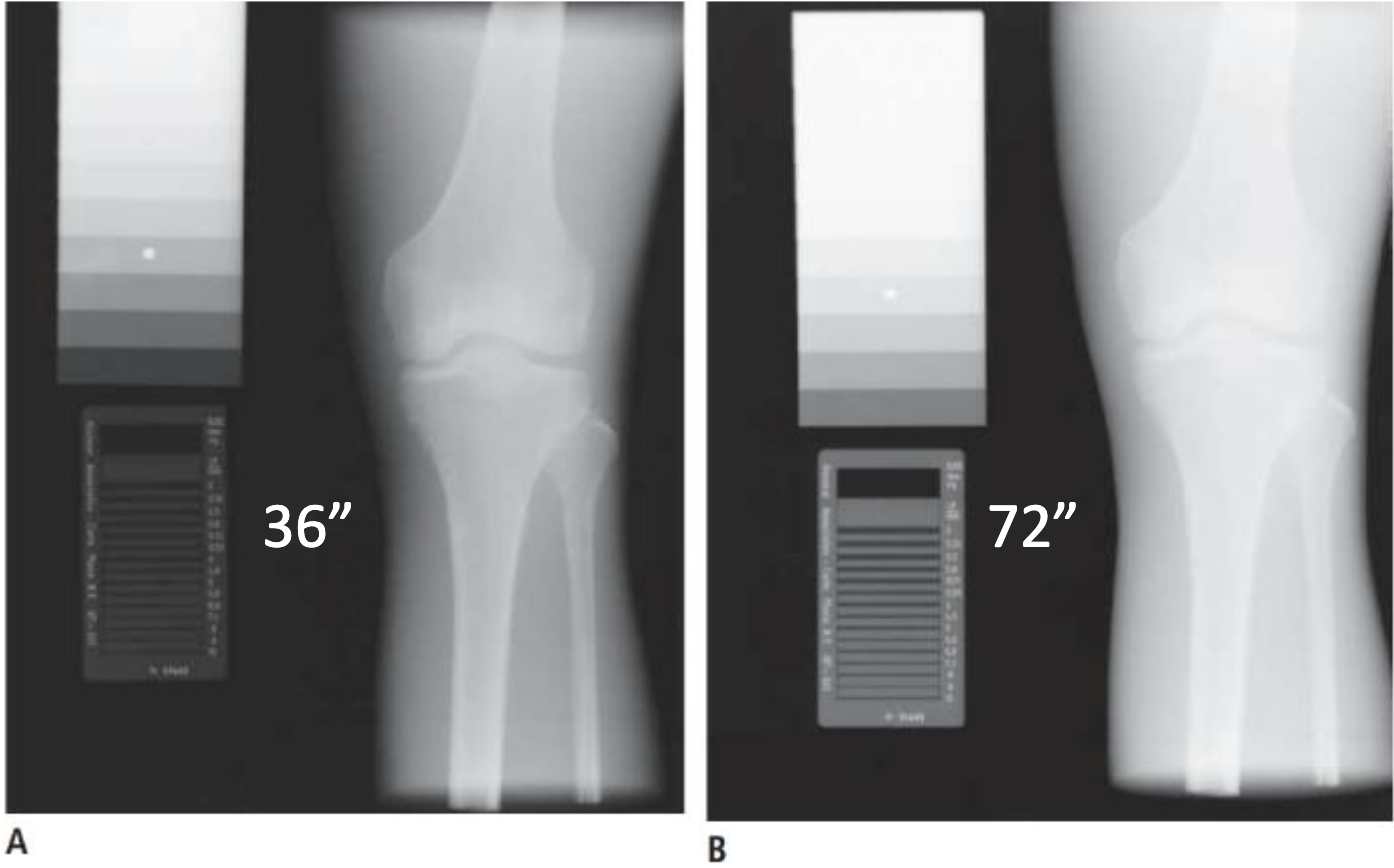
With digital, these x-rays appear the same but have different EI values.
In order to maintain the same appearance, what correction was made in relation to the SID?
Distance was doubled, so mAs was increased 4x to maintain exposure
EX: In Figure A, 60@2 In Figure B, 60@8
Exposure Index (EI):
Actual Exposure
Target EI (EIt):
Ideal Exposure
Deviation Index (DI):
% Deviation from target (how far you were off)
DI value of 2 or more, you may need a repeat
Carestream/Siemens Optimal EI Range:
1500-1800
Higher EI = overexposed
Lower EI = underexposed
If you double the mAs, your EI will _______
double
-directly proportient
You have taken a digital radiograph at 80@20 that yields an EI# of 85. The recommended target EI# for this projection is 170. When you repeat the image, you will achieve the desired results by:
doubling mAs to 40
85 × 2 = 170
Fuji, Konica, and Phillips Optimal S number Range
150-250
Higher S number = underexposed
Lower S number = overexposed
Setting the appropriate prime factors of ____, _____, and _______ will ensure effective exposure to IR
mAs
kVp
distance
Use the fixed kVp appropriate for that exam (which is based on the desired contrast), then mAs is adjusted to provide the appropriate exposure to the IR (this is what AEC does...)
!!
All of these are true EXCEPT:
A. Brightness and contrast are controlled primarily through post-processing parameters
B. Exposure index numbers are inconsistent between manufacturers
C. Digital detectors will not compensate for minor errors in technique selection
D. Fixed kVp systems are best suited for use with digital image receptors
C
-Digital detectors WILL compensate for minor errors in technique selection
Which equation do we use for this?
An x-ray exposure of 200 mR is recorded at a distance of 40 inches. If the same technical factors are used, what will the exposure be if the distance is increased to 72 inches?
Inverse square law
In order to increase image receptor (IR) exposure by 40%, the radiographer would
change the mAs from 15 to 21 mAs
