Oceanography - Chapter 3 - Studying the Ocean
 Call Kai
 Learn
Learn Practice Test
 Spaced Repetition
 Match
Match Flashcards
 Knowt Play
1/33

There's no tags or description
Looks like no tags are added yet.
Name | Mastery | Learn | Test | Matching | Spaced | Call with Kai | Chat |
|---|
No analytics yet
Send a link to your students to track their progress
34 Terms
Why does visible light easily pass through the atm and not water?
Visible light passes through air more easily than water because air is much less dense, so there are fewer molecules for the light to interact with.
In water, light is more likely to be absorbed or scattered by water molecules and particles, so its intensity decreases quickly with depth.
Why do open oceans have greater light penetration than costal waters?
Costal waters are more turbid with suspended sediments
Scientists use what to “see underwater”?
Sound waves ; and the speed of sound is affected my temperature and pressure
What are some constraints of studying the oceans?
Very deep
High Pressure
Salt water is corrosive
Unstable conditions on ocean surface
All this culminates to it being very expensive
One deep sample could cost $10,000-$70,000
pressurized environments
In space = 0 atm pressure
Earths surface = 1 atm pressure
Oceans = Pressure increases 1 atm every 10m depth
Problems with working in salt water
Can conduct electricity and cause short circuiting of equipment
Corrosive to metals
Allows for bacteria and biofilm to collect, fouling the equipment, and attracting other organisms
Bathymetry
the measurement and mapping of the depth and shape of the ocean floor.
Think of it as topography, but underwater:
Depth Sounding
Depth soundings using a lead line
However time, weight, wind/current, and slack of the line can make this method difficult
It’s not really done like this anymore in favor of echo sounding

Methods of measuring bathymetry
Depth Sounding
Echo Sounders
Multibean sonar
Echo Sounding
Instead of using a lead line, a sonar is attached to the bottom of the boat.
Sonar - emits sound waves a detects the echo returning
Continuous data being collected under a moving ship
This is the modern standard

What is multibeam sonar?
A sonar system that sends multiple sound beams over a wide area of the seafloor, allowing scientists to create detailed bathymetric maps much faster than traditional single-beam echo sounding.
Seafloor sediments
are basically layers of material that accumulate on the ocean floor over time. This matters because those layers can act like a historical record of the ocean and Earth.
Methods of collection seafloor sediment samples:
grab samplers
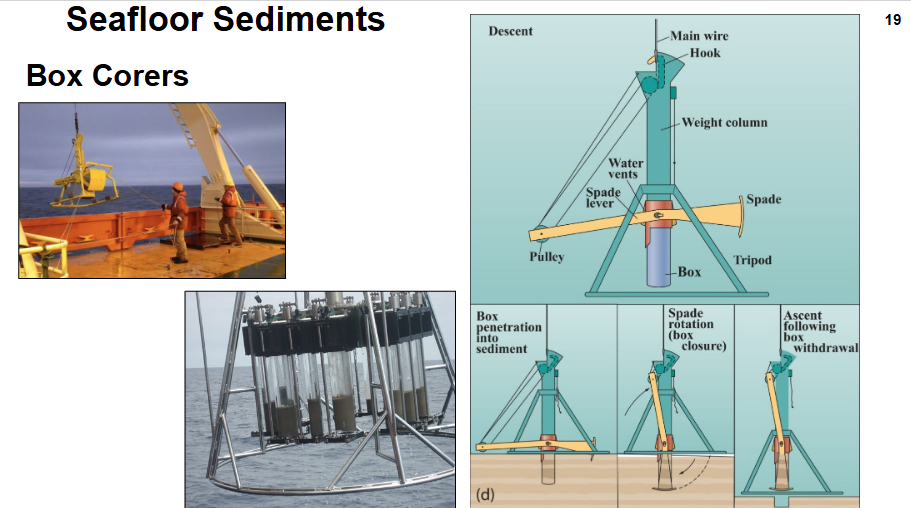
Box corers
Gravity cores
Drilling Ships
Dredges
Seismic sound (no actual sediment, just data)
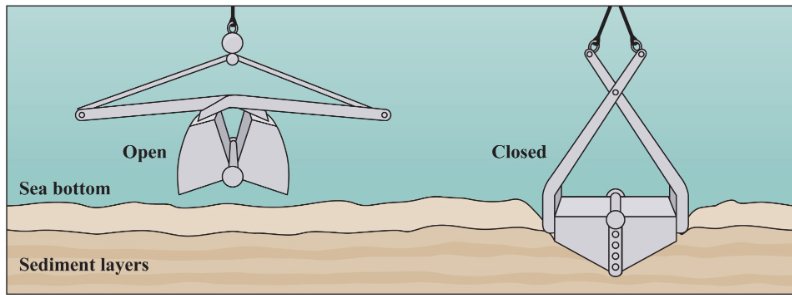
Grab samplers
claw devices that are lowered to the seafloor and grab a small sample of surface sediment.
Box corers
are another tool used to collect seafloor sediment, but they remove a relatively large, intact block of the upper sediment
Gravity Cores
is a tool used to collect deeper seafloor sediment cores. Your presentation says these cores can be about 2–50 meters deep.
It works by using gravity and the corer's weight to drive a long tube down into the seafloor sediment. When it's pulled back up, the tube contains a vertical column—or core—of sediment

Drilling ships
Ships used to collect the deepest seafloor sediments that are even older in time
100s - 1000s of meters of cores
Dredges
is essentially dragged along the bottom, where it scrapes/scoops up rocky material, which is then brought back to the ship for study.

Seismic Sound Profiling
A technique that uses sound waves reflected from sediment layers beneath the seafloor to study their structure, especially where physical sediment cores aren't available
Niskin and Van Dorn bottles
are devices used to collect water samples from specific depths in the ocean so the water can be brought back for lab-based chemical and physical analysis
CTD
An instrument that continuously measures conductivity, temperature, and depth through the water column, helping identify differences between water layers. It can also measure O₂, pH, turbidity, and fluorescence.
Measuring Currents
Measure speed and direction
For large scale currents, there can be indirect measurements
Model these large currents for sal and temp distributions
For small currents, we can get more specific direct measurements using passive samplers or current meters
Types of passive samplers
Drifters
Drogues
passive devices are used to measure ocean currents, particularly their speed and direction
Drifter passive sampler
they float on the surface and measure surface currents
Drogues passive sampler
use a tether parachute beneath the surface, and weights, to measure deeper currents
Current Meters
Instruments held at fixed positions that measure the speed and direction of water moving past them, often at different depths.
Can be deployed at different depths
Accoustic Current meters
A device that measures water movement using sound waves reflected off moving particles. It uses the Doppler effect to determine current movement.

Doppler Affect
pitch increases as particles move closer to the meter
Acoustic Tomography
A method that uses an array of sound sources and receivers over hundreds of kilometers to study large-scale ocean conditions

Challenges of biological oceanography
Ocean life moves in three dimensions
Large range in body size
Many mobile species
Fragile species
Deep sea species cannot survive being brough to the surface
Types of nets used to catch biological samples
Otter trawl
Purse Seine
Plankton Net
Drift net

Types of Autonomous Under Water Vehicles (AUVs)
Argo floats
Gliders (look like a plane drone)
Satalite Data
Can survey in days, not years
Observe daily, yearly, and long term changes
Limited to only surface water data
Monitors weather, currents, waves, temp/salinity, sediment plumes, plankton etc