HPA-II | Exam 3 | HIV
 Call Kai
 Learn
 Practice Test
 Spaced Repetition
 Match
 Flashcards
 Knowt Play
1/50

There's no tags or description
Looks like no tags are added yet.
51 Terms
What is HIV, and how does it affect the immune system?
Human Immunodeficiency Virus (HIV) is a retrovirus that targets and weakens the immune system by infecting and destroying vital white blood cells.
Which specific receptor and cell type does HIV primarily target?
HIV targets the CD4 receptor on the surface of Helper T cells (CD4+ T lymphocytes).
What is the key clinical distinction between HIV and AIDS?
HIV is the infectious retrovirus, whereas Acquired Immunodeficiency Syndrome (AIDS) is the advanced, late-stage manifestation of chronic HIV infection.
Where in the body does the maturation of Helper T cells take place?
The thymus.
After maturing and entering circulation, in which secondary lymphoid organs do Helper T cells reside?
Lymph nodes, the spleen, and Peyer's patches.
What are Peyer's patches and where are they located?
Small clusters of lymphoid tissue distributed throughout the mucosa of the gastrointestinal (GI) tract.
Through which four primary body fluids can HIV be transmitted, and which sexual practices carry transmission risk?
Transmission occurs through:
- Blood and blood products
- Seminal fluid
- Vaginal secretions
- Amniotic fluid
Risk is highest during unprotected vaginal and anal intercourse.
What are the three specific timeframes when maternal-to-child transmission of HIV can occur?
- In utero (transplacental)
- Intrapartum (during labor and delivery)
- Postpartum (through human breast milk during feeding)
What are the primary risk factors for contracting an HIV infection?
- Unprotected sexual intercourse with an infected partner
- Sharing contaminated injection drug needles and equipment
- High-risk sexual behaviors (e.g., multiple sexual partners)
- Perinatal exposure during pregnancy, delivery, or breastfeeding
- Receiving unscreened organ transplants or blood products (primarily prior to 1985)
What are the three progressive clinical stages of an HIV infection in chronological order?
- Stage 1: Acute Infection
- Stage 2: Clinical Latency (Chronic HIV)
- Stage 3: Acquired Immunodeficiency Syndrome (AIDS)
In which stage of HIV infection do opportunistic infections and defining clinical complications first typically appear?
Stage 3 (AIDS).
A patient diagnosed with HIV is found to have a CD4 count of 220 cells/mm³. Which stage of infection does this indicate?
Stage 2: Clinical Latency (the CD4 count is between 200 and 499 cells/mm³).
A newly diagnosed patient has a confirmed CD4 count of 574 cells/mm³. Which stage of HIV infection are they in?
Stage 1: Acute Infection (CD4 count is 500 cells/mm³ or greater).
A patient positive for HIV with no outside exposures for 9 years presents with night sweats and a CD4 count of 115 cells/mm³. Can latency last this long, and which stage is this?
Yes; clinical latency can last 10 years or more without treatment. Because the CD4 count is below 200 cells/mm³ and systemic symptoms are present, the patient is in Stage 3: AIDS.
Which stages of HIV infection are characteristically symptomatic?
Stage 1 (Acute Infection) and Stage 3 (AIDS).
What pathophysiologic changes and clinical symptoms define the acute infection stage of HIV?
- High levels of viral replication until reaching the viral set point
- Rapid dissemination of the virus throughout lymphoid tissue
- Marked drop in circulating CD4 count (often from 1500 to 500 cells/mm³)
- Flu-like symptoms including fever, maculopapular rash, sore throat, myalgias, generalized lymphadenopathy, and headache
What pathophysiologic processes occur during the clinical latency stage of HIV?
- The virus continues to actively replicate at low levels within lymphoid tissue
- Anti-HIV antibodies remain detectable
- CD4 cells undergo steady destruction and viral load slowly increases
- Host maintains sufficient immune function to prevent opportunistic infections
What specific criteria distinguish a diagnosis of AIDS from earlier HIV stages?
A CD4 count falling below 200 cells/mm³ (or CD4 percentage < 14%) and/or the emergence of an AIDS-defining opportunistic condition.
What general systemic findings are commonly expected during Stage 3 (AIDS)?
- Drenching night sweats, persistent chills, and fever
- Chronic generalized swollen lymph nodes
- Severe weakness and fatigue
- Involuntary, severe weight loss
- Proliferation of opportunistic infections and secondary malignancies
What are common neurological opportunistic infections and conditions seen in AIDS?
- Cytomegalovirus (CMV) encephalitis and HIV encephalopathy
- Cryptococcal neoformans meningitis
- Toxoplasma gondii encephalitis (often linked to cat feces)
- HIV-associated dementia and subcortical neurodegeneration
- Peripheral neuropathy
What clinical manifestations suggest Cryptococcus neoformans meningitis in an immunocompromised patient?
- Fever
- Persistent headache
- Nuchal rigidity (stiff neck)
- Altered mental status and profound fatigue
- Seizures
What opportunistic infections most commonly affect the respiratory system in patients with AIDS?
- Pneumocystis jirovecii pneumonia (PJP)
- Mycobacterium tuberculosis (TB)
- Recurrent bacterial pneumonia
- Candidiasis of the trachea, bronchi, or lungs
Which body system is at the highest risk for developing opportunistic infections in AIDS patients?
The respiratory system.
What are the priority nursing interventions when caring for an AIDS patient with an opportunistic respiratory infection?
- Monitor for fever, dyspnea, cough, night sweats, and nuchal rigidity
- Initiate airborne precautions immediately if tuberculosis is suspected
- Administer supplemental oxygen as prescribed
- Monitor adherence to prescribed antimicrobial regimens
- Implement nutritional support (high-calorie diet, enteral, or parenteral nutrition)
- Provide psychosocial and emotional support
What gastrointestinal complications commonly occur during Stage 3 (AIDS)?
- Chronic, severe diarrhea (frequently linked to C. difficile or enteric pathogens) leading to fluid and electrolyte imbalances
- Inability to perform activities of daily living (ADLs) due to weakness
- HIV wasting syndrome
What is HIV wasting syndrome and what causes it?
The involuntary loss of greater than 10% of baseline body weight, characterized by severe lean muscle mass depletion accompanied by chronic diarrhea or fever lasting over 30 days. It is caused by intestinal malabsorption, hypermetabolism, and anorexia.
What nursing and dietary interventions help manage GI complications and wasting in AIDS?
- Provide at least six small, high-protein, calorie-dense feedings daily
- Decrease dietary fat intake to reduce complications from fat intolerance and diarrhea
- Offer oral nutritional supplements between meals
- Monitor daily weight, strict intake and output (I&O), and calorie counts
- Administer total parenteral nutrition (TPN) if intestinal absorption fails
What are the primary oncologic complications associated with AIDS?
- Kaposi's sarcoma (KS)
- Non-Hodgkin lymphoma and Hodgkin lymphoma
- Invasive cervical cancer
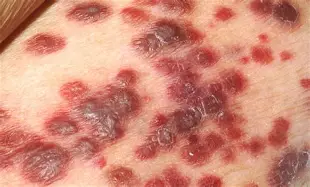
Which vascular malignancy characteristically causes purplish-brown cutaneous lesions in AIDS, and how is it managed?
Kaposi's sarcoma; managed through antiretroviral therapy (ART) combined with radiation therapy, localized interventions, or systemic chemotherapy.
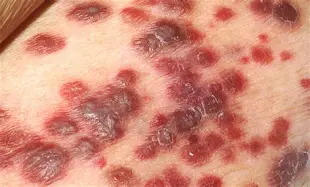
What is the nurse's priority action when an AIDS patient presents with new or progressive cutaneous lesions?
Perform a focused assessment and detailed documentation of the patient's specific skin lesions (appearance, size, and distribution).
What psychiatric and psychosocial complications should nurses evaluate in patients living with AIDS?
- Major depressive disorder and generalized anxiety
- Suicidal ideation (SI)
- Apathy and reduced cognitive/behavioral initiation
- Substance and alcohol misuse
- Social isolation and stigma
What are the two general classifications of HIV diagnostic testing, and what tests belong to each?
- Screening tests: ELISA, rapid antigen/antibody fingerstick, and oral fluid assays
- Confirmatory tests: HIV-1/HIV-2 differentiation immunoassay and Nucleic Acid Tests (NAT)
What does a Nucleic Acid Test (NAT) measure, and when is it indicated?
It directly detects the viral RNA of HIV in the blood; it is indicated to confirm acute HIV infection before antibodies form or to resolve indeterminate screening tests.
What are the two primary purposes of an HIV-1/HIV-2 differentiation assay?
- Confirms an HIV diagnosis following a reactive screening test
- Differentiates whether the infection is caused by HIV-1 or HIV-2 to determine appropriate treatment regimens
What is the normal physiologic reference range for a CD4+ T-cell count?
500 to 1,500 cells/mm³.
What does a patient's HIV viral load indicate in clinical management?
It quantifies the number of viral copies per milliliter of blood, serving as a key indicator of disease progression and the clinical efficacy of antiretroviral therapy (ART).
What does an 'undetectable' HIV viral load mean regarding disease transmission?
It means the viral load is below laboratory detection limits (typically < 20 copies/mL); an undetectable viral load prevents sexual transmission to an HIV-negative partner (Undetectable = Untransmittable / U=U).
Which two antiretroviral medications are combined in standard oral Pre-Exposure Prophylaxis (PrEP)?
Tenofovir disoproxil fumarate (300 mg) and Emtricitabine (200 mg).
What is the dosing schedule for standard oral Pre-Exposure Prophylaxis (PrEP)?
Taken orally once daily on a consistent schedule.
What is the minimum age requirement for initiating PrEP to reduce the risk of sexual HIV acquisition?
12 years of age or older (weighing at least 35 kg).
What long-acting injectable medication serves as an alternative to daily oral PrEP to enhance adherence?
Cabotegravir (Apretude), administered as a 600 mg (200 mg/mL) intramuscular injection every other month (bimonthly).
Within what timeframe must Post-Exposure Prophylaxis (PEP) be initiated following a potential HIV exposure?
Within 72 hours (3 days) of the exposure event.
What medications are typically prescribed in a standard Post-Exposure Prophylaxis (PEP) regimen?
A combination of Tenofovir and Emtricitabine (the PrEP backbone) plus an integrase inhibitor such as Raltegravir (or Dolutegravir).
What is the dosing frequency and total duration of a Post-Exposure Prophylaxis (PEP) course?
Taken once to twice daily for a continuous 28-day course.
What critical behavioral teaching point must be reinforced to a patient completing PEP?
The patient must continue using barrier precautions (such as condoms) during the 28-day regimen to prevent potential secondary transmission until follow-up testing confirms negative status.
What are the five primary drug classes utilized in Antiretroviral Therapy (ART)?
- Nucleoside Reverse Transcriptase Inhibitors (NRTIs)
- Non-Nucleoside Reverse Transcriptase Inhibitors (NNRTIs)
- Protease Inhibitors (PIs)
- Integrase Strand Transfer Inhibitors (INSTIs)
- Entry/Fusion Inhibitors
What are the common mild side effects associated with the initiation of Antiretroviral Therapy (ART)?
- Nausea, vomiting, and diarrhea
- Headache, dizziness, and fatigue
- Mild skin rash
What major adverse effects and organ toxicities are linked with Antiretroviral Therapy (ART)?
- Nephrotoxicity and hepatotoxicity
- Bone demineralization and osteoporosis (notably with Tenofovir)
- Neuropsychiatric disturbances (insomnia, vivid dreams, mood alterations)
- Metabolic abnormalities (lipodystrophy, hyperlipidemia, hyperglycemia, weight gain)
What is the most critical priority topic for the nurse to teach an immunocompromised patient on ART?
Infection prevention practices and strict adherence to the prescribed medication regimen.
What specific infection control measures should nurses teach to patients diagnosed with HIV/AIDS?
- Practice frequent, thorough hand hygiene
- Avoid crowds and contacts with active respiratory infections
- Avoid raw or undercooked meats, eggs, and unwashed fruits or vegetables
- Avoid cleaning cat litter boxes and handling animal waste (to prevent toxoplasmosis)
- Maintain a clean domestic environment and practice safe food preparation
What are the primary overarching therapeutic goals of Antiretroviral Therapy (ART)?
- Durably suppress viral replication to undetectable levels
- Restore and preserve immune function (elevating CD4 counts)
- Reduce HIV-related morbidity and mortality
- Enhance patient quality of survival
- Prevent secondary transmission of the virus