Physiology exam 2 lecture 13 smooth and cardiac muscles
 Call Kai
 Learn
 Practice Test
 Spaced Repetition
 Match
 Flashcards
 Knowt Play
1/35

There's no tags or description
Looks like no tags are added yet.
36 Terms
Nonstriated
Smooth muscle is ______ tissue
thick and thin filaments (myosin and actin), generates force via crossbridge cycling
Smooth muscle similarities to skeletal muscle
filaments not structured in sarcomeres, filament runs in various directions, no troponin
Smooth muscle differences to skeletal muscle
calcium
smooth muscle contractions are regulated by ________(from extracellular fluid rather than the endoplasmic reticulum)
1
which mechanism step of excitation-contraction coupling in smooth muscle: calcium binds to calmodulin
2
which mechanism step of excitation-contraction coupling in smooth muscle: a conformation change is triggered which allows calmodulin to bind and activate myosin light chain kinase (MLCK)
3
which mechanism step of excitation-contraction coupling in smooth muscle: MLCK catalyzes phosphorylation of myosin bridge, initiating the crossbridge cycle
calcium, phosphate group, myosin
Termination of the cross-bridge cycle in smooth muscle is due to the removal of ______ and the action of phosphatase enzymes which removes the ____________ from the ________
autonomic, involuntary
Neural regulation of smooth muscle contraction is innervated by the _______ nervous system, ________ control
excitatory or inhibitory
What type of neural regulation is used by smooth muscle contraction
do not always
smooth muscle cells ______ respond to neural input with an action potential (unlike skeletal muscles)
graded, excitatory, inhibitory
tension created by smooth muscle can be manipulated in a _______ fashion (more tension with ______ input, less tension with _______ input)
striated, found only in the heart
cardiac muscle tissue is ______ and ______
cardiomyocytes
small, single nucleus, short wide T-tubules, no T-tubule with terminal cisternae structure, have sarcoplasmic reticulum with no terminal cisternae, only aerobic, have intercalated discs
only aerobic, have intercalated discs
two important characteristics of cardiomyocytes
intercalated discs
specialized contact points between cardiomyocytes.
Gap junctions and desmosomes
function to maintain structure, enhance molecular and electrical connections and conduct actional potentials
cardiac muscle similarities
Like skeletal muscle: striated with sarcomeres, thick and thin filament structure, troponin-myosin regulation
cardiac muscle differences
unlike skeletal muscle: gap junctions within intercalated discs, pacemaker cells, innervated by autonomic nervous system, Ca2+ from extracellular fluid and sarcoplasmic reticulum, AP lasts almost as long as tension (no summation)
automaticity, variable contraction tension, extended contraction time, prevention of wave summation
four functions of cardiac tissue
long refractory period
in cardiac muscle why does action potential last almost as long as tension (no summation)
automaticity
contraction w/o neural stimulation, controlled by pacemaker cells
pacemaker cells
initiate the heartbeat
initiate an AP in rhythmic fashion w/o intervention of external stimuli
unstable resting membrane potential if due to sodium entering cell via “funny” channels
gap junctions
pacemaker cells and cardiac muscle cells are connected via
sodium, calcium, action potential, synchronization
the connection of pacemaker cells and cardiac muscle cells via gap junctions allows for the movement of ______ and ______ between cells. this allows for the movement of the _______ through the cardiac muscle fiber and ___________ of muscle contraction
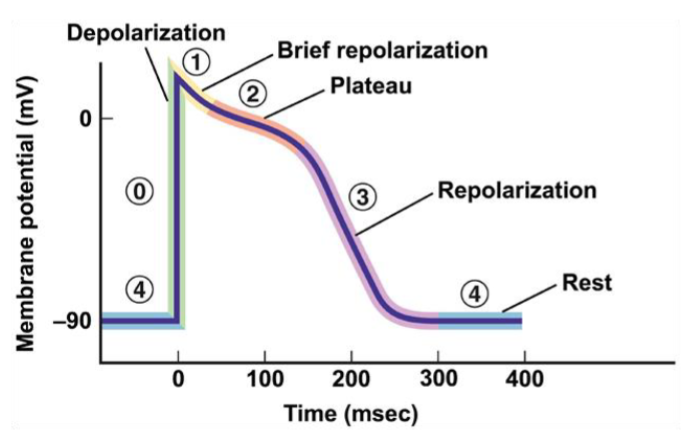
opening, Na+, depolarize
cardiac muscle contraction phase 0: cell reaches the threshold (due to pacemaker cells) which causes the _____ of ___ voltage-gated channels, causing the membrane potential to _________

Na+, inactive, K+, open, repolarize
Cardiac muscle contraction phase 1: ____ voltage-gated channels become _______, ___ voltage-gated channels partially _____, causing the membrane potential to briefly ______

Na+, inactive, K+, closed, L-type Ca2+, open, plateau
cardiac muscle contraction phase 2: ___ voltage-gated channels are _____, ___ voltage-gated channels are ______, ______ channels are _____, causing the membrane potential to ______

K+, open, K+, exit, Na+, closed, L-type Ca2+, repolarize
cardiac muscle contraction phase 3: ___ voltage-gated channels ______ allowing ____ to _____ the cell, ____ voltage-gated channels are ______, ______ channels close causing the membrane potential to _______

K+, open, Na+, L-type Ca2+
cardiac muscle contraction phase 4: return to resting. _____ leak channels are ____, _____ voltage-gated channels are _____, ______ voltage-gated channels are closed.
more contractions at same force, more force generated
why do cardiac muscle cells not summate like skeletal muscle cells?
cardiac muscle: more action potential → ________
skeletal muscle: more action potential → _________
autonomic, heart rate, stroke volume
neural control of the heart is carried out by the _______ nervous system
through these neurons, they are capable of regulating both _____ and _____
75, parasympathetic
Rest: inhibitory neural integration
heart rate: ___ bpm
controlled by the ________ nervous system
acetylcholine, muscarinic cholinergic, K+, Na+, depolarization, hyperpolarization
mechanism of heart rate regulation (inhibitory neural integration/rest) controlled by parasympathetic nervous system
1) ______ released by parasympathetic nerve
2) acetylcholine binds to ________ receptors (metabotropic)
3) increased open state of ____ channels and closed state of ___ channels
4) decreased rate of spontaneous ________ and _______ the cell
5) decrease heart rate
increases, sympathetic
excitement: excitatory neural integration
heart rate: _____
controlled by ______ nervous system
epinephrine, B1, SA, funny, Ca2+, depolarization
mechanism of heart rate regulation (excitatory neural integration/excitement) controlled by sympathetic nervous system
1) _______ released by sympathetic nerve
2) epinephrine binds to ____ receptors (metabotropic) in the pacemaker cells of the __(sinoatrial) node
3) increase the open state of _____ channels and ____ channels
4) increase the rate of spontaneous _______
5) increase heart rate
epinephrine, cAMP, Ca+, Ca2+-ATPase
ventricular contractility (more forceful contractions) mechanism
1) ______ binds to B1 receptors
2) _____ (secondary messenger) is released
3) opens ____ channels (on plasma membrane and sarcoplasmic reticulum)
4) activates the rate of ______ on the sarcoplasmic reticulum (to maintain clear periods of contraction and relaxation)