The Large Intestine & Defecation
 Call Kai
 Learn
Learn Practice Test
 Spaced Repetition
 Match
Match Flashcards
 Knowt Play
1/33

There's no tags or description
Looks like no tags are added yet.
Name | Mastery | Learn | Test | Matching | Spaced | Call with Kai | Chat |
|---|
No analytics yet
Send a link to your students to track their progress
34 Terms
Where is the large intestine and where does it start and end
The large intestine is in the abdominal cavity around the small intestine
it starts at the cecum and ends at the anal canal
How does the large intestine compare to the small intestine
it is shorter but wider
what are the 4 main funcitons of the large intestine
absorb water!!!
store indigestible food
propel feces to anaus
hosue good bacteria
What are the three unique features of the large intestine
teniae coli, haustra, epiploic appendages
Tenia coli
three bands of smooth muscle in the muscularis externa layer
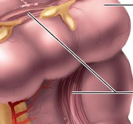
Tenia coli (large intestines)
Haustra
pouches in the colon caused by muscle tone of teniae coli
muscle tone = slight constant activation

Haustra of large intestine
epiploic appendages
fat filled poucches that hangs off the serosa (most outer layer) of from transverse to sigmoid colon

omental (fatty) appendices / epiploic appendages
What are the two main parts of the large intestine
cecum → colon

Cecum of large intestine
cecum - and has what (2)
first segment of the large intestine
illeal papilla (connects to ileum of small intestine)+ appendix
What are the four parts of the colon in order
ascending, transverse ,descneding, sigmoid
What is a flexure and what are the two and why
a flexure is a bend
right colic hepatic flexure → on the liver side (right)
left colic splenic flexure → on the spleen side (left)
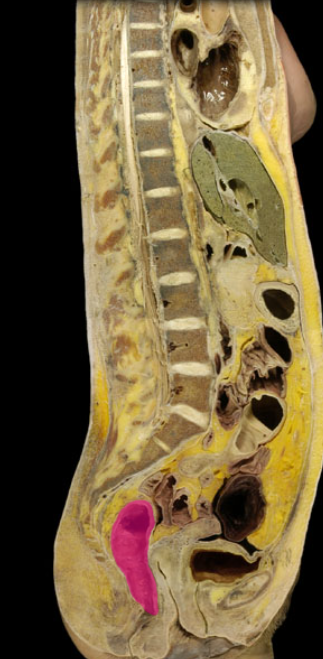
Rectum

Rectum contains
transverse rectal folds (rectal valves) → three curves and infoldings
also has goblet cells
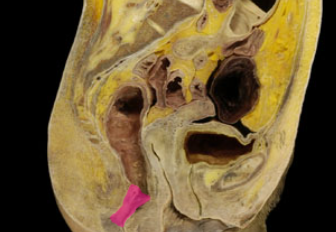
anal canal
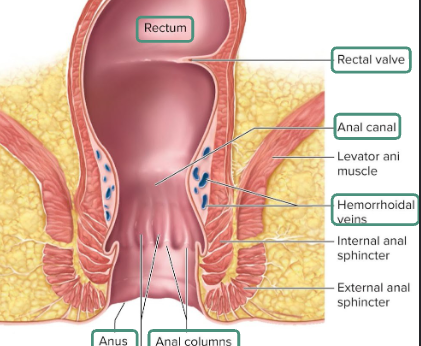
anal canal
final segment of the large intestines - ends at the anus
the mucosa folds into anal columns with anal sinuses in between

Superficial venous plexus
Hemorrhoidal veins part of the anal canal

Anus and what is it regulated by
the opening that feces exits
regulated by internal anal sphincter and external anal sphincter
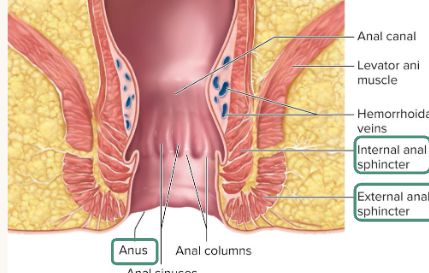
Internal anal sphincter
smooth muscle of muscularis externa

External anal sphincter
skeletal muscle of pelvic diaphragm
Pathway of the large intestine
cecum - ascending colon → right hepatic flexure → transverse colon → left splenic flexure → descending colon → sigmoid colon → rectum → anal canal → anusTh
the large intestine houses and what two things do they do
gut microbiomes (microbiota) → helpful gut bacteria
digest cellulose, pectin, and carbohydrates we can’t digest because we dont’t have the enzymes to do so
help synthesize vitamin B and K
Vitamin K
synthesized by gut bacteria in large intestines → needed by liver to produce clotting proteins
Flatus and what 2 things cause it
intestinal gas that is expelled
caused by swallowed air as well as bacteria
What are the two main large intestine mobility
haustral contractions and mass movements
Haustra contractions - what is it- what type of movement and what is it good for (often or not often)
Haustra = pouches → distension/stretching causes it to contract moving materail (feces) from one haustra pouch to another
slow segmentation movement for churning and absorption of water and salt
every 30 min
Mass movement and what are they triggered by (2)
strong contractions 1-3 times a day
triggered by gastrocolic and duodenocolic reflexes
filling of stomach (gastro) and duodenum → motility of colon
Mass movement vs haustra contractions
mass movements are stronger contractions and pushes materials further
while haustra contraction is slow segmentation for absorbtion and mixing
defecation pathway (what causes it, what reflex, what response → does what 2)
mass movement pushes feces into rectum → rectum fills → stretches/distension → spinal defecation reflex → parasympatheic response → peristalsis contraction of rectum and relaxation of internal anus sphincter
Why dont you immediately defecate
defacation only occurs if exteranl anal sphincter is voluntarily relaxed as well
Valsalva maneuver
abdominal contractions that increase pressure and compress rectum → helps defecation